

AI May Kill the Approval Chain Before It Kills the Job

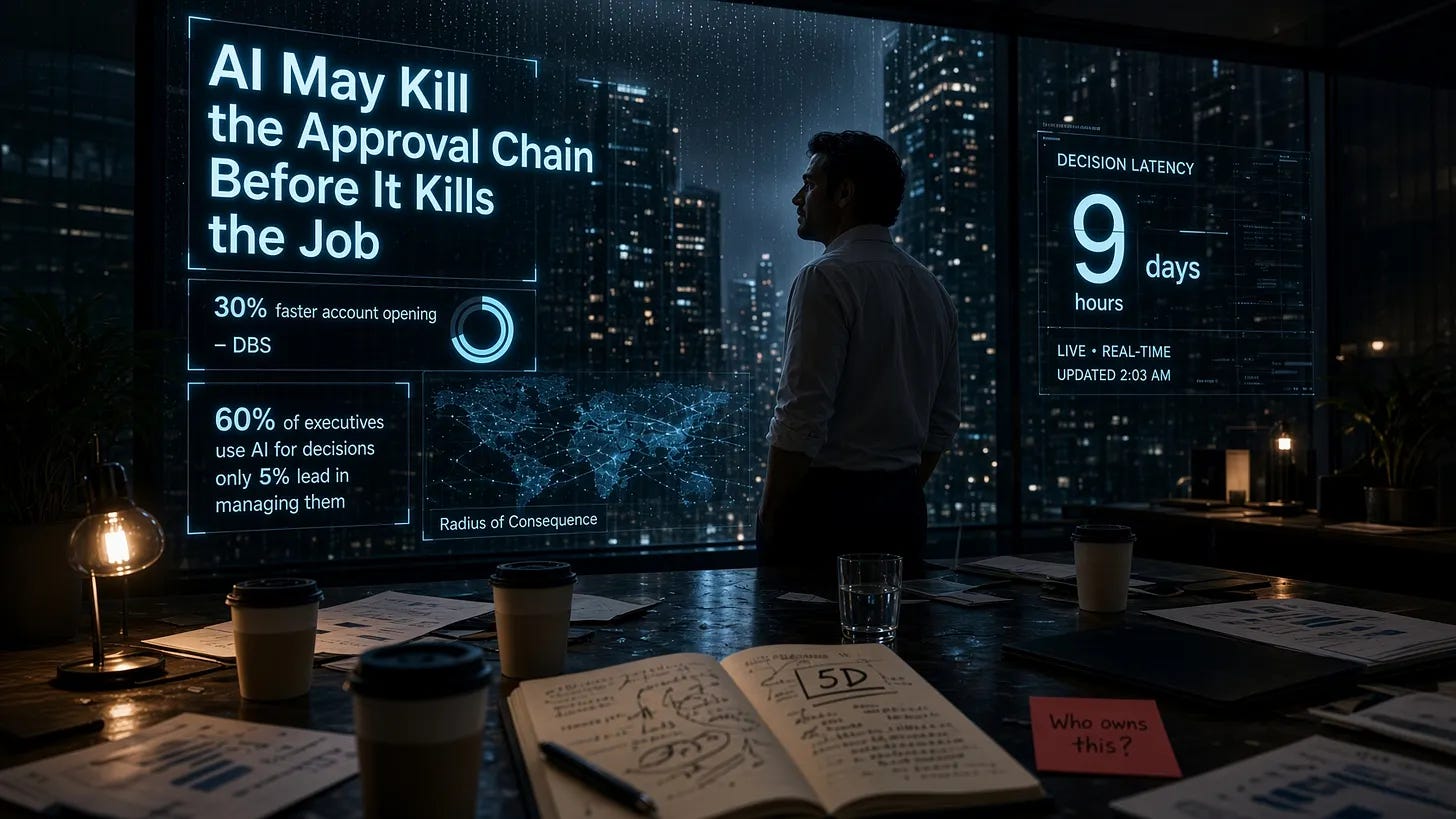
AI isn’t making companies faster. It is making their slowness impossible to hide.
A machine can listen to thousands of customer conversations overnight and notice an objection that sales leadership has missed, compare that pattern with months of pipeline data, identify which accounts are most exposed, and suggest several responses before anyone has even arrived at the office. And then the company can spend nine days deciding whether anybody is allowed to test one of them.
We have spent extraordinary amounts of money making intelligence faster, and the machinery that turns that intelligence into action has barely moved. Analysis now travels at something close to machine speed, and authority still has to navigate human hierarchies, incentives, politics, culture, and fear. When intelligence accelerates faster than decision rights, a predictable gap opens up. Call it an authority mismatch.
Authority mismatch exists when the speed and location of useful information no longer match the speed and location of the authority required to act on it. The employee closest to the signal cannot move, and the person who can move is often several layers removed from whatever originally happened. AI does not simply increase decision speed. It systematically shifts the economically optimal location of authority downward and outward unless the radius of consequence pulls it back inward. Better information pulls authority toward the signal. Greater consequence pulls authority toward oversight. That is the governing law of the AI era. AI lowers the cost of distributing context, which means the optimal location of decision authority is shifting inside the firm. The org chart, not the job, may be AI’s first real casualty because the old hierarchy cannot absorb machine-speed information without creating latency.
Once you begin looking at a company this way, familiar frustrations take on a different shape. A salesperson realizes that three important customers are rejecting the same contract provision, and she cannot alter it. A service employee knows exactly what would save a valuable account, and the concession exceeds his authority. A country manager sees a local opportunity before headquarters does, and the budget sits thousands of miles away. An AI system flags an operational anomaly almost instantly, but the people responsible for responding still need several meetings. The intelligence arrives, and then it waits.
The interesting question is no longer whether your company has enough AI. It is whether the intelligence your company already possesses lands somewhere that has permission to matter.
A bank is an unusual place to study organizational speed because banking is supposed to preserve certain forms of friction. Risk matters, fraud matters, and regulation matters. A decision that appears small at one desk can move through customers, technology systems, counterparties, regulators, and a balance sheet before anyone fully understands the consequences. And that is precisely why DBS is interesting.
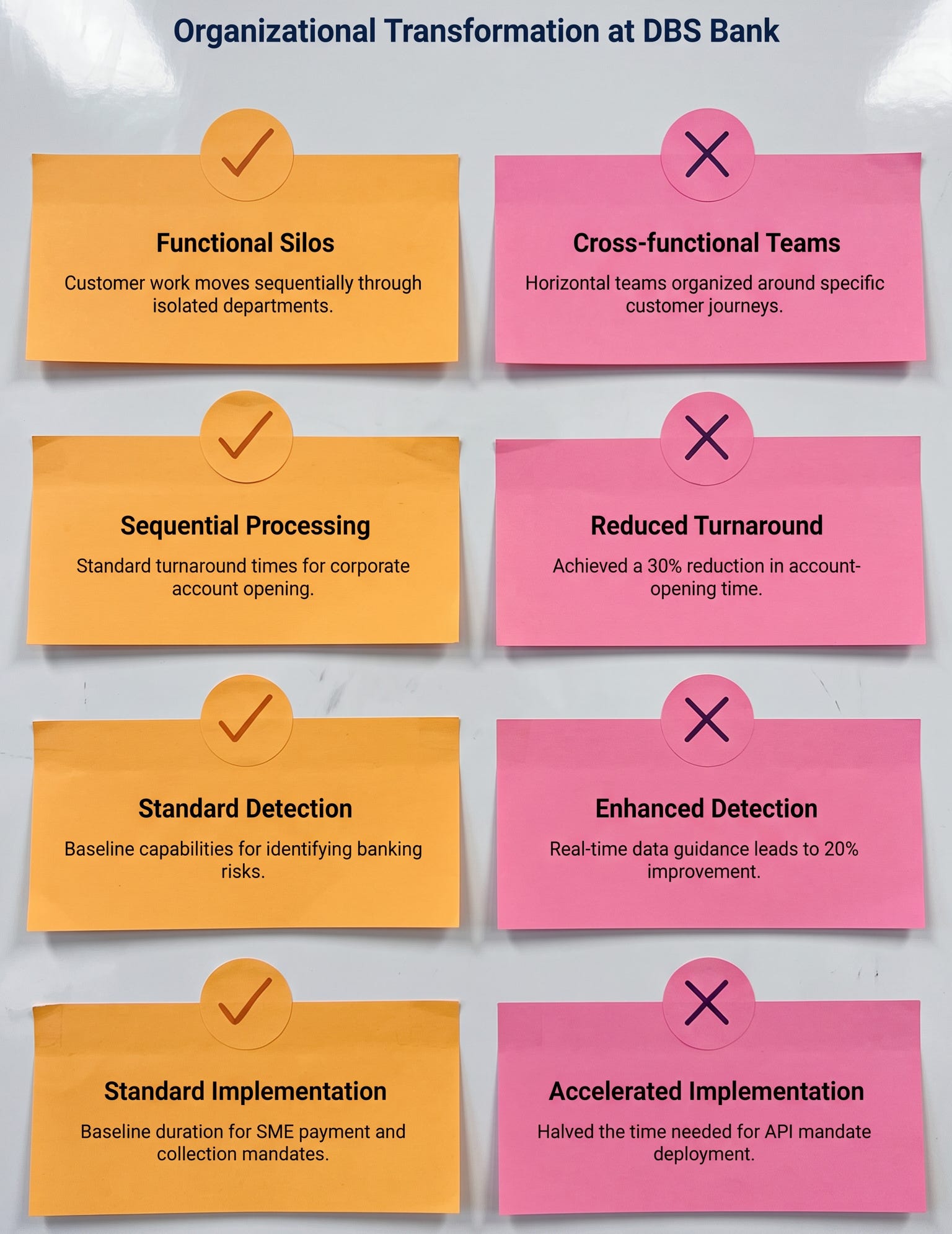
The Singapore-based bank has spent years reorganizing significant parts of its work around what it calls Managing through Journeys. Instead of allowing customer work to move sequentially through functional silos, DBS organizes horizontal cross-functional teams around customer journeys and guides them with real-time data. In its 2024 reporting, the bank said the model led to a 30% reduction in corporate account-opening turnaround time and a 20% improvement in risk detection, and it also reported that it halved the time needed to implement certain SME payment and collection API mandates in Singapore. Those results come from the company, so treat them carefully. But Euromoney, when it named DBS its World’s Best Bank for 2025, independently reported the same 30% improvement in corporate account-opening time and the same kind of SME API implementation time, and it linked both gains to the bank’s agile-at-scale structure.
DBS describes journey leaders as mini-CEOs with a mandate over the customer outcome. Performance cells operate under common KPIs with business and support co-leads, and funding and prioritization can be adjusted through quarterly reviews rather than locked into an annual plan. DBS did not decentralize everything. It shortened the distance between context and accountable authority. Then DBS accelerated the technology. In 2025 the bank reported more than 2,000 AI models across more than 430 use cases, and it said those initiatives generated approximately SGD 1 billion in economic value. Code deployment time fell by 25%, and some model deployment cycles dropped to between seven and 10 weeks. DBS frames these efforts as Operating Model Transformations, which means processes, workflows, human-AI collaboration, skills, and organizational structures are redesigned together.
The sequence is the point. DBS worked on how information, people, responsibility, and governance connected, and then it accelerated the resulting system. Redesign responsibility first, and then accelerate it. Many companies are doing the reverse. They are buying intelligence before they fix authority.
How DBS Bank Makes Everyone an Innovator | MIT Sloan Management Review
For years productivity has been management’s favorite diagnosis. Reduce meetings, automate repetitive work, install better software, hire stronger people, and produce more with less. None of this is wrong, but all of it assumes that the bottleneck is work. Increasingly it isn’t.
Deloitte’s 2026 Global Human Capital Trends research found that 60% of executives regularly use AI to support decisions, and yet only 5% considered their organizations leaders in managing AI-enabled decision-making. Separate research cited by Deloitte found that 57% of organizations operate at relatively low levels of decision-making maturity. The broader study covered more than 9,000 business and HR leaders across 89 countries. We are inserting faster intelligence into organizations that were already struggling with decision quality, accountability, and ownership.
Picture a salesperson who hears the same objection from three important prospects. AI can transcribe the calls, identify the pattern, compare those accounts with the rest of the pipeline, model alternative pricing, and prepare revised proposals before lunch. But the salesperson cannot test anything because pricing belongs to finance, packaging belongs to product, contract language belongs to legal, and exceptions ultimately belong to an executive. The analysis becomes nearly instantaneous, and the decision barely moves. That is an authority mismatch. AI can reveal organizational dysfunction rather than cure it. You have not transformed the company. You have created a technologically enhanced queue.
McKinsey’s research points in the same general direction, though the results should be treated as directional associations rather than proof that speed itself causes superior performance. Leaders in fast-moving organizations reported three times higher growth, 2.5 times higher financial performance, 2.1 times higher resilience, and 4.8 times higher innovation than leaders in slower organizations. The useful question therefore changes. It is no longer “How do we make our people work faster?” It is “Where is intelligence outrunning authority inside our company?”
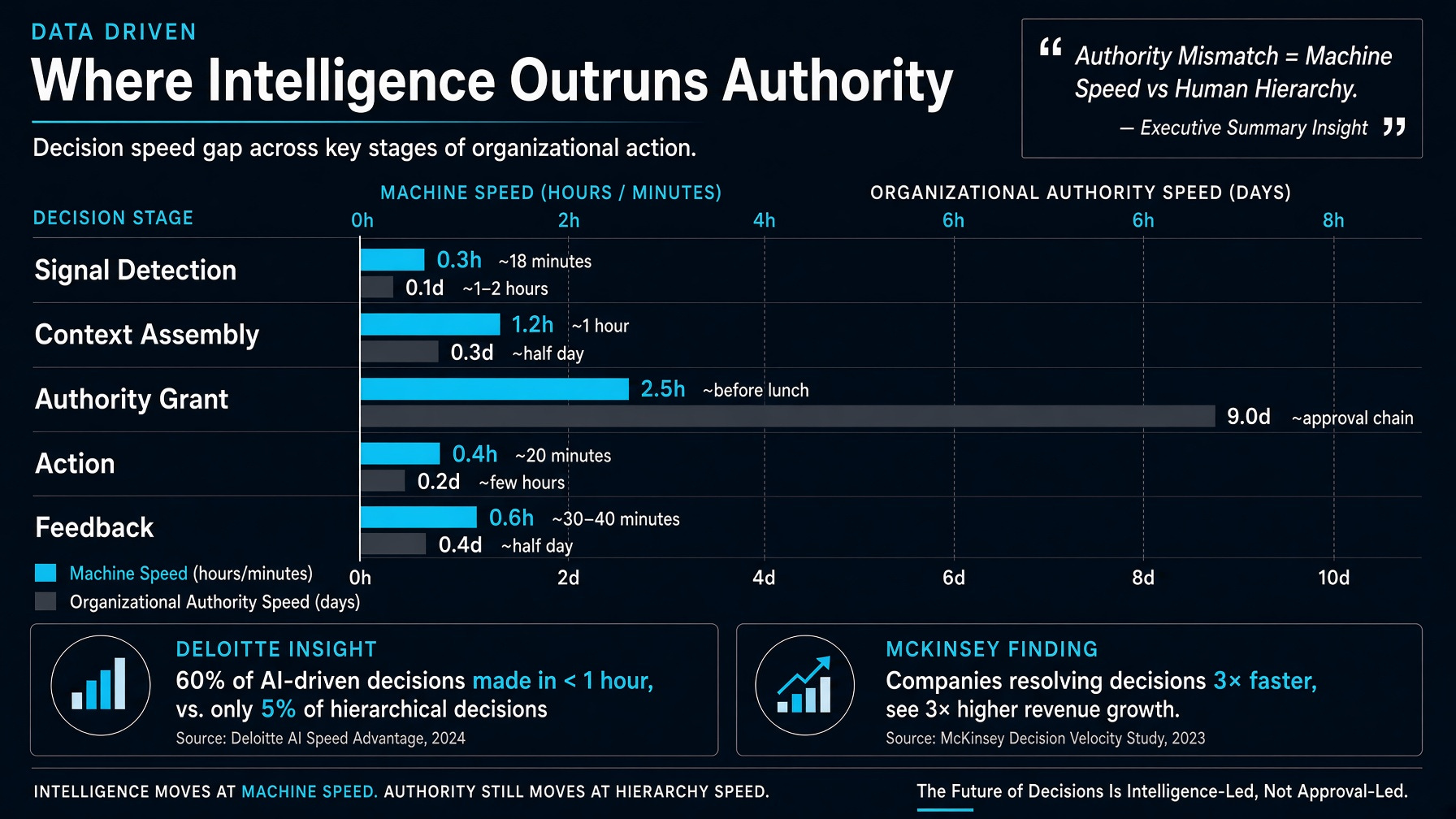
Every consequential business decision travels through five ingredients: signal, context, authority, action, and feedback. A signal tells you something changed, and context tells you whether it matters. Authority determines who can respond, action puts judgment into reality, and feedback tells you whether reality agreed. The organization can move only as quickly as the weakest connection. Signal without context becomes noise. Context without authority becomes bureaucracy. Authority without context becomes gambling. Action without feedback becomes guessing. The objective isn’t maximum speed. It is the shortest intelligent decision loop appropriate to the consequences involved. Sometimes that should be measured in hours, and sometimes it should be measured in months. The hard part is knowing which is which.
The July 2024 CrowdStrike outage shows why the apparent size of a decision can be misleading. According to the company’s own post-incident materials, a Rapid Response Content update contained problematic data that passed validation and resulted in Windows system crashes. CrowdStrike later outlined stronger testing, phased deployment that began with canary releases, improved monitoring, and greater customer control over how it deployed updates. The easy conclusion is that the company should simply have moved more slowly. The structural lesson is more useful. A decision’s risk is determined less by how large the action looks when someone authorizes it than by how far its consequences can travel once the action has entered the system. That is the radius of consequence. A tiny software configuration can touch millions of systems. A discount offered to one large customer can change expectations across an entire account. A supplier decision that seems local can interrupt a broader production chain. A two-sentence public statement can create reputational consequences that last for years. Executives routinely ask how big a decision is. They should also ask: If the decision is wrong, how far can the mistake travel?
Jeff Bezos on how to make decisions
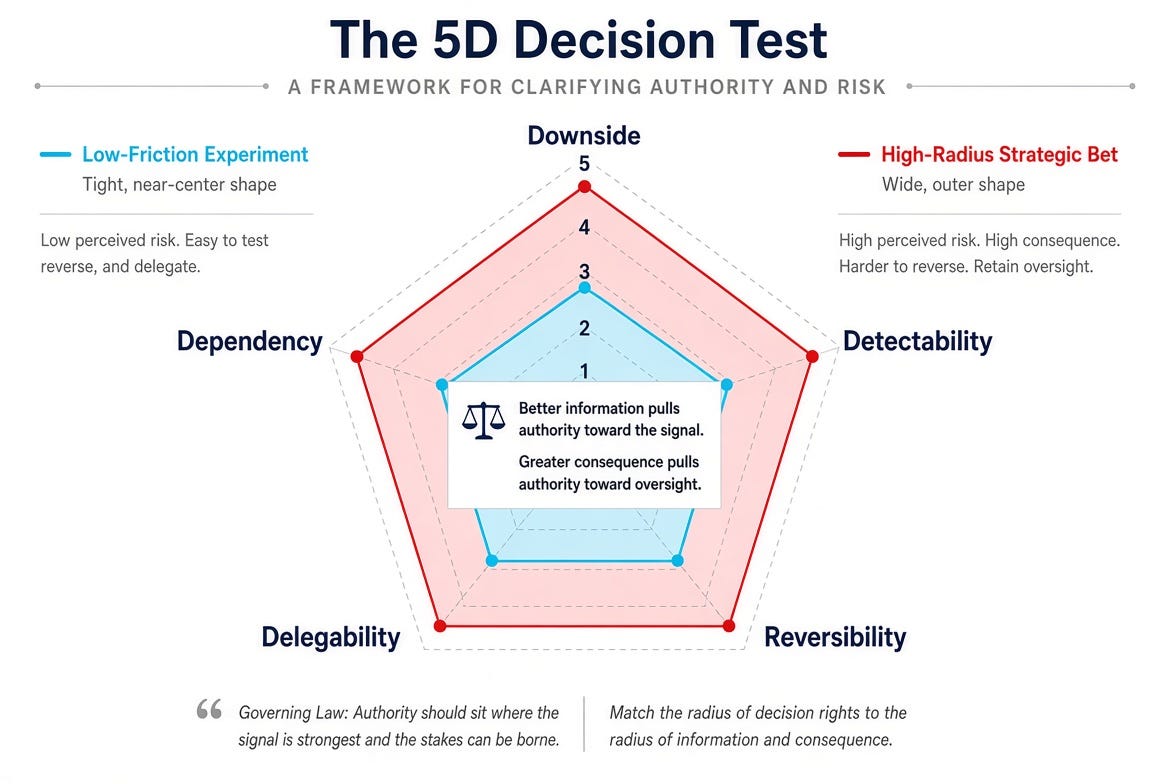
This is where a more disciplined way of allocating authority becomes useful. The 5D Decision Test isn’t meant to become another form that teams fill out. Its purpose is to determine the appropriate level of resistance for a decision.
Start with the downside. What is the realistic financial, operational, legal, customer, or reputational damage if the decision is wrong?
Then consider detectability. How quickly will reality tell you? A marketing experiment may reveal useful evidence tomorrow, while a senior hire may take months and an acquisition may take years.
Next comes reversibility. Can the decision genuinely be undone at an acceptable cost? Technical reversal and real reversal are not the same thing. A price can be restored, and customer trust may not return with it.
The fourth dimension is delegability. Where does the best combination of context, competence, incentives, and accountability actually live? Delegability asks where enough of the relevant truth can be assembled without moving the decision unnecessarily far from the signal. The person closest to the signal may also be the one with the most distorted incentive. A salesperson may want to discount too aggressively. A plant manager may underweight enterprise risk. A local unit may optimize itself at the expense of the system. And occasionally there is no single closest person at all. Sales may see customer urgency, risk may see default probability, and operations may see execution complexity. The purpose of integration isn’t consensus. It is to assemble the minimum set of conflicting truths required to make the decision responsibly. Once the unresolved uncertainty wouldn’t materially change the 5D classification or the action itself, make a decision. If the expected cost of waiting exceeds the expected value of additional information, decide.
Fifth is dependency. What else can the decision touch? Customers, suppliers, infrastructure, regulators, employees, reputation, or other strategic commitments?
When downside is limited, feedback arrives quickly, reversal is realistic, competence sits close to the signal, and the radius of consequence is narrow, decisions should generally be made. When those conditions reverse, friction has a purpose.
The EU AI Act reflects a related principle in its treatment of high-risk systems. Human oversight must be proportionate to risk and context, and the people responsible for that oversight need sufficient competence, training, authority, and support to intervene meaningfully. A human who can watch a machine but cannot stop it isn’t really supervising it. An employee who can see a business problem but cannot meaningfully respond isn’t truly empowered.
People will game the 5D test, of course. A project sponsor will underestimate downside because approval matters. A product team will call something reversible because they can technically roll back the code while quietly ignoring what customers may think. A cautious executive will ask for more detectability because ordering another analysis feels safer than deciding. That does not make the framework useless. It reveals what useful frameworks are actually for. They do not eliminate judgment. They make the assumptions behind judgment visible enough for somebody else to challenge.
This is also where formal authority and real authority begin to separate. A founder can announce that a vice president now owns pricing, the org chart can reflect this, the memo can state it, and everyone can nod in agreement. Nobody knows whether the transfer is real until the vice president makes a reasonable decision the founder dislikes. If the founder immediately reverses the call simply because he would have chosen differently, the entire company learns the actual governance model in about thirty seconds. Authority was never transferred. Permission was temporarily extended. Employees do not infer decision rights from manuals. They infer these decision rights from observing what happens after a disagreement.
The pattern changes across cultures. In more consensus-oriented organizations, including some Japanese management traditions, authority mismatch may not look like a domineering chief executive at all. It can look like social permission-seeking, where somebody formally owns a decision and still waits for informal agreement because acting alone carries social cost. Slow consensus that improves implementation quality is different from permission-seeking that simply delays action. The former builds commitment. The latter merely adds latency.
AI can make the politics stranger. A manager can say “the model recommends this” because the machine provides political cover for a difficult decision. Another manager can insist on “human review” because sending the recommendation upward feels safer than owning it locally. The evidence changed, and the politics did not. Deloitte’s 2026 research found that only 14% of leaders surveyed said their organizations were adept at shaping human and AI interactions, and it argues that these relationships need to be intentionally designed rather than left to emerge on their own. Authority has to be granted formally, accepted socially, and defended politically. Otherwise, it is decoration.
Using AI: what to own, when to partner, what to delegate | Justin W. Carter, Ph.D.
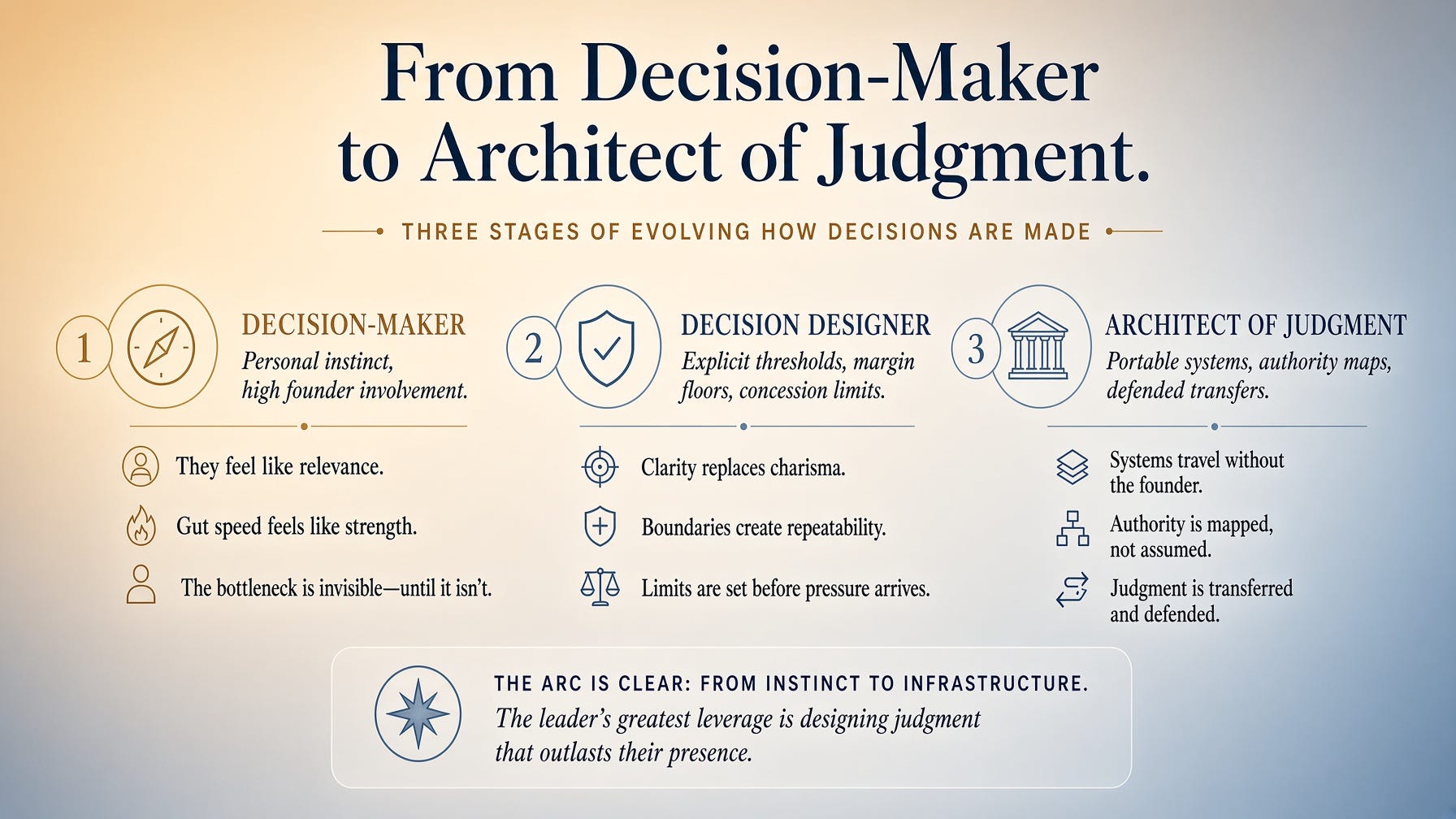
The strange thing about founder bottlenecks is that they rarely feel like bottlenecks to the founder. They feel like relevance. People ask for your opinion because your opinion has historically been useful, customers ask for you because you understand the promise, and managers escalate because you have seen ten versions of the problem they have seen once. After enough years, judgment starts to look like instinct. But instinct is often compressed experience.
“This deal feels wrong” may really mean the margin is too thin, or the customer is a poor fit, or the payment terms create unacceptable risk, or the opportunity distracts the company from something more important. “Save this customer” may mean the lifetime value justifies a concession and the recovery economics still make sense. “Do not spend $100,000 testing that” may mean you can purchase the evidence required to make the next decision much more cheaply. Scale requires the founder to unpack those instincts and turn them into something other people can use. That is considerably harder than telling somebody to delegate. The founder moves from decision-maker to decision designer and eventually to architect of judgment.
The transition becomes real at a very specific moment. Giving someone authority when you agree with their decisions is easy. The test comes when they make a reasonable decision you wouldn’t have made. If you override them simply because your preference differs, everyone learns where authority actually lives. You have not truly transferred authority until you are willing to protect somebody else’s reasonable judgment from your preference. The politics continue after the first disagreement because authority is rarely reclaimed all at once. It returns one exception at a time. This customer is unusually important, this hire is unusually sensitive, this quarter is unusually difficult, and this transaction is different. Each intervention sounds reasonable in isolation, and eventually the exception becomes the operating model, and everyone learns that waiting remains safer than deciding. Defending distributed authority isn’t an organizational event. It is a leadership discipline.
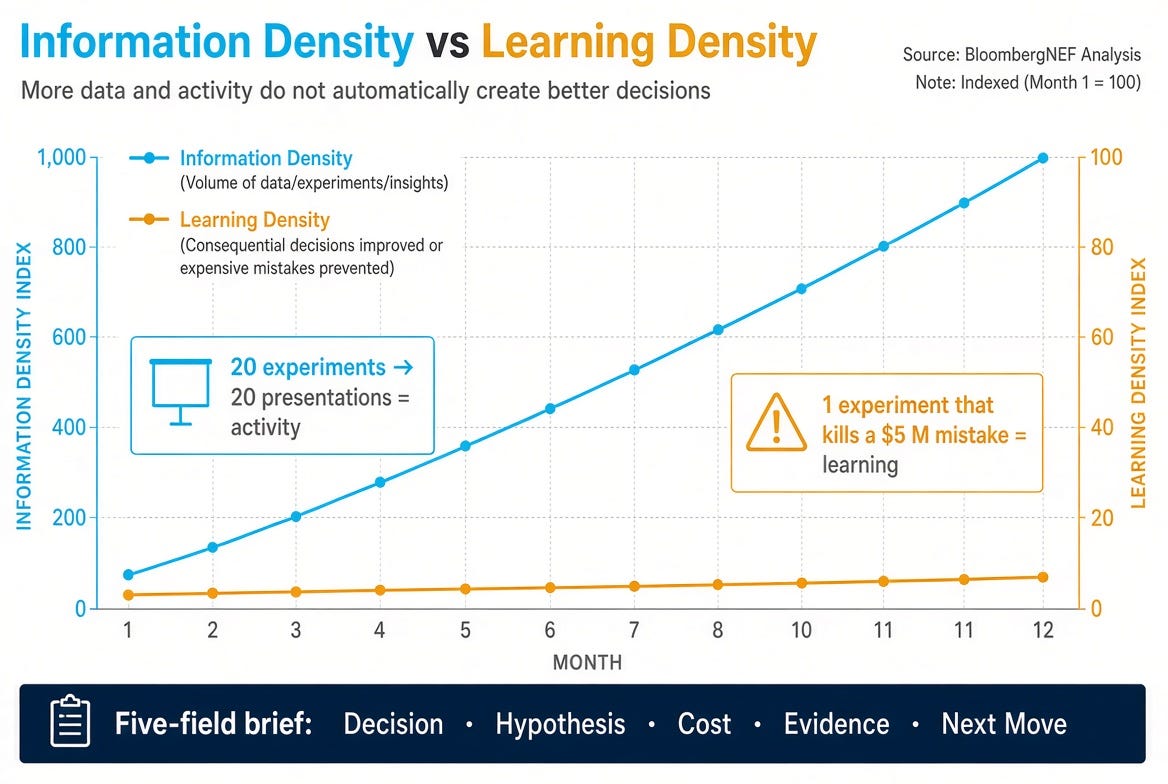
AI creates one final illusion because it can make a company feel dramatically smarter while changing surprisingly little. That is the difference between information density and learning density. Information density measures how much the organization can know. Learning density measures how efficiently the organization reduces consequential uncertainty and improves the odds of a better decision for the time and capital it consumes. The distinction sounds theoretical until you examine what companies routinely celebrate: experiments launched, dashboards built, customer comments collected, reports completed, insights generated. None of these necessarily mean the organization learned anything. Information becomes learning when it changes a consequential choice. It confirms an important decision, or it changes one, or it kills an expensive bad idea, or it gives the company enough confidence to commit harder to something that is working.
A changed decision isn’t automatically a better one. Learning density should reward evidence that improves the probability of a better decision, not merely evidence that creates movement. Some valuable experiments do not change a decision immediately because they map uncertainty. Exploratory work can still be useful if it clearly narrows what the next consequential test must answer.
Imagine two companies each willing to spend $100,000 to understand a new market. One spends the entire budget on a polished launch. The other runs smaller tests around customer segment, pricing, acquisition channel, and willingness to pay. The second company does not automatically learn more because four weak experiments can create four piles of noise instead of one. The work has to begin with the decision. What is the actual decision we are trying to make? What do we believe now? How much are we willing to spend to reduce this uncertainty? What evidence would make us change our mind? And what happens when the evidence arrives? That final question is the part organizations routinely forget. Without it, “learning” becomes something people put into a presentation. The easiest way to destroy learning density is to turn it into an activity metric. The moment teams receive rewards for running experiments, testing hypotheses, or generating insights, they will manufacture all three because that is what incentives do. If nobody can identify the decision that new evidence might change, the experiment is probably actively wearing an innovation badge. Twenty experiments that produce twenty presentations are active. One experiment that prevents a $5 million mistake is learning.
AI can make research, simulation, prototyping, analysis, and monitoring dramatically cheaper, which means it can improve learning density. Deloitte’s 2026 research also found that organizations taking a primarily technology-focused approach to AI were 1.6 times more likely not to exceed expected returns than organizations taking a more human-centered approach to redesigning work. Information density can explode while learning density barely moves. More intelligence enters the company, and nothing consequential changes. That may become one of the most expensive illusions of the AI economy.
Find the authority mismatches.
Take ten recurring decisions and trace where the original signal first appears, who understands it first, who can actually act, and how many people sit between those points. Do not automatically blame meetings, as they are usually a symptom. The deeper issue is often unclear or misplaced ownership.
Match friction to consequence.
Use the 5D questions to examine downside, detectability, reversibility, delegability, and dependency. The objective is neither decentralization for its own sake nor centralized control. The objective is proportional governance, where a narrow and reversible experiment does not have to travel through the same machinery as a commitment with a broad radius of consequence. As an illustrative example, a regional sales director may own discounts up to 8% when gross margin remains above a defined threshold and no strategic account precedent is created. Anything beyond that escalates the situation. The CEO, COO, or relevant business owner should review authority mappings and 5D thresholds quarterly. Major structural changes such as a regulatory shift, significant customer concentration change, or new AI automation should automatically trigger review rather than waiting for the next quarter.
Measure learning rather than motion.
Every serious experiment should identify the decision, the current hypothesis, the capital at risk, the evidence that would change the decision, and the next move. If a team cannot identify the consequential choice that the evidence may alter, there is a significant chance it is buying activity rather than truth. The five-field brief resists gaming better than experiment counts because it forces the consequential decision into the open before the work begins. The owner of the consequential decision owns the quality of the experiment brief.
Defend the authority you transfer.
Delegation looks clean on an org chart, and it becomes political the moment the new owner makes a decision you wouldn’t have made. If the decision is reasonable and within the agreed guardrails, leadership must defend the owner even when it prefers a different answer. Then it has to keep defending the arrangement because authority can be centralized again through a series of innocent-looking exceptions. That ongoing political work is the part most delegation programs miss.
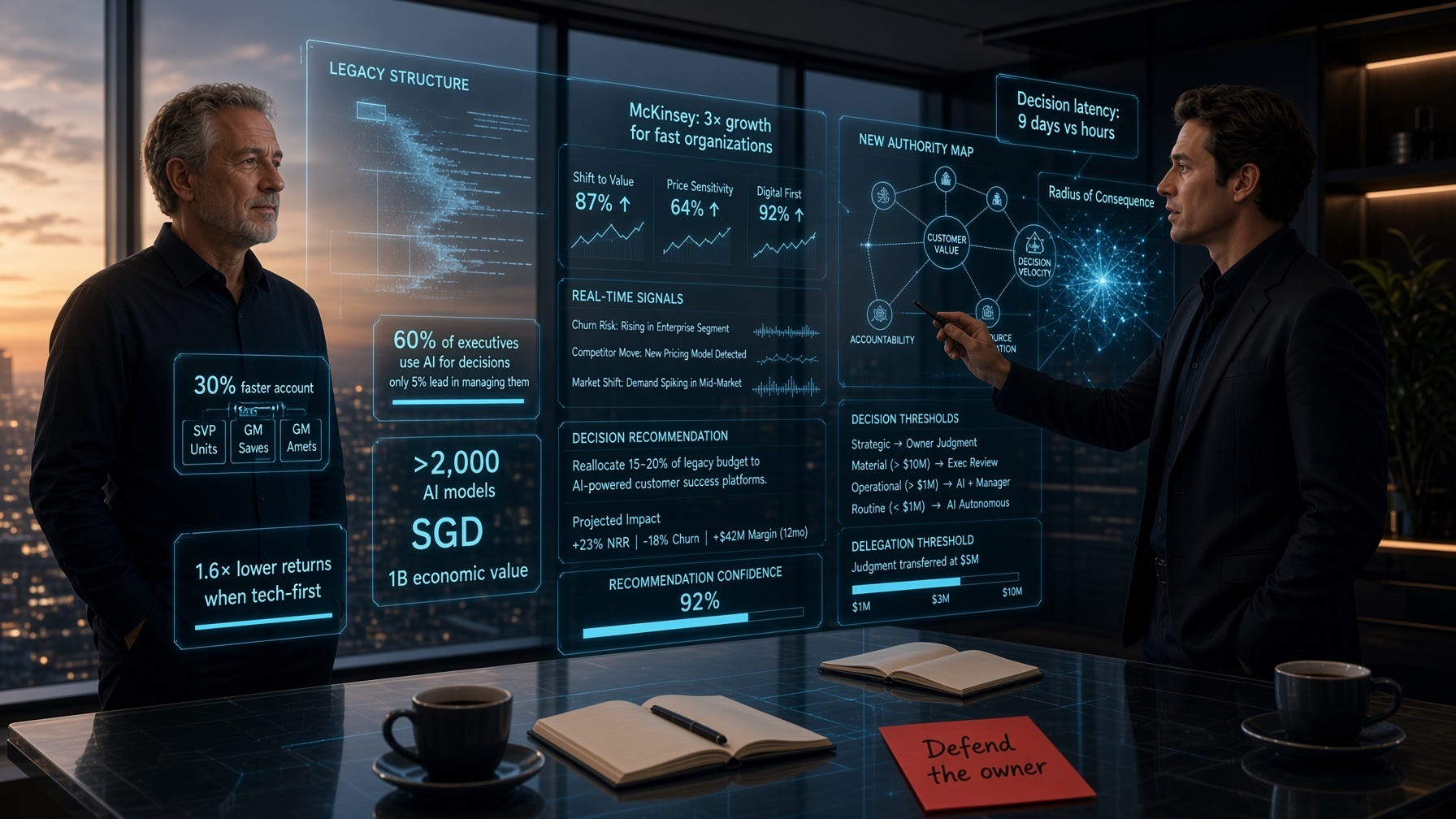
AI will not create a shortage of intelligence. It will create abundance. Agents will monitor customers continuously, models will find patterns people miss, and analysis that once required a week will arrive before breakfast. The bottleneck moves. The question is no longer whether the company knows enough. The question becomes whether somebody who knows is allowed to act.
For most of a company’s early life, the founder’s scarcity value is judgment, because you notice what others miss and make the call when nobody else wants to. Eventually the company becomes too large for that judgment to remain centralized, and leadership changes with it. The founder’s job is no longer to be the source of every good decision. It is to make good judgment portable. That is quieter work, and it offers less immediate proof of personal importance, which is probably one reason it is so difficult. Founders become indispensable by developing exceptional judgment. Scale asks them to accomplish something harder. It asks them to build a company in which that judgment no longer depends on their constant presence.
Your judgment has truly scaled only when its quality can survive your absence.