

Attention Is Not Demand
Why visibility only matters when it becomes urgency, proof, and purchase


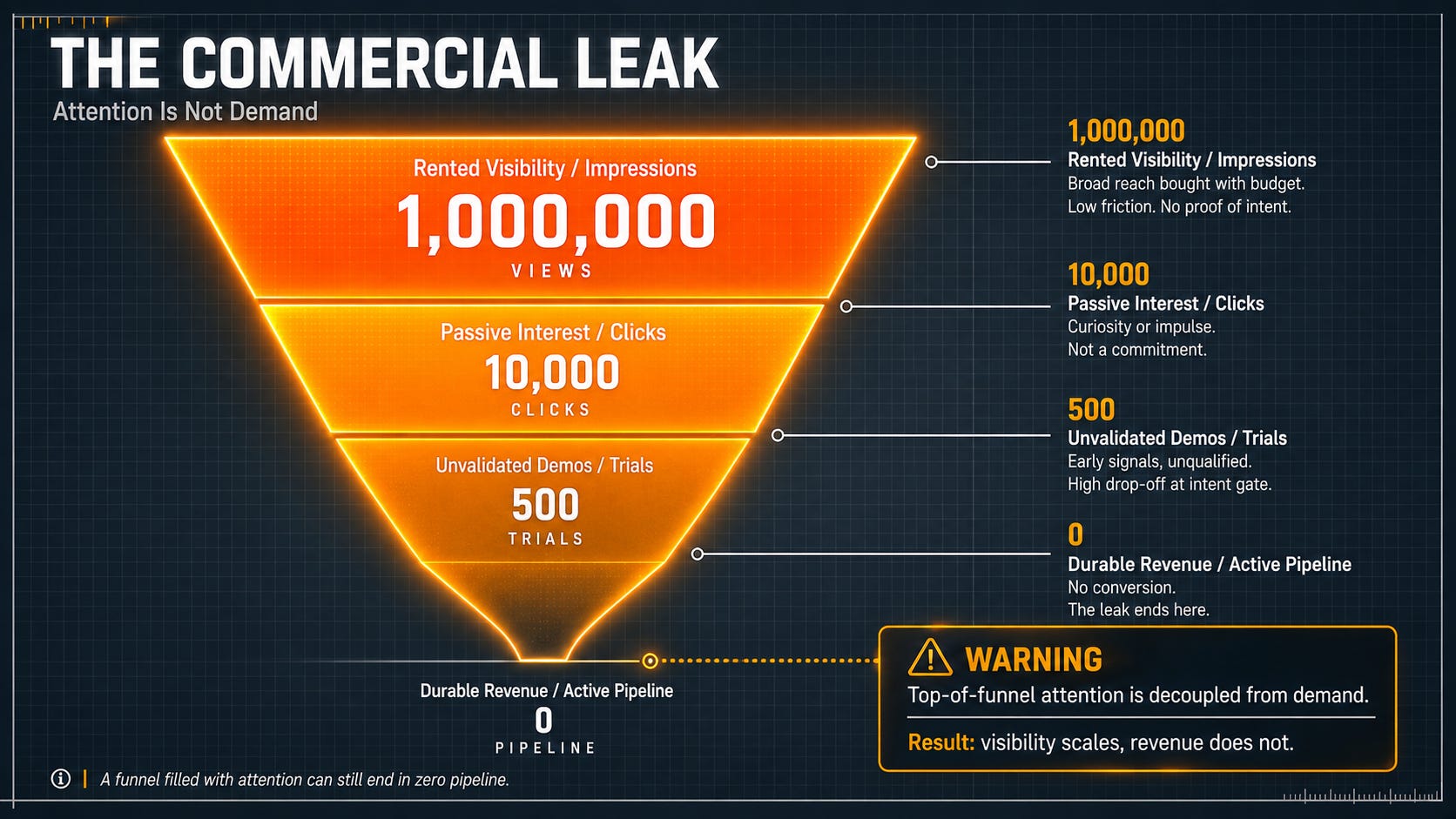
A founder can get a million people to watch a digital video and still have no business by Friday.
The views look like momentum. The bank account says otherwise.
The campaign worked. The dashboard lit up. The team celebrated. Then the pipeline barely moved, the sales calls stayed cold, and the CFO asked the only question that mattered: who is buying?
The winners are not chasing everyone’s attention. They are becoming obvious to buyers who already feel the problem.
For years, the startup market rewarded a convenient mistake: confusing visibility with momentum. Companies optimized for impressions, viral clips, launch theatrics, and algorithmic favor. The launch worked. The business did not.
Attention is rented visibility. It opens the first door, but the door is not the destination. Attention makes the market look. Demand makes the market act. Demand is urgency with proof attached.
If your company is getting views but not pipeline, demos but not urgency, trials but not expansion, or customers who like the product but cannot explain the business case, this is your problem.
Demand engineering is the work of finding real customer pain, making the cost of inaction visible, and proving your offer is the safest path to a specific outcome. Done well, it feels less like persuasion and more like recognition. Hype tries to create urgency around the seller. Demand engineering reveals urgency already present in the buyer’s world. It is about telling the truth about the cost of standing still.
Demand capture finds people already looking. Demand creation helps buyers understand why the problem can no longer stay unresolved. The best companies do both, but they do not confuse the two.
A click is not a commitment. Noise can create a spike. It cannot create a reason to buy.
Why Trust Got Harder
The old customer acquisition playbook did not disappear. It became less reliable.
AI made content cheap. It did not make trust cheap. Higher capital costs made waste expensive. CFOs made software sprawl visible. Buyers, buried under options, became harder to move with volume alone.
When anyone can generate endless posts, emails, and clips, volume stops being impressive. Buyers reward the company that reduces uncertainty fastest.
Higher capital costs changed the math. More companies now have to show that acquisition does not merely create growth, but growth that survives margin, retention, and payback scrutiny. Many CFOs and procurement teams now treat software sprawl as a cost center that they audit. Every new tool enters the room as a suspect line item. It has to prove what it removes, not just what it adds.
Buyers are taking on more of the buying process themselves. Gartner’s research points to a paradox: many B2B buyers prefer rep-free buying, but complex self-service purchases can increase regret. Buyers want control. They still need confidence.
Brand creates memory. Attention creates the entry point. Demand creates movement. But movement has to continue. First they notice. Then they pause. Then they compare change against staying still. Demand begins when staying still becomes more painful than moving. Revenue arrives when money and people commit. Retention proves the promise was real. A view is rented. A renewal is earned.
How to Progress Customers Through the B2B Sales Funnel
How Demand Builds
Demand does not appear all at once. It builds in layers. Miss one, and the deal slows, stalls, or dies:
Pain Recognition: The buyer recognizes their pain in your words.
Cost Visibility: The buyer sees that doing nothing is not free.
Outcome Certainty: The buyer believes the promised result is achievable and will not create a bigger mess.
Adoption Safety: The buyer believes implementation will not embarrass the team or create more work.
Proof That Travels: The buyer has evidence strong enough to carry into the next meeting.
Internal Repeatability: Your champion can explain the business case without you in the room. If the champion cannot repeat your value, your positioning failed.
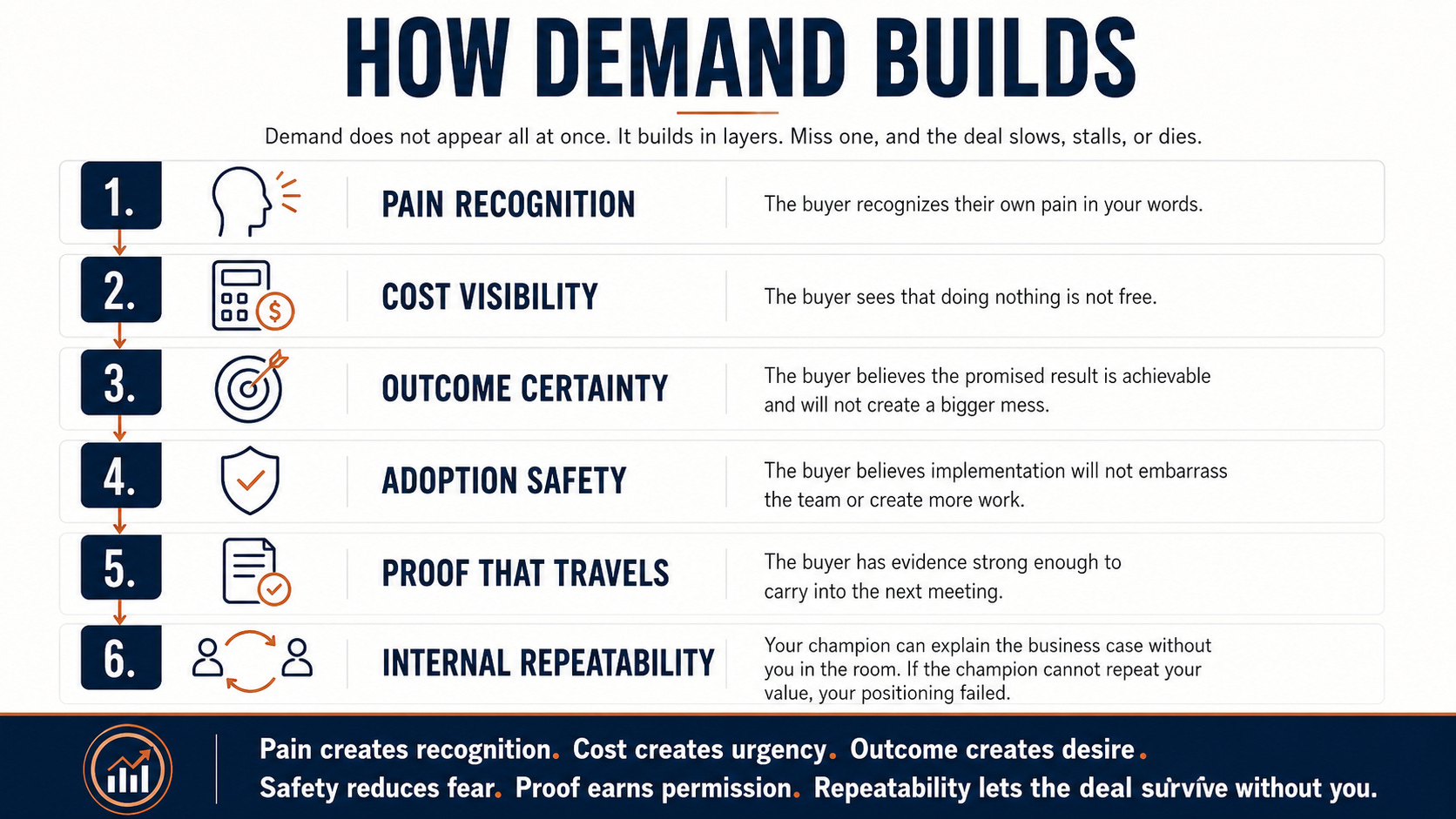
Pain creates recognition. Cost creates urgency. Outcome creates desire. Safety reduces fear. Proof earns permission. Repeatability lets the deal survive without you.
Demand in the Wild
In B2B, demand often forms around risk. In consumer markets, it often forms around identity. The mechanics differ, but the principle does not: the product matters when it resolves pressure the customer already feels. The clearest companies do not create demand by shouting louder. They make the buyer’s next move feel obvious.
Stripe
Online payments used to feel like bank infrastructure: slow, opaque, compliance-heavy, and hostile to developers. Developers did not want a payments seminar. They wanted to accept money without losing weeks to banking complexity.
Stripe did not eliminate the complexity of payments. It absorbed enough of it that developers could move faster. Its early story centered on a simple promise: accepting payments could begin with a few lines of code and unusually clear documentation. Stripe reduced implementation pain enough for developers to start fast and carry the product upward. Its real demand engine was not payments; it was developer momentum.
Nvidia
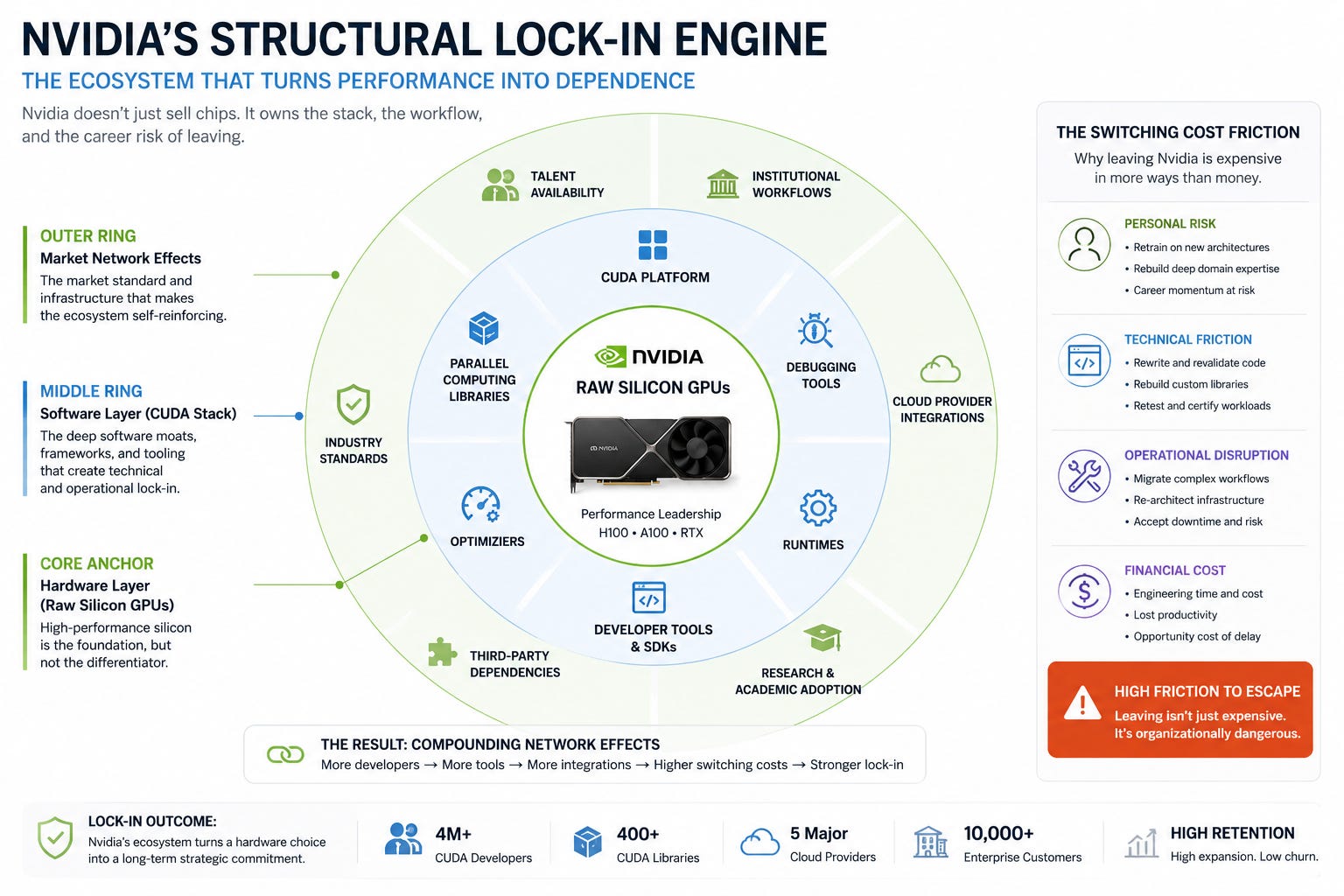
The semiconductor industry traditionally assumed that graphics processing units compete strictly on hardware speed, clock cycles, and technical data sheets. But enterprise engineering teams did not just need faster silicon; they needed a stable computational ecosystem that reduced software deployment risk and developer switching costs.
Long before the generative AI boom, Nvidia invested heavily in CUDA, its parallel computing platform and programming model. Nvidia officially describes its CUDA Toolkit as including GPU-accelerated libraries, debugging and optimization tools, a compiler, runtime libraries, and developer resources. This built a deep software layer around Nvidia’s architecture.
It made Nvidia difficult to replace because replacing it meant retraining people, rewriting workflows, revalidating tools, and accepting execution risk. The buyer was not only choosing a chip. They were choosing whether to disturb everything built around the chip. CUDA made Nvidia explainable inside organizations. Engineers knew it, managers trusted it, and cloud providers built around it. Nvidia did not merely sell performance. It sold continuity. Specs can win attention. Ecosystems create dependence.
Liquid Death
Water is one of the most commoditized categories in beverages. But at concerts, bars, and parties, the can in your hand says something. Liquid Death understood that water had a social problem before it had a product problem.
It did not make water more premium by softening it. It made water feel native in rooms where a plastic bottle felt out of place. Through a tallboy aluminum can, punk rock aesthetic, aggressive humor, and a “Murder Your Thirst” tagline, they built a cultural object. Venture financing reports indicate that Liquid Death closed a $67 million funding round at a reported $1.4 billion valuation. Valuation is not durability, but it shows how much value a market can assign when a brand finds social tension inside a category everyone else treats as functional. The demand was not hiding in the water. It was hiding in the social meaning of holding it.
How Liquid Death Turned Advertising Around
The Buyer Is Carrying Risk
Buyers are not lazy. They are overloaded. In B2B, every purchase is also a reputation bet. The more complex the sale, the more the buyer is asking whether your solution will protect or expose them. The buyer is not just buying a product. They are buying the right to look reasonable when someone questions the decision later. The CFO is not being difficult. The CFO is asking whether the pain is real enough to justify another line item.
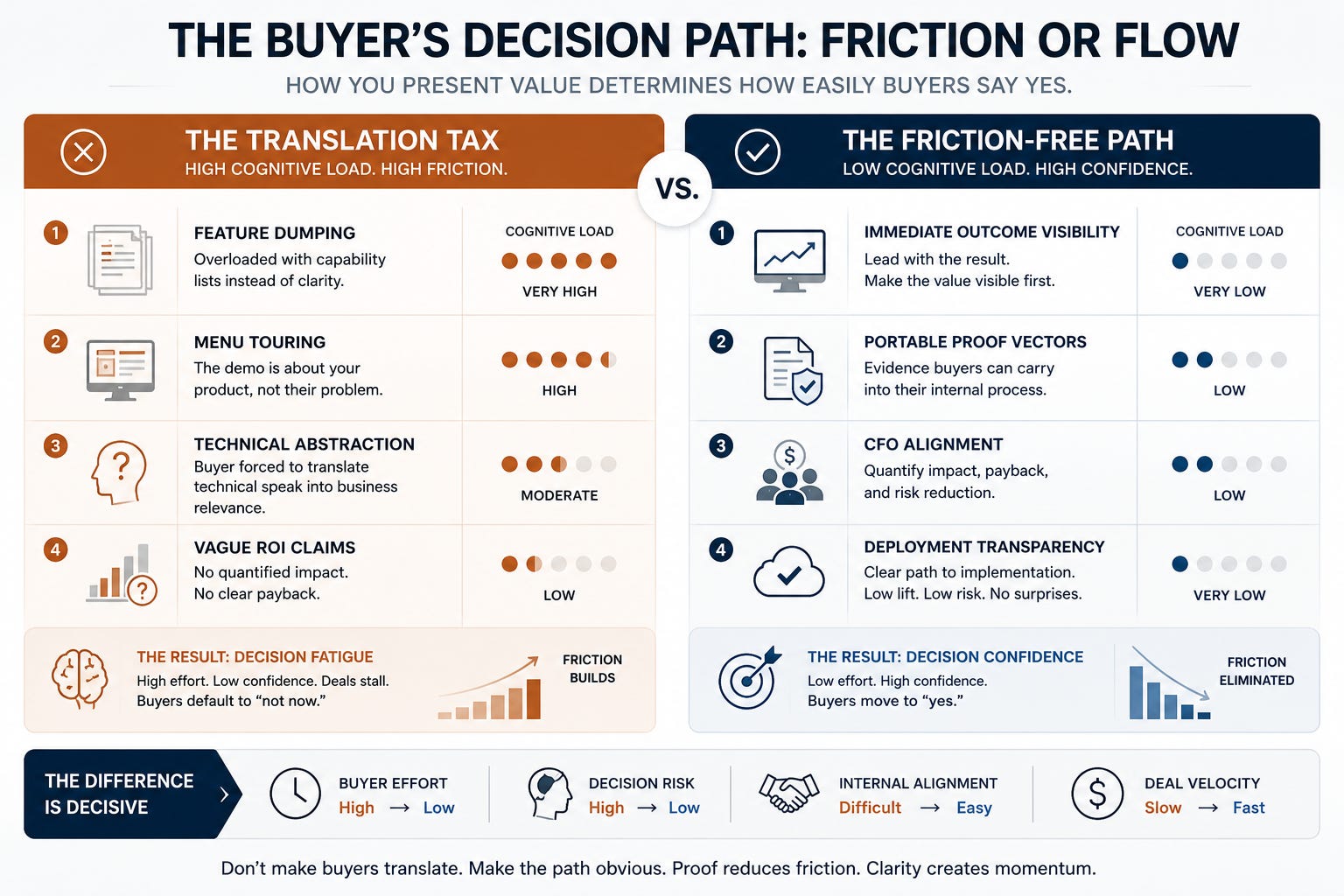
Buyers do not want more information; they want less uncertainty. A standard features list or an exhaustive technical demo forces the buyer to perform heavy cognitive translation. They have to convert your abstract capabilities into their own business case, their own internal politics, and their own risk model. That is a mental tax to levy against an executive who is already managing an overextended staff and urgent problems.
A buyer can like you, believe you, and still refuse to move if the internal risk feels too high. The best sales systems reduce this burden. They do not just persuade your champion; they also arm them to persuade the room they must return to. That is why proof matters. It provides the buyer something to hold when the room gets skeptical. Buyers do not buy because they understand you. They buy because they feel understood.
Proof Has to Travel
Narrative creates desire. Proof turns private desire into organizational permission. The champion does not need proof just for themselves. They need proof for the room that was not on the call. The best proof is the proof the buyer can take with them.
Proof must be concrete enough to survive the skeptical room: before-and-after workflows, time saved, errors reduced, implementation time, payback period, renewal behavior, expansion revenue, and a quote from the actual champion.
Features matter after the buyer believes the destination is worth reaching. A product demo should not be a museum tour. Technical depth matters during proof, but the first doorway is recognition: “These people understand my day.”
The Four Diagnostic Signs of the Attention Trap
You are still chasing attention if these four signs show up:
Your best marketing slide would not survive a CFO meeting. It reports views, impressions, and traffic, but does not report on qualified pipeline, expansion, retention, or payback.
Your homepage explains what you built before it proves why the buyer should care. Your demo shows the product before it shows the relief.
Your sales team creates urgency from scratch on every call. The market message should ideally establish that urgency prior to the meeting.
Your customers use the tool but cannot explain the business case. They may like the product, but they cannot describe its ROI, workflow impact, or internal value in one clear sentence.
How to Build Demand Instead of Chase Attention
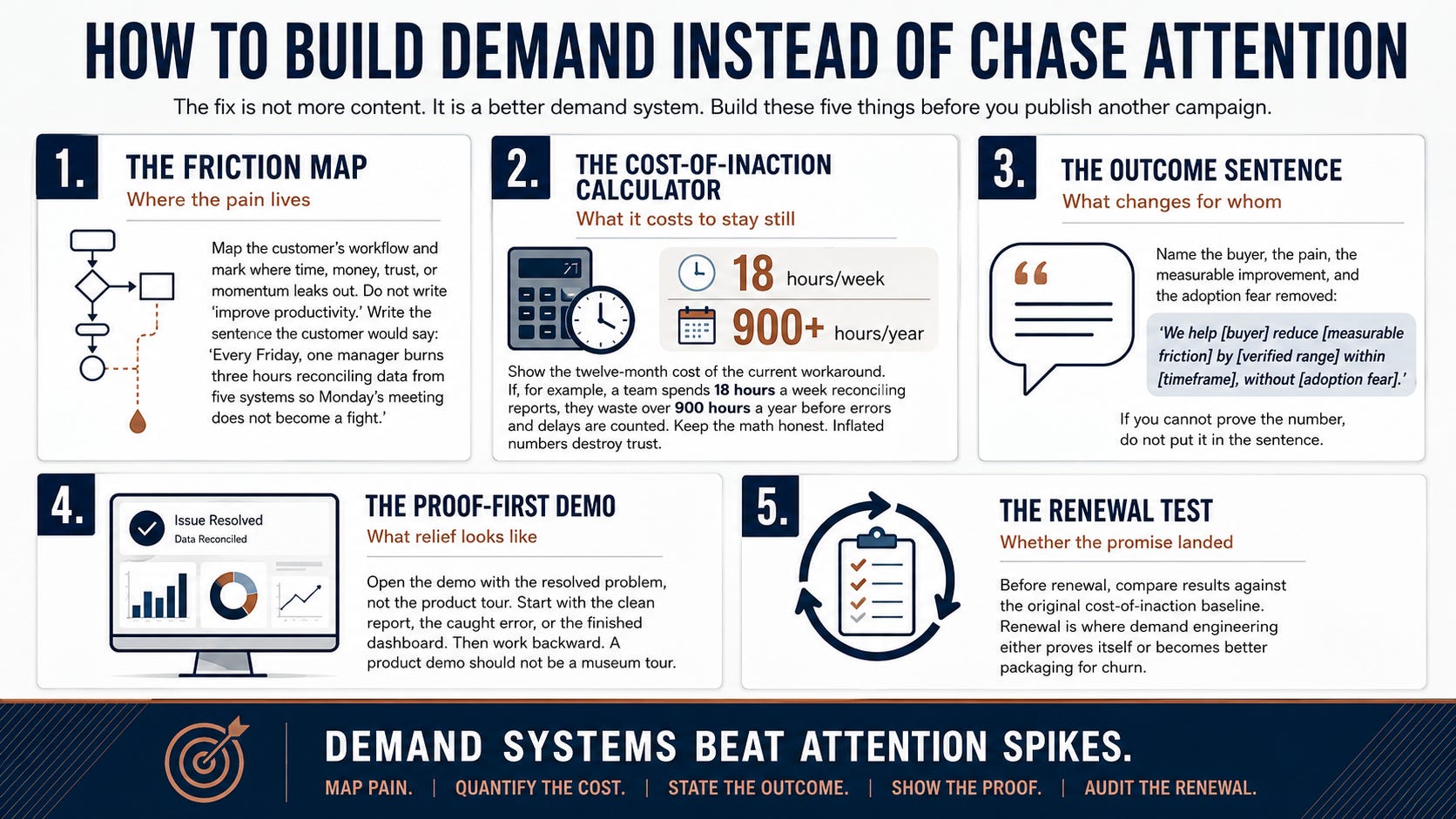
The fix is not more content. It is a better demand system. Please build five things before you publish another campaign.
The Friction Map: Where the pain lives. Map the customer’s workflow and mark where time, money, trust, or momentum leaks out. Do not write “improve productivity.” Write the sentence the customer would say: “Every Friday, one manager burns three hours reconciling data from five systems so Monday’s meeting does not become a fight.”
The Cost-of-Inaction Calculator: What it costs to stay still. Show the twelve-month cost of the current workaround. If, for example, a team spends 18 hours a week reconciling reports, they waste over 900 hours a year before errors and delays are counted. Keep the math honest. Inflated numbers destroy trust.
The Outcome Sentence: What changes for whom. Name the buyer, the pain, the measurable improvement, and the adoption fear removed: “We help [buyer] reduce [measurable friction] by [verified range] within [timeframe], without [adoption fear].” If you cannot prove the number, do not put it in the sentence.
The Proof-First Demo: What relief looks like. Open the demo with the resolved problem, not the product tour. Start with the clean report, the caught error, or the finished dashboard. Then work backward. A product demo should not be a museum tour.
The Renewal Test: Whether the promise landed. Before renewal, compare results against the original cost-of-inaction baseline. Renewal is where demand engineering either proves itself or becomes better packaging for churn.
The Line Between Noticed and Needed
Look at your homepage, sales deck, and demo. Does it begin with the customer’s pain or your product’s architecture? Does it show the cost of inaction or your feature set? Could your champion repeat the business case after the call without forwarding your deck? If not, you are not engineering demand. You are asking for attention to do a job it cannot do.
Engineered demand changes the economics because it changes who enters the funnel. You stop attracting spectators and start attracting people who already feel the problem. The cheapest customer to acquire is the one already carrying the problem in a language you can name.
Pricing power improves when the buyer believes you own the clearest path from pain to outcome. Price resistance falls when the alternative is not a cheaper competitor but another year of the same pain. If you sell features, buyers will compare them. When you offer the clearest path to relief, the comparison shifts. You are no longer just another tool competing for budget space. You are the clearest path to a critical operational result the buyer already requires.
How to Get Your First 10 Customers
The next great companies will not be the ones most people briefly notice. They will be the ones buyers can no longer ignore because the pain is named, the cost is visible, the proof travels, and the outcome lands.
Attention asks the market to look at you. Demand makes the market recognize itself. That is the line between what gets noticed and what gets needed.
This is exactly right and so true. One of the biggest mistakes I see entrepreneurs make is confusing attention with demand.
I've helped bring more than 160 products to market, and I can tell you this. Viral videos, likes, comments, and millions of views don't pay the bills. Customers do.
I've watched products with very little social media presence quietly become multi million dollar businesses because they solved a real problem. I've also seen products with millions of views disappear because no one was willing to pull out their wallet.
Attention is a starting point. Demand is the finish line.
That's one of the reasons we're building Infortum and Earnva the way we are. I'm far more interested in understanding verified consumer intent than vanity metrics. A click can be accidental. A view can be purchased. A real purchase, a real visit, and a real engagement tell an entirely different story.
As product developers, our job isn't to chase attention.
Our job is to solve problems so well that consumers create the demand for us.
That's the difference between building content and building a business.
#Entrepreneurship #ProductDevelopment #ConsumerBehavior #Innovation #BusinessGrowth #NeverQuit #DesignDevelopDeliver #EddyPham