

Engineering the Infinite Blueprint
Systems That Compound Beyond Capital Cycles

Why This Matters Now - Venture scalability is rarely the result of capital injection alone. Most leaders treat top-line revenue as the scoreboard—but the companies that endure treat it as a byproduct. The ones that last are obsessed with something less glamorous: entropy resistance. This is the ability to convert volatility, domain authority, and operational discipline into value that doesn’t require you to be in the room.
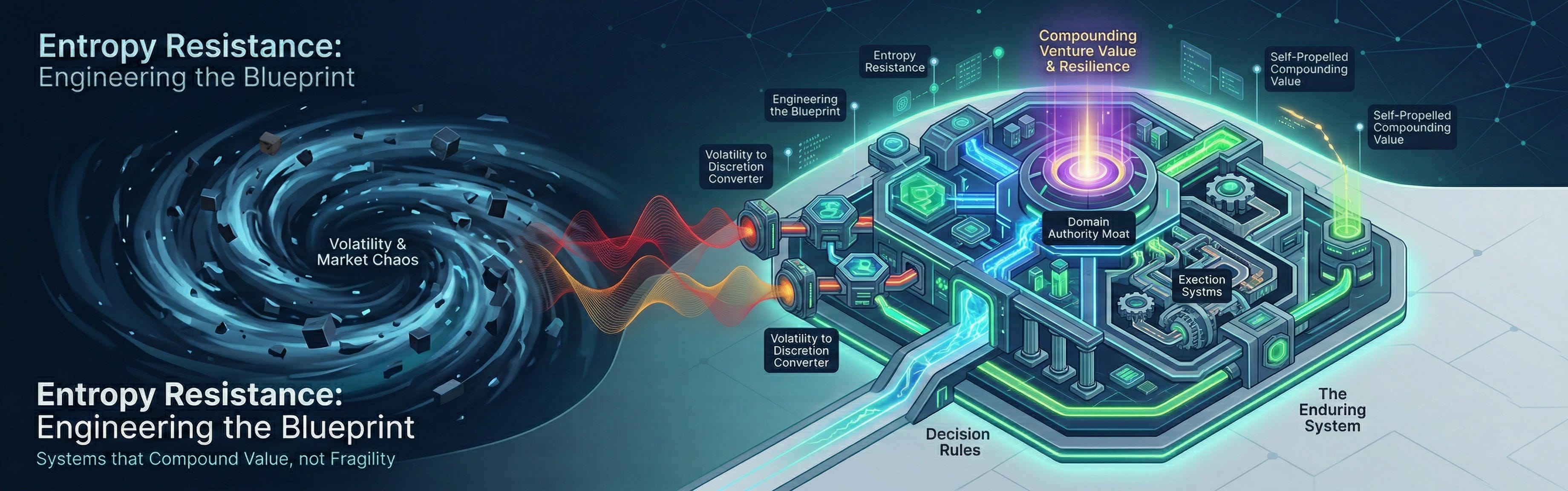
The real risk isn’t failure. It’s building something that works, until it doesn’t. Companies rarely die from competition alone; they more often die from the weight of their complexity, accumulated quietly during the years when everything looked like it was going well. The Infinite Blueprint is a structural response to that problem: systems where growth buys simplicity instead of bureaucracy, and scale reduces fragility instead of amplifying it.
The Performance Engine: Mastery Over Complexity
The single biggest preventable cause of venture failure isn’t a competitor outmaneuvering you—it’s your own organization becoming too slow to respond to itself. Research from Bain & Company (”Killing Complexity Before Complexity Kills Growth”) highlights that for roughly 85% of companies, the primary barriers to growth are now internal. Looking at recent reviews of failed companies shows that problems within the organization, like being too slow and misusing money, are more important than competition when it comes to growth issues.
The Necessity Principle cuts through this: every dollar, hire, and feature must prove it protects the core engine. Not that it’s useful. Not that it was requested. That it actively defends the thing that makes the business worth building.
Patagonia is the clearest example of this discipline executed at scale. They have never chased the low-margin, high-complexity growth that their brand recognition could have easily unlocked. Instead, they kept their SKU count tight and their supply chain accountable. The result is a retention engine fueled by repair and resale programs—like Worn Wear—that drive customer advocacy levels most direct-to-consumer brands cannot match through discounting alone. They didn’t grow their way to resilience. They edited their way there.
The Diagnostic Question: Before every major operational decision, ask: if you doubled revenue next quarter, would your complexity double with it—or would your system absorb the growth? If the honest answer is the former, you don’t have a performance engine. You have a pressure cooker.
Recognize the drift before it calcifies. The companies that fail this test rarely collapse suddenly. They accumulate drag incrementally:
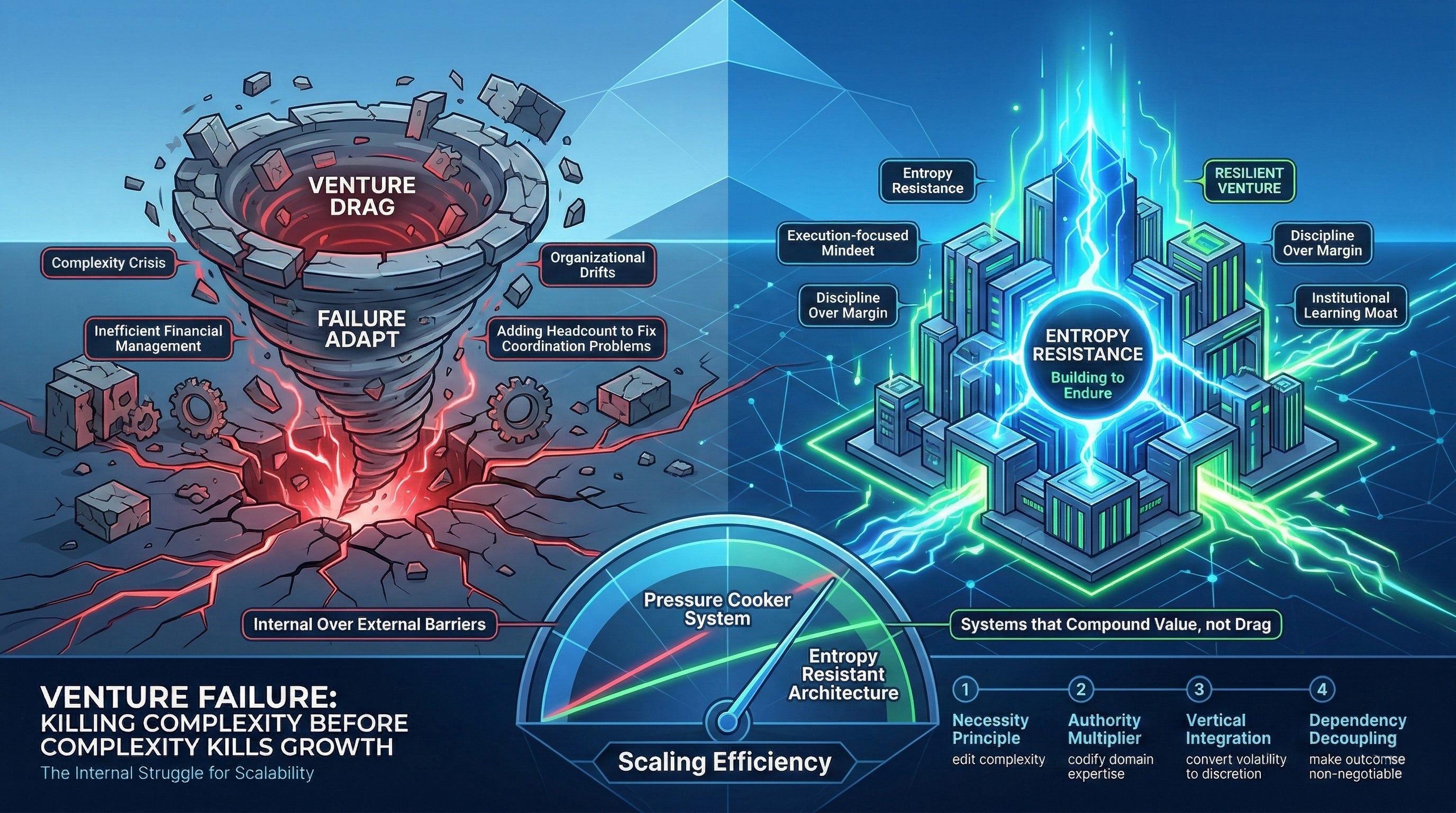
Adding headcount to solve coordination failures instead of fixing the underlying system.
Shipping features to appease edge-case customers while diluting the core product.
Mistaking a good quarter for permanent product-market fit.
The Authority Multiplier: Converting Trust into Leverage
In a crowded marketplace, authority is the ultimate competitive advantage. It is not audience size; it is the market’s willingness to trust your execution before the results arrive. Visibility without delivery decays. Authority compounds—and when it compounds long enough, it starts to function like infrastructure.
NVIDIA stands out as the most illuminating case study of the past decade due to its seemingly instant success. It wasn’t. The foundation of their market position, currently valued at approximately $4.5 trillion (as of late February 2026), was laid in 2006 with the release of CUDA, which stands for Compute Unified Device Architecture and is a parallel computing platform and application programming interface created by NVIDIA.
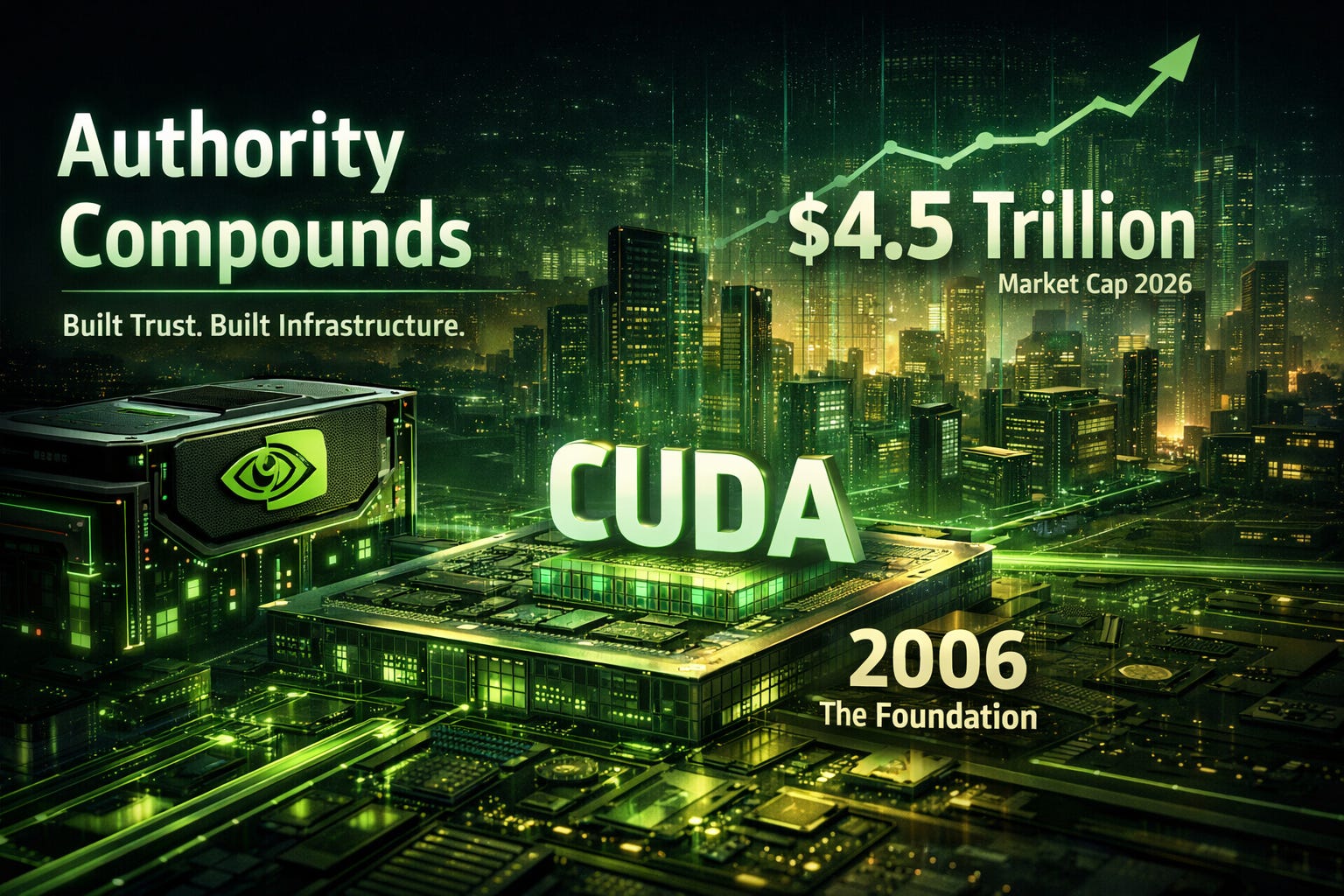
What looked like a niche technical decision was actually a two-decade bet that the developer ecosystem, not the hardware itself, would become the real moat. By the time the AI buildout created enormous demand, there was no viable alternative ecosystem for developers to migrate to. NVIDIA had become infrastructure, and infrastructure doesn’t compete. It extracts. Infrastructure wins not by persuasion, but by inevitability.
When walking away from your platform costs more than staying, you’ve stopped competing on value and started competing on gravity. This Authority Multiplier lowers customer acquisition costs, compresses sales cycles, and creates a pricing floor that isn’t subject to negotiation.
Legacy Architecture: Engineering Systems That Scale Without You
The difference between a high-performing startup and an enduring institution is whether the system performs when the founder is absent. Most ventures fail to close this gap because they do not architect around their removal. To transition from “heroic leadership” to “systemic performance,” a venture must resolve three distinct layers:
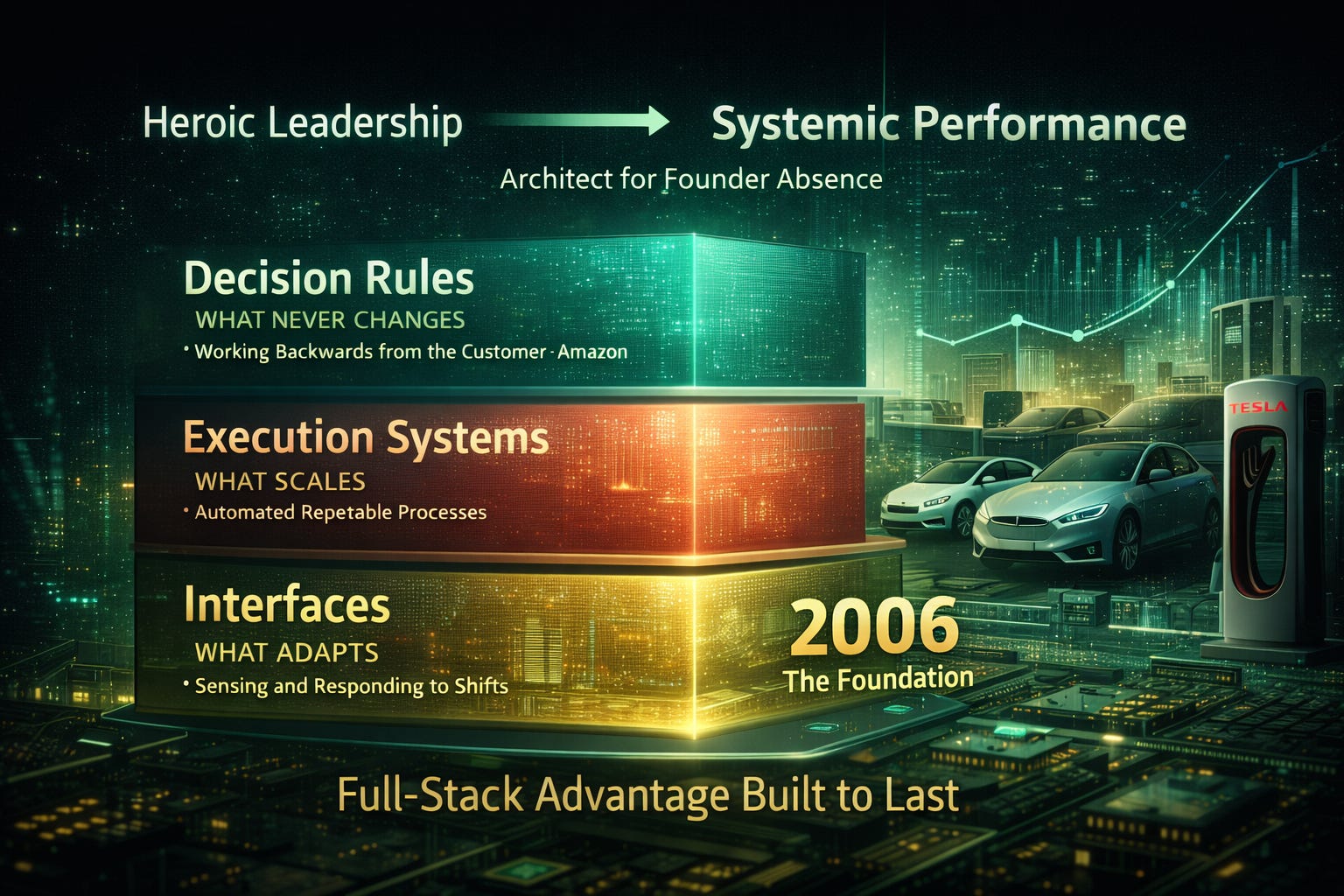
Decision Rules: The non-negotiable principles that define what the company will not do. Amazon’s insistence on “working backwards” from the customer is a Decision Rule; the moment it becomes negotiable, the system optimizes for the wrong thing.
Execution Systems: The automated, repeatable processes that handle scale without requiring heroic effort. They exist so output quality doesn’t depend on who is in the building that day.
Interfaces: The adaptive layers that allow the organization to sense and respond to market shifts without cracking the core.
Tesla exemplifies this full-stack approach. By vertically controlling the battery chemistry, the software stack, and the charging network, they converted external volatility into internal control. During recent shortages, supplier contracts held other manufacturers hostage, but Tesla reconfigured their own software to circumvent component scarcity. That is entropy resistance made physical. Integration only becomes an advantage when it converts dependency into discretion.
The 90-Day Challenge: From Philosophy to Architecture
If your operational blueprint doesn’t materially change your margin structure within 90 days, it isn’t a system. It’s a philosophy. Execute these three actions in sequence:
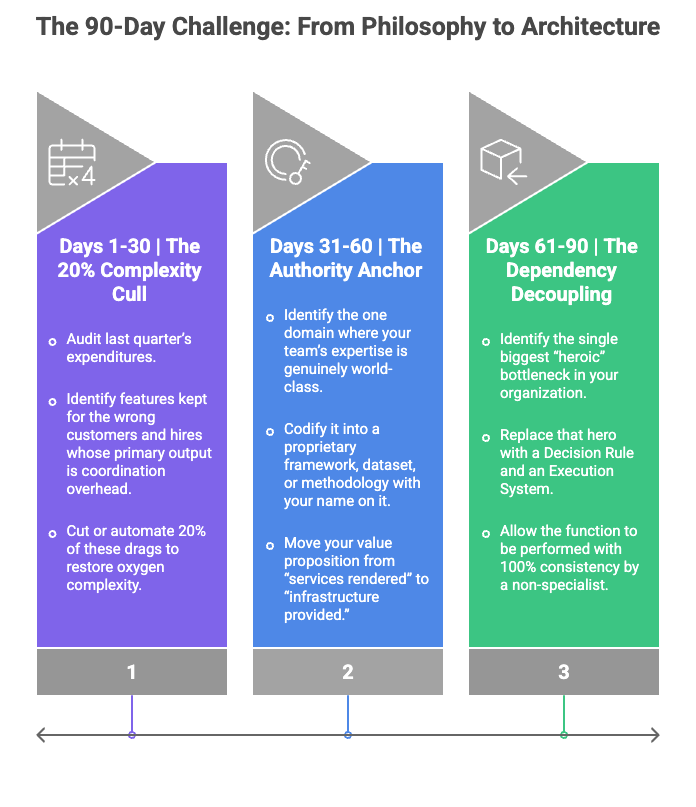
1. The 20% Complexity Cull (Days 1-30)
Audit last quarter’s expenditures. Does this protect the core engine, or does it exist because cutting it would require a difficult conversation? Features kept for the wrong customers and hires whose primary output is coordination overhead are where complexity hides. Cut or automate 20% of these drags to restore the oxygen complexity that has been consumed.
2. The Authority Anchor (Days 31-60)
Identify the one domain where your team’s expertise is genuinely world-class. Codify it into a proprietary framework, dataset, or methodology with your name on it. Move your value proposition from “services rendered” to “infrastructure provided.” This shift changes your pricing and retention simultaneously.
3. The Dependency Decoupling (Days 61-90)
Identify the single biggest “heroic” bottleneck in your organization—the hero whose absence would stall growth. Replace that hero with a Decision Rule and an Execution System that allows the function to be performed with 100% consistency by a non-specialist.
The most dangerous moment in any venture’s life isn’t the early years when everything is fragile and everyone knows it. It’s the middle years, when growth masks the complexity accumulating underneath, and the very system that got you here quietly becomes the thing most likely to stop you.
Start engineering your entropy resistance—before growth turns against you.