Systematic Creativity
The Executive’s Manual for Manufacturing Innovation

Stop waiting for a “lightning strike” of inspiration. Here is the 5-part mechanical process to manufacture breakthroughs on demand.
TL;DR: (too long; didn’t read)
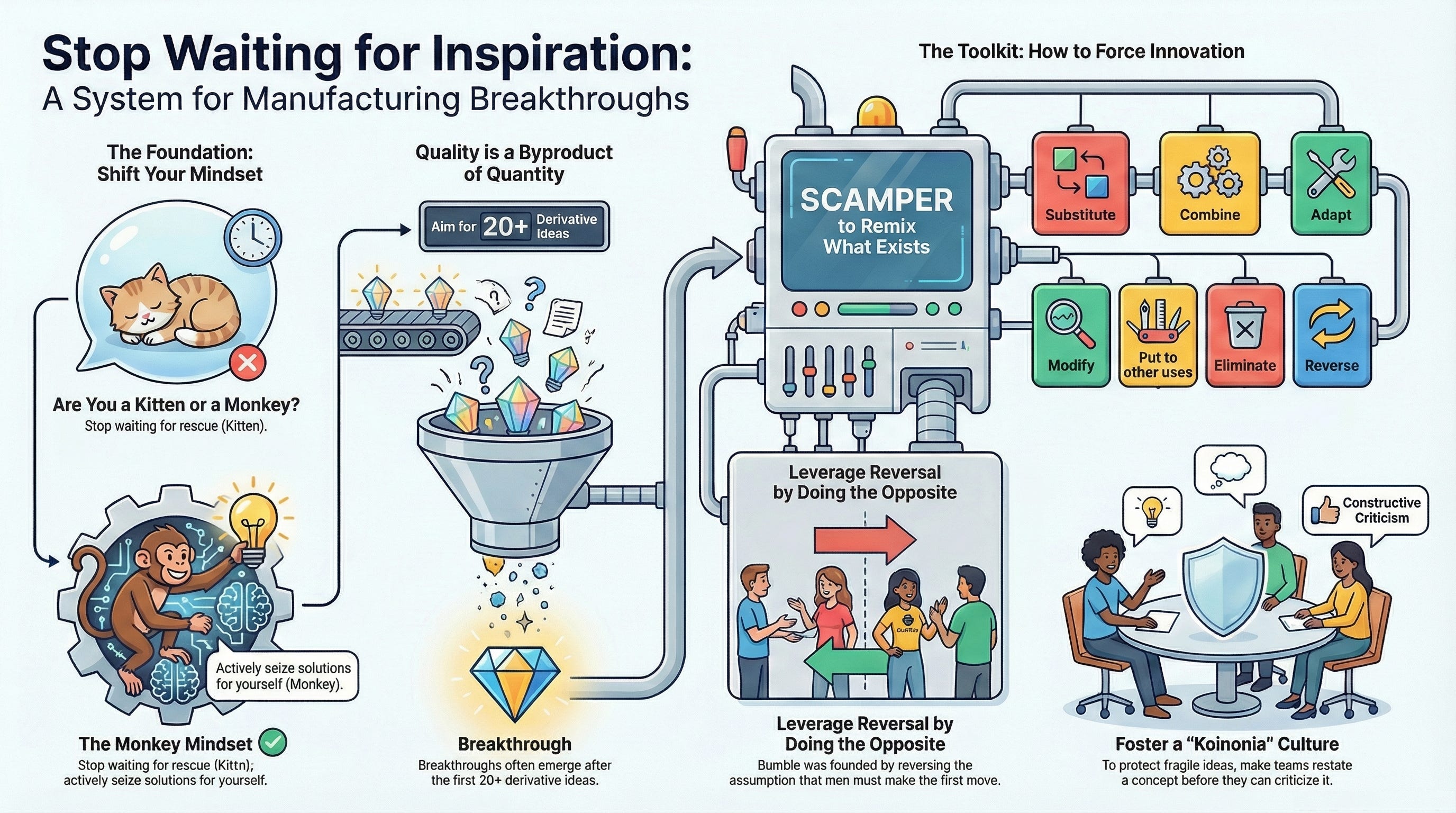
The Trap: Most leaders wait for market trends to save them (The “Kitten” Mindset).
The Shift: You must aggressively hunt for solutions (The “Monkey” Mindset).
The Math: Quality is a byproduct of quantity. You need an “Idea Quota.”
The Tool: Use SCAMPER and Reversal techniques to force innovation.
The Culture: Implement “Koinonia” to stop your team from killing good ideas.
The era of the “fast follower” is dead. In a market saturated by AI-driven efficiency and global competition, copying what works is a fast track to irrelevance. The only safety lies in the dangerous work of originality—building “Blue Oceans” where you set the price, the pace, and the rules.
This is your playbook for shifting from a business operator to an industry architect.
Most business owners treat creativity like the weather. They view it as something they hope for but cannot control. They wait for a “lightning strike” of inspiration to solve a revenue dip or a product flaw.
This is a strategic error.
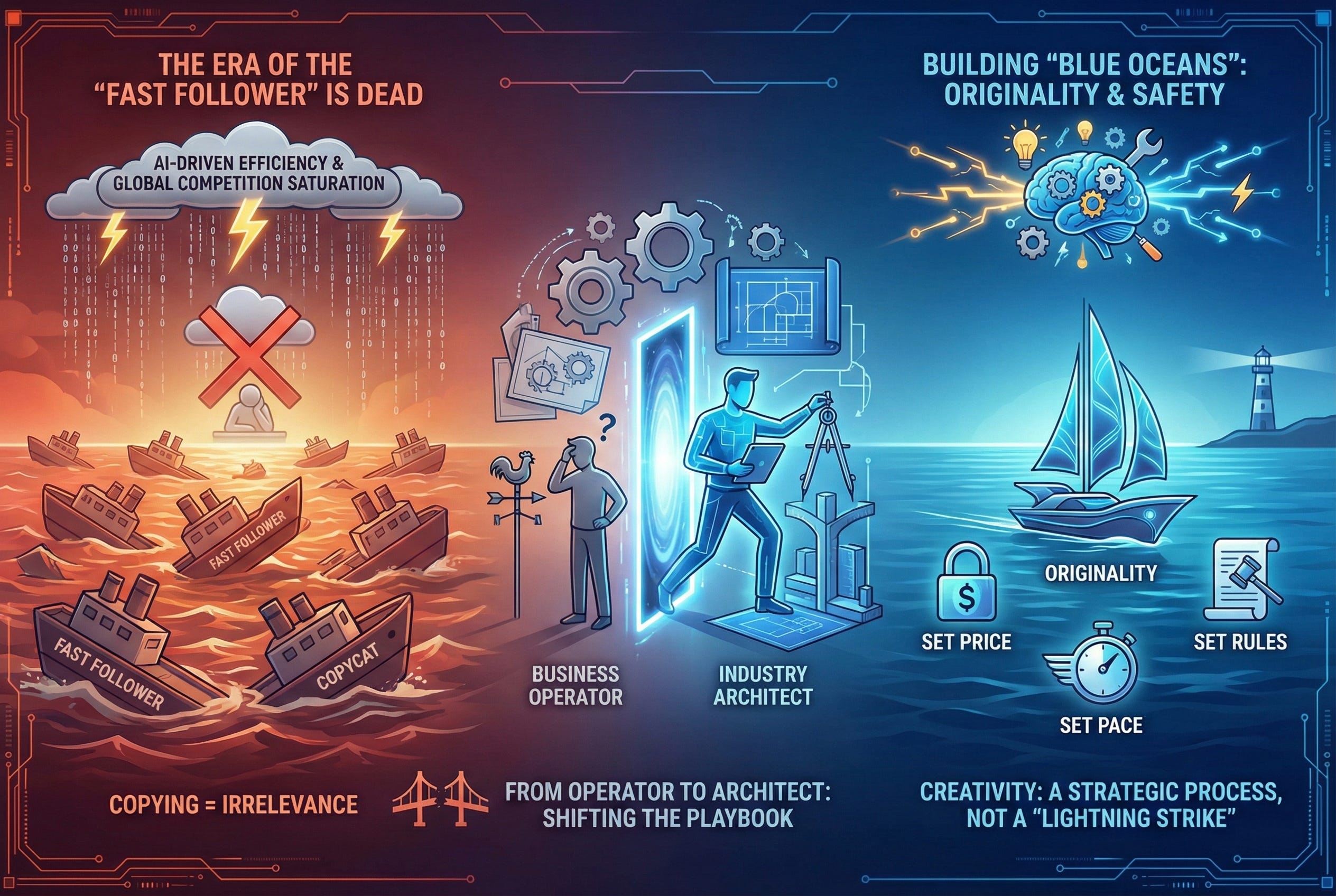
Creativity is not a biological trait. It is a mechanical process. Just as you have a system for payroll and a system for logistics, you need a system for ideation. Based on Michael Michalko’s Thinkertoys, this guide breaks down the cognitive mechanics of innovation into five teachable modules.
Here is how to stop waiting for ideas and start manufacturing them.
Module 1: The Psychology of Ownership (Locus of Control)
Before you can use tools, you must correct the software running in your head. Michalko categorizes professional problem-solvers into two distinct psychological profiles: The Kitten and The Monkey.
The Kitten Mindset: When a kitten is in trouble, it mews and waits for its mother to lift it to safety. In a business context, this is the leader who waits for external factors to rescue them. They wait for a consultant, an economic upturn, or a viral trend.
The Monkey Mindset: When a young monkey senses a threat, it behaves differently. It does not wait. It actively leaps onto its mother’s back. It takes full responsibility for its own preservation.
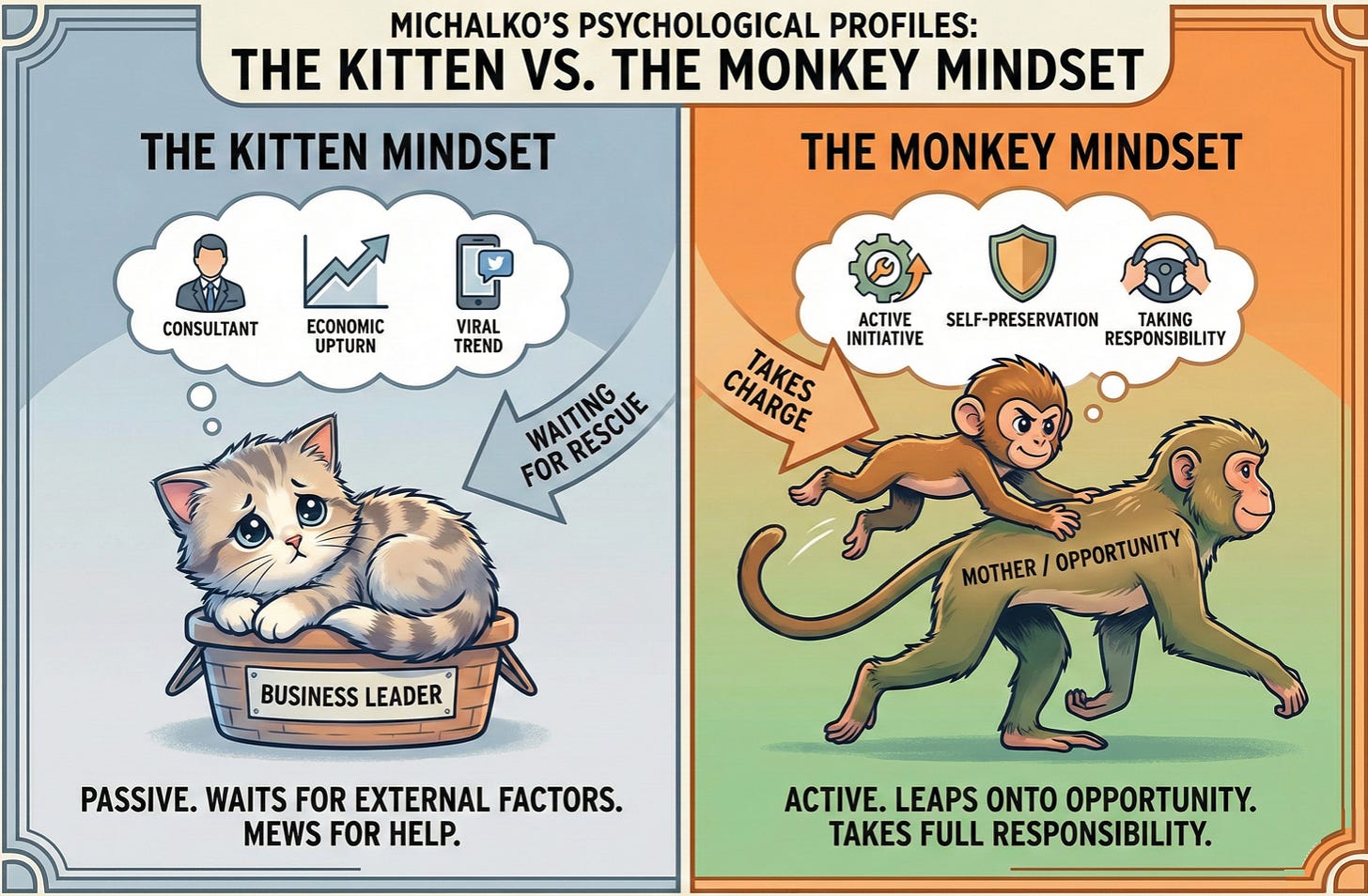
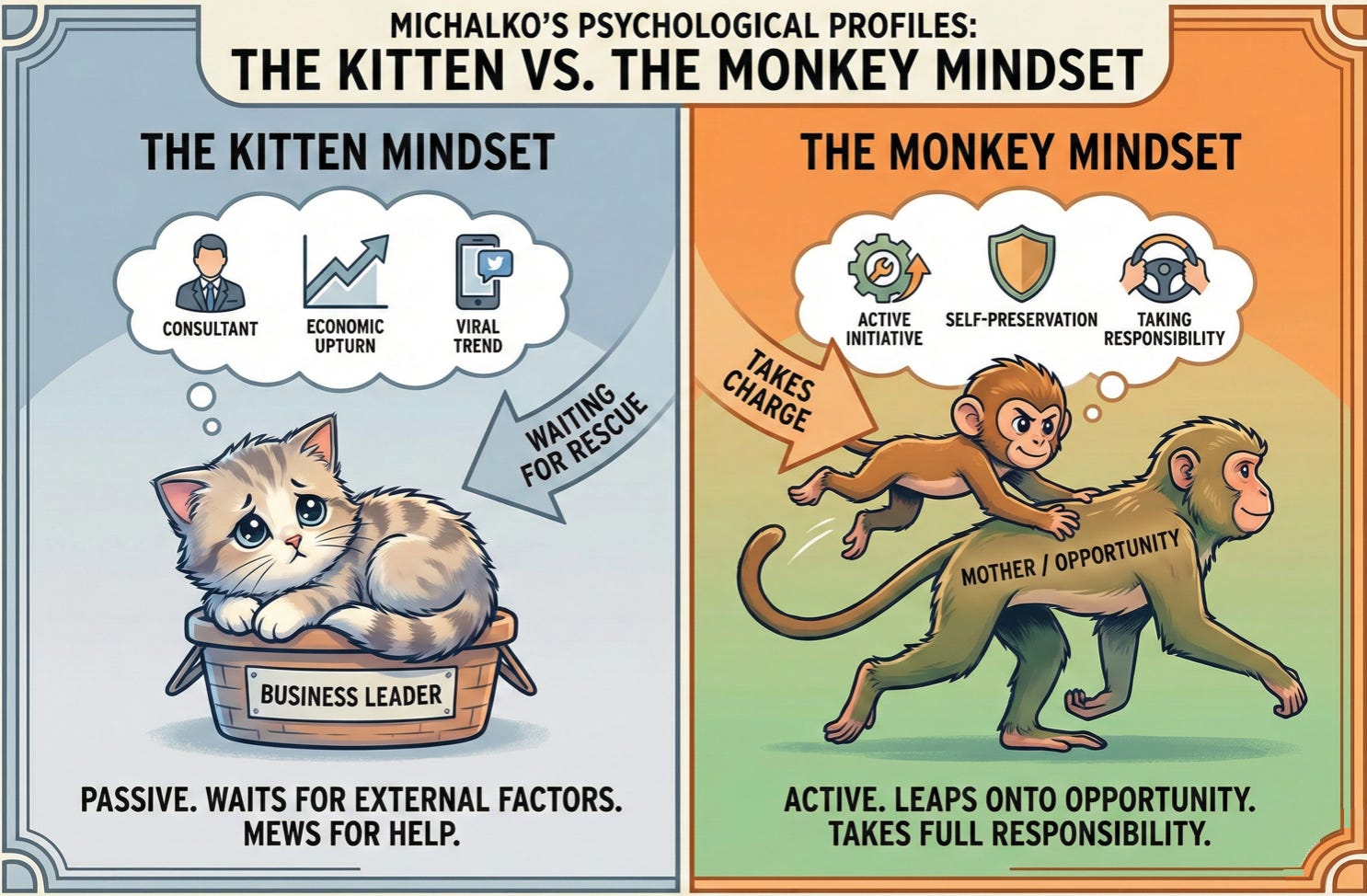
The Lesson: Innovation requires an internal locus of control. You must train your brain to reject passivity. If you catch yourself saying, “We have to wait and see what the market does,” you are in Kitten mode.
The Monkey mode alternative asks a different question: “How can we force the market to react to us?”
Module 2: The Physics of Quantity (The Idea Quota)
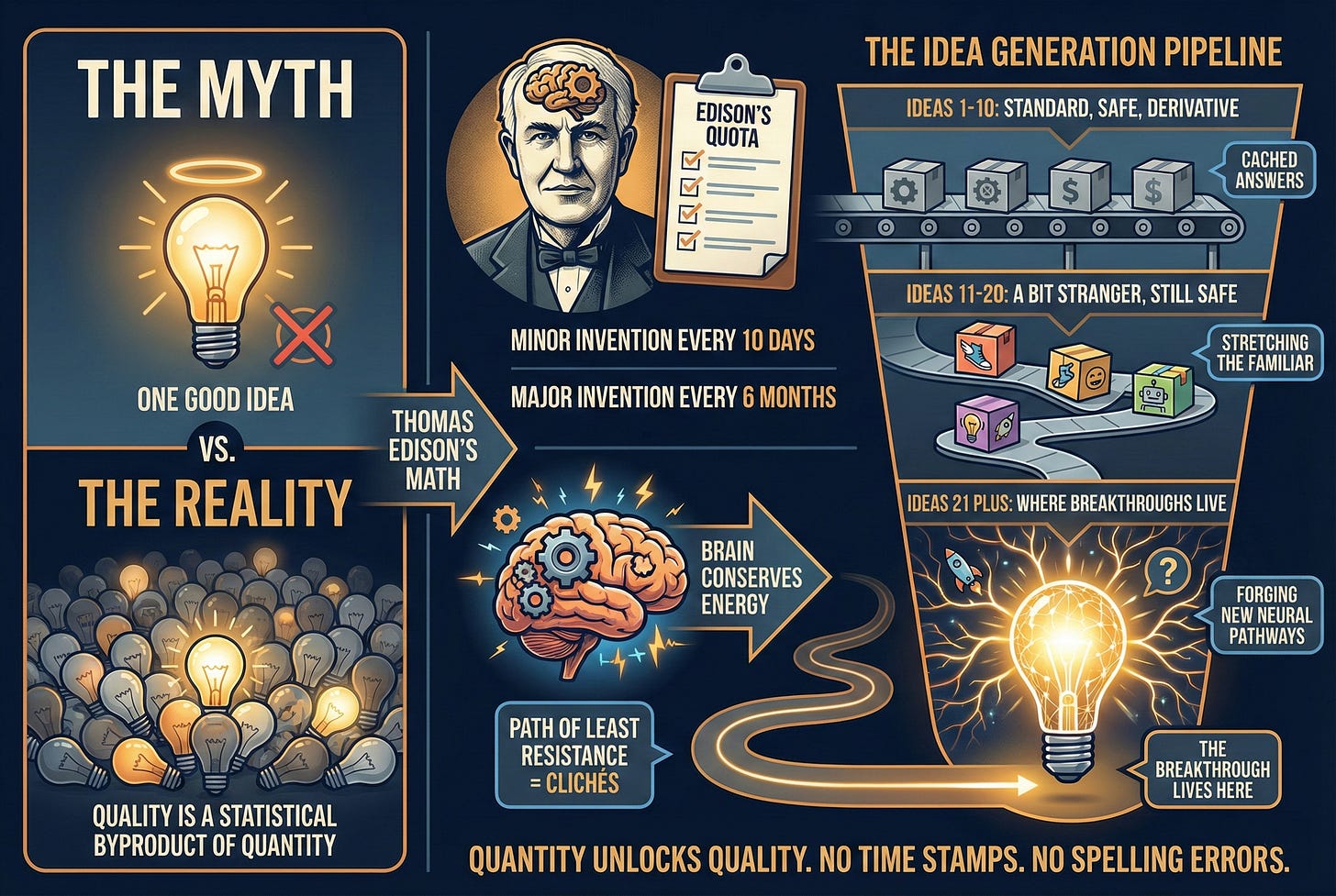
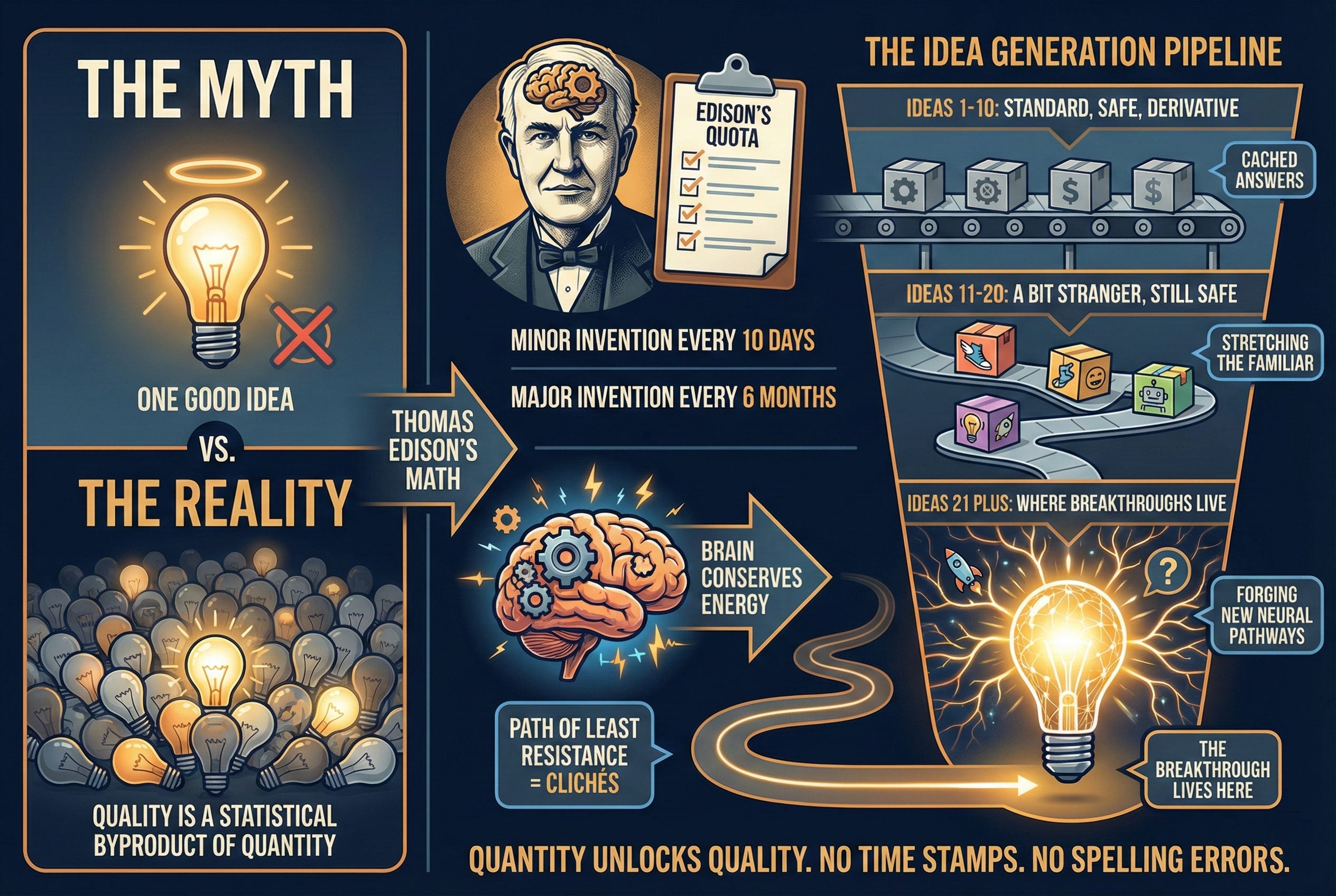
One of the most damaging myths in business is that you need one good idea. In reality, quality is a statistical byproduct of quantity.
Thomas Edison understood this math. He did not rely on flashes of genius. He relied on a quota. He mandated one minor invention every 10 days and a major one every six months.
Why This Works: Your brain is designed to conserve energy. When you ask it for an idea, it will give you the path of least resistance. This is usually a cliché or something a competitor is already doing.
Ideas 1 to 10: Standard, safe, derivative.
Ideas 11 to 20: A bit stranger, but still safe.
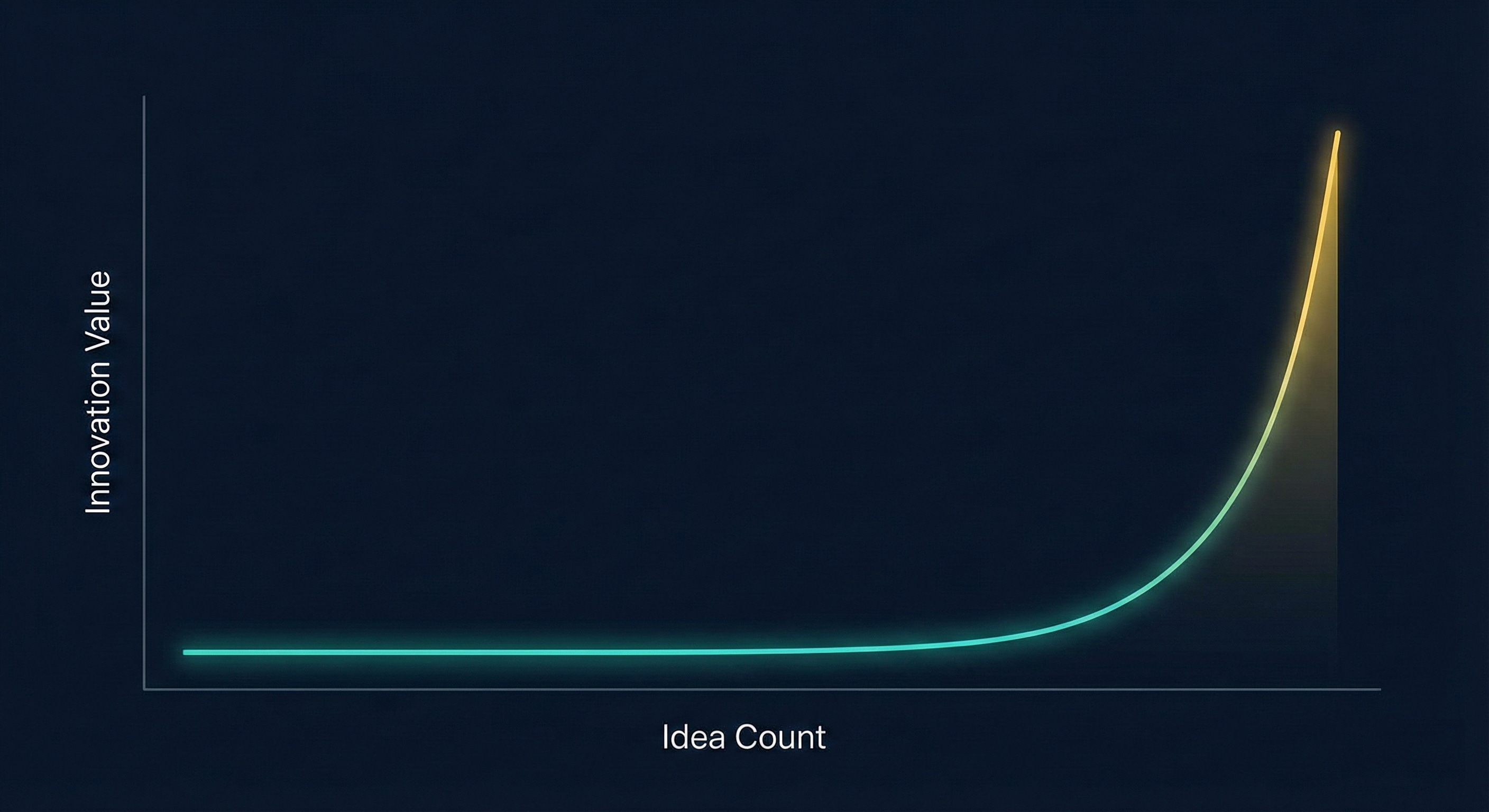
Ideas 21 Plus: This is where the brain runs out of cached answers. It must start forging new neural pathways. This is where the breakthrough lives.
Student Exercise: In your next team meeting, do not ask for “a solution.” Ask for 20 potential solutions. Do not stop until number 20 is written down. You will discover that the idea that saves you is usually number 18 or 19.
Module 3: The Linear Toolkit (Systematic Manipulation)
Once your mindset is primed, you need specific tools to manipulate your problems. These are linear, left-brain techniques for systematic innovation.
Technique A: The SCAMPER Checklist
You do not need to invent something new. You often just need to tweak what exists. Run your product or service through these seven specific filters:
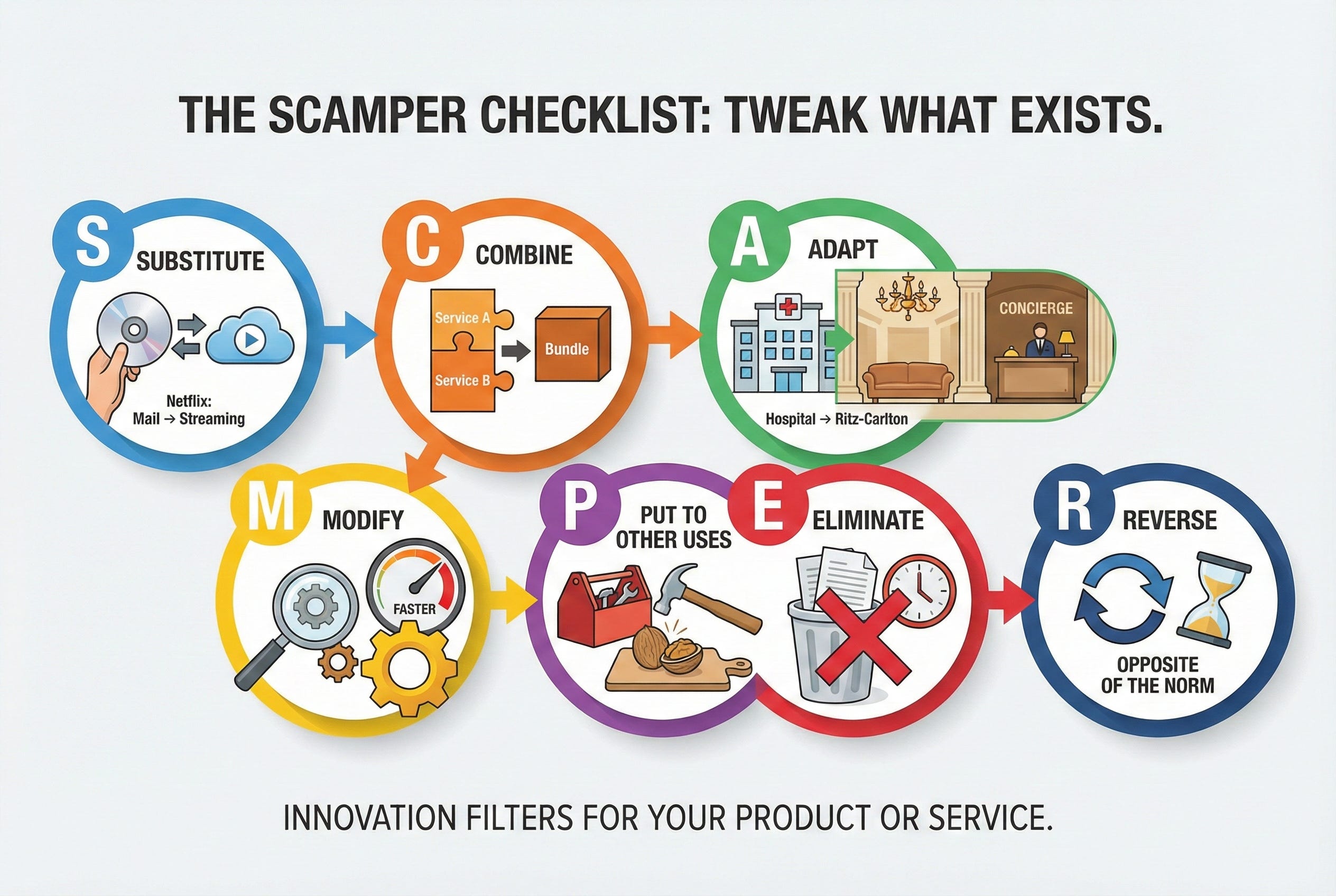
Substitute: Can you change the rules? (e.g., Netflix substituted physical stores for mail, then streaming).
Combine: Can you bundle services?
Adapt: What works in another industry? (e.g., How can a hospital run like a Ritz-Carlton?)
Modify: Change the scale. Make it bigger, smaller, or faster.
Put to other uses: Who else needs this?
Eliminate: This is the most powerful tool for efficiency. What can you stop doing?
Reverse: Do the exact opposite of the norm.
Technique B: False Faces (The Power of Reversal)
State the assumptions of your industry, and then enforce the opposite.
Assumption: “Dating apps require men to make the first move.”
Reversal: “Women must make the first move.”
Result: Whitney Wolfe Herd used this exact reversal to found Bumble. She created a billion-dollar niche by solving the pain point of harassment.
Technique C: Cherry Split (Fractionation)
If a problem seems too big to solve, break it into attributes.
Technique: State the problem in two words (e.g., “Sell Apples”). Split it into attributes. “Sell” becomes “Wholesale / Retail.” “Apples” becomes “Color / Taste.”
Application: Continue splitting until you find a micro-component you can innovate. You might end up reinventing the sticker on the apple rather than the apple itself.

Module 4: The Intuitive Toolkit (Lateral Thinking)
Sometimes logic fails. When you hit a wall, you need to force your brain to make non-logical connections. This is called Lateral Thinking.
Technique A: The Hall of Fame (Forced Connection)
When stuck, select a quote from a historical figure at random and force a connection to your problem.
The Problem: Your marketing is not converting.
The Random Quote: Winston Churchill said, “If you are going through hell, keep going.”
The Connection: Maybe the marketing is not the problem. Maybe the customer is in “hell” or pain. Instead of selling features, change the copy to acknowledge their pain and offer a way out.
Technique B: Brutethink (Random Stimulation)
Force your brain to find a connection between your business problem and a completely random word from the dictionary.
The Problem: “How to get more clients.”
Random Word: “Soap.”
The Connection: Soap washes things clean. Maybe we can “clean” our client list? Or offer a “clean slate” discount for past clients who left?
Why This Works: It forces “bisociation,” or connecting two unrelated planes of thought. It jars the brain out of its rut and offers a fresh perspective that logic would never have found.
Module 5: The Culture of Innovation (Koinonia)
If you are the only one in your company coming up with ideas, you are the bottleneck. You need to instill Koinonia. This is a Greek concept of fellowship and dialogue.
In standard meetings, ideas are shot down instantly. People say, “That won’t work,” or “It is too expensive.”
In a Koinonia-driven session, you establish a new rule: No one is allowed to disagree with an idea until they can restate it to the speaker’s satisfaction.
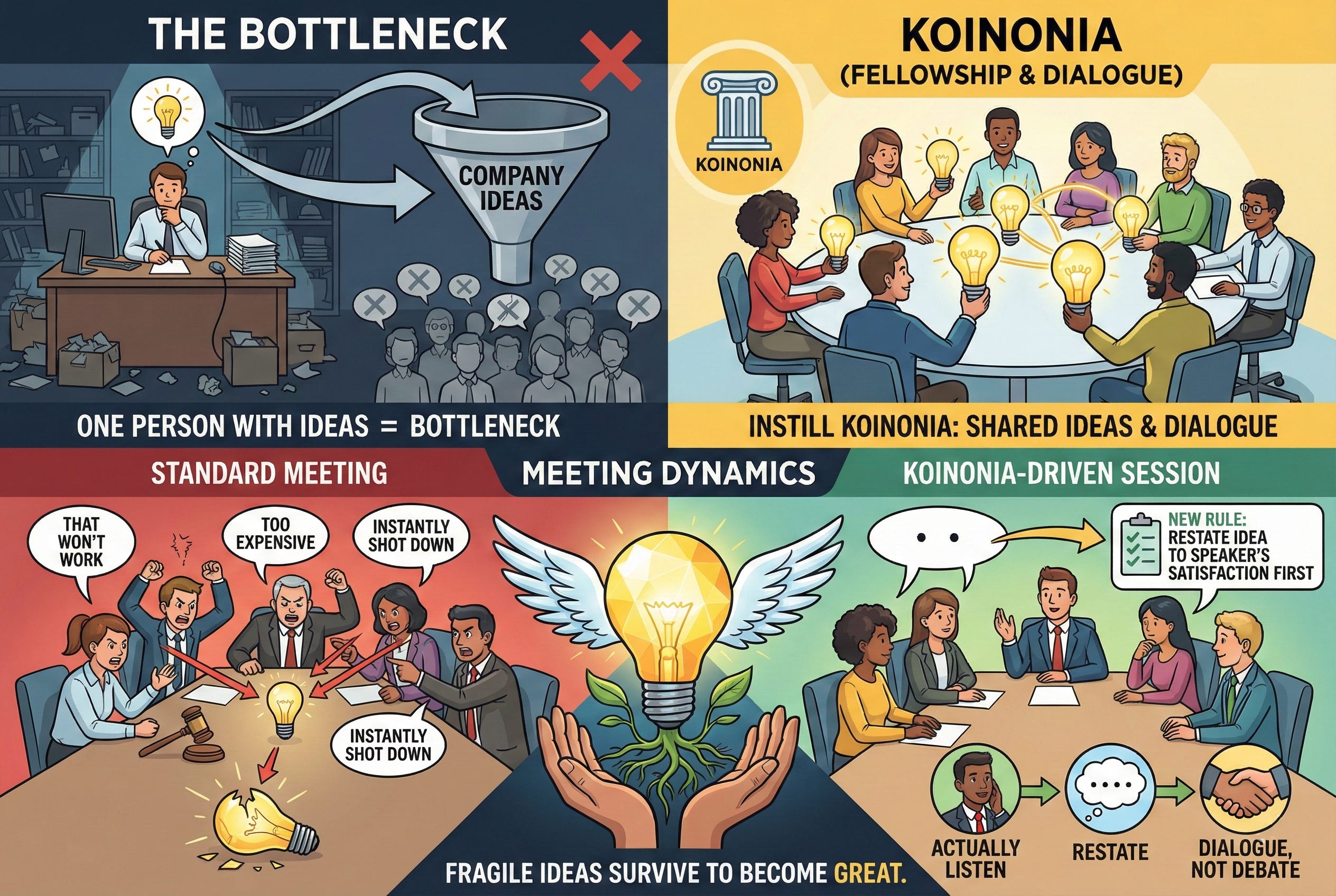
This forces your team to actually listen rather than just reloading their arguments. It turns a debate into a dialogue. This allows fragile, early-stage ideas to survive long enough to become great.
Your Implementation Roadmap
Knowledge without execution is just trivia. Follow this four-step plan to integrate these tools into your business this week.
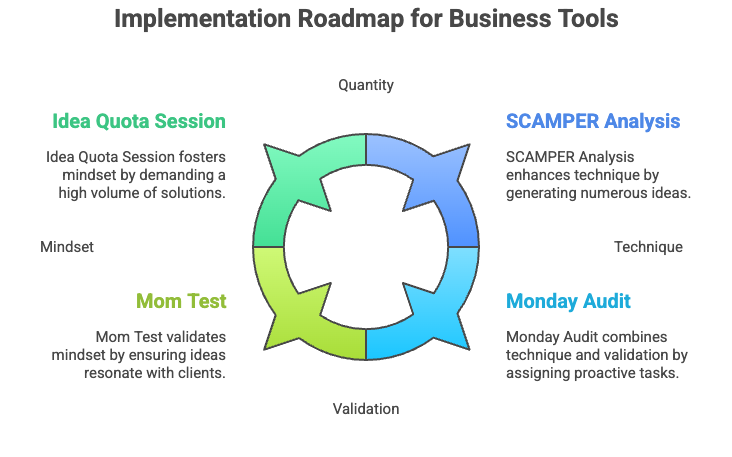
The Monday Audit (Mindset): Identify one area where your team is being a “Kitten” or waiting for instructions. Assign a specific “Monkey” task. This must be a proactive step they must take without your help.
The Wednesday Workshop (Quantity): Hold a 30-minute “Idea Quota” session. Pick one bottleneck in your business. Demand 20 distinct solutions from the team. Forbidden phrase: “That won’t work.”
The Friday Review (Technique): Take your best-selling product and run it through the SCAMPER list. Find one way to Eliminate a cost or Reverse a feature to add value.
The Weekend Test (Validation): Don’t guess if your new ideas are good. Use the “Mom Test.” Call three current clients and ask about their problems. Do not pitch your solution yet. Listen to see if your new idea actually fits their reality.
The goal is not to be a genius. The goal is to build a system where genius becomes inevitable.