

The 90-Day Kill Switch
Why Annual Planning Breeds Complacency and How Elite Operators Move Faster

Why the companies moving fastest no longer treat the calendar year as the real unit of execution.

By the second week of January, the whiteboards are still clean. Forecast spreadsheets are still color-coded. The leadership team still believes this will be the year execution finally matches ambition.
Every January, companies perform the same comfortable ritual. Leadership teams gather in conference rooms with fresh slide decks, optimistic forecasts, and carefully engineered annual targets. Revenue goals get stretched just enough to sound ambitious. Marketing budgets are approved. Hiring plans are mapped out. Strategic initiatives are assigned owners. For a few weeks, everyone feels productive.
Then something entirely predictable happens.
February arrives. The deadlines still feel distant. Teams convince themselves there is plenty of time. Product launches drift. Meetings multiply. Output slows into a familiar corporate rhythm that feels busy without being particularly urgent. By the time summer arrives, the gap between the original plan and reality has quietly widened. Priorities have changed. Markets have shifted. Competitors have adapted. Internal assumptions no longer match the outside world.
Then comes the inevitable fourth-quarter panic. Budgets get rushed out the door. Forecasts are revised. Teams scramble to salvage annual targets that stopped being realistic months earlier.
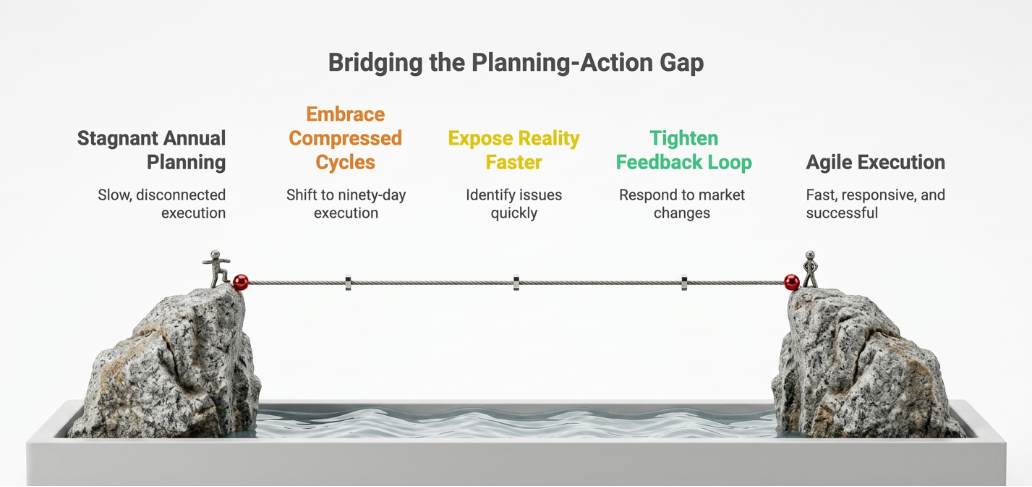
Most organizations do not fail because they cannot plan. They fail because the distance between planning and action becomes too large. That gap is where momentum dies. The problem is the timeline. Annual planning creates a false sense of security while actively hiding execution failures.
The companies moving fastest right now understand something many legacy organizations still resist: annual planning is useful for capital allocation and long-range direction, but execution itself increasingly operates on compressed cycles. For many elite operators, ninety days has become the real unit of competition. Not because quarterly thinking sounds trendy, but because shorter execution windows expose reality faster.
A twelve-month strategy allows teams to postpone difficult truths; a ninety-day cycle does not. If a product is weak, you find out quickly. If positioning is unclear, customers tell you immediately. If the workflow is broken, the bottleneck becomes impossible to hide. In markets moving at blistering speed, that tight feedback loop matters more than beautifully designed annual forecasts.
The Dangerous Psychology of Long Timelines
Long deadlines create emotional distance. Behavioral research on temporal discounting and goal-setting shows that humans struggle to act urgently against far-off consequences. The farther away the deadline feels, the easier it becomes to rationalize delay. Corporations institutionalize this tendency. An annual target sounds serious in January, abstract in March, negotiable by June, and existential by October.
The result is a strange, sluggish rhythm that infects many organizations: slow first-half production followed by frantic second-half recovery attempts. You see it across almost every industry: sales teams backloading targets into the final quarter, product organizations endlessly refining features instead of launching, and marketing departments spending months preparing campaigns that should have been tested weeks earlier.
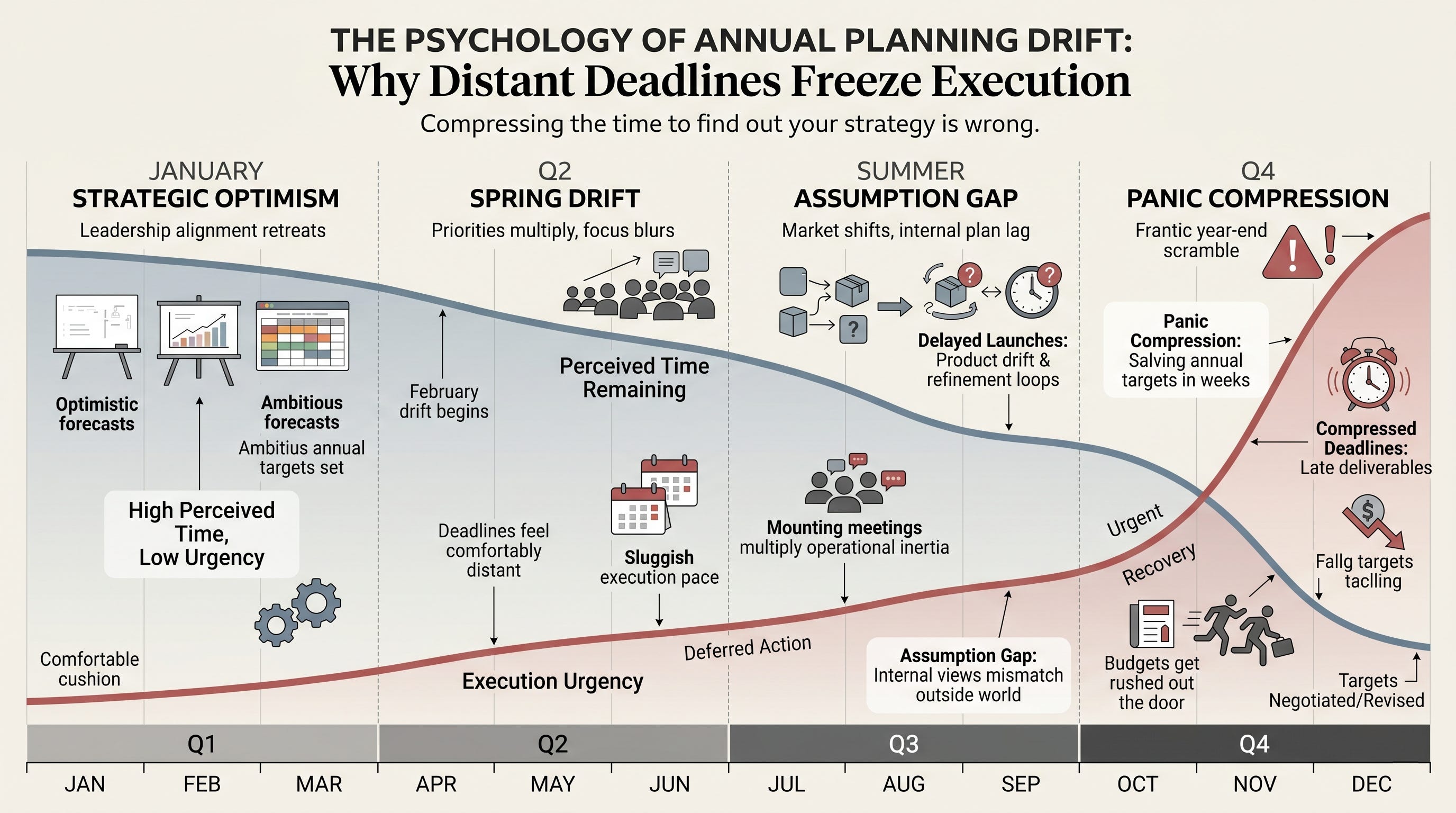
The issue is not employee laziness; it is systemic design. When companies organize work around long horizons, they unintentionally create permission structures for delay.
Short cycles change the emotional texture of work. Twelve weeks is psychologically different from twelve months. There is no comfortable amount of excess time. Problems surface faster. Accountability sharpens naturally. Priorities become brutally clear because there simply is not enough room for ten competing initiatives. That constraint is not a disadvantage; it is the point.
When a 90-day cycle is treated as a full fiscal year, learning speed shifts instantly. Procrastination becomes harder to hide because a single week represents nearly ten percent of the entire operating horizon.
How Great Leaders Inspire Action
The Speed Advantage Nobody Talks About
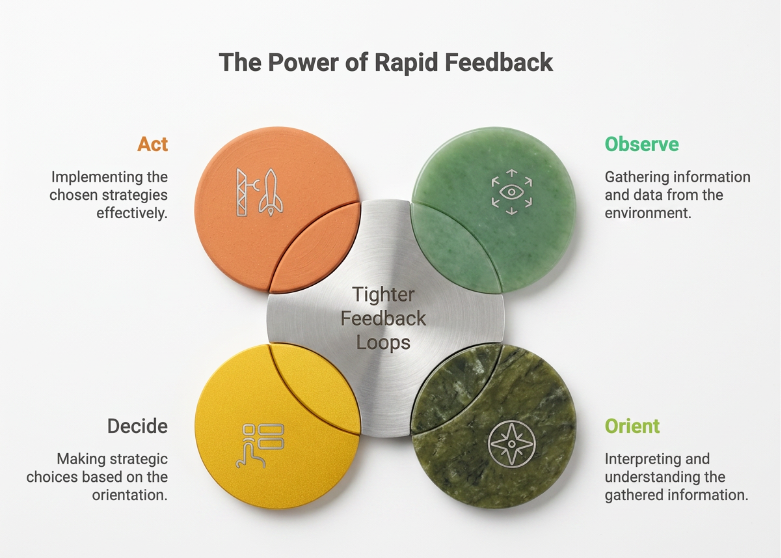
Most companies dramatically underestimate the compounding advantage of tighter feedback loops. This reality is well-documented in military and business strategy through John Boyd’s OODA loop framework: Observe, Orient, Decide, Act. The organization that cycles through this loop fastest consistently forces its competitors into a state of reactive panic.
Imagine two competitors testing the same strategic idea in the market.
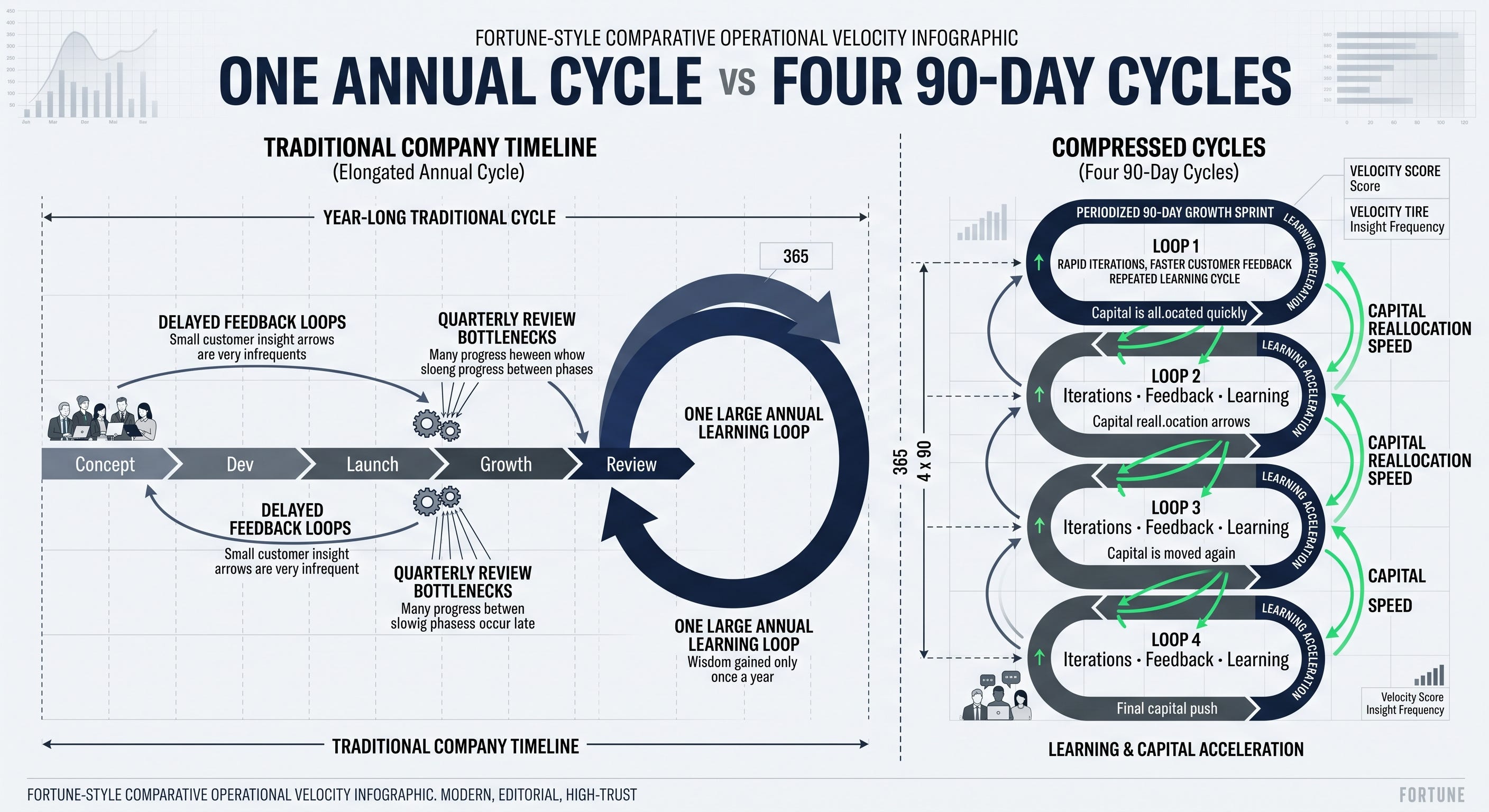
The first company operates on a traditional annual cadence. Product development takes six months. Rollout takes another quarter. Performance gets evaluated near year-end. One full year passes before leadership fully understands whether the strategy worked.
The second company runs tightly scoped, twelve-week execution cycles. The team ships a lean version quickly, gathers real market feedback, cuts what fails, doubles down on what works, and immediately begins the next iteration. In the same amount of time the first company completes one major learning cycle, the second completes four.
That difference compounds exponentially. Faster cycles produce faster learning. Faster learning improves resource allocation. Better allocation creates confidence. That confidence allows more decisive action. Over time, the organization begins behaving differently altogether. The culture becomes less political because reality arrives faster. Opinions matter less. Results matter more.
This edge is precisely what allows agile scale-ups to displace well-capitalized incumbents. Consider the historical trajectory of a company like Netflix. During its transition from DVD rentals to streaming, and later into original content production, the company avoided multi-year waterfall roadmaps. Instead, Netflix organized engineering and product deployment around continuous, short-cycle validation experiments. By testing consumer behavior in compressed windows, Netflix learned faster than legacy media companies still tied to slower development cycles.
The incumbent is not out-capitalized; it is out-learned.
Reed Hastings on Netflix’s Culture of Reinvention
Why Most Bottlenecks Are Misdiagnosed
One of the most common management mistakes is assuming slow growth automatically means people need to work harder. Usually, that diagnosis is entirely wrong. Eliyahu Goldratt’s Theory of Constraints argues that every system is governed by a primary bottleneck: one specific constraint that limits overall output more than any other variable in the chain.
Most organizations never identify it correctly. Instead, they optimize whatever looks easiest to improve. Engineering teams get pushed to ship code faster while customer onboarding remains broken. Marketing departments generate more leads while sales qualification collapses downstream. Executives blindly add headcount before fixing fundamental decision delays. The result is local optimization without systemic improvement.
Artificial intelligence is making this problem harder to ignore. Organizations are rapidly adopting advanced technology to automate the execution of routine, high-volume tasks. Content can be drafted in seconds; code can be generated instantly; data can be parsed at a massive scale. Yet, faster production alone does not solve an underlying constraint.
When technology automates raw production, the primary bottleneck inevitably moves upstream to human judgment, framing, and system design. The constraint is no longer production pace; it is critical systemic judgment.
Without this judgment, AI simply accelerates chaos. For example, a company might use automated pipelines to flood a broken sales process with thousands of low-quality leads or dump massive amounts of AI-generated code into an unclear product roadmap.
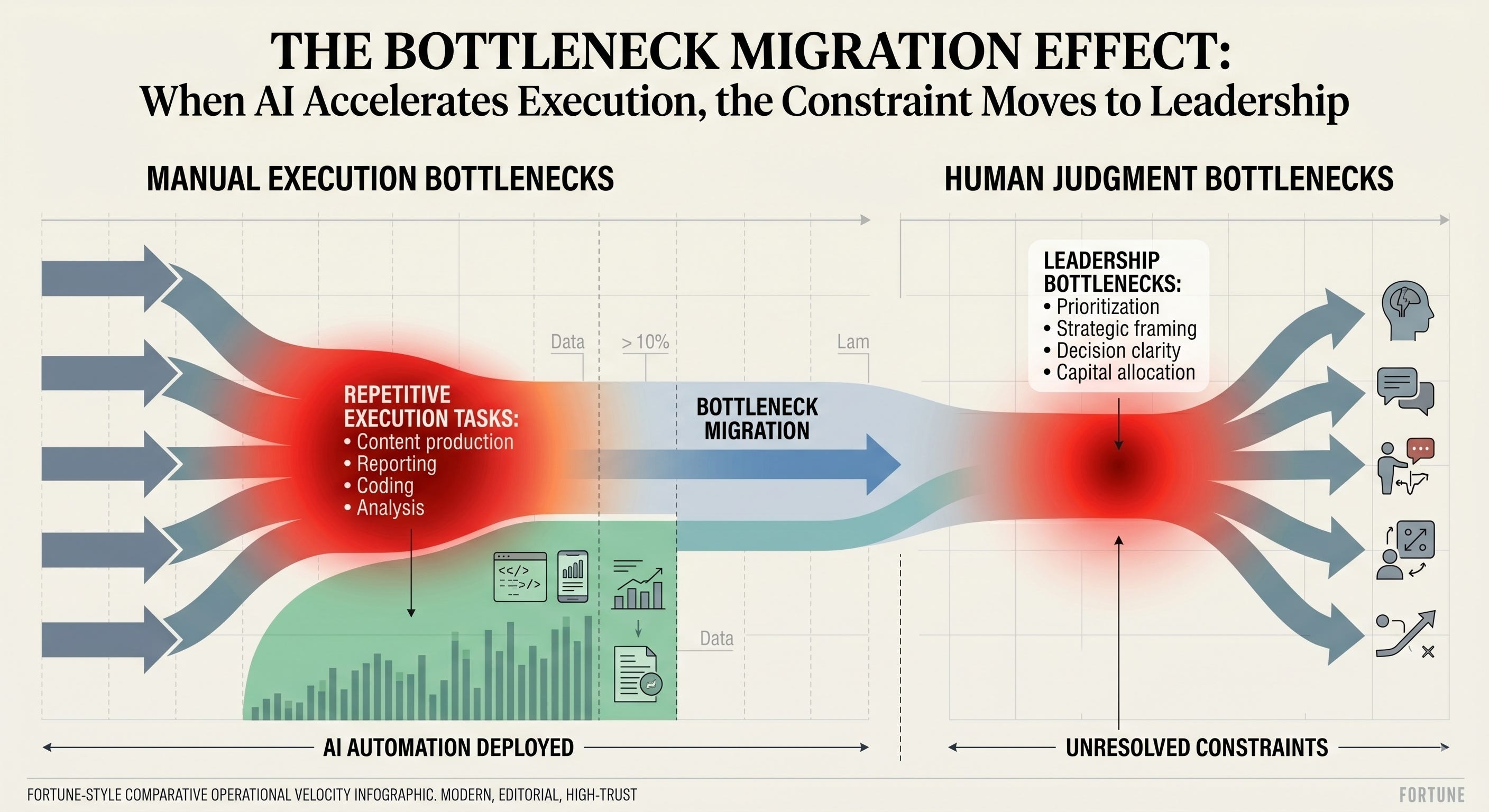
What problem are we actually solving? Which initiatives deserve capital? What should be abandoned immediately? These are not software problems; they are leadership problems. Left unaddressed, automation simply accelerates noise and scales existing chaos. A ninety-day sprint removes the luxury of ambiguity, exposing weak judgment and hidden constraints very quickly.
The Companies Winning With AI Are Redesigning Workflows First
A surprising number of companies are approaching AI entirely backward. They are layering automation onto dysfunctional workflows and expecting radical transformation. That rarely works. Technology tends to amplify existing design. If the system is chaotic, automation simply scales the chaos.
The more sophisticated operators do something entirely different: they redesign the workflow first, and only then do they automate the repeatable pieces.
Consider modern growth and customer acquisition processes. When an enterprise attempts to use advanced technology to scale visibility or optimize pipelines, the speed gain does not come from the automated tool alone. It comes from shortening the distance between market signal and strategic action.
The companies seeing meaningful gains from technology are the organizations reducing decision friction, compressing reporting lag, tightening execution visibility, and eliminating unnecessary handoffs. In practical terms, this means dashboards update automatically instead of through manual reporting rituals. Customer signals move directly into review systems, meaning teams spend less time preparing status updates and more time responding to reality.
AI Will Change Work Faster Than You Think
Brand as a Margin Defense System
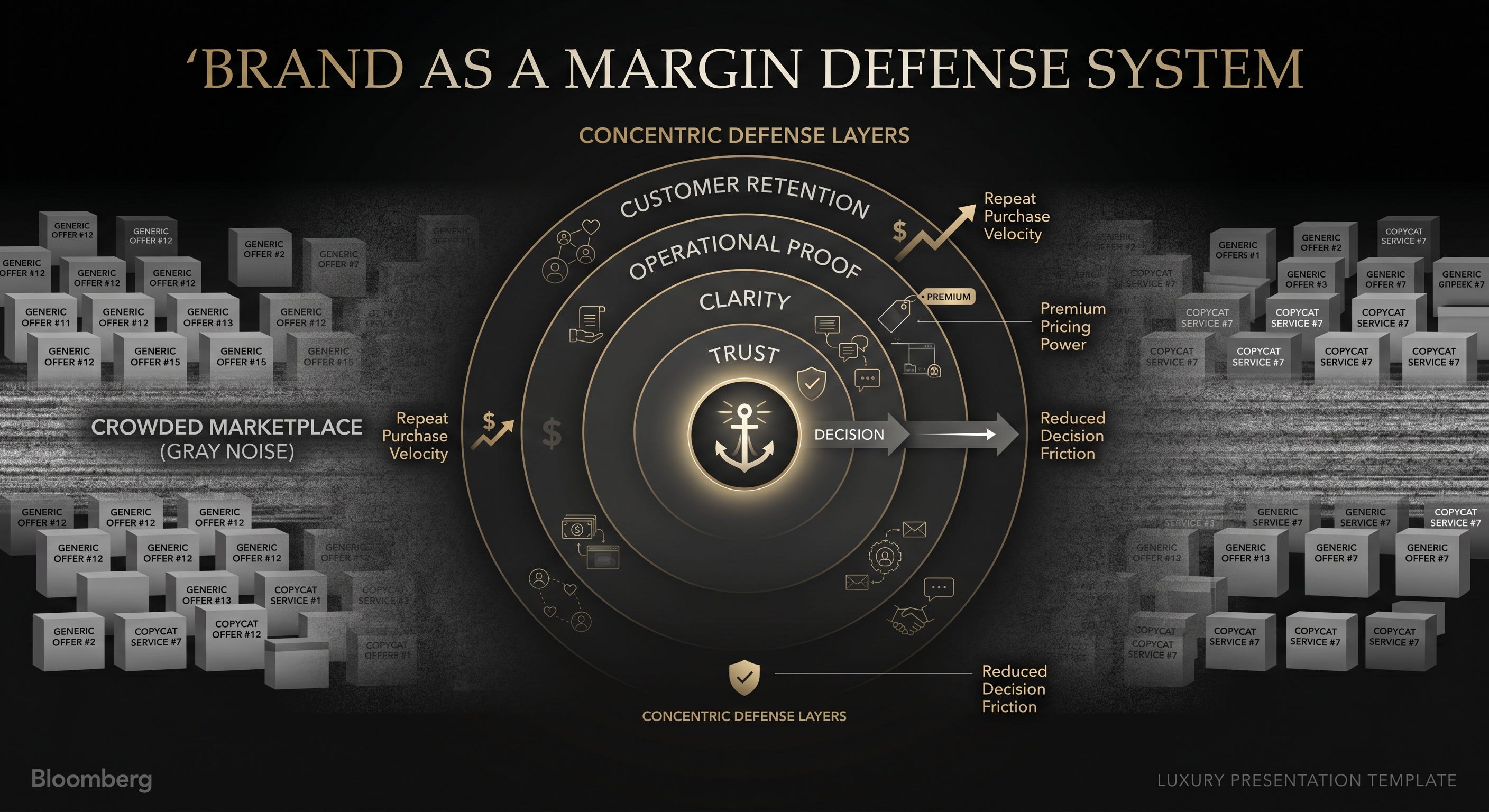
As production becomes easier and execution cycles compress, differentiation becomes harder. This is the defining paradox of the current business environment. Technology lowers the cost of producing content, launching campaigns, building interfaces, and imitating competitors. Which means production capability alone becomes less defensible over time.
When markets become saturated with lookalike offers, buyers search for shortcuts. Trust becomes the shortcut. Clarity becomes the shortcut. Reputation becomes the shortcut.
In crowded markets, brand identity is no longer an aesthetic decoration; it functions as a margin defense system. When customers cannot tell the difference between multiple similar offers, the company with the clearest story and the most consistent delivery retains ultimate pricing power.
The strongest brands are not built through clever slogans. They are built through execution consistency. A company says one thing, then repeatedly proves it. Tied to a 90-day framework, this means each short sprint must actively test whether the brand promise is being proven in the market. If your positioning claims you are the fastest solution in the space, but your client onboarding takes three weeks, your sprint priority is fixing the workflow, not buying more ads. Reputation is the lagging indicator of operational proof.
The Founder Bottleneck Nobody Wants to Admit
There is a distinct stage many growing companies eventually hit where growth mysteriously slows. Revenue plateaus. Margins tighten. Decision-making becomes sluggish. Everyone works harder, but the business somehow feels heavier.
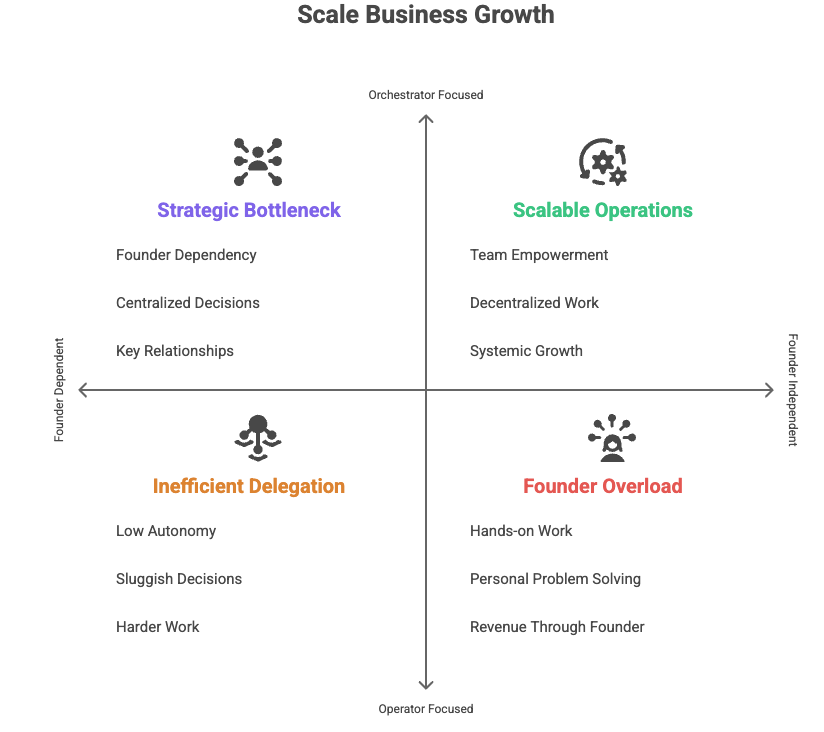
In many cases, the bottleneck is the founder. Not because the founder lacks talent, usually quite the opposite. The business grew precisely because the founder was exceptional at solving problems personally. Sales flowed through them. Relationships centered around them. Key decisions waited for them. Over time, the company becomes dependent on one human nervous system. That structure eventually breaks.
To scale further, the leader must transition from a hands-on operator to a strategic orchestrator. The businesses that successfully escape this stage do so through highly focused, 90-day redesign periods. They do not launch massive, multi-year corporate restructurings; they deploy short, aggressive execution windows aimed entirely at institutionalizing knowledge and removing founder dependency from day-to-day work.
In many mid-market turnarounds, the gains come from fixing the invisible drag: handoffs, pricing gaps, unclear ownership, and founder-dependent decisions. The gains are not realized by discovering a magic marketing channel or launching a revolutionary product line. They are achieved by applying rigorous, systematic pressure to specific drag points, fixing them at the root, and immediately scaling the newly freed capacity.
The goal is not replacing the founder; it is removing the founder as the primary routing mechanism for every important decision. That distinction changes everything.
The Operating Rhythm of High-Velocity Teams
A true ninety-day execution system is not just a shorter calendar. It is a completely different behavioral architecture built around a single foundational benchmark.
The 90-Day Rule
If an initiative cannot be tested, measured, or killed within twelve weeks, it is not an execution priority.
To implement this rule successfully, you must follow three absolute parameters.
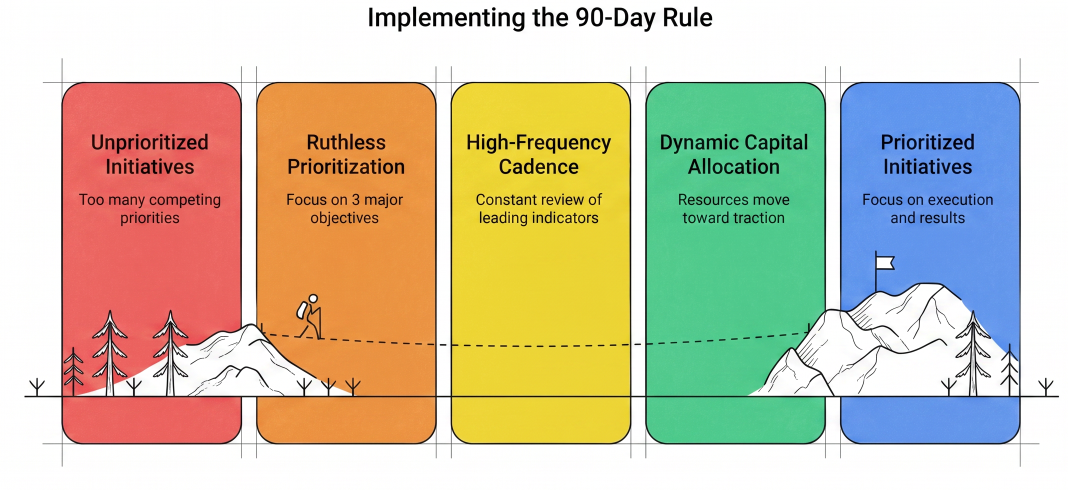
Parameter 1: Ruthless Prioritization
Most organizations attempt too many strategic initiatives simultaneously, confusing activity with progress. Once teams carry eight competing priorities, execution quality collapses under the weight of cognitive fatigue. High-performing operators narrow focus aggressively. Three major objectives are the practical upper limit for a 12-week cycle.
Parameter 2: High-Frequency Cadence
Fast organizations review leading performance indicators constantly, not lagging financial metrics after the damage is already done.
Parameter 3: Dynamic Capital Allocation
Resources move toward immediate traction. Weak initiatives lose oxygen quickly; strong initiatives absorb additional support rapidly.
Execution Is Becoming the Final Moat
For years, abstract strategy occupied the center of management thinking. Today, decision speed increasingly determines market survival. The market punishes hesitation faster than ever before. Ideas decay quickly once exposed to competition. Operational lag compounds silently until entire companies wake up realizing they are optimizing systems built for a slower era.
This does not mean annual planning disappears entirely. Large organizations still need long-range direction, capital forecasting, and governance requirements. But the companies adapting best to modern volatility increasingly separate their strategic horizon from their execution cadence.
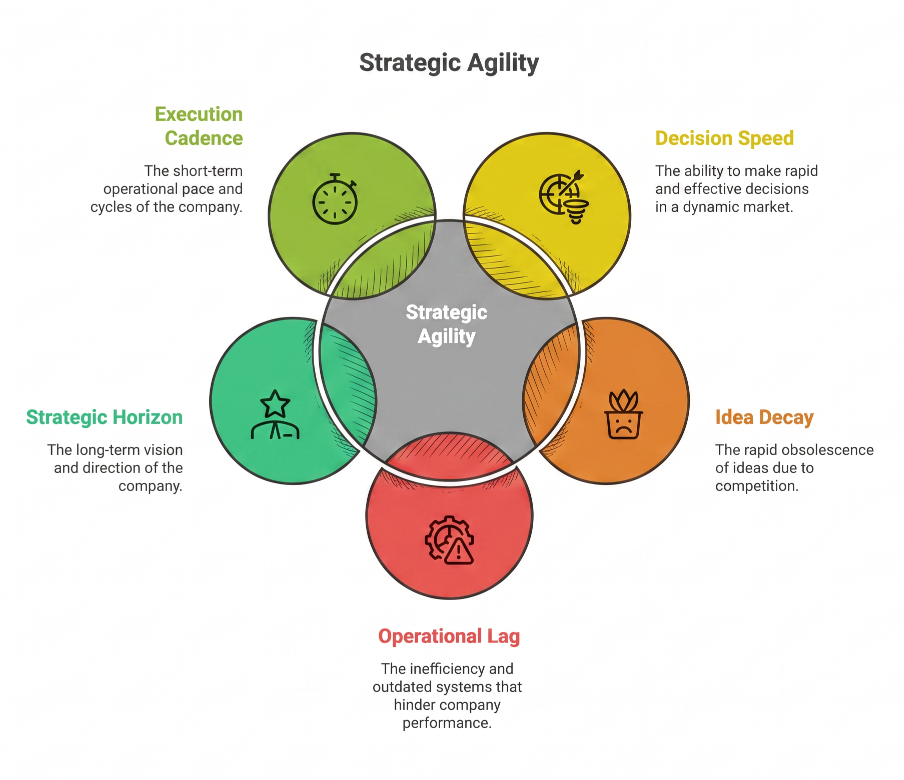
They may think in years, but they operate in weeks.
That distinction matters. The future belongs to organizations capable of learning faster than competitors, reallocating resources faster than competitors, and confronting uncomfortable truths faster than competitors. A ninety-day cycle is not magic; it simply removes the dangerous illusion that there is still plenty of time.
When next January arrives, the whiteboards will fill up once again. But while your competitors spend the first quarter drifting through long timelines and comfortable assumptions, the high-velocity enterprise is already deep into its first execution cycle. They know that the calendar year is a fiction and that the race is won twelve weeks at a time.
This is a powerful mindset because too many people stay emotionally attached to ideas, systems, partnerships, products, or strategies long after the market already gave them the answer.
In product development and direct response marketing, I learned early that speed matters, but honest evaluation matters even more.
Sometimes the smartest thing you can do is shut something down quickly before it drains more time, energy, money, and focus from the next opportunity.
People think successful entrepreneurs fall in love with their ideas.
The best ones fall in love with solving problems.
I have pivoted products, changed messaging, rebuilt campaigns, redesigned packaging, changed sourcing, changed audiences, and sometimes completely walked away from concepts that no longer made sense.
That is not failure.
That is discipline.
A “kill switch” is not negative.
It is operational intelligence.