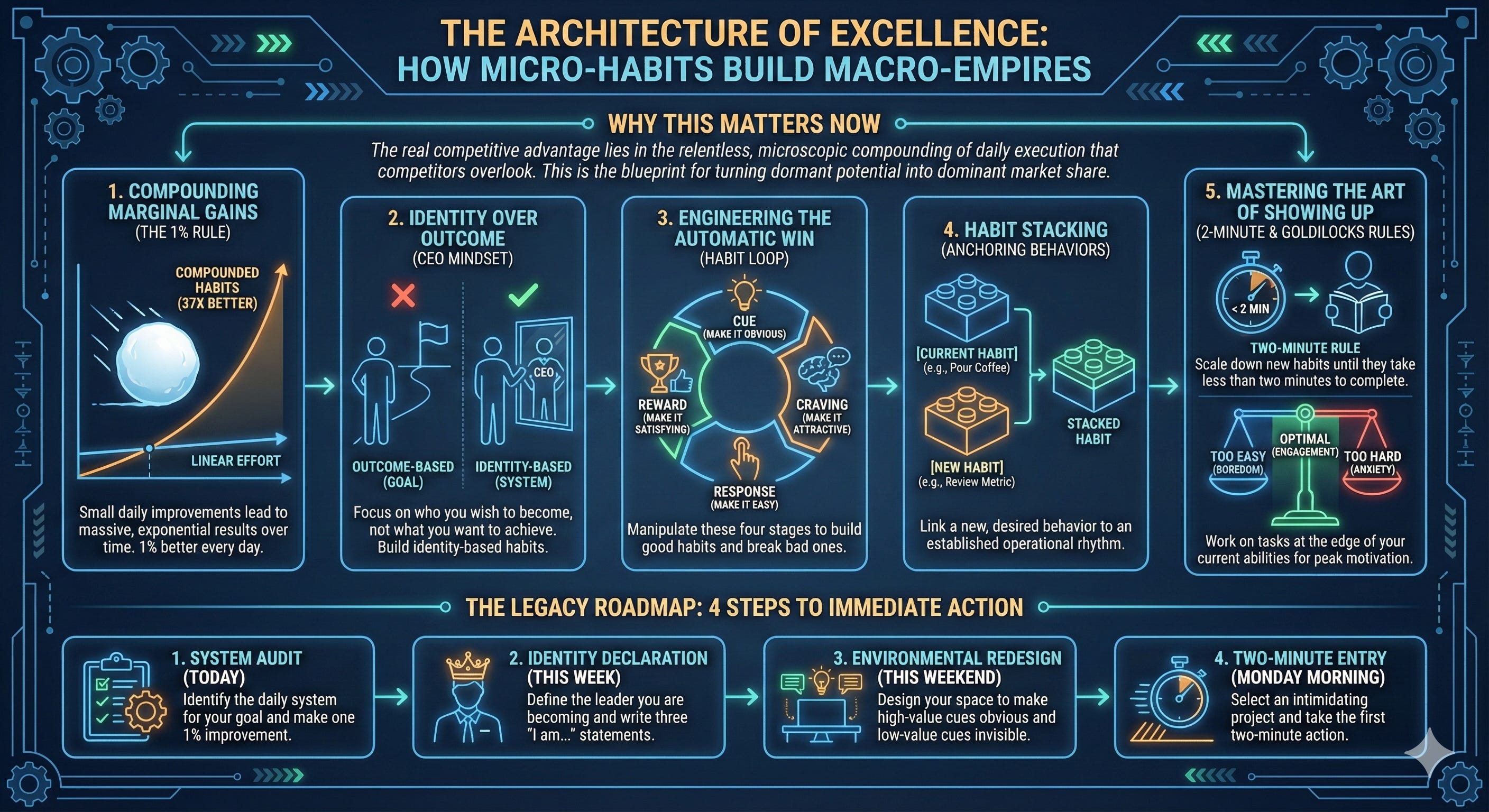
The Architecture of Excellence
How Micro-Habits Build Macro-Empires

Why This Matters Now
The landscape shifts too fast for reliance on massive, infrequent pivots; unsustainable effort leads to burnout. The real competitive advantage lies in the relentless, microscopic compounding of daily execution that competitors overlook. This is the blueprint for turning dormant potential into dominant market share.
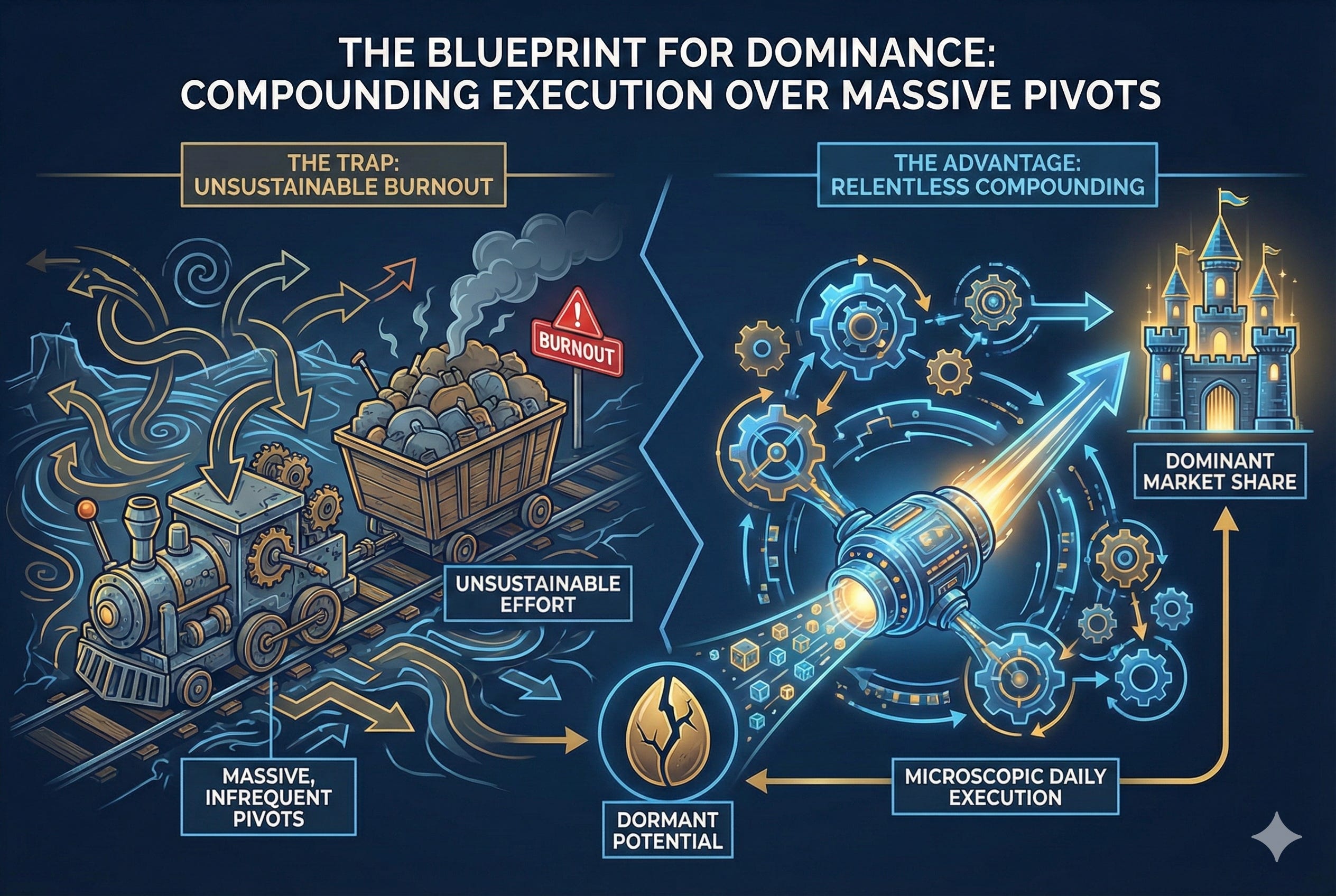
In the high-stakes arena of entrepreneurship, the seduction of the “quantum leap” is powerful. We celebrate the billion-dollar valuation, the market-disrupting product launch, and the overnight success story. Yet, behind every headline-grabbing triumph from leaders like Whitney Wolfe Herd or Elon Musk lies a foundation not of radical, sudden change, but of relentless, nearly invisible consistency.
Building a legacy company isn’t about willpower or a singular stroke of genius. It is an engineering challenge. You must design the architecture of your daily operations so that success becomes the default outcome. Drawing on the principles of behavioral design, we can decode how top-tier leaders automate progress and construct the systems that make high performance inevitable.
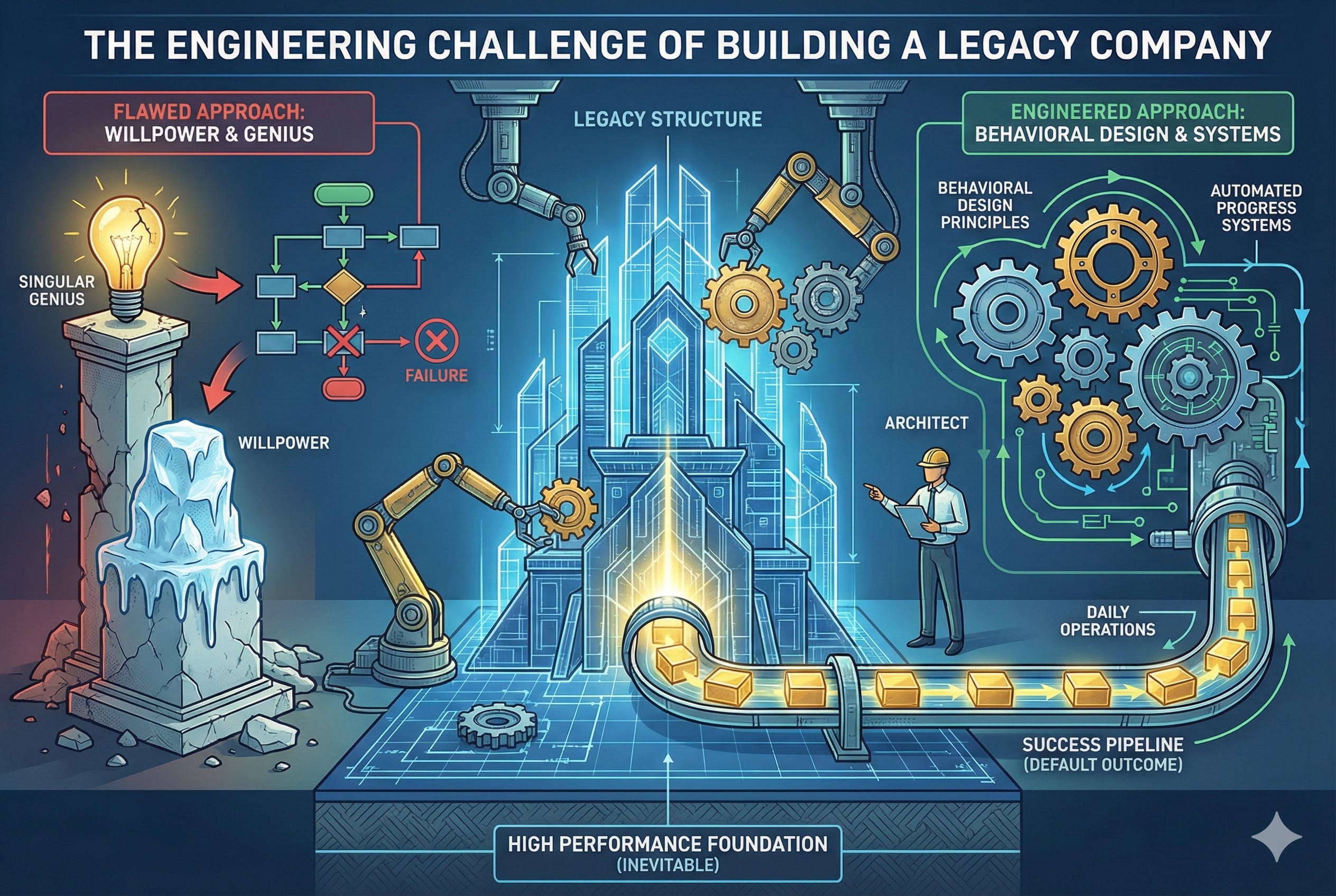
It is time to stop relying on motivation and start relying on mechanics.
The Mathematics of Dominance: Compounding Marginal Gains
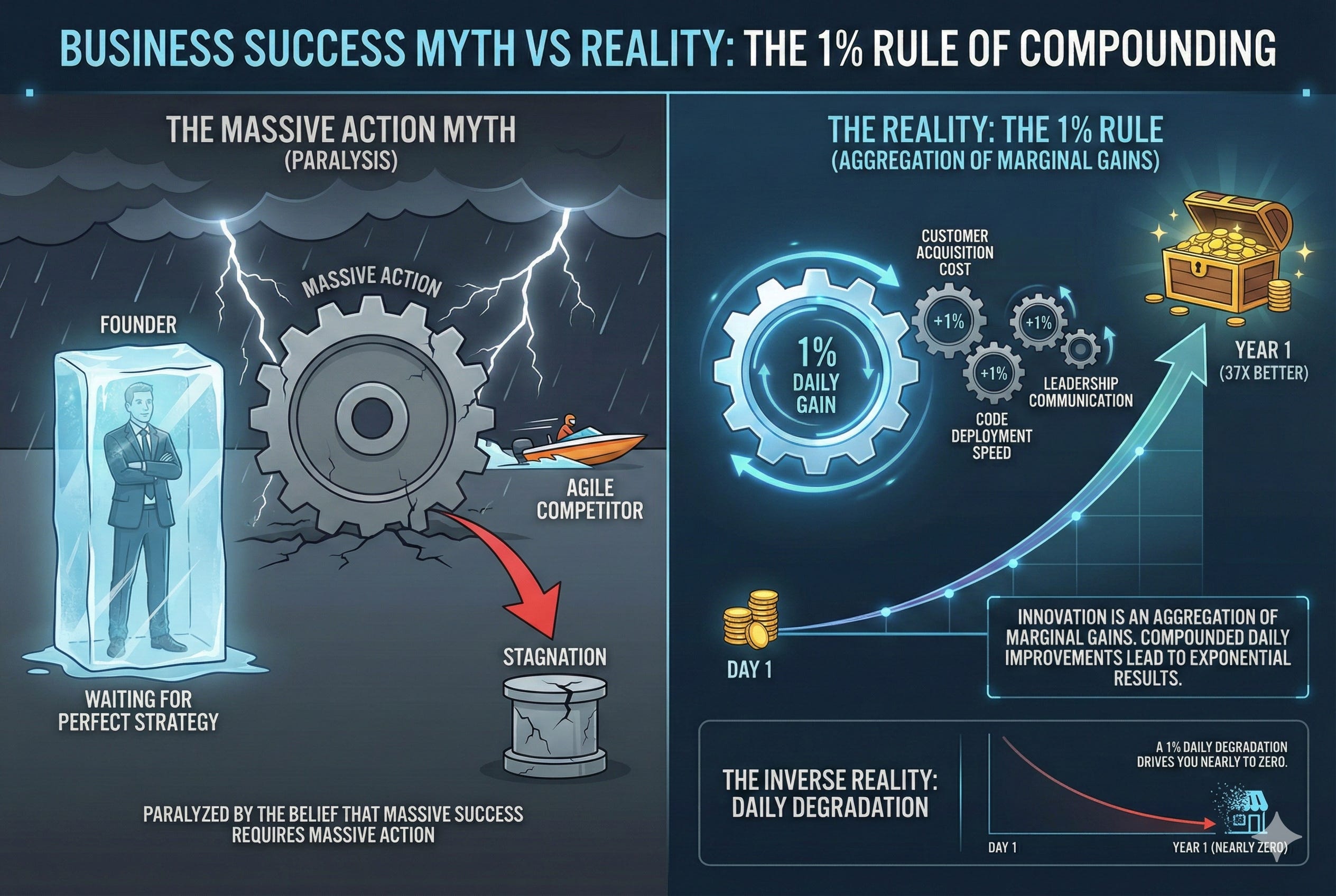
The most perilous myth in business is that massive success requires massive action. This belief paralyzes founders who wait for the perfect strategy while their agile competitors overtake them. The reality is grounded in the “1% Rule.”
Innovation is rarely a lightning strike; it is an aggregation of marginal gains. Improving your customer acquisition cost, your code deployment speed, or your leadership communication by just 1% daily seems negligible in the moment. Yet, compounded over a year, you end up 37 times better. The inverse is also true: a 1% daily degradation drives you nearly to zero.
Global powerhouses like Toyota built their reputations on Kaizen—the philosophy of continuous improvement. They didn’t aim to build the perfect car instantly; they aimed to improve thousands of tiny processes daily.
However, entrepreneurs must navigate the “Plateau of Latent Potential.” When implementing new protocols, results often lag behind efforts. You are working hard but seeing little change in revenue or efficiency. This is the “Valley of Disappointment” where most founders quit. You must persist through this valley. You are not wasting time; you are storing potential energy that will eventually erupt into exponential growth.
Watch how Sir Dave Brailsford applied the “marginal gains” doctrine to transform British Cycling from mediocrity to global dominance in just a few years: [LINK: Watch the marginal gains philosophy in action.]
Identity over Outcome: The CEO Mindset Shift
Goals are necessary for direction, but systems are essential for progress. If you are a founder focused solely on the goal—the exit strategy, the IPO—you are fixated on the scoreboard rather than the game.
Winners and losers in any market share the same goals. Every startup wants to be a unicorn. The difference is the system of daily inputs they utilize. Fix the inputs, and the outputs will resolve themselves.
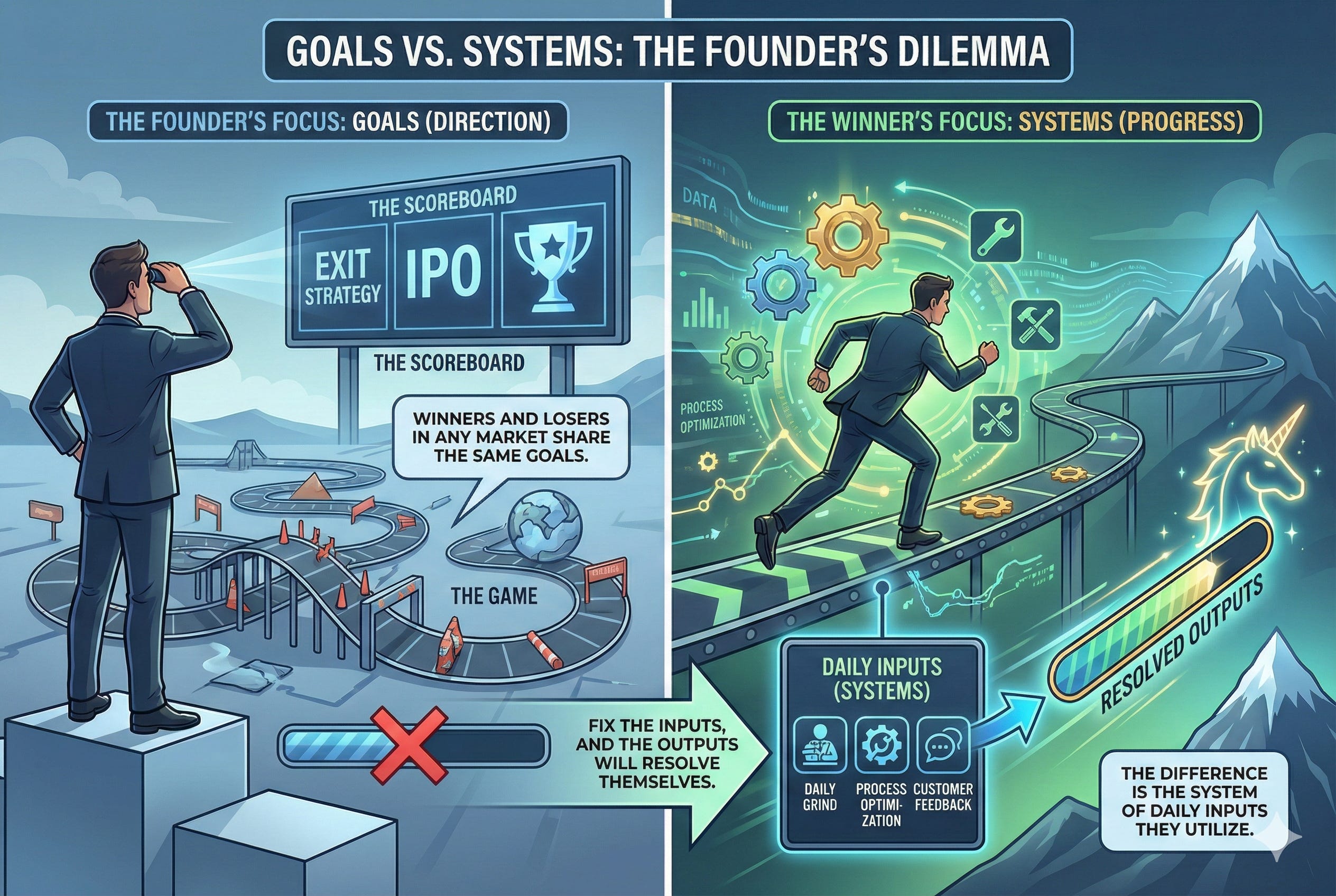
This requires a fundamental shift from outcome-based habits to identity-based habits. Instead of setting a goal like “I want to build a $10 million company,” adopt the identity: “I am the type of leader who runs a disciplined, data-driven organization.”
Sara Blakely didn’t just want to sell footless pantyhose; she embraced the identity of an inventor and a problem-solver long before Spanx was a household name. Every action you take is a vote for the type of leader you are becoming. When you act like the CEO of a major corporation today, you begin to construct that reality.
Engineering the Automatic Win
Discipline is not a character trait to be cultivated; it is a product of environmental design. If you rely on willpower to make the right strategic decisions or do deep work every day, you will eventually fatigue and fail. The goal is to make the execution of your business strategy automatic by manipulating the “Habit Loop”: Cue, Craving, Response, and Reward.
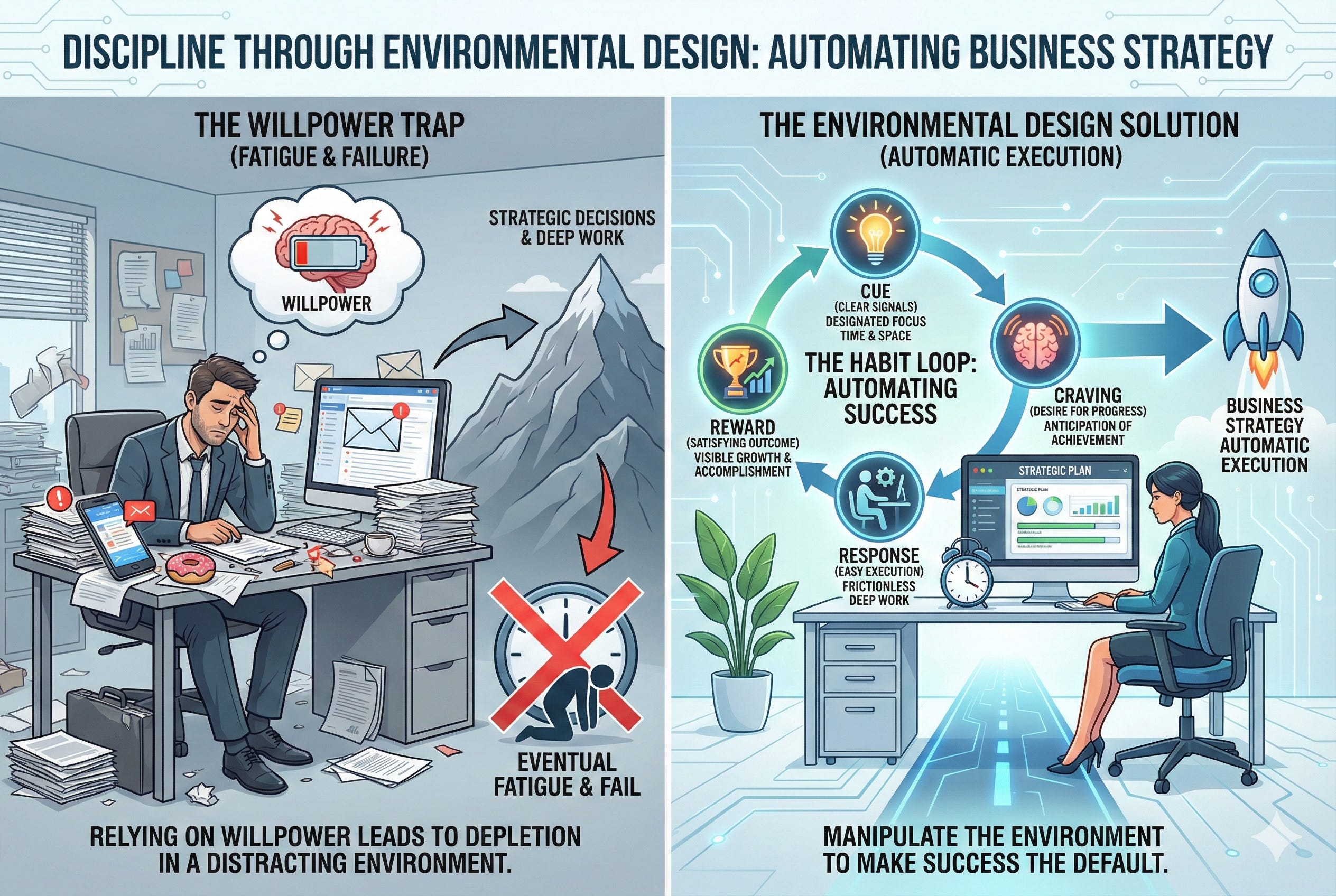
Start by auditing your physical and digital environments. Are the cues for productive work obvious, and the cues for distraction invisible? Steve Jobs was notorious for obsessing over the Apple headquarters’ design to force collision and collaboration among different departments; he didn’t hope for collaboration, he engineered the environment to make it inevitable.
To embed new critical behaviors, utilize “Habit Stacking.” Anchor a new, desired behavior to an established operational rhythm.
The Sales Stack: “After I close my laptop on the final zoom call of the day [Current Habit], I will immediately send three personalized follow-up videos to prospects [New Habit].”
The Leadership Stack: “After I pour my morning coffee [Current Habit], I will review the single most important metric for the day [New Habit].”
By linking these actions, you remove the decision-making friction. The existing habit becomes the automatic trigger for the new growth behavior.
Mastering the Art of Showing Up
The greatest barrier to high performance is often inertia. The friction of starting a complex task—revamping the marketing strategy or auditing finances—can lead to procrastination.
Combat this with the “Two-Minute Rule.” When establishing a new operational habit, scale it down until it takes less than two minutes to complete. Do not aim to “optimize the entire supply chain”; aim to “open the logistics spreadsheet.” You cannot optimize a habit that does not exist. You must master the art of showing up before you can master the art of execution.
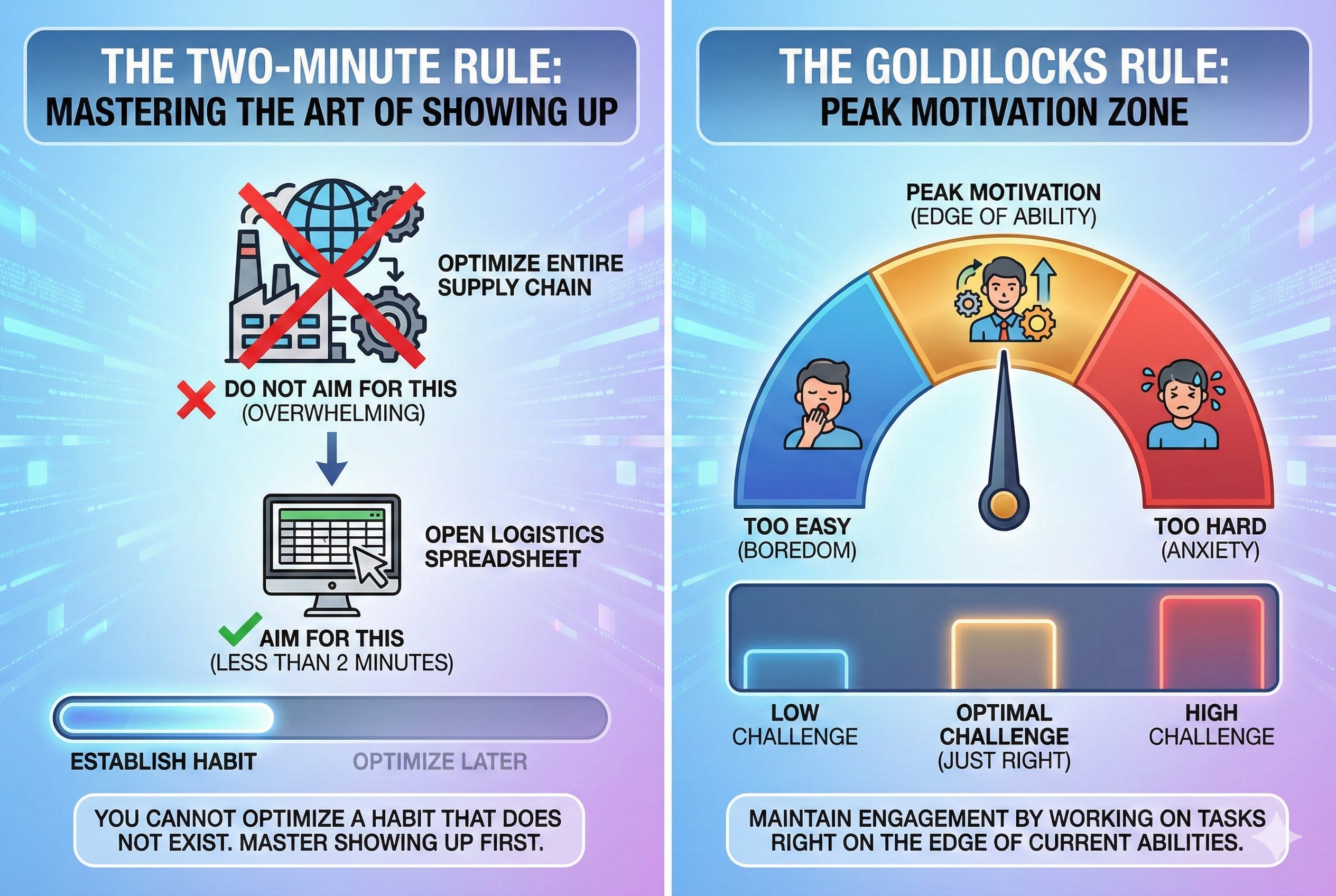
Simultaneously, apply the “Goldilocks Rule” to maintain engagement for yourself and your team. Humans experience peak motivation when working on tasks right on the edge of their current abilities. If a challenge is too easy, you get boredom; too hard, you get anxiety. Great leaders, like Mark Cuban, constantly push themselves into that zone of manageable difficulty, ensuring continuous growth without burnout.
Conversely, to eliminate destructive business habits—like checking email every ten minutes or micromanaging—you must invert the laws of behavior change. Make the bad habit invisible, unattractive, difficult, and unsatisfying. If you spend too much time on low-ROI tasks, add friction: require a written justification before engaging in them.
Watch Shark Tank investor Mark Cuban discuss the discipline needed to “show up” and outwork the competition: [LINK: Watch Mark Cuban on the grit required to start.]
The Legacy Roadmap: 4 Steps to Immediate Action
The empires of tomorrow are being built today through the microscopic actions of determined leaders. Stop waiting for a breakthrough and start engineering one. Here is your immediate execution plan:
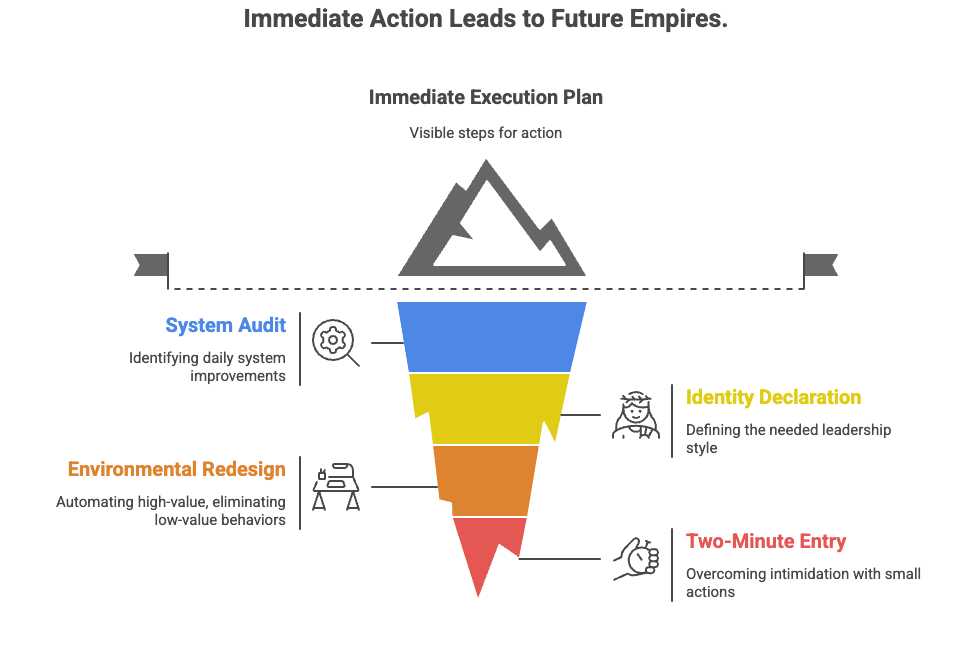
1. The System Audit (Today) Identify your primary business goal for the quarter. Now, ignore the goal entirely. Write down the daily system (the inputs) required to achieve it. What is the 1% improvement you can make to that system today?
2. The Identity Declaration (This Week) Define the leader your company needs at its next stage of growth. Write down three statements starting with “I am the type of leader who...” (e.g., “Who prioritizes deep work over urgent shallow tasks”). Post this where you see it daily.
3. The Environmental Redesign (This Weekend) Choose one high-value behavior you want to automate (e.g., strategic planning) and one low-value behavior you want to eliminate (e.g., reactive email checking). Redesign your physical workspace to make the high-value cue undeniable and hide the cue for the low-value behavior entirely.
4. The Two-Minute Entry (Monday Morning) Select the most intimidating project on your slate. Shrink the entry requirement down to a two-minute action. Do not plan the project; just open the file and write the first sentence. Master showing up.