

The Counterfeit Candidate
Why Your Old Hiring Playbook Is Destroying Your Business—And The Radical New Rules For The AI Age

Why This Matters Now - The resume is dead; long live the audit. In an era where algorithms can fake competence in seconds, the only currency that matters is proven, pressure-tested reality.
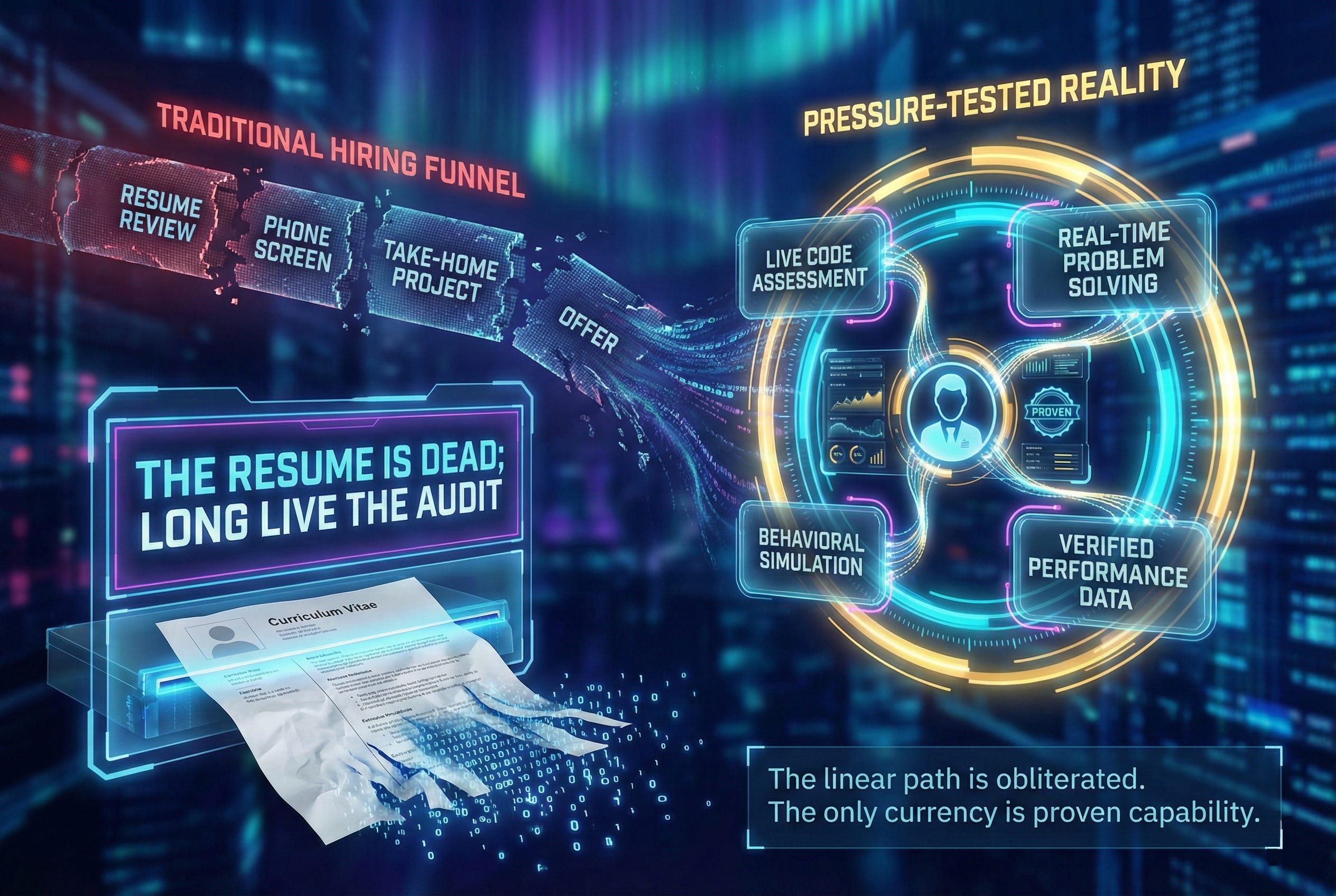
The traditional hiring funnel is broken. For decades, the process was predictable: review the resume, conduct a phone screen, assign a take-home project, and make an offer. That linear path relied on a singular assumption: that the work presented by the candidate was a proxy for their actual capability.
That assumption has been obliterated.
We have entered the age of the “Artificial Counterfeit.” With the widespread adoption of Large Language Models (LLMs) like ChatGPT, Gemini, and Perplexity, candidates can now synthesize “expert” answers, generate code, and craft persuasive cover letters in seconds. A recent survey by ResumeBuilder.com revealed that nearly 46% of job seekers are using AI to build their resumes and cover letters. While efficiency is a virtue, this trend has birthed a crisis of verification. You are no longer just interviewing a person; you are interviewing a person augmented by a supercomputer.
For the ambitious leader, this presents a terrifying risk. The cost of a bad hire is not just a line item; it is a cancer. The U.S. Department of Labor estimates the price of a bad hire at up to 30% of the employee’s first-year earnings. In a high-growth startup, where velocity is everything, a “fake expert” doesn’t just cost money; they cost time, momentum, and morale.
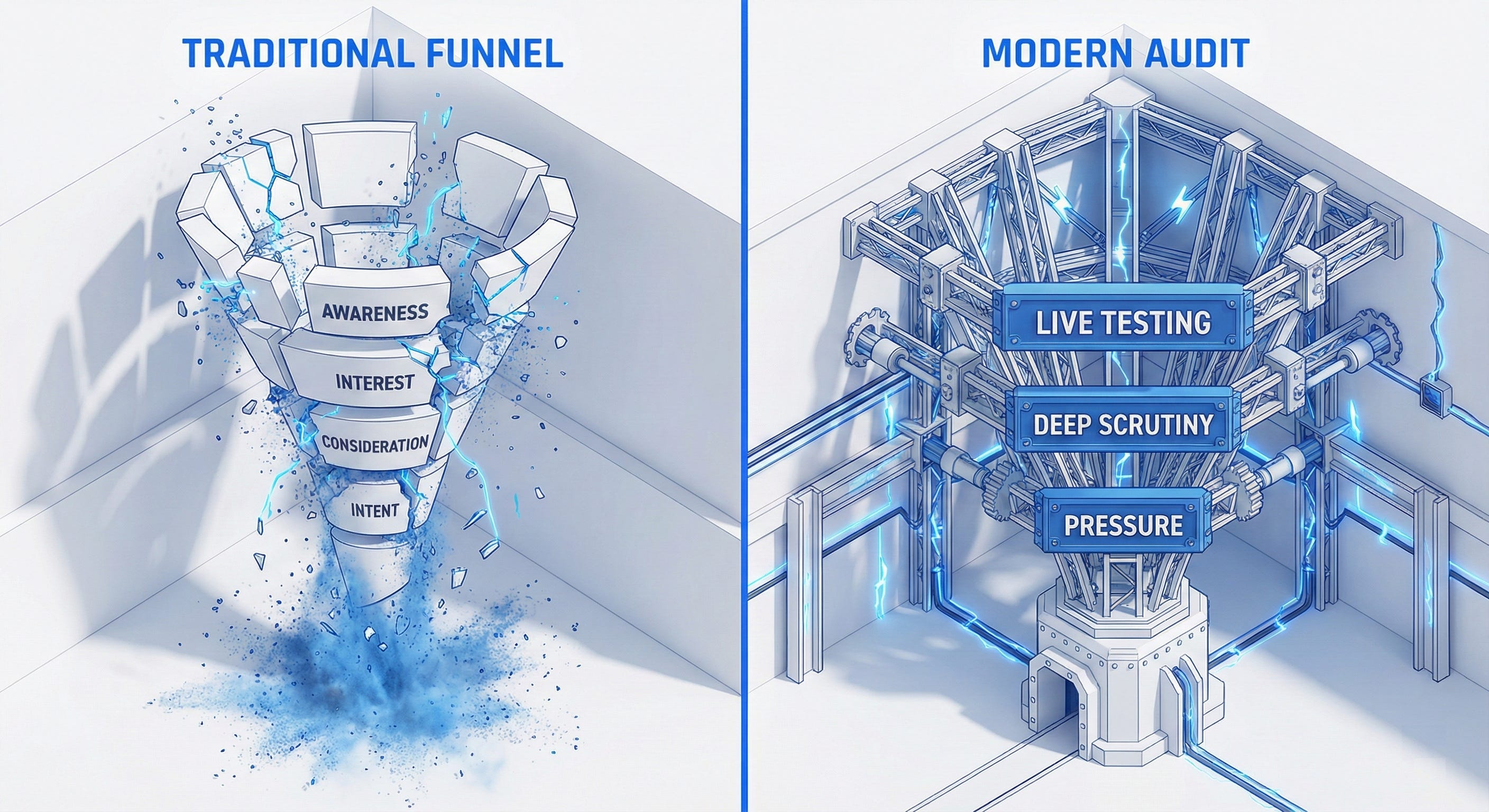
The solution is not to retreat but to radically pivot. We must move from reviewing history to auditing reality. The following strategy is not theoretical. It is synthesized from the battle-hardened protocols of high-growth firms that processed over 27,000 resumes and conducted 4,000 interviews in a single year to make just 160 hires. It combines the forensic scrutiny of financial auditors with the pressure-testing of elite sports teams.
If you want to build a legacy, you must stop hiring for the past and start auditing for the future.
Phase 1: The Analog Pivot
Kill the Remote Assignment
The remote “take-home” assignment—once the gold standard for testing competence—is now obsolete. If you ask a candidate to “write a marketing strategy for Q4” or “code a Python script for data scraping” and give them 48 hours, you are not testing their skill; you are testing their prompt engineering.
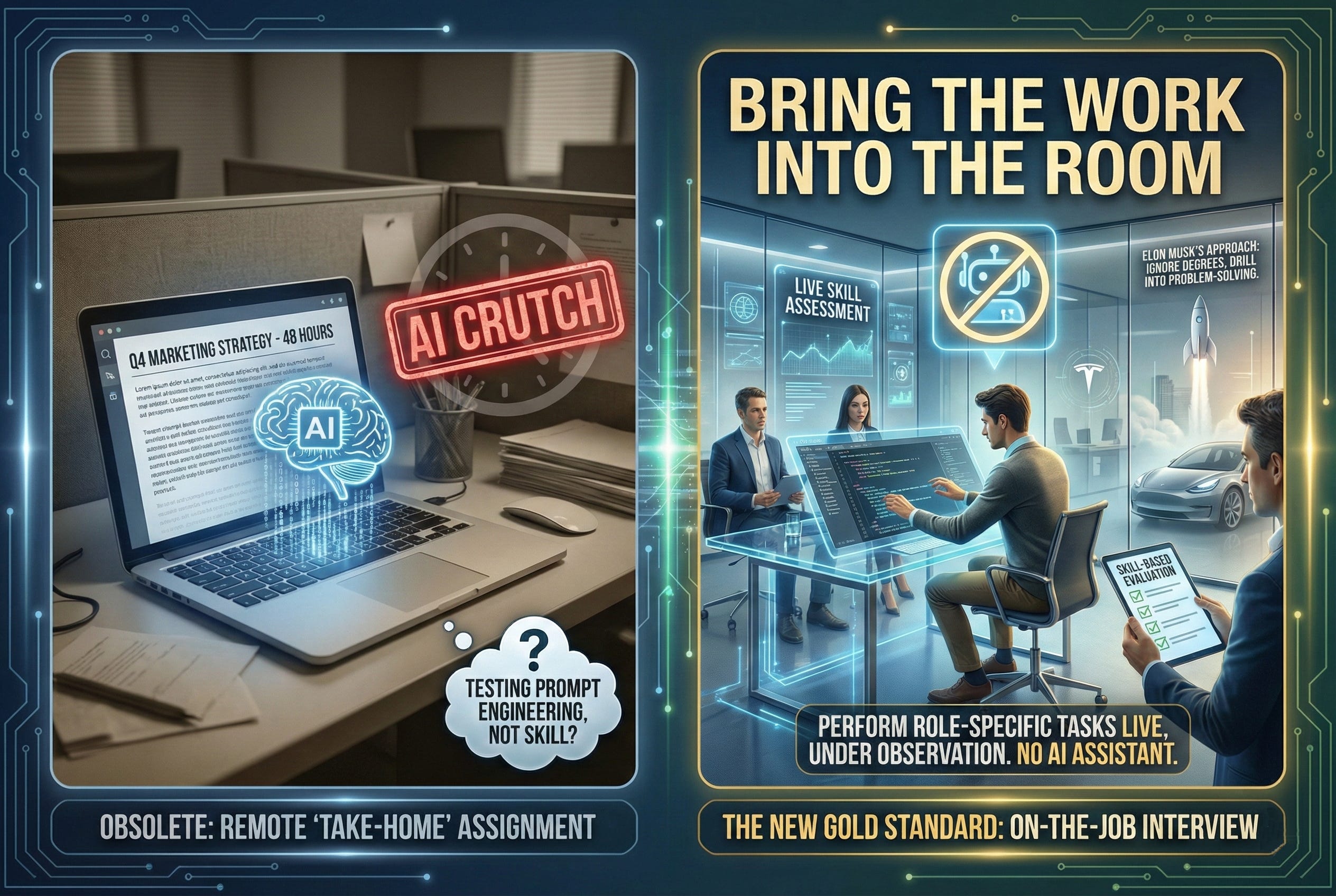
You must bring the work into the room.
Elon Musk has long championed this approach at Tesla and SpaceX. He famously ignores degrees, stating, “There’s no need to even have a college degree at all, or even high school.” Instead, he drills down into the specific problems a candidate has solved. But in the AI age, we must go a step further: The On-the-Job Interview.
This protocol demands that candidates perform role-specific tasks live, under observation, without the crutch of an AI assistant.
The Tech Audit: Consider a recent case where a candidate for a YouTube marketing role claimed deep expertise in analytics. Under the old model, his polished resume and articulate answers would have secured him the job. Under the new protocol, he was handed a phone with the company’s Creator Studio open and asked to locate a specific data point. He froze. The task took five seconds for a pro; he couldn’t do it. He later admitted he would have “learned it on ChatGPT” if hired. That five-second test saved the company a six-figure salary and months of stagnation.
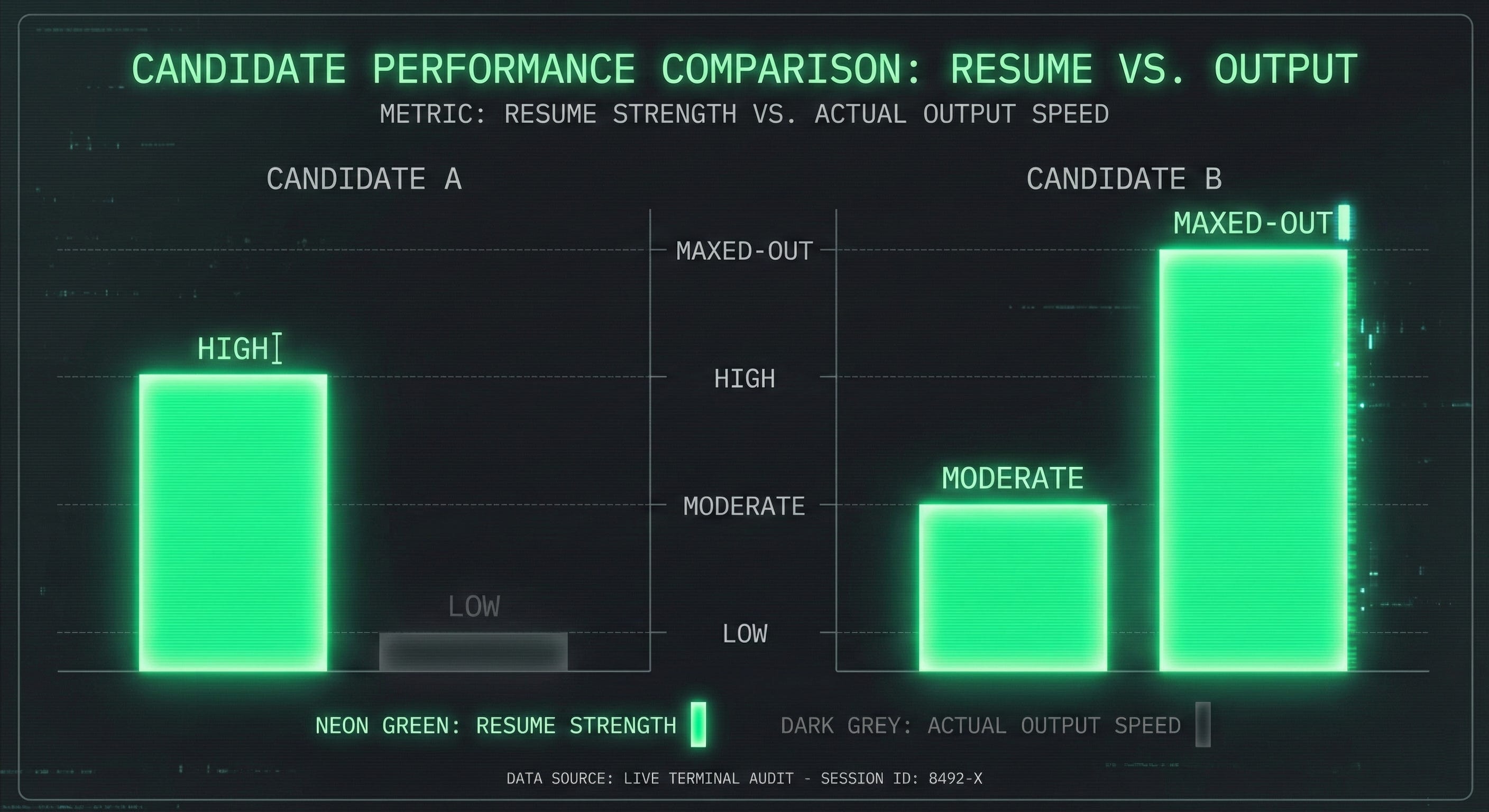
The Engineering Sprint: When evaluating two engineers, discard the pedigree. In a recent head-to-head, a candidate with a “fat” resume and high salary demands took 20 minutes to complete a simple coding task, citing “rustiness.” A second candidate, with less on-paper experience, finished it in two minutes. The lesson? Speed and fluency are the only metrics that matter. Rust is expensive.
The Service Test: This applies to every tier of the organization. If you are hiring hospitality staff, do not ask them if they can make a drink. Put a glass in front of them and say, “Make me an Old Fashioned.” If you are hiring for sales, do not ask for their philosophy on cold calling. Hand them a phone, give them a scenario, and say, “Sell me.”
Phase 2: The Logic Stress Test
Face-to-Face Case Studies
Once technical competence is verified, you must test critical thinking. This cannot be done over Zoom, where a candidate can have notes, browser tabs, or even another person feeding them answers. It must be face-to-face, phone set aside, eye-to-eye.
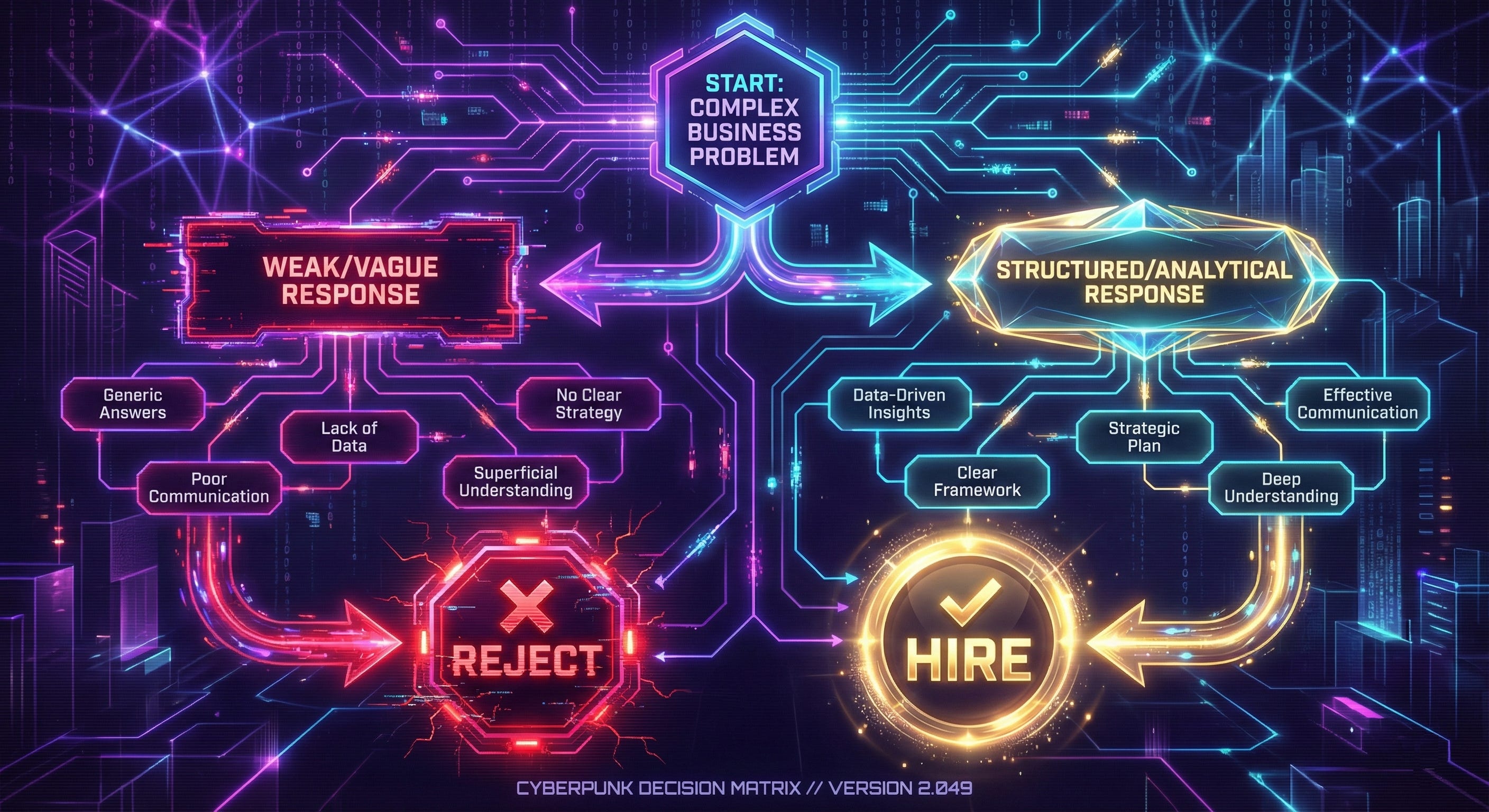
This is the Logic Stress Test. The goal is not to hear the “right” answer, but to watch the process of thinking.
Kevin O’Leary of Shark Tank is a master of this. He doesn’t care about the narrative; he cares about the numbers and the logic behind them. He often asks entrepreneurs to explain their customer acquisition cost (CAC) relative to lifetime value (LTV) on the spot. If they stumble, they are out. He is testing their grasp of the fundamental physics of their business.
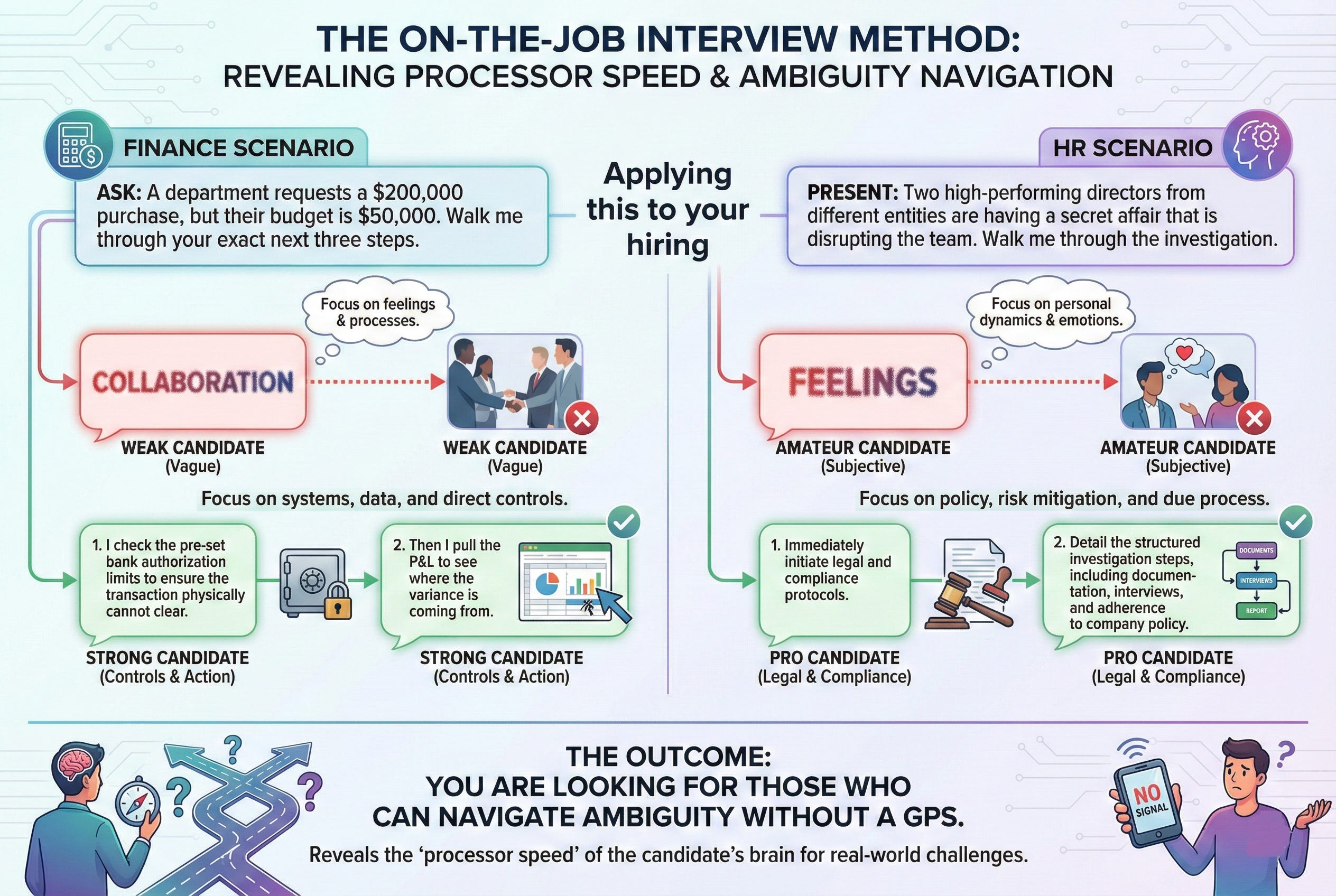
Apply this to your hiring:
For Finance: Ask, “A department requests a $200,000 purchase, but their budget is $50,000. Walk me through your exact next three steps.” A weak candidate will talk about “collaboration.” A strong candidate will talk about controls: “I check the pre-set bank authorization limits to ensure the transaction physically cannot clear, then I pull the P&L to see where the variance is coming from.”
For HR: Present a toxic scenario. “Two high-performing directors from different entities are having a secret affair that is disrupting the team. Walk me through the investigation.” A pro will detail the legal and compliance steps immediately. An amateur will talk about “feelings.”
This method reveals the “processor speed” of the candidate’s brain. You are looking for those who can navigate ambiguity without a GPS.
Watch Kevin O’Leary explain why knowing your numbers is the ultimate test of leadership.
Phase 3: Forensic Talent Accounting
The Art of the Deep Dive
In the same way a forensic accountant looks for irregularities in a ledger, you must look for irregularities in a human life. The resume is a marketing document; your job is to find the balance sheet.
Interrogate the Gaps: A gap in a resume is not a disqualifier; the explanation is the test. If a candidate says, “I took time off to travel,” drill down. How did they fund it? What was the itinerary? If they say, “I was let go because the job wasn’t a fit,” that is a signal of integrity. Radical honesty about failure is a leading indicator of future success.

Analyze the Frequency: Beware the “Job Hopper.” A resume showing eight jobs in eight years is a siren. It suggests a pattern of quitting when friction occurs. Business is hard; you need people who have stayed long enough to fix the problems they created.
The “Lazy” Reference Check: Most reference checks are performative waste. To get the truth, you must disarm the other party. Call the former boss, but frame the conversation as executive-to-executive. “Look, we both know how hard hiring is. I need your help.” Then, drop the nuclear question: “Would you rehire this person today?” Any pause, any hesitation, any answer other than an enthusiastic “Yes” is a “No.”
Huda Kattan, founder of Huda Beauty, built a billion-dollar empire by hiring people who—like her—had something to prove. She often speaks about the power of “not fitting in” and using rejection as fuel. When vetting talent, look for the candidate who has faced a crisis and navigated it with grit rather than gloss. Kattan values the ability to pivot and find validation from within, rather than relying on external approval or traditional paths.
Watch Huda Kattan discuss how to guide yourself and your business through a crisis.
Phase 4: Selling the Nightmare
The Founder vs. Corporate Divide
There is a “night and day” difference between a corporate executive and a startup operator. A corporate CEO manages a machine; a Founder is the machine. Their life savings, reputation, and identity are leveraged against the company’s survival.
When hiring for a founder-led company, you must screen for “Founders’ Mentality.” Ask explicitly: “How many founders have you worked for?” If the answer is zero, you have a massive education gap to bridge.
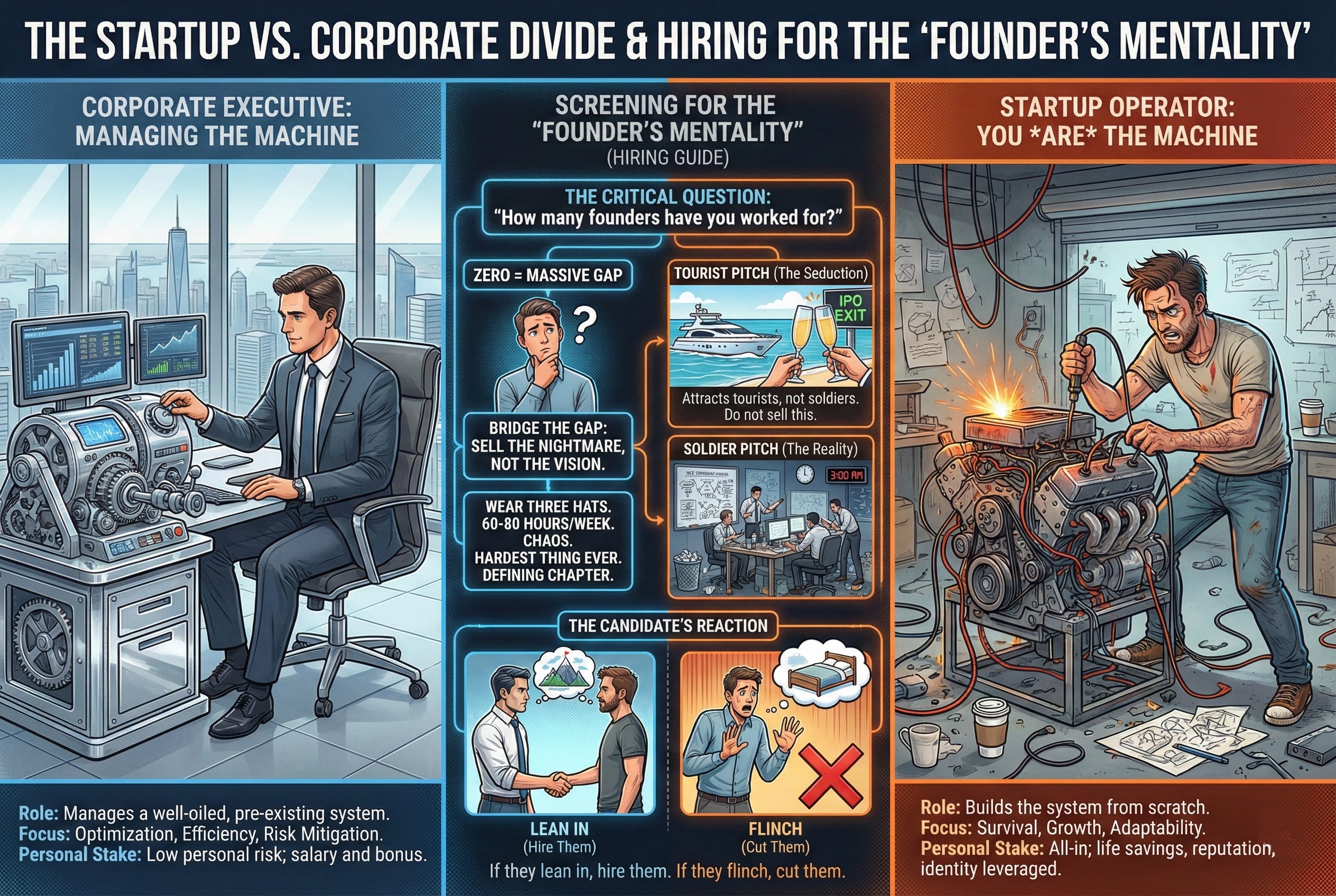
You bridge it by Selling the Nightmare. Too many leaders seduce candidates with the vision—the exit, the IPO, the champagne. This is a mistake. It attracts tourists, not soldiers. You must sell the friction. “We are in a chaotic growth phase. You will wear three hats. You will work 60 to 80 hours a week. It will be the hardest thing you have ever done. But if we win, it will be the defining chapter of your career.”
If they lean in, hire them. If they flinch, cut them.

Simon Sinek articulates this perfectly with his concept of the Navy SEALs matrix: High performance with low trust (toxic) is worse than medium performance with high trust. You need people who can survive the nightmare together. Watch Simon Sinek explain why trust is more important than performance in elite teams.
Phase 5: The Revenue Mandate
Fixing the C-Suite Turnstile
The average tenure of a Chief Marketing Officer (CMO) is just 4.1 years—the lowest in the C-suite. Why? Because too often, their role is tethered to vanity metrics: impressions, brand sentiment, “eyeballs.” CEOs don’t care about eyeballs. They care about revenue.
To stop the churn, you must redefine the role. Do not hire a CMO; hire a Chief Revenue Officer or a Chief Growth Officer. The offer must be structured around outcomes, not activities. “I expect you to grow revenue by 48% in the next 12 months. Your bonus and equity are tied entirely to that number. Can you handle that pressure?”
This clarity eliminates the ambiguity that leads to resentment. It aligns the incentive structure with the survival of the business.
Your Breakthrough Roadmap
The market does not reward intention; it rewards execution. To inoculate your business against the counterfeit candidate and build a team of undeniable performers, execute this four-step protocol immediately:
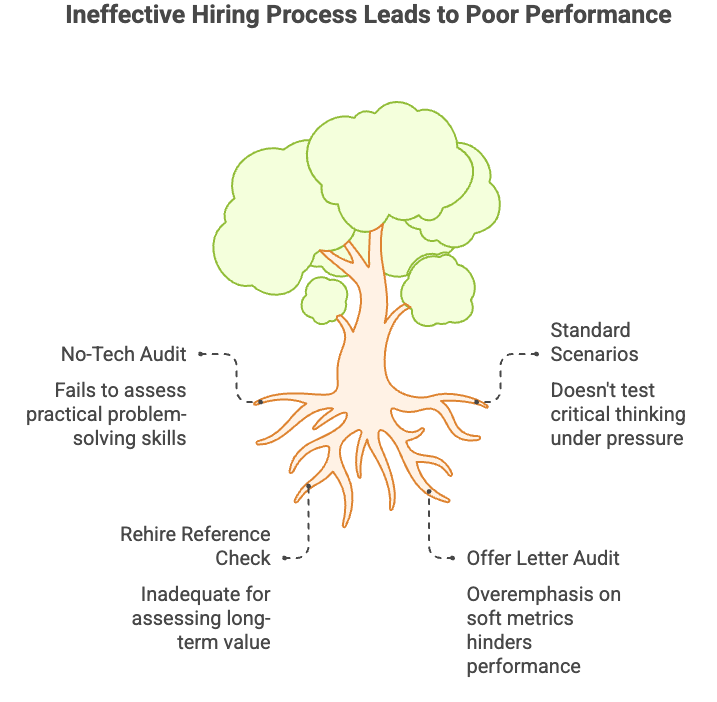
Institute the “No-Tech” Audit: For your next three hires, mandate a 20-minute “analog” session. No laptops, no phones. Give them a marker and a whiteboard (or a practical tool of their trade) and ask them to solve a real problem your company faced last month.
Rewrite Your Scenarios: Scrap your standard interview questions. Create three “Crisis Scenarios” specific to your department (e.g., budget freeze, PR scandal, tech outage). Test for the order of operations in their thinking, not just the solution.
The “Rehire” Reference Check: Contact the references for your top current candidate. Ask only one question: “Would you rehire them?” If you hear a pause, move on.
Audit Your Offer Letter: Review the compensation package for your senior leaders. If more than 20% of their variable comp is tied to “soft” metrics (brand awareness, team sentiment), change it. Tie at least 50% to hard revenue or profitability targets.
The tools of deception will only get better. Your vetting process must get harder. Stop hiring avatars. Start hiring builders who can innovate within tradition.
Abigail Johnson, CEO of Fidelity Investments, exemplifies this balance. She didn’t just inherit a legacy; she modernized it by making bold, early bets on cryptocurrency and digital assets when others hesitated. She teaches that true leadership isn’t just about preserving the past, but about having the discipline to build for a future that doesn’t exist yet.
Watch Fidelity CEO Abigail Johnson discuss innovation bets and the future of finance.
This video is relevant because it illustrates how Abigail Johnson navigates the balance between traditional finance and modern innovation, serving as a prime example of the forward-thinking leadership discussed in the article.