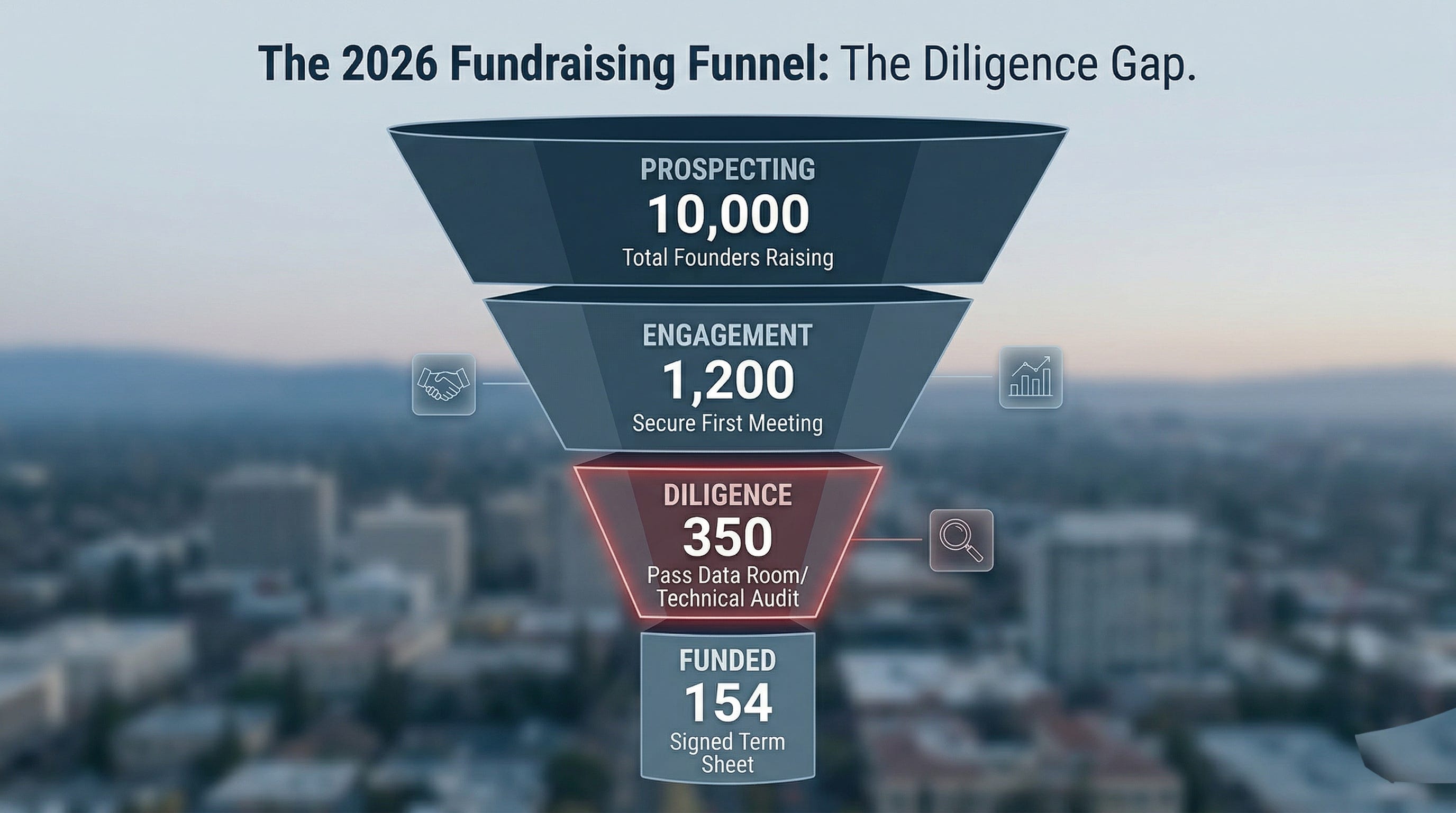
The Default Alive Manifesto
Why the most successful founders in 2026 are trading hype for high-margin boredom

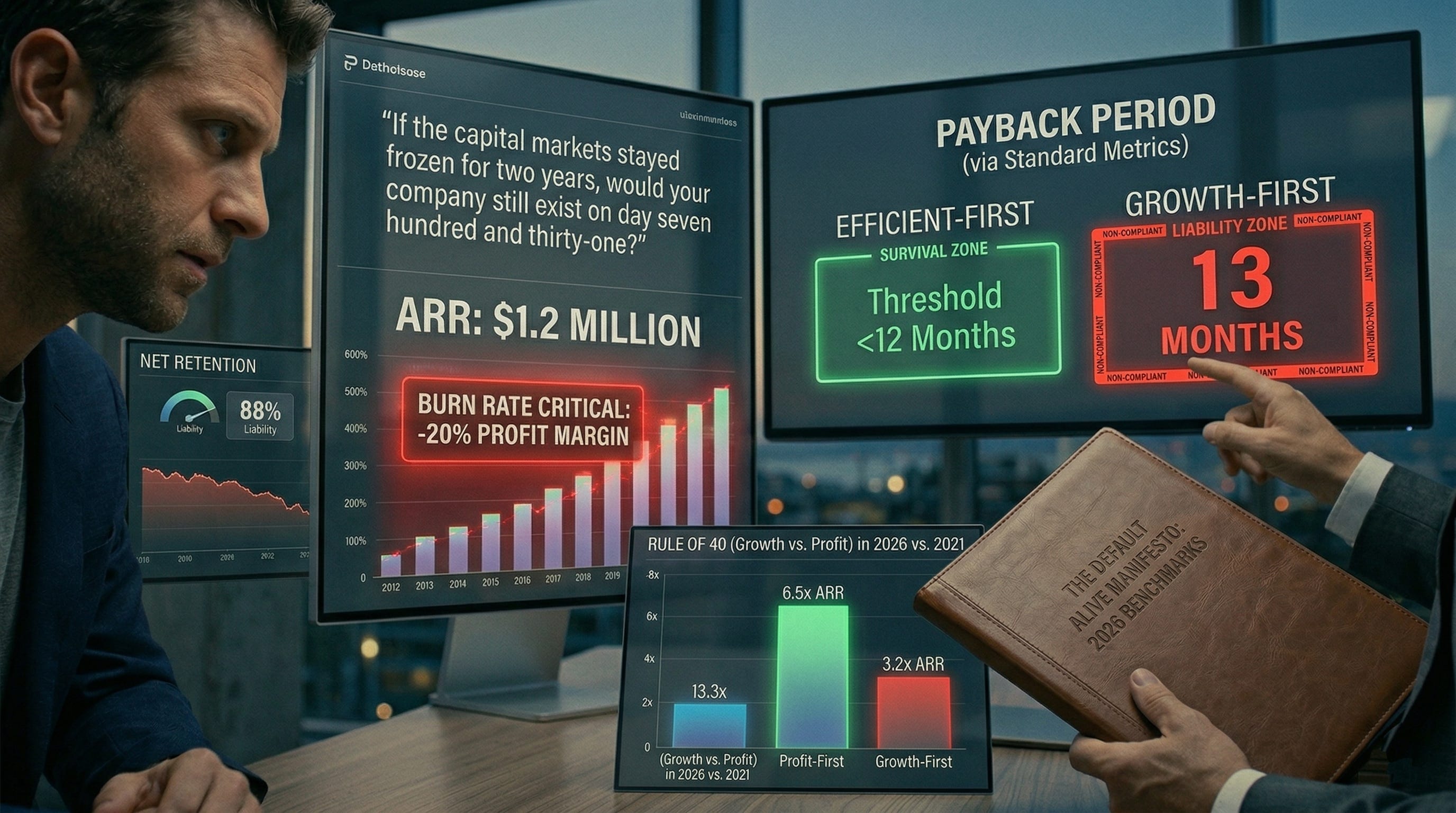
In March 2024, a founder named Elias sat in a glass-walled office in Palo Alto with $1.2 million in annual recurring revenue and a burn rate that kept him awake until the birds started chirping. During the “Zero Interest Rate” years, Elias would have been a hunted man: investors would have tripped over themselves to hand him a $10 million Series A at a $50 million valuation. Instead, the partner across from him checked a real-time dashboard and asked a question that felt like a cold shower: “If the capital markets stayed frozen for two years, would your company still exist on day seven hundred and thirty-one?”

That moment signaled the death of the dream-based economy. As we move through 2026, the data confirms that the safety net has not just frayed; it has been taken down. Global venture funding reached $425 billion in 2025, but that money is hiding in the attic. Late-stage rounds sucked up 68% of all North American capital. Meanwhile, seed-stage investments dropped by 9%. The message is clear: the bridge to the next round has been replaced by a tightrope.
The modern founder must understand a startling reality. Investors are no longer buying potential. They are buying efficient, resilient, and undeniably boring economic engines.
The New Math of Efficiency
To raise money today, you have to prove you do not actually need it. We used to talk about the “Rule of 40” as a suggestion. Now, it is a survival requirement. In the past, you could hide a 20% loss behind a 60% growth rate. Today, that math is seen as a liability.
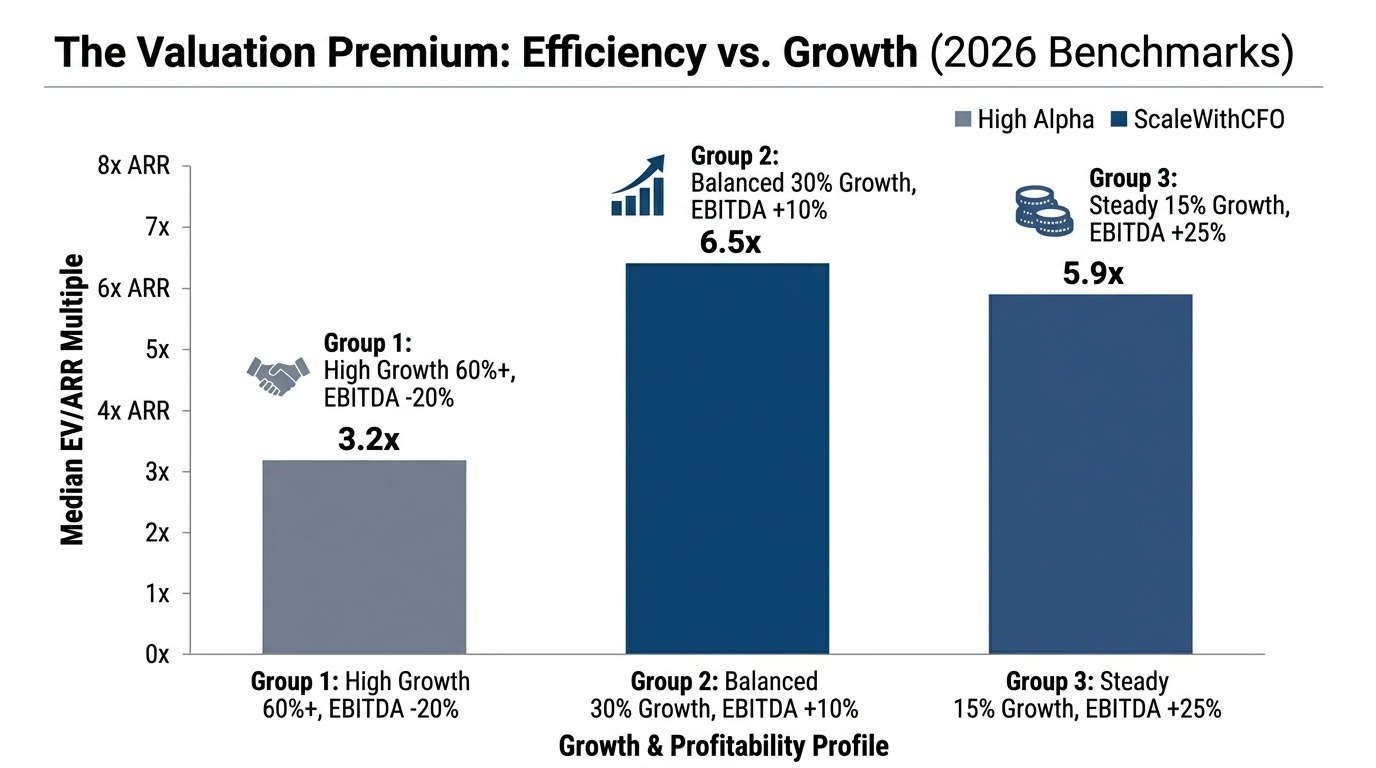
Recent benchmarks from High Alpha and ScaleWithCFO show a split that should worry every “growth at all costs” advocate. Companies growing at 30% with positive profit margins are commanding multiples between 4x and 7x ARR. Their peers who grow at 80% but burn cash are lucky to see half that. The market has decided that a dollar of efficient revenue is worth twice as much as a dollar of subsidized revenue.
Investors are now using auditing software like Standard Metrics to look past your slides. They are checking your net retention and your customer payback periods before you even finish your pitch. If it takes you longer than twelve months to earn back the cost of acquiring a customer, you are no longer considered a high-growth startup. You are a charity project.
The Sophisticated Hybrid
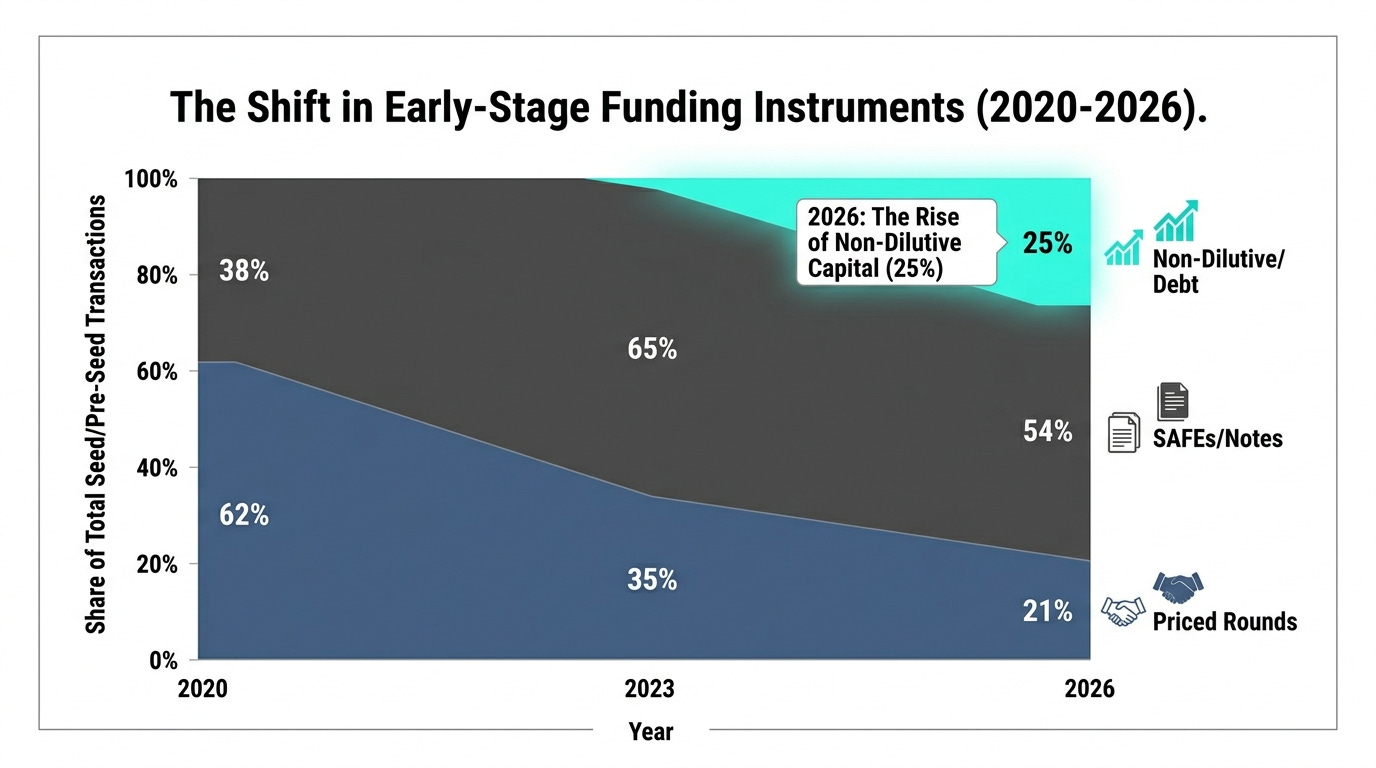
We are seeing a quiet rebellion against the traditional venture model. The most intelligent raises in 2026 are not pure venture rounds. They are “Coordinated Capital” plays.
Data from the Global Equity Crowdfunding Association (GECA) reveals that campaigns with a professional “Lead Investor” have a 78% higher success rate. This hybrid model uses a professional to set the terms and a crowd of advocates to provide the momentum. It is a way to gain the governance of a VC without the total loss of autonomy.
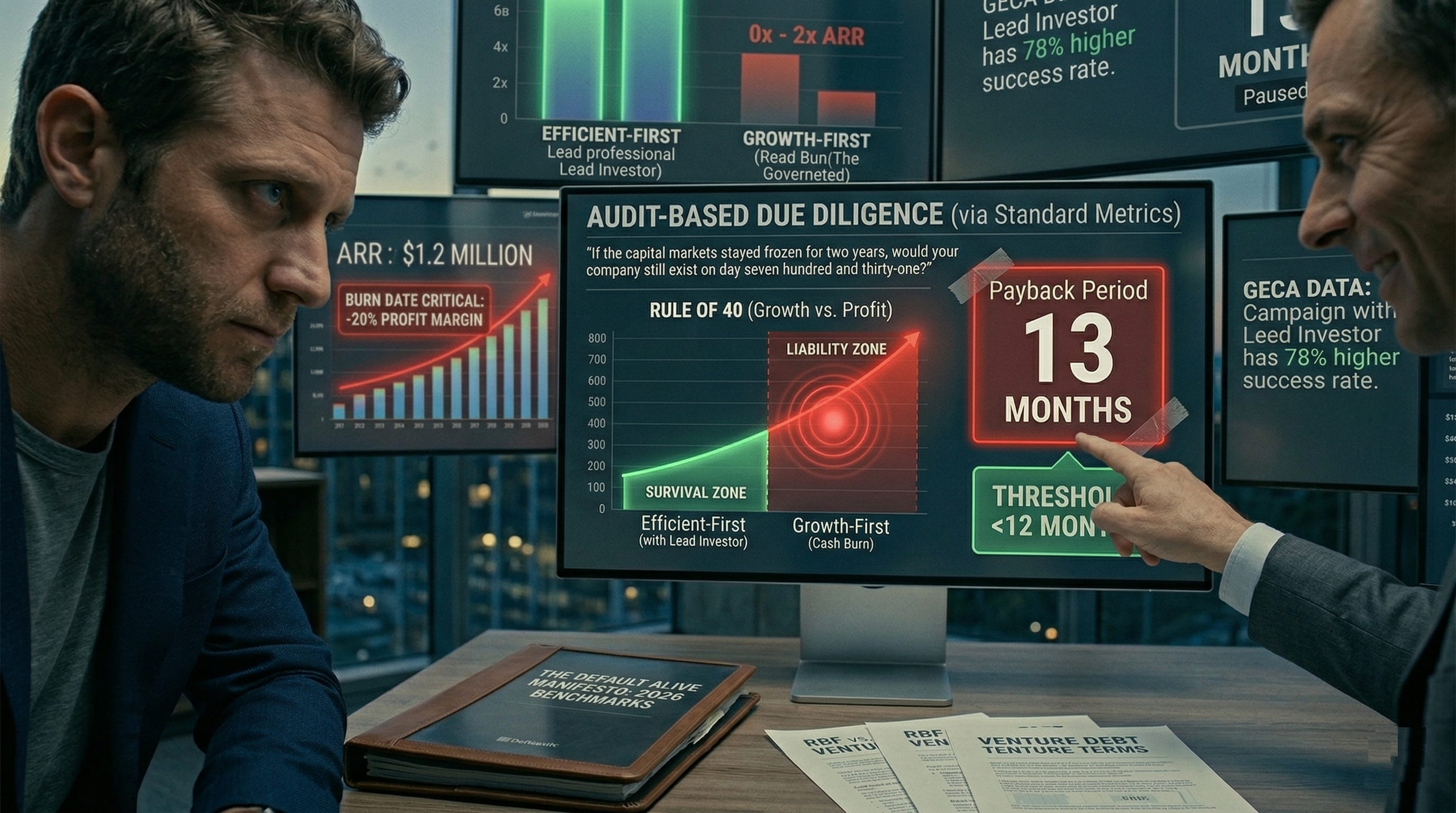
Furthermore, the smartest founders are staying away from equity entirely when they can. The Revenue-Based Financing (RBF) market is expected to hit $15.86 billion this year. If you have predictable contracts, selling 20% of your company just to buy more servers is a strategic error. You should not sell your house to pay for the electricity. You should rent the capital.
The AI Filter
If you describe your company as an “AI startup” in 2026, you have already lost the room. AI is no longer a category; it is the baseline. PitchBook data shows that AI and Machine Learning deals grabbed 65.6% of all venture value in 2025 (amounting to $222 billion out of $339 billion). But the era of the AI “wrapper” is finished.

Investors are looking for domain experts who solve invisible problems. Bessemer Venture Partners recently noted that the healthcare companies hitting $100 million in revenue in record time are not the ones with the flashiest apps. They are the ones solving clinical trial efficiency and automated billing. They are solving the problems that are too boring for the headlines but too expensive for hospitals to ignore.
The bar for a Series A has also moved. You used to be able to raise a Series A with £500,000 in revenue. Today, the floor is closer to £2 million. This means you must survive on your own for much longer. You must be “Default Alive.”
Precision Over Volume
There is a myth that fundraising is a numbers game. Founders think they should email five hundred investors and hope for the best. The data from Evalyze.ai proves the opposite. A focused, researched list of thirty to fifty investors results in a conversion rate four times higher than a blind blast.

This is about investor fit. Do they actually fund your sector? Have they sat on boards of companies that hit the wall you are currently staring at? In a world where VCs use AI to screen your deck, the only way to stand out is to be undeniably human. One founder I know spent weeks researching the “Anti-Portfolios” of ten specific partners. He did not pitch them on why his company was great; he pitched them on why he was not going to make the specific mistakes they had made in the past. He closed his round in three weeks.
The Survival Test
The capital exists. There is over $311 billion in “dry powder” sitting in venture funds globally. But the people holding that money are cautious. They are weary of relying solely on paper markups and pursuing growth at any cost. They want to see a company that can run itself.
Fundraising in 2026 is no longer a talent show. It is a transparency test. The founders who win are the ones who can open their laptop and prove their company is a machine that prints money (even if it only prints a little bit for now). For the rest, the “Default Alive” era is not a challenge: it is an ending. The most fundable startup in the world is the one that does not need the money to survive.