


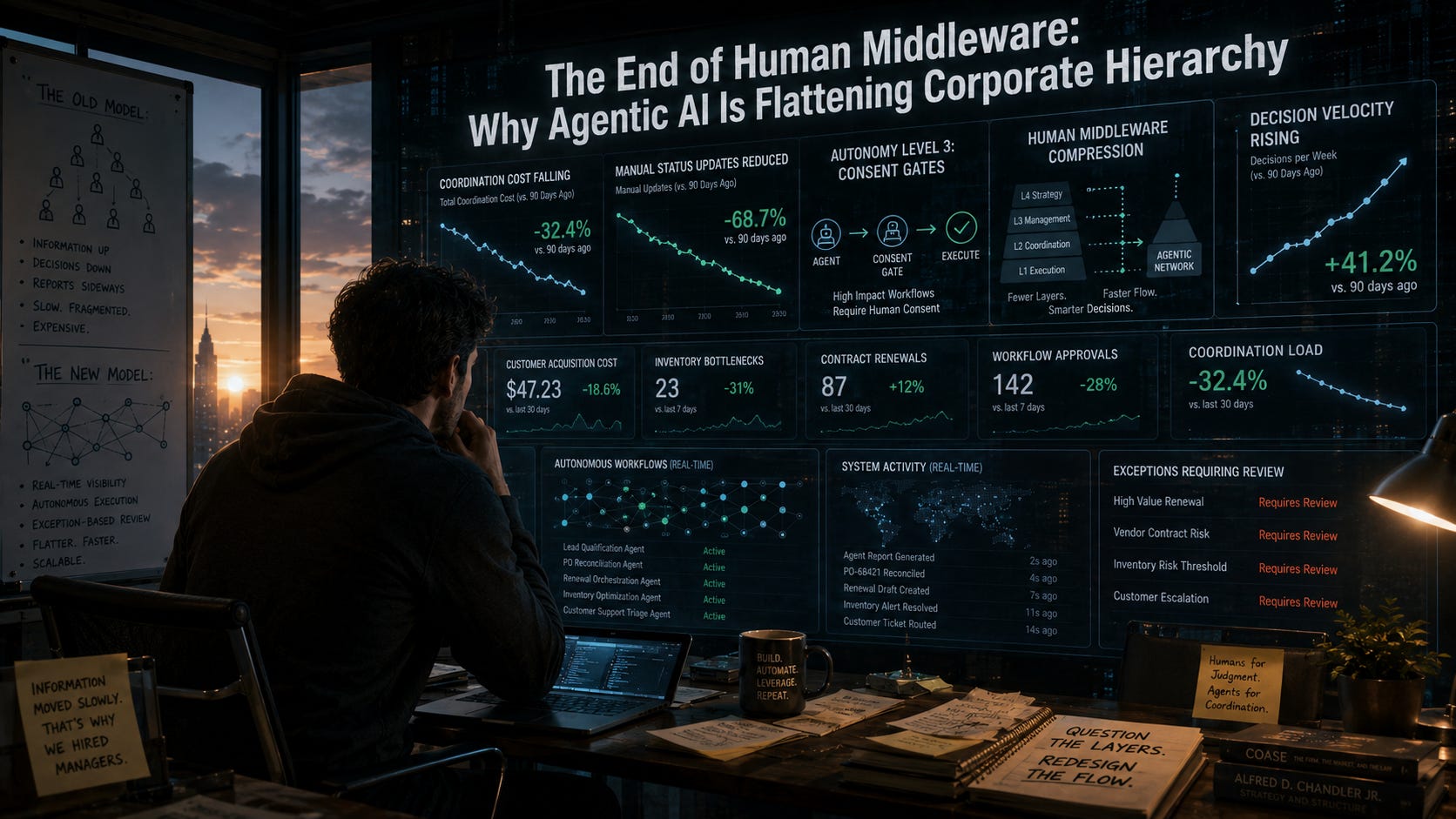
On a quiet Tuesday morning, an enterprise founder sits in a home office, looking at a real-time corporate dashboard. The screen displays a live feed of customer acquisition costs, inventory bottlenecks, and automated contract renewals.
A snapshot that once required multiple cross-departmental meetings, several managers, and days of follow-up now updates continuously. A network of autonomous software agents queries the company’s systems, reconciles the discrepancies, and updates the interface.
The founder is not looking at a productivity tool. They are looking at the first signs of managerial gravity beginning to weaken.
For most of modern corporate history, scaling a business required hiring people whose primary job was managing other people. Not building the product. Not talking to customers. Not inventing strategy. They were hired to manage flow. Information had to move upward, decisions had to move downward, and reports had to move sideways. Somewhere in the middle sat an expanding managerial class translating chaos into order.
That structure made sense when communication was slow, fragmented, and expensive. It makes less sense when software can monitor the entire organization at once.
The real breakthrough behind agentic artificial intelligence is not that machines can write emails or summarize meetings. Those are surface-level efficiencies. The deeper shift is organizational. AI is not killing managers; it is weakening the economic need for human coordination at scale. Much of what middle management historically did was act as human middleware, manually routing information between disconnected people and disconnected systems.

Increasingly, software can handle that synchronization faster, continuously, and at a significantly lower marginal cost. For many middle managers, the uncomfortable reality is that they were not hired for their unique judgment. They were hired because information moved slowly.
Why This Matters Now
The administrative middle is becoming expensive to maintain.
Autonomous agentic networks are beginning to absorb the routine coordination work that historically required bloated hierarchies.
Founders who redesign their core workflows around software-driven coordination may be able to scale revenue without adding headcount at the old rate.
The Collapse of Organizational Sediment
In the early twentieth century, as railroads and steel mills grew too massive for a single owner to oversee, the modern corporation invented middle management. Alfred Chandler, the legendary business historian, detailed how visible hand managerial layers emerged because information moved at the speed of paper. Every new layer existed partly to compress uncertainty and keep the machine synchronized. Over decades, this created a form of organizational sediment, thick layers of bureaucracy that accumulated simply because human communication had physical limits.
What’s next for AI agentic workflows ft. Andrew Ng of AI Fund | Sequoia Capital
For years, growth-stage companies followed a predictable, expensive formula: revenue grows, complexity multiplies, meetings double, and reporting layers appear. The resulting tax inside modern organizations is coordination overhead. Research from enterprise work labs has repeatedly highlighted how much time knowledge workers spend on the “work about work,” chasing approvals, scheduling updates, and aligning teams, rather than core execution.
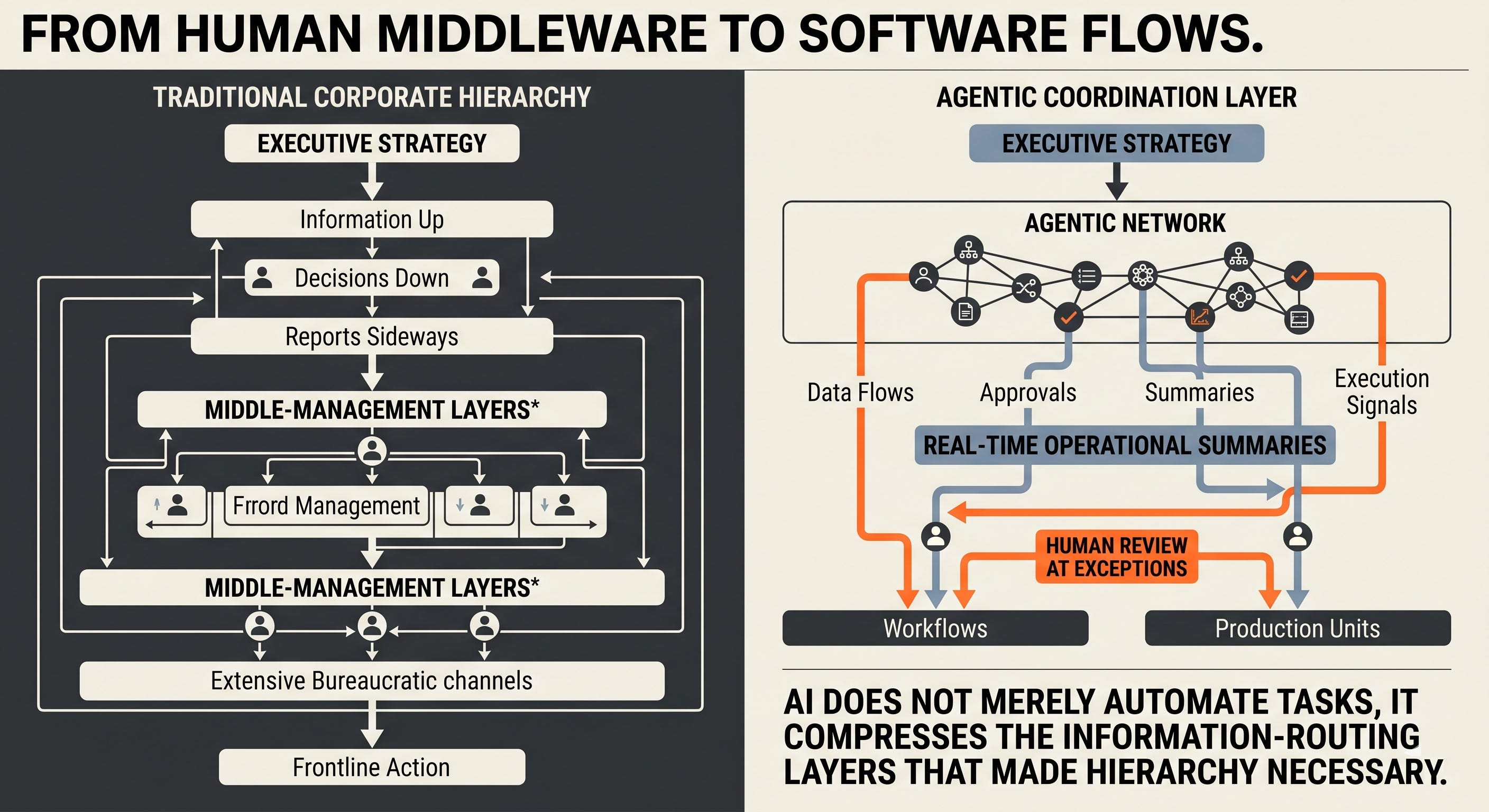
Middle managers routinely dedicate many hours each week purely to status aggregation, dashboard updates, and email summaries. This administrative overhead is highly vulnerable to automation. Agentic networks reduce much of this manual burden by directly querying databases, communication logs, and project management platforms to generate real-time operational summaries.
When coordination becomes software, the fundamental economics of the firm shift. The economist Ronald Coase famously argued that firms exist partly because coordinating activity through open markets is expensive. Companies internalize coordination because internal transaction costs are lower than market costs.
AI alters those costs. When software systems can autonomously route information, monitor execution, generate operational summaries, coordinate tools, and trigger workflows, portions of the organization begin behaving less like bureaucracies and more like programmable systems.
Instead of scaling headcount to handle a spike in operational volume, enterprises can deploy networks of specialized agents that operate continuously. This consolidation is already altering corporate structures across global industries:
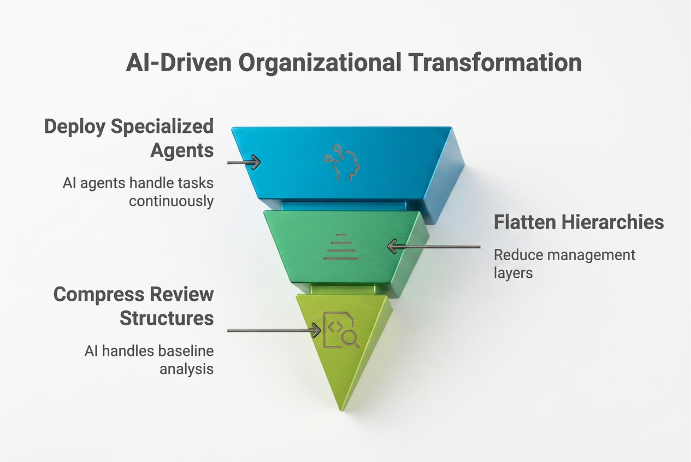
Corporate Efficiency Mandates: Major technology and retail enterprises are actively re-evaluating their organizational depth. In corporate updates, companies like Amazon have explicitly focused on flattening hierarchies, reducing management layers, and increasing the ratio of individual contributors to managers to remove bureaucracy and restore nimble operating speeds.
Hierarchy Compression Projections: The financial incentives driving this change are clear. Industry forecasts increasingly point toward flatter organizational structures driven by AI automation.
The Squeeze on Review Structures: From tech giants to elite professional services, the deep pyramids of old are weakening. If AI networks can perform the baseline analysis, assemble the data, and handle the system handoffs, the economic rationale for a multi-layered human review apparatus degrades.
Shifting from Manual Rules to Managed Autonomy
To convert technical tools into operational leverage, founders must move away from vague uses of AI toward clear boundaries of authority. Operators can apply a clean, four-tier framework to define exactly how much autonomy is granted to a software agent based on the underlying operational risk:
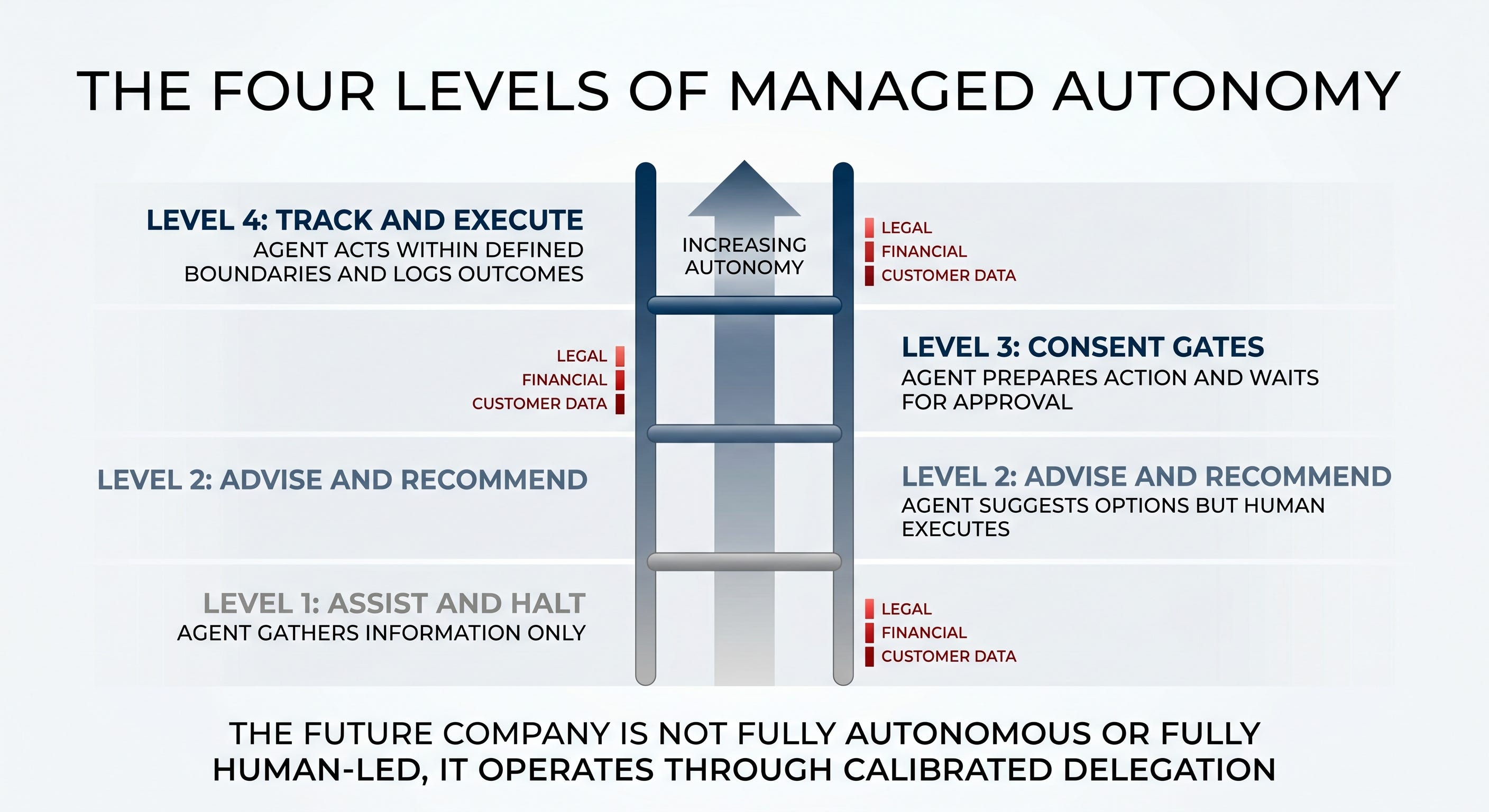
Level 1: Assist and Halt
The agent aggregates raw data, identifies anomalies, and provides necessary context, but cannot execute next steps or suggest actions. This is recommended for early-stage project discovery or complex compliance diagnostics where human intuition and absolute legal accountability are required.
Level 2: Advise and Recommend
The agent synthesizes internal data, outlines alternative approaches, details the pros and cons of each path, and recommends a specific course of action. The human retains complete execution responsibility.
Level 3: Consent Gates
The agent drafts the end-to-end action plan, configures the necessary tools, and requests explicit human validation before executing any downstream processes. This is the standard setting for high-impact processes like vendor procurement or customer onboarding.
Level 4: Track and Execute
The agent operates continuously within its defined operational boundary. It optimizes workflows, routes data, self-corrects runtime errors, and executes tasks autonomously, logging its outcomes to an audit trail for asynchronous human review.
Friction, Failure, and The Bureaucracy Paradox
The transition to an agentic workforce is rarely a straight line. There is a dangerous fantasy spreading through parts of the executive world that autonomous systems are inherently reliable because they sound confident. They are not.
Agentic AI in Business: Power, Control, and the Road Ahead | Pascal Bornet
Delegating execution privileges to multi-agent networks introduces severe operational, security, and data vulnerabilities. AI risk research points to several barriers when companies scale autonomous systems:
The Bureaucracy Paradox: Many enterprises are currently making a predictable mistake: they are adding AI tools while preserving every existing approval layer, reporting structure, and communication ritual. Instead of flattening the company, this layers software noise on top of human bureaucracy, initially creating more work, more communications, and slower decision cycles.
Context and Integrity Flaws: Agents operating without a centralized business glossary or shared semantic layer can misinterpret corporate metrics. Confidently generated numbers derived from incomplete data paths can quickly lead to strategic misalignment.
The Velocity of Error: Because agentic systems possess tool-calling privileges, they can write to production databases, trigger conflicting decisions, or spark infinite automation loops without proper system gates.
The Security Perimeter: Agents often run with over-privileged access tokens, violating basic data access rules. Risk research organizations have highlighted that under adversarial prompt injection attacks, agents can be manipulated into bypassing authorization controls or leaking customer records.
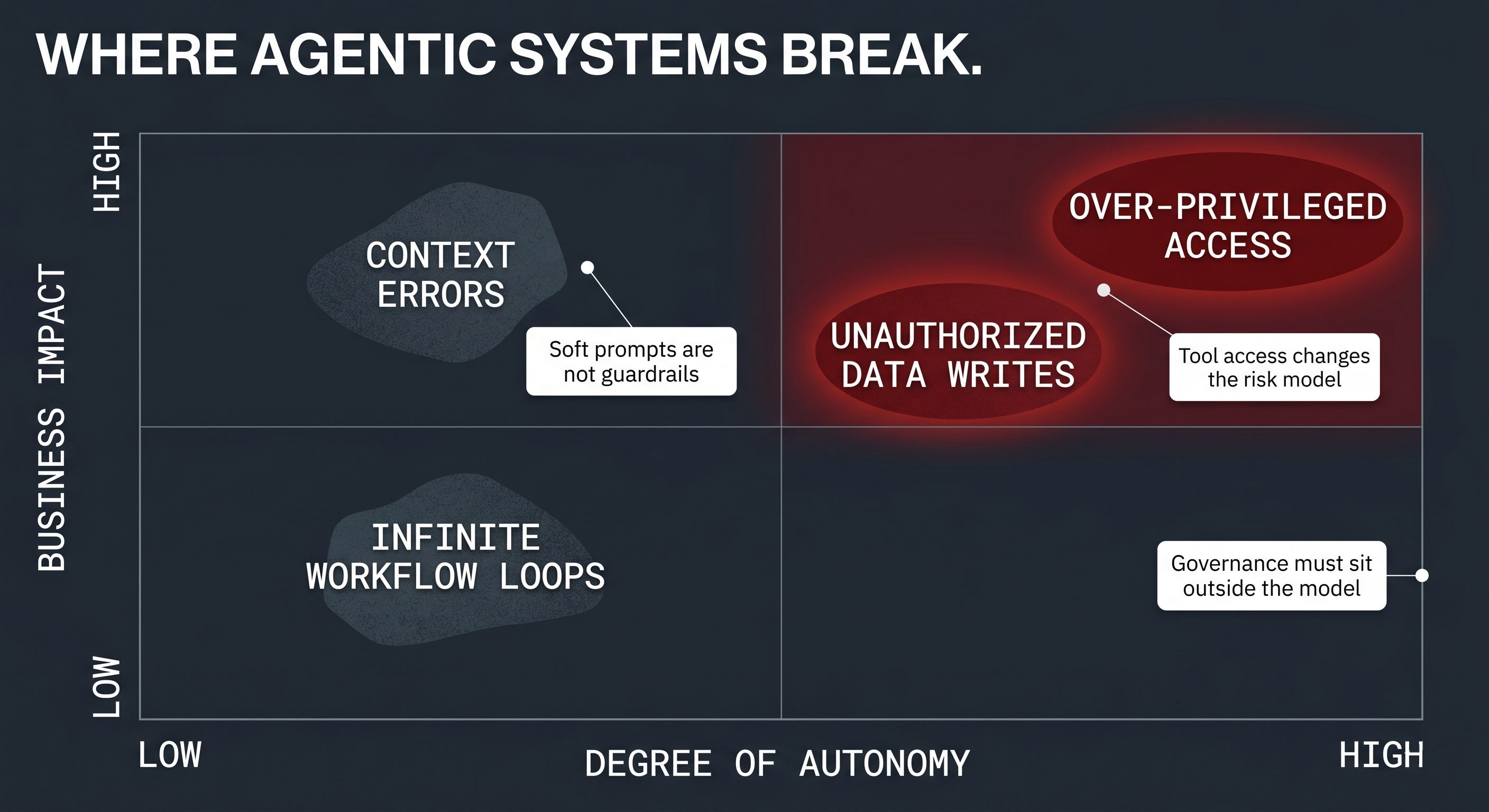
Regulated industries, such as healthcare, aerospace, and banking, are likely to move slower due to these compliance vectors. The companies that gain the largest advantage will realize that the challenge is no longer just generating intelligence; it is governing it. This means implementing rigid, independent software guardrails that run entirely separate from the AI models themselves, acting as a hard checkpoint on every input, output, and tool action.
From Coordinators to Multipliers
As the software-driven coordination layer matures, the manager’s job changes sharply. This shift divides middle managers into two distinct classes: Coordinators and Multipliers.
Coordinators, whose primary value lies in tracking, aligning, and distributing information, are finding their daily tasks absorbed by software layers.
Multipliers, who focus on coaching, resolving ethical nuances, navigating organizational ambiguity, and making high-stakes judgments, become highly leveraged assets within a flattened organizational structure.
The manager of the next decade looks less like an administrative dispatcher and more like an air traffic controller. Less time is spent chasing updates, and more time is spent supervising systems. Less time is spent compiling reports, and more time is spent interpreting anomalies. AI is highly effective at procedural consistency, but it remains uneven at contextual wisdom. That distinction will define the next decade of management.
Agents: Hype or the Future of Work? | Lisa Crosbie
The Executive Playbook
Transitioning away from human middleware requires a deliberate shift in how leaders structure teams and measure performance. The goal is to gradually allow software to absorb routine synchronization while elevating human oversight.
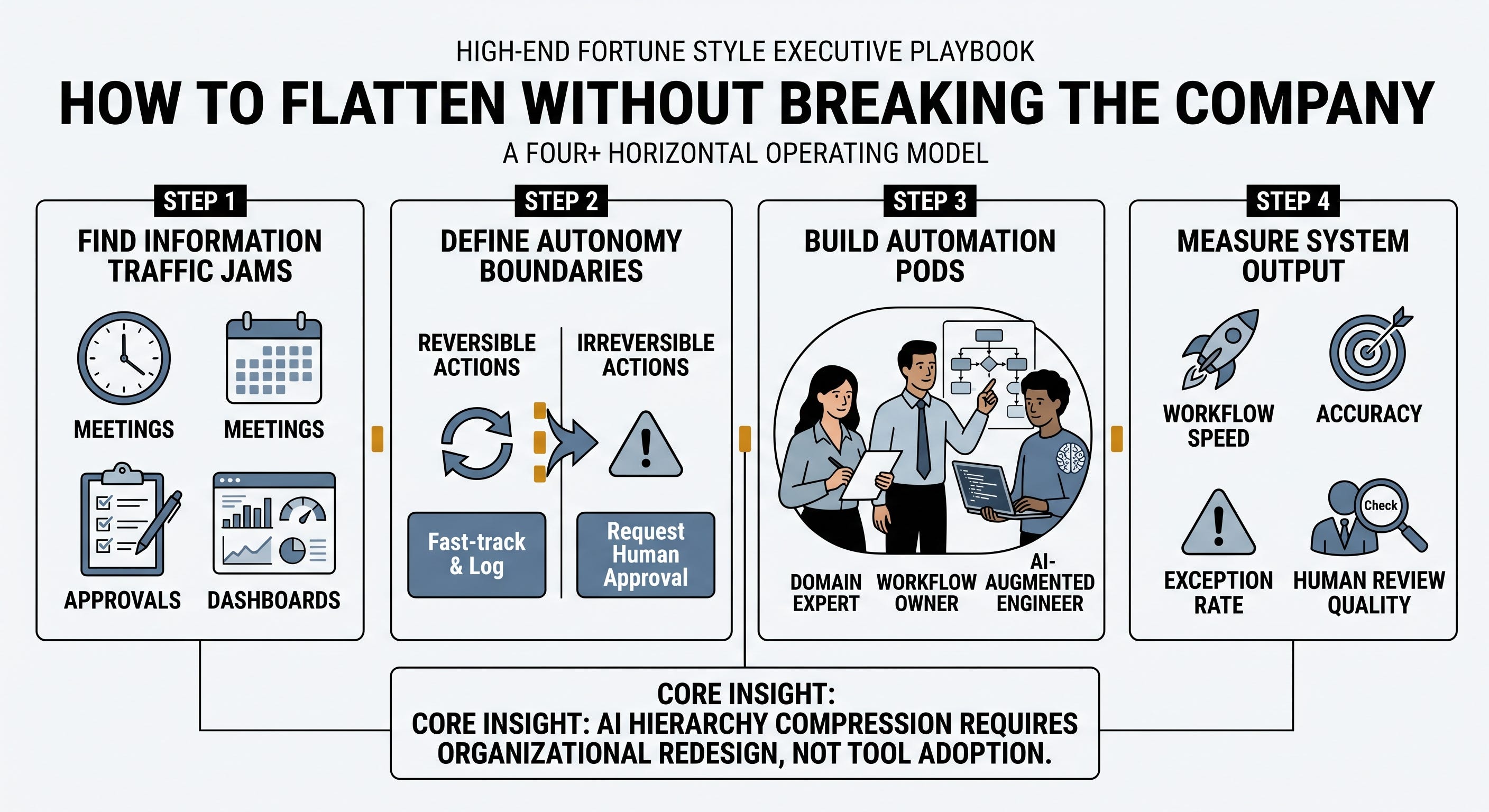
First, look for the information traffic jams. Audit your operational teams’ weekly schedules and identify the top three repetitive, administrative bottlenecks that consume significant time each week. Deconstruct these high-impact, bottlenecked processes, such as lead qualification or customer onboarding, into their constituent microtasks, systems, and data dependencies.
Second, define your autonomy boundaries. Map each microtask explicitly to the four tiers of delegation. Specify which actions are safely reversible and can run under managed autonomy and which require an explicit human gatekeeper before final execution. Create an operational matrix that separates these tasks cleanly so that high-stakes financial, legal, or strategic decisions remain tied to human accountability.
Third, change how you build software teams. Form small automation pods of no more than three to four individuals, pairing business domain experts directly with AI-augmented developers. Equip these small teams with advanced, AI-assisted development environments to accelerate prototyping and process iteration. Small pods combine deep institutional knowledge with rapid technical execution, removing traditional development bottlenecks.
Finally, shift your managers’ core performance metrics away from team size or report volume. Execute a clear internal pivot plan to transition your human capital away from chasing updates and compiling slide decks. Retrain them to focus entirely on defining corporate intent, analyzing system anomalies, managing edge-case exceptions, and continuous performance tuning of the digital workforce. Anchor their success metrics to the speed, accuracy, and output of the automated workflows they supervise.
The New Metric of Scale
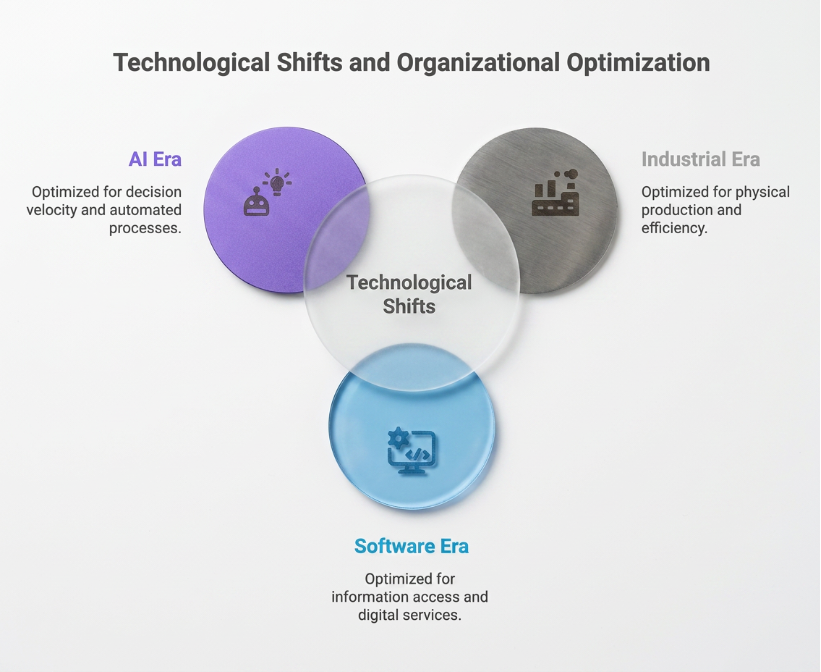
Every major technological shift changes what organizations optimize for. The industrial era was optimized for physical production. The software era was optimized for information access. The AI era will optimize for decision velocity.
Historically, scaling a company required building managerial infrastructure almost as quickly as revenue infrastructure. Coordination costs exploded as organizations grew, creating a natural penalty for size. AI changes that math. A lean company with strong automated systems can now compete against much larger firms because the traditional penalties of scale are shrinking. The historic relationship between headcount and operational capability is weakening.
For founders and executive leaders, the ultimate strategic question is no longer: “How do we hire enough people to scale?” It becomes: “How much coordination can software absorb before we add another human?” The future enterprise will not be measured by how many people it employs but by how little coordination it requires to move.