

The End of Speculative Software

Why elite founders are using customer cash, manual workflows, and service-wrapped software to outmaneuver bloated SaaS competitors.

Why This Matters Now - Capital got expensive. Software got cheap. That single inversion changed the startup economy. The winners now are not simply the founders who build fastest. They are the founders who get customers to fund the learning before the code is finished.
In early 2020, Sarah Ahmad and her co-founder Colin found themselves in a position familiar to hundreds of venture-backed entrepreneurs. They graduated from college, moved to San Francisco, quit their engineering jobs, secured a spot in Y Combinator’s winter batch, and raised a pre-seed round to build an international benefits platform for remote teams. Then the pandemic hit.
Virtually overnight, market demand vanished. They could not give the product away for free. The pressure test of a shifting market exposed a brutal truth: they had built something the market no longer urgently needed.
Instead of raising more capital to engineer their way out of the hole, Ahmad went back to basics. She ran discovery conversations with hundreds of operations managers and uncovered a persistent, highly specific bottleneck: distributed companies without physical offices did not know what to do with their physical mail and business registration documents.
Her MVP was a Google Drive folder. She hit $10M ARR
Rather than spending months building an elegant software interface, Ahmad launched a radically manual experiment. She set up a single mail partner in San Francisco, used Google Drive for storage, onboarded clients over Zoom, and processed payments via a standard Stripe link. When mail arrived, she opened, scanned, and emailed it to customers by hand. They ran this code-free operations model for their first 100 customers before writing a single line of software architecture. Today, that business, Stable, is a leading AI-powered virtual mailbox platform serving over 10,000 corporate customers.
Stable’s trajectory illustrates a fundamental shift in the technology sector. For nearly two decades, the startup ecosystem was dictated by the economics of the Zero Interest Rate Policy era. When capital was practically free, the financial system heavily subsidized speculation. Investors tolerated enormous burn rates and multi-year experimentation timelines because the eventual promise of platform dominance outweighed the risk of waste. Founders raised capital first, hired engineers second, and looked for recurring revenue much later.
That framework fractured under the macroeconomic tightening that began in late 2022. According to historical funding indices from PitchBook and Carta, venture activity experienced a dramatic contraction as interest rates rose, forcing a strict premium on capital discipline. Simultaneously, corporate IT buyers began consolidating vendors and cutting redundant software seats. Overall enterprise software spending slowed from the historic surges of the early 2020s, according to Gartner and IDC tracking data, leaving early-stage founders with far less room for error.
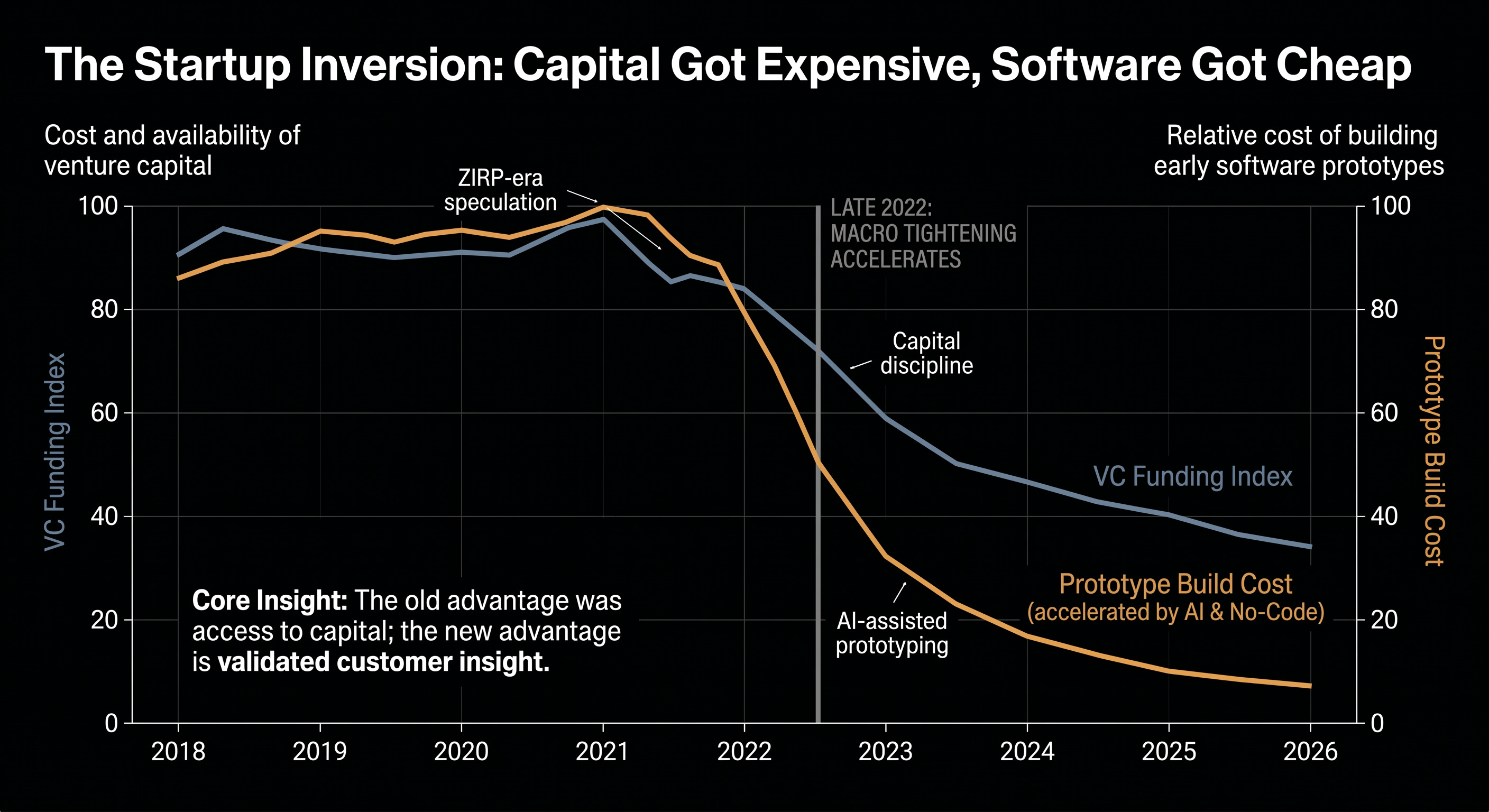
The core reality of the modern software market can be stated in a single sentence: Software is no longer the scarce asset; validated operational insight is.
The Economics of Premature Automation
To be clear, some of the most legendary technology companies in history required speculative engineering. Building a global logistics network like Amazon, an advanced mobile operating system like Apple, or a foundational search engine like Google demands massive, unvalidated upfront capital expenditure long before a single dollar of market revenue arrives. In deep tech, hardware infrastructure, and hard science, speculative code is a necessary barrier to entry.
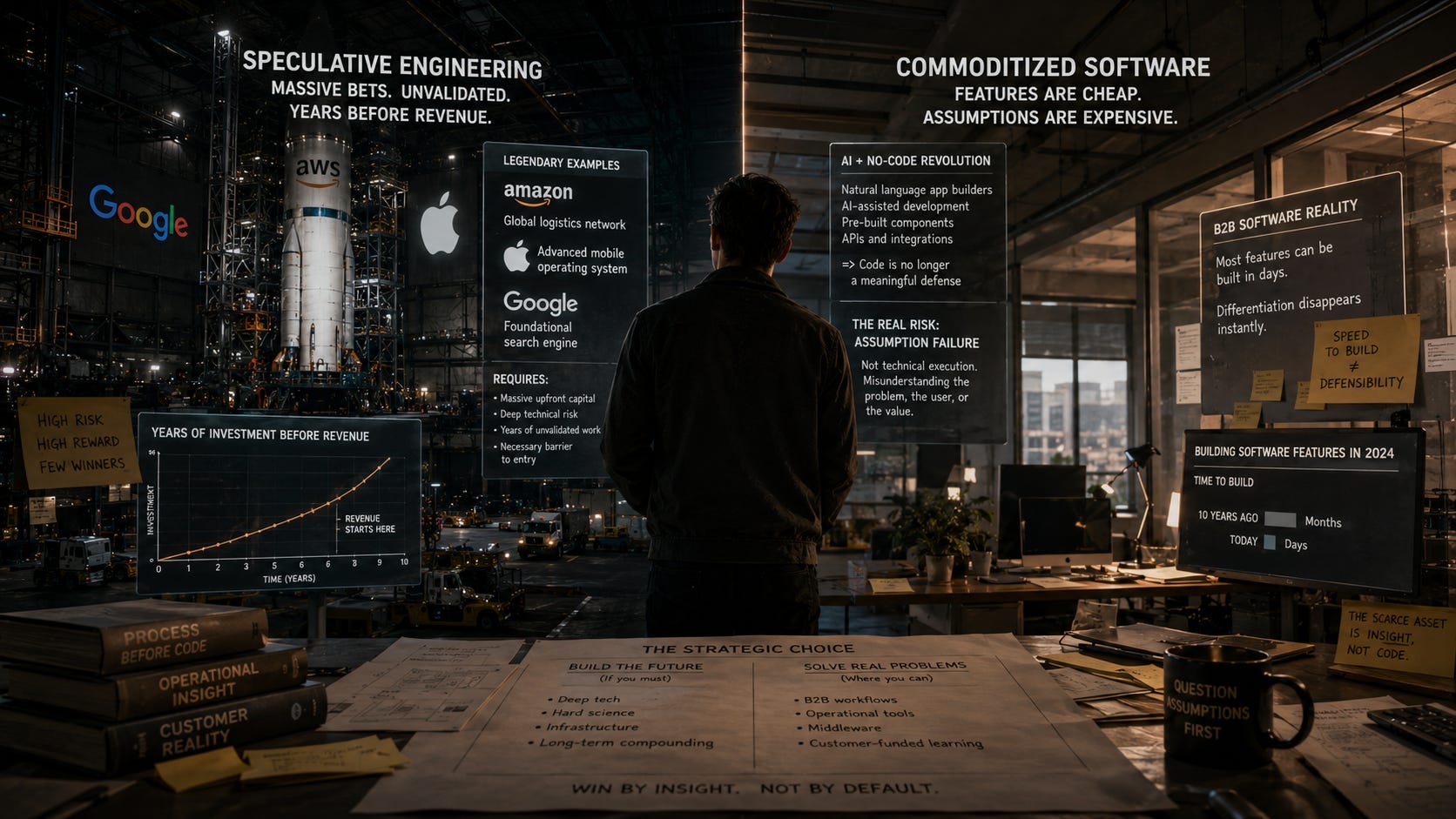
But for the vast majority of B2B applications, enterprise workflow tools, and middleware platforms, that model has become an operational liability. Because AI-assisted development platforms and natural language app builders have collapsed the time and cost required to generate code, building generic software features is no longer a meaningful defense. The primary risk is no longer technical execution; it is assumption failure.
Founders routinely waste capital automating workflows they do not fully understand for customers they have barely observed. They optimize user interfaces and build complex dashboards before confirming whether the underlying business problem is acute enough for anyone to pay to solve.
The service-wrapped software model flips this sequence. The framework works because customers pay for the outcome long before the infrastructure is fully automated. By packaging the solution as a premium service, operators turn the volatile early-product phase into a paid research and development engine funded entirely by customer cash flow.
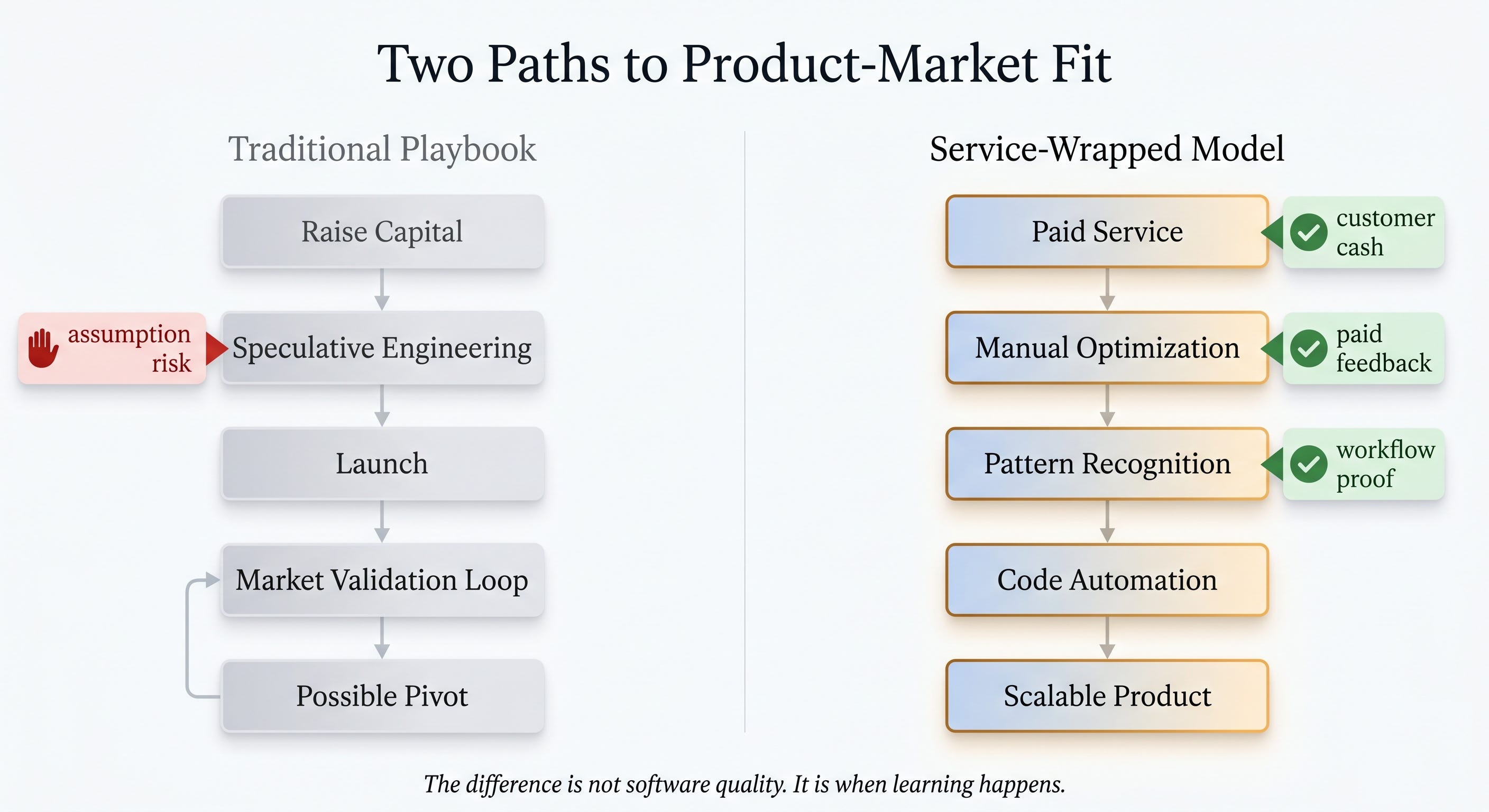
This structural shift alters early-stage startup metrics:
Initial Capital Requirement: Traditional business models demand immediate equity financing to build unproven infrastructure. The service-wrapped model leverages lightweight front-ends and manual execution to keep upfront costs near zero.
Gross Margin Profile: While pure software eventually scales to high margins, it carries massive initial loss profiles. Standardizing a service-wrapped framework captures healthy early margins by replacing custom labor with repeatable workflows.
Time-to-Value: Instead of forcing a buyer to wait months for an engineering team to ship a feature, the service-wrapped model delivers immediate utility through high-touch human orchestration.
Validation Velocity: Pure software requires statistically significant user cohorts to verify engagement trends. Service-wrapped models create rapid, direct, paid feedback loops with the target audience.
Practical Discovery and Readiness Frameworks
Moving away from speculative roadmaps requires simple, practical tools to evaluate customer friction points and verify operational readiness.
The Diagnostic Filter and 3 E’s Test
The discovery phase begins by sorting potential customer frustrations into four categories: financial pain, productivity blocks, process friction, and support failures.
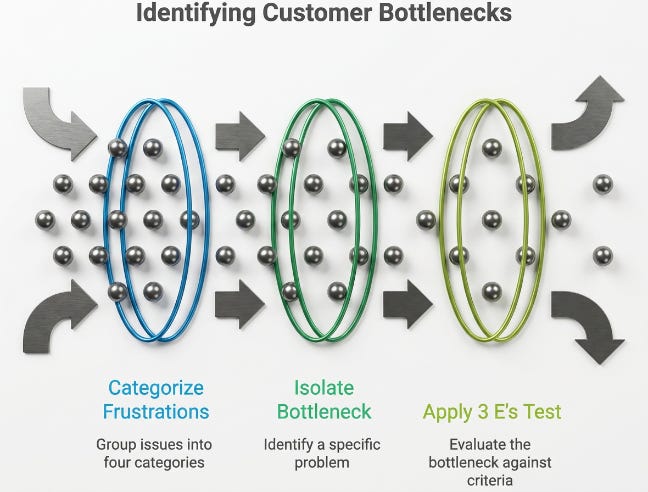
Once a candidate bottleneck is isolated, it must pass the 3 E’s Test. The problem must be Existing, meaning the customer is already using manual workarounds or duct-tape software configurations. It must be Expensive, carrying a high, quantifiable cost of inaction. And it must be Explicit, meaning the buyer describes the frustration clearly using specific, urgent language.
How To Talk To Users | Startup School | Y Combinator
The Productization Readiness Score
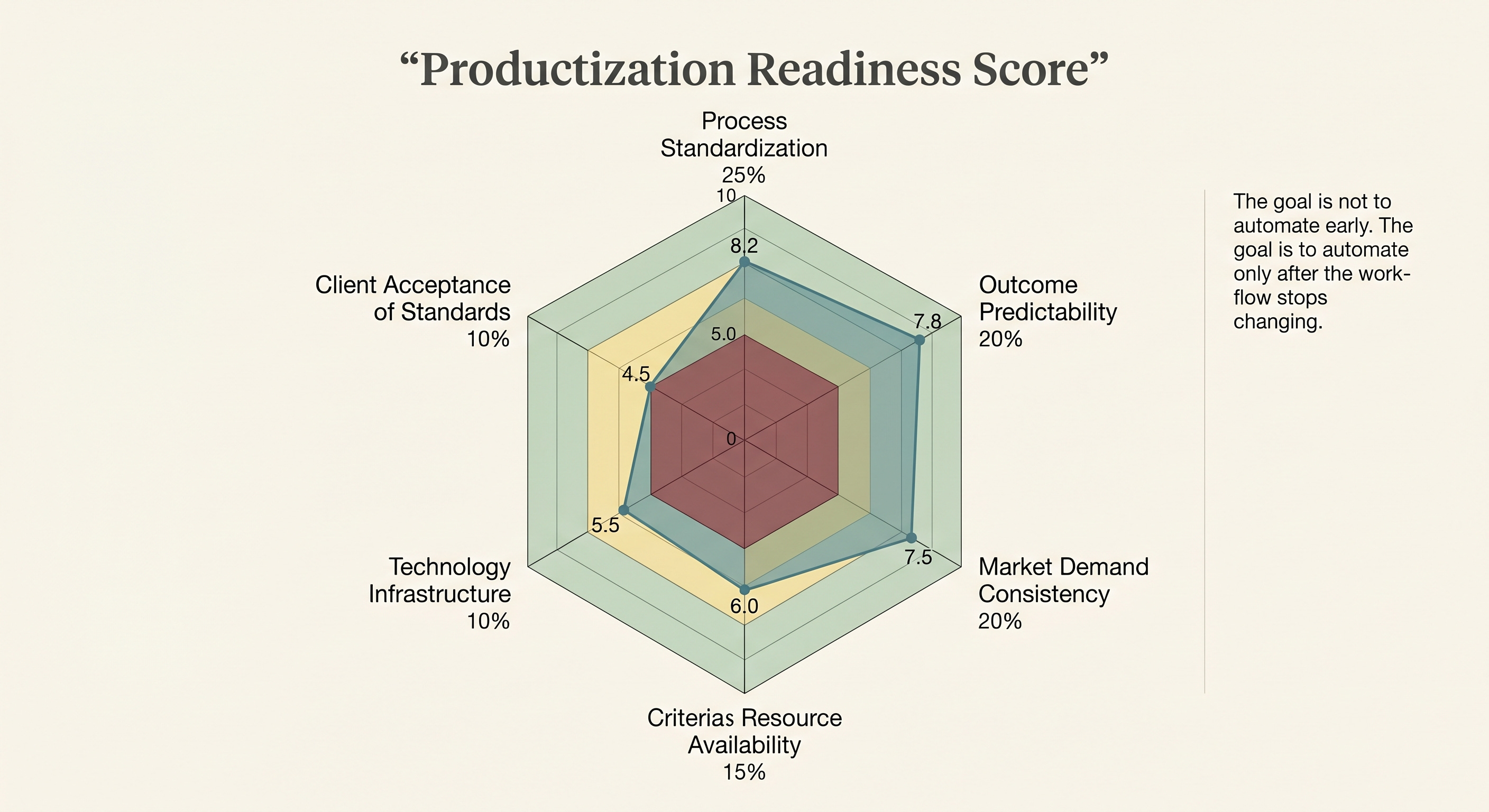
To determine exactly when a manual workflow is stable enough to be codified into custom software, founders can score their current operations across six practical criteria, applying their respective weights:
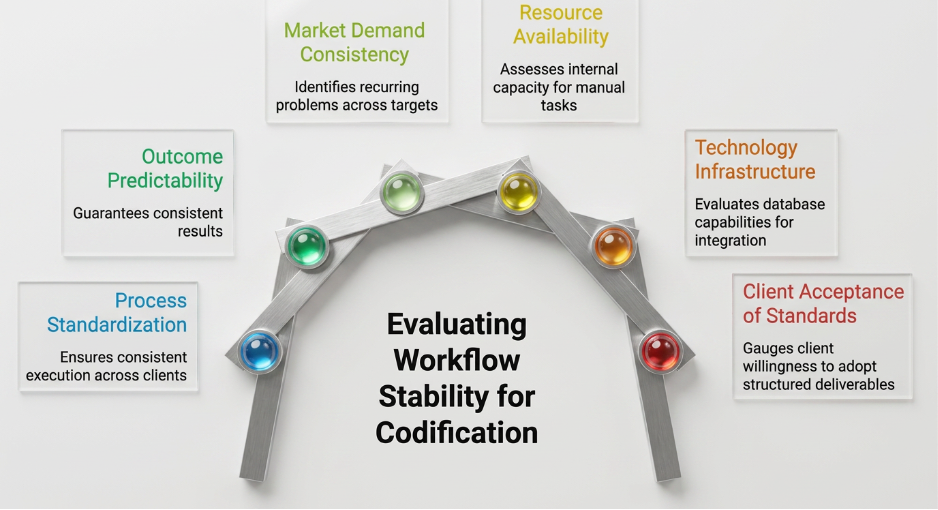
Process Standardization: Can the workflow be run identically across all clients without custom deviations?
Outcome Predictability: Does the service consistently deliver the exact same data payload or business result?
Market Demand Consistency: Do multiple separate targets experience the identical problem repeatedly?
Resource Availability: Is there enough internal capacity to fulfill manual tasks without starving core growth functions?
Technology Infrastructure: Can basic visual databases handle the integration requirements of the current client portal?
Client Acceptance of Standards: Is the buyer willing to accept a highly structured, self-service deliverable?
A combined, weighted score of 7.0 or higher indicates an operational signal to transition manual operations into automated software code. A score below 5.0 dictates a hard freeze on product development until internal processes are thoroughly documented and stabilized.
Where the Service-Wrapped Model Fails
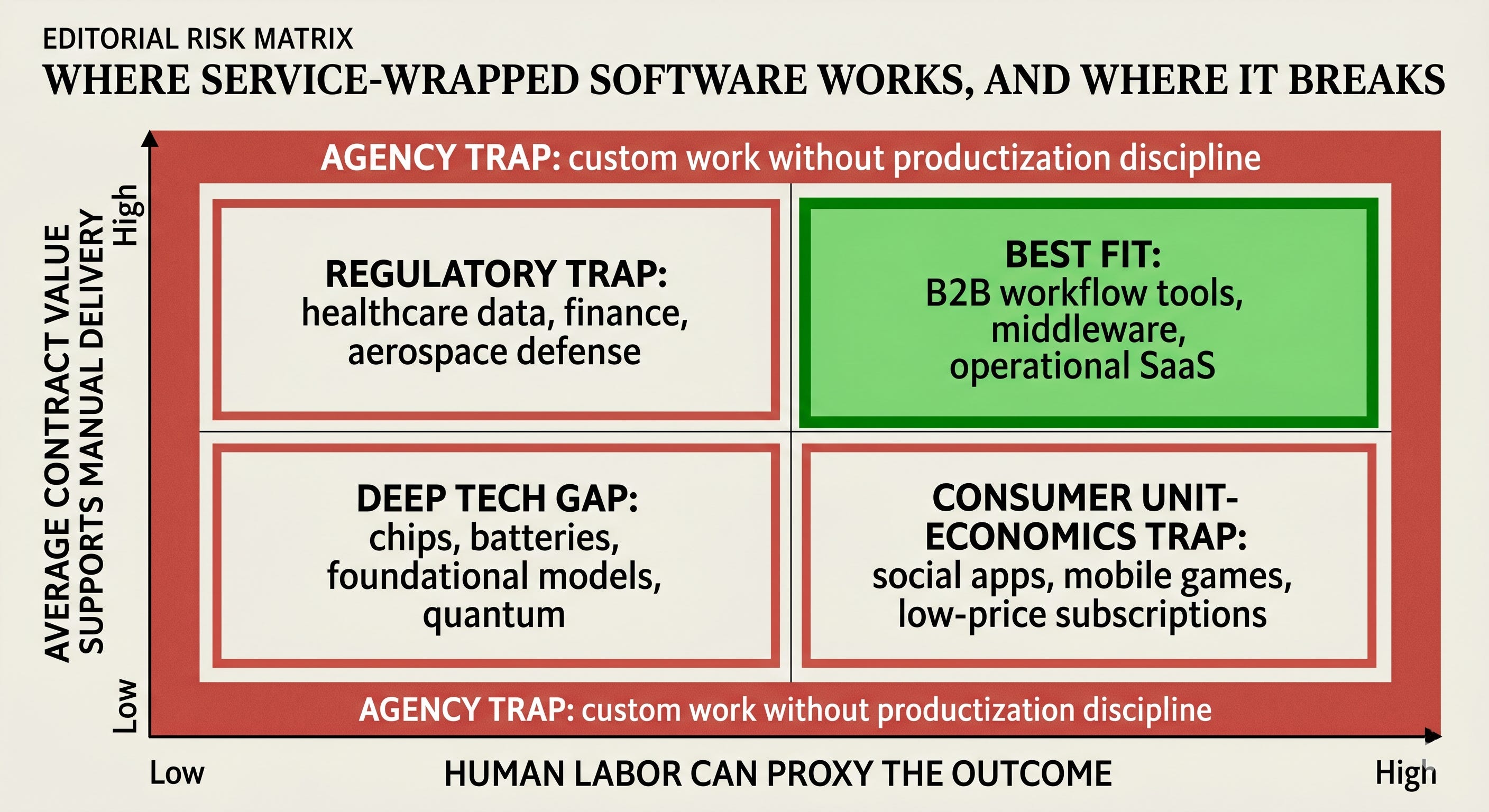
The service-wrapped software playbook is not a universal solution. It breaks down rapidly when applied to specific market categories where human intervention cannot bridge the technical gap.
Consumer Applications
Consumer tech relies entirely on self-service adoption, viral loops, and low friction. You cannot manually wrap a consumer social network or a casual mobile game with concierge labor. The unit economics fail immediately because low transaction values cannot support human intervention, and consumers expect instant, automated digital gratification.
Deep Tech and AI Infrastructure
Startups building novel cryptography, quantum computing architectures, or training foundational large language models cannot utilize a concierge workaround. There is no manual proxy for an advanced chip architecture or GPU compute clustering. These fields require fundamental, capital-intensive engineering long before an outcome can be demonstrated to a client.
Highly Regulated Industries
In environments governed by strict compliance, such as clinical healthcare data, financial clearinghouses, or aerospace defense, manual workarounds introduce severe legal and security liabilities. Operating without fully audited, secure software infrastructure can violate data privacy mandates, making human intervention impossible from a regulatory standpoint.
The Agency Trap
The greatest operational risk for a founder executing this model is the temptation to stay a service provider permanently. When revenue grows, founders often succumb to custom client demands, creating bespoke workflows for every new account. If the organization fails to treat its internal product as an independent project funded by a set percentage of operational profits, it mutates into a traditional, unscalable agency wearing a software costume.
Deep-Dive Operational Case Studies
Analyzing successful executions reveals how early-stage operators navigate the transition from high-touch labor to scalable software engines.
1. Stable
Founder Name: Sarah Ahmad and Colin.
Starting Constraint: The sudden collapse of product-market fit for their remote benefits platform during the 2020 pandemic left them with zero revenue and a pressing need to pivot.
Manual Workaround: They launched a virtual address landing page in the Y Combinator community. When founders signed up, Ahmad physically drove to a mail partner in San Francisco, collected the physical mail, opened it, scanned the pages, and manually emailed the documents to clients.
Validation Moment: Dozens of founders instantly emailed stating they needed the service immediately, confirming an explicit willingness to pay before any code existed.
Productization Leap: After manually managing the workflow for their first 100 customers, they mapped the recurring operational bottlenecks and engineered an automated, AI-powered document storage and mailbox interface to replace manual email delivery.
Current Outcome: Stable has publicly reported operating across more than 20 U.S. locations and serving over 10,000 corporate customers, scaling into 8-figure annual recurring revenue.
2. Design Pickle
Founder Name: Russ Perry.
Starting Constraint: After running traditional creative agencies for over eight years, Perry grew exhausted by the unpredictable revenue cycles, custom client demands, and the constant friction of chasing unpaid invoices.
Manual Workaround: He hired an outsourced design team in the Philippines, established a basic digital ticketing system, and emailed every contact in his historic database to offer flat-rate, unlimited design support.
Validation Moment: Despite getting temporarily blacklisted by Google for sending too many direct emails, the offer struck a nerve. The business secured enough immediate sign-ups to hit $6,000 in monthly recurring revenue and become cash-flow positive within its first 30 days.
Productization Leap: Perry discovered that small business owners remained highly retained compared to in-house marketers, allowing him to standardize fulfillment rules and build a specialized backend quality control layer with dedicated customer success managers.
Current Outcome: As documented in founder growth retrospectives compiled by the SaaS Club Podcast, within two years of launching, the business scaled entirely out of its own operational cash flow to $160,000 in monthly recurring revenue with 45 full-time employees, successfully turning graphic design into a predictable, productized subscription model.
How to Create Recurring Revenue Through a Productized Service With Russ Perry
3. Browserless
Founder Name: Joel Griffith.
Starting Constraint: While attempting to build a web-scraping side project, Griffith spent months dealing with the constant memory crashes and infrastructure instabilities of running background headless web browsers.
Manual Workaround: He reviewed open GitHub issue trackers to confirm that thousands of other engineers were experiencing identical browser performance blocks. Instead of building a comprehensive user platform, he engineered a minimal infrastructure tool designed strictly to keep browsers running reliably for developers.
Validation Moment: His very first customer agreed to a $200 monthly contract while his total hardware infrastructure cost was strictly limited to $50, making the operation instantly profitable from day one.
Productization Leap: Griffith spent three years working nights and weekends, writing technical documentation, and answering developer forum questions. He scaled the business solo to $60,000 in monthly recurring revenue before partnering with an operations firm to handle hiring and team building.
Current Outcome: Backed by primary operational updates featured in case tracks by the SaaS Club Podcast and accelerated by the rise of AI autonomous agents requiring web-navigation rails, Browserless scaled to approximately $4 million in annual recurring revenue with zero outside venture capital and a lean team of under 10 people.
The New Strategic Advantage
The restraint demonstrated by these founders highlights the fundamental reality of the modern software landscape. Modern developer frameworks, no-code integrations, and frontier AI models have permanently altered the competitive mechanics of building a company.

When software generation becomes faster and cheaper, building a feature first no longer provides lasting defensibility. AI-assisted competitors can now replicate many generic software features at extraordinary speed, and an automated system can begin commoditizing it almost immediately.
Durable competitive advantage is no longer found in the code itself. It is found in the operational insight gathered before the code was written.
That insight cannot be easily automated, scraped, or engineered away by a competitor because it was earned through direct exposure to reality. It is the product of manual customer onboarding, tedious workflow mapping, and the painstaking documentation of real operational bottlenecks. For years, the startup world treated manual labor as a sign that a business was not a real technology company. Today, elite operators are proving that temporary manual work is the most reliable way to ensure you build software that actually matters.
The future will not belong to the founders who write the most code. It will belong to the founders who know, with painful specificity, what should never have been automated in the first place.
I enjoyed this article because it highlights something I have believed for years: technology is only valuable when it solves a real problem.
Over the last 30+ years, I have watched thousands of products, apps, and platforms come and go. Many were built because the technology existed, not because the market needed them. The graveyard of great ideas is filled with products searching for a problem to solve.
What excites me about AI is that it is forcing entrepreneurs to ask a better question: "What outcome am I creating for the customer?"
As someone who has spent most of his career developing products, I have learned that consumers do not buy technology. They buy convenience. They buy savings. They buy security. They buy a better version of their lives.
The companies that will win in this next era will not be the ones with the most features. They will be the ones that remove friction, simplify decisions, and create measurable value.
When we built EARNVA, the card was never the goal. The platform was never the goal. The data was never the goal. They are all tools to solve problems around savings, healthcare, rewards, security, and engagement. Technology should be invisible to the user. The value should not be.
I think we are entering an exciting period where execution, customer understanding, and real world utility matter more than hype. As someone who has spent decades taking products from a napkin sketch to retail shelves, I welcome that shift.
The future belongs to builders who solve problems, not just developers who build software.