

The Experience Advantage
Why This Market Finally Rewards Seasoned Founders

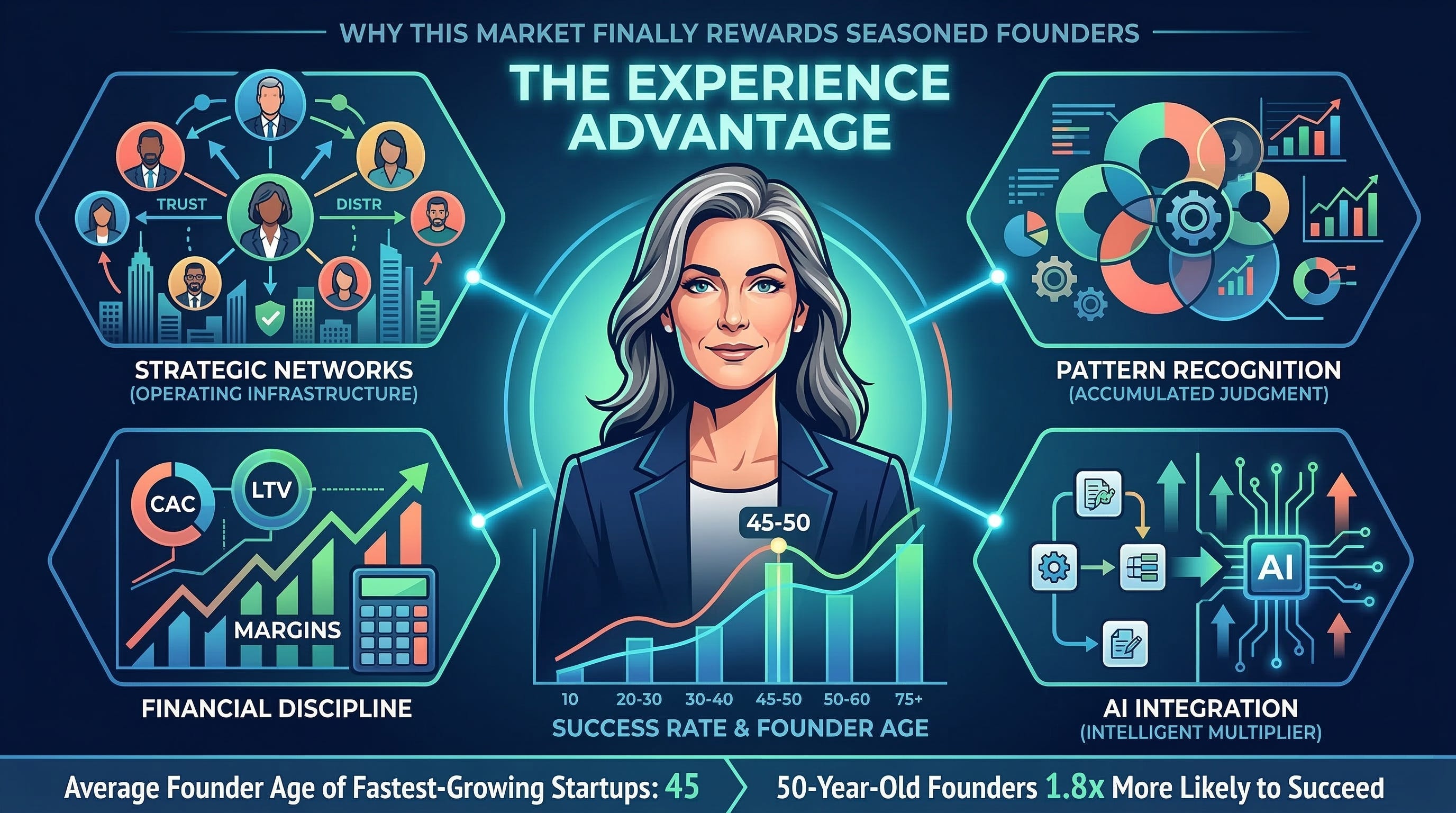
The twenty-something dorm-room founder story has always been more headline-friendly than representative. First-time prodigies rarely build the strongest companies. They are built by operators who have spent years accumulating judgment, pattern recognition, and the kind of scar tissue that sharpens decision-making.
This book is a playbook for ambitious builders ready to convert hard-earned experience into durable scale.
That distinction matters far more today than it did a few years ago.
The era in which rapid growth could excuse weak fundamentals is over. Capital hasn’t vanished. It has simply become selective. Investors continue to back breakout technologies and clear category leaders, but the broader market now demands efficiency, defensibility, and execution discipline. Money still exists. It is simply no longer forgiving.
This shift favors a different kind of founder. It favors leaders who have lived through market cycles. It rewards people who know how to allocate scarce resources, hire against reality instead of charisma, read customer behavior beneath the hype, and build systems that endure when sentiment turns. In loose markets, inexperience can hide behind momentum. In tight markets, judgment compounds.
Experience in this context is not merely age. It is accumulated pattern recognition. The ability to separate a trend from a shift, a real moat from a marketing story, and a temporary spike from durable demand. The founders best positioned right now are those who have turned years of exposure into sharper decisions.
The Data Behind the Myth
The real correction to the founder-age narrative is that young founders sometimes succeed. They are not the norm, but the culture pretends they are.
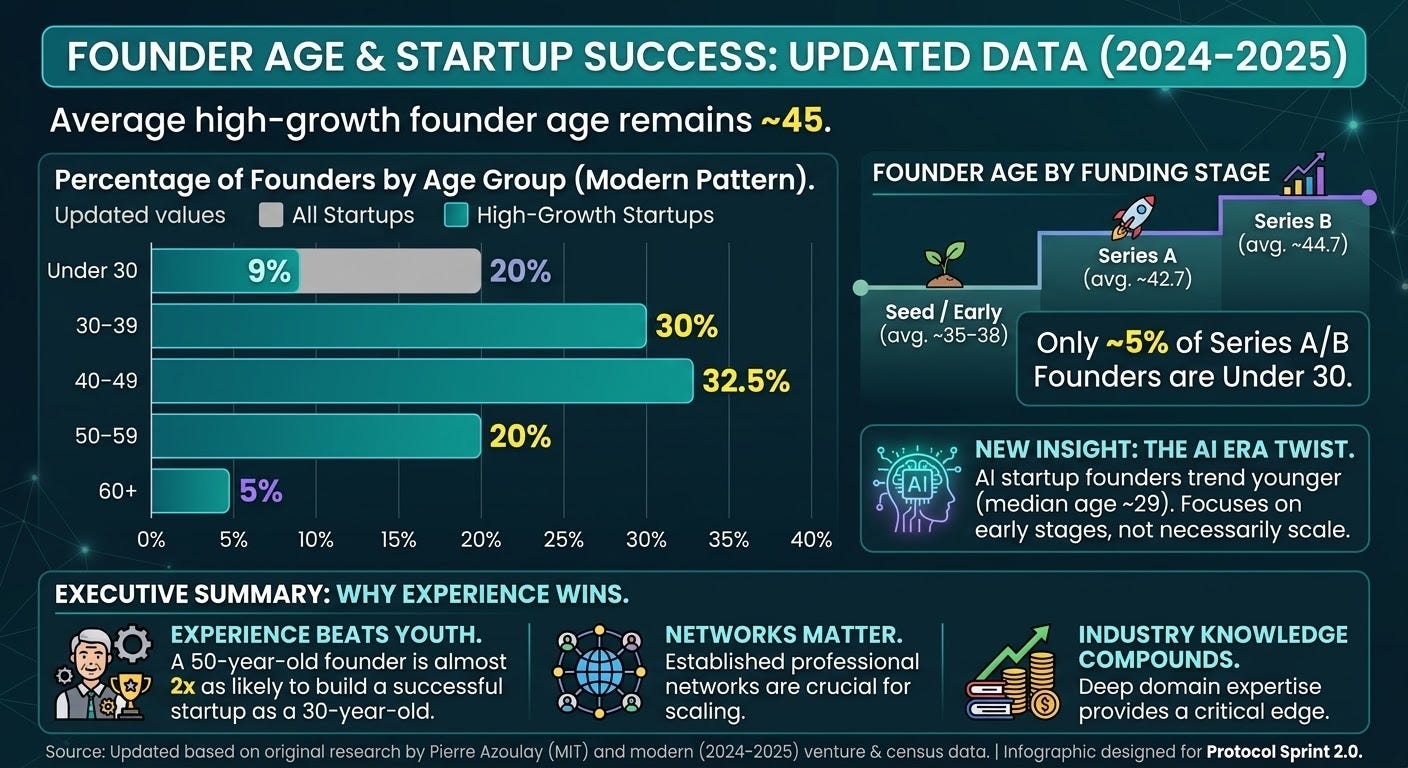
In the widely cited NBER study by Pierre Azoulay and colleagues, which used U.S. Census-linked data shows that the average founder of the fastest-growing new ventures is 45 years old. Conditional on starting a firm, a 50-year-old was 1.8 times more likely than a 30-year-old to achieve upper-tail growth. The research also indicated that founders with prior experience in the same industry were significantly more likely to succeed. Youth is not a disadvantage in every category. But the popular narrative has long confused visibility with prevalence.
This issue matters because many founders still operate as if raw brilliance is the primary engine of scale. It almost never is. Scale rewards, calibration, sequencing, restraint, hiring judgment, and capital discipline. It requires knowing exactly which problem matters now, which can wait, and which is simply noise dressed as urgency.
Early-stage founders may win with speed, instinct, and force of personality. But once a company enters the harder phase (organizational design, capital allocation, process architecture, and strategic timing), experience stops being biographical and becomes an operating advantage.
That advantage shows most clearly in selling. Experienced founders understand the buyer’s full decision environment: procurement friction, budget cycles, internal politics, implementation failures, and shifting priorities. They know exactly where deals stall, what customers are afraid to admit, and which promises can be made safely versus which will become expensive liabilities later. Hard-earned judgment shortens the distance between opportunity and execution.
What Experience Looks Like in Practice
Experience is often mistaken for caution. At its best, it is compression.
A seasoned founder moves faster not because they are reckless, but because they are familiar with the problem. They have seen adjacent versions. They understand second-order effects. They know which variables actually matter and which are distractions.
NVIDIA is a clear example. Its AI-era dominance was not a late pivot to catch a wave. It was built on deliberate, long-term bets: the GPU invention in 1999, CUDA in 2006, and years of expanding parallel computing beyond graphics. Those early decisions created the technical and ecosystem foundation that later made NVIDIA central to modern AI infrastructure. Durable category leadership is usually built well before the market pays full price for it.
Spanx shows the pattern in consumer form. Sara Blakely didn’t win with massive early capital. She won by staying close to the customer, iterating relentlessly, and turning rejection into refinement. Founders with operating scar tissue treat resistance as data. They listen harder than they pitch. One of experience’s quietest advantages is proximity to reality.
📺 Watch how Jensen Huang built NVIDIA’s culture and strategy in the early days
Mastering Purpose Without Performing It
Enduring success requires more than expertise. It requires coherence.
Brands that survive pressure align what they say with how they operate. Values are not decorative. They are embedded in product design, customer experience, and decisions under stress.
Patagonia’s “Don’t Buy This Jacket” campaign became iconic not because it was provocative, but because it matched an operating philosophy already built around durability, repair, and environmental commitment. Sales rose more than 30 percent the following year, reaching roughly $543 million. The deeper lesson is not the revenue spike. The message landed because the company had already earned the right to say it.
Experienced founders understand the situation earlier than most. The brand is not as you claim and is in good condition. Brand is what you can continue to prove when conditions are difficult.
Networks Are Not Cosmetic. They Are Infrastructure.
One of the most common founder mistakes is treating networks as soft power instead of operating infrastructure.
A strategic network reduces information latency, accelerates trust transfer, expands access to talent, partners, customers, and distribution, and shortens the path from problem to solution. That is not vanity. It is leverage.
Founders who operate in silos shrink their own surface area. They learn slower, recruit weaker, and waste time solving problems someone two calls away already solved. At scale, strategic relationship-building is not optional. It is part of the operating system.
Canva’s Melanie Perkins illustrates this well. Her fundraising journey involved repeated rejections until access completely changed the game. Warm introductions and credibility transfers opened doors that cold outreach could not. A respected connection can accomplish in an hour what blind outreach fails to do in six months.
Over time, capable operators accumulate trusted relationships: people who have scaled from 10 to 100 employees; navigated channel conflict; understood regulatory friction; and know what breaks when a company shifts from founder hustle to institutional execution. The network becomes an extension of judgment.
📺 Watch how Melanie Perkins navigated early fundraising rejection
The New Premium on Financial Discipline
The market reset has brought to the forefront a trait that should always be in vogue: capital discipline.
Investors now scrutinize the quality of growth. The question is no longer just whether revenue rises. It is whether the business can scale without destroying its economics.
Founders need fluency in the fundamentals: customer acquisition cost, lifetime value, contribution margin, payback period, and cash conversion. Growth without clarity is not ambition. It is drift.
Airbnb is a useful case. When travel collapsed, the company cut aggressively, narrowed focus, and leaned into resilient segments. Q4 2022 revenue reached $1.9 billion, up 24 percent year over year, contributing to full-year revenue of $8.4 billion.
The lesson is not scale replication. It is that disciplined leadership matters most when conditions change fast.
Experienced founders have an edge here. Scar tissue teaches simplification, faster cuts, and less sentimental resource allocation. Bloated teams often hide weak strategy. Many businesses fail slowly before they fail suddenly. Financial discipline is not anti-growth. It is what allows growth to survive reality.
📺 Watch how Kevin O’Leary evaluates cash flow and unit economics
The AI Twist
Artificial intelligence changes the founder equation, but not in the simplistic way many assume.
Yes, many recent AI unicorns have emerged from the minds of exceptionally young builders. Antler’s analysis of over 1,600 unicorns showed the average age of AI unicorn founders fell to 29 in 2024. That does not undermine the case for experience. It sharpens it.
Building fast and scaling durably are different challenges. The companies that win with AI will be those that know exactly where it reduces friction, where it introduces risk, and where human judgment remains irreplaceable.
Experienced founders have a quiet advantage here. They recognize truly bottlenecked workflows, identify high-value customer problems, and distinguish real leverage from false confidence. They know AI is a multiplier, and a multiplier only matters if the underlying business is coherent. The opportunity is not to replace experience. It is to amplify it intelligently.
📺 Watch how Chamath Palihapitiya talks about AI and investing
The Real Edge
The best founders in this market are not simply older. They are more integrated.
They combine domain knowledge with customer fluency. Strategic relationships with operating rigor. Ambition with discipline. They do not confuse momentum with strength.
That should be encouraging.
Every difficult client, failed hire, bruising cycle, delayed deal, and product misfire may have done more than slow you down. It may have forged the exact judgment this market now rewards. For those who have spent years learning the challenging way, this environment is not a handicap.
It is a filter. And increasingly, it is a filter that rewards them.
Your Breakthrough Roadmap
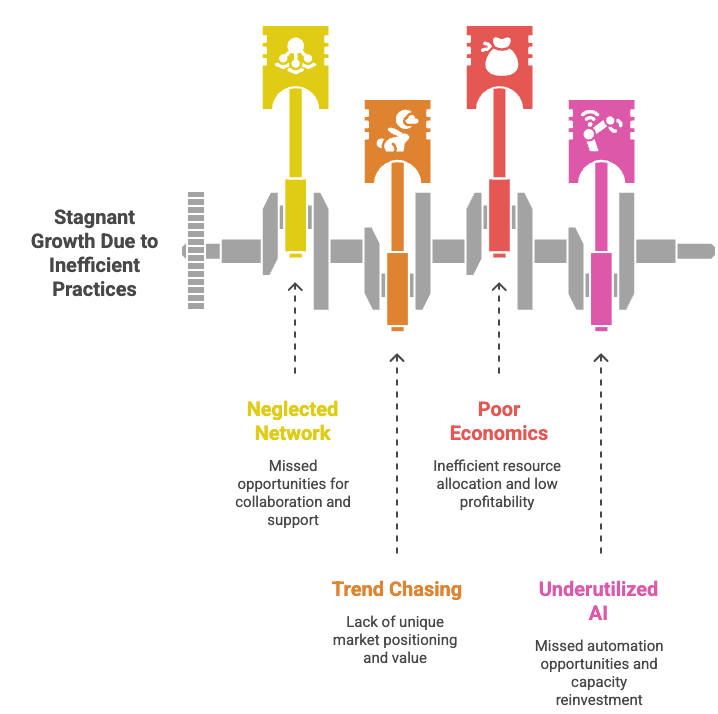
1. Audit and Activate Your Network Map your 50 most valuable professional relationships this week. Identify gaps around your next growth milestone. Reach out to three people with genuine value first, before asking for anything.
2. Compete on Earned Insight Stop chasing trends. Isolate the market blind spot your experience lets you see clearly. Build your positioning and messaging around that single, hard-earned truth.
3. Tighten Your Economics Run a ruthless audit within 30 days. Know your true CAC, LTV, margins, and payback periods. Cut the bottom tier of initiatives that consume resources without meaningful return. Reallocate to winners.
4. Institutionalize Useful AI Identify three repetitive, time-draining workflows. Deploy targeted AI solutions to automate them within the next month. Measure hours saved. Reinvest that capacity directly into revenue, product quality, or customer experience.