

The Fast-Dollar Trap
Why the Fastest Money in AI Has the Shortest Shelf Life


The danger is not that fast AI service work fails. It is that it succeeds just long enough to trap you.
I keep seeing the same pattern with AI service businesses, especially those built around content packages, prompt systems, and quick automation.
They do not look broken from the outside. They look busy.
The money comes fast at first. A client needs posts. A founder wants a prompt system. A team wants a simple automation that saves a few hours. The work is delivered quickly. The invoice is paid. Everyone feels ahead.
Then the gap closes.
The client learns the tool. A cheaper provider appears. The platform adds the feature natively: a summary button, an auto-caption tool, a built-in email draft, and a one-click report.
Fast-dollar work is a treadmill with invoices attached.
It feels like momentum, but nothing is being built underneath it.
That’s the trap. The work pays, but it does not compound.
This is not an argument against service work. Services are often the best place to learn where the real pain is. The point is to turn service work into something that continues to work after the invoice clears.
The problem is not the act of doing service work. The problem is doing service work that teaches you nothing and leaves nothing behind.
If you are selling AI work that a client could soon approximate on their own, the issue is about you.
The trap is not the work. It is the reset.
Fast-dollar work arrives quickly because it is easy to sell, easy to deliver, and easy for someone else to replicate. The better version of the business is not passive income. It is something reusable: a workflow, dataset, system, tool, or habit that makes the next month a little easier than the last.
The dangerous part is that fast-dollar work often looks successful right before it starts compressing.
You do not wake up one day with a broken business. You wake up with a full calendar, thinner margins, more delivery pressure, and a nagging sense that the machine you built only runs when you are pushing it.
A full calendar can disguise a weakening business.
Why the margin starts to disappear
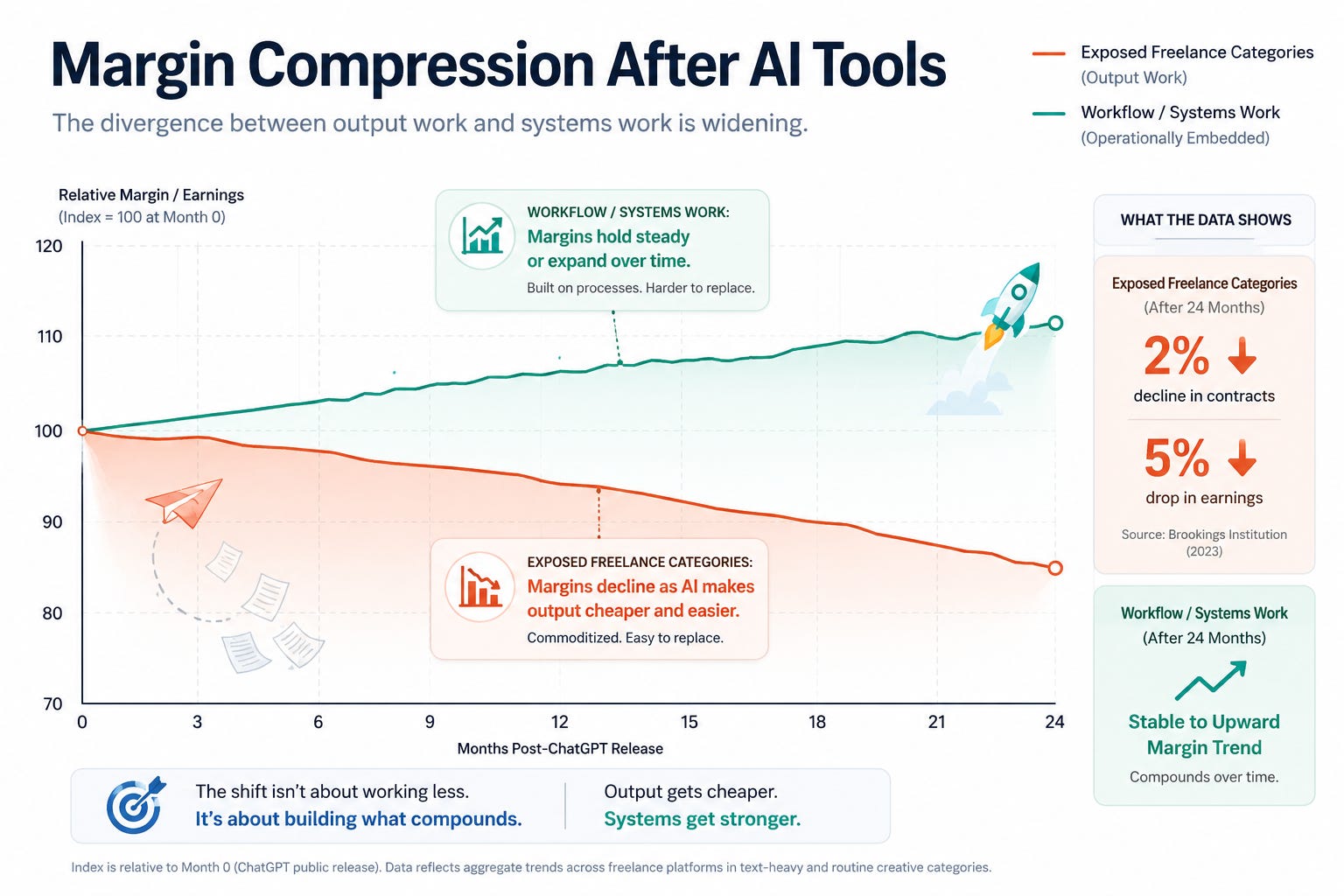
You can already see hints of this trend in freelance markets. Brookings, looking at online freelance work after the release of new AI tools, found that freelancers in occupations most exposed to generative AI saw about a 2% decline in contracts and about a 5% drop in earnings, especially in text-heavy and routine creative categories. The numbers are modest, but the direction matters: when acceptable output gets easier to produce, the buyer has more options.
The closer you stay to raw output, the more exposed your margin becomes. The business does not lose because demand disappears. It loses because supply becomes legible, comparable, and cheap.
The advantage comes from what is left behind after the engagement.
Generative AI Explained In 5 Minutes | What Is GenAI? | Introduction To Generative AI
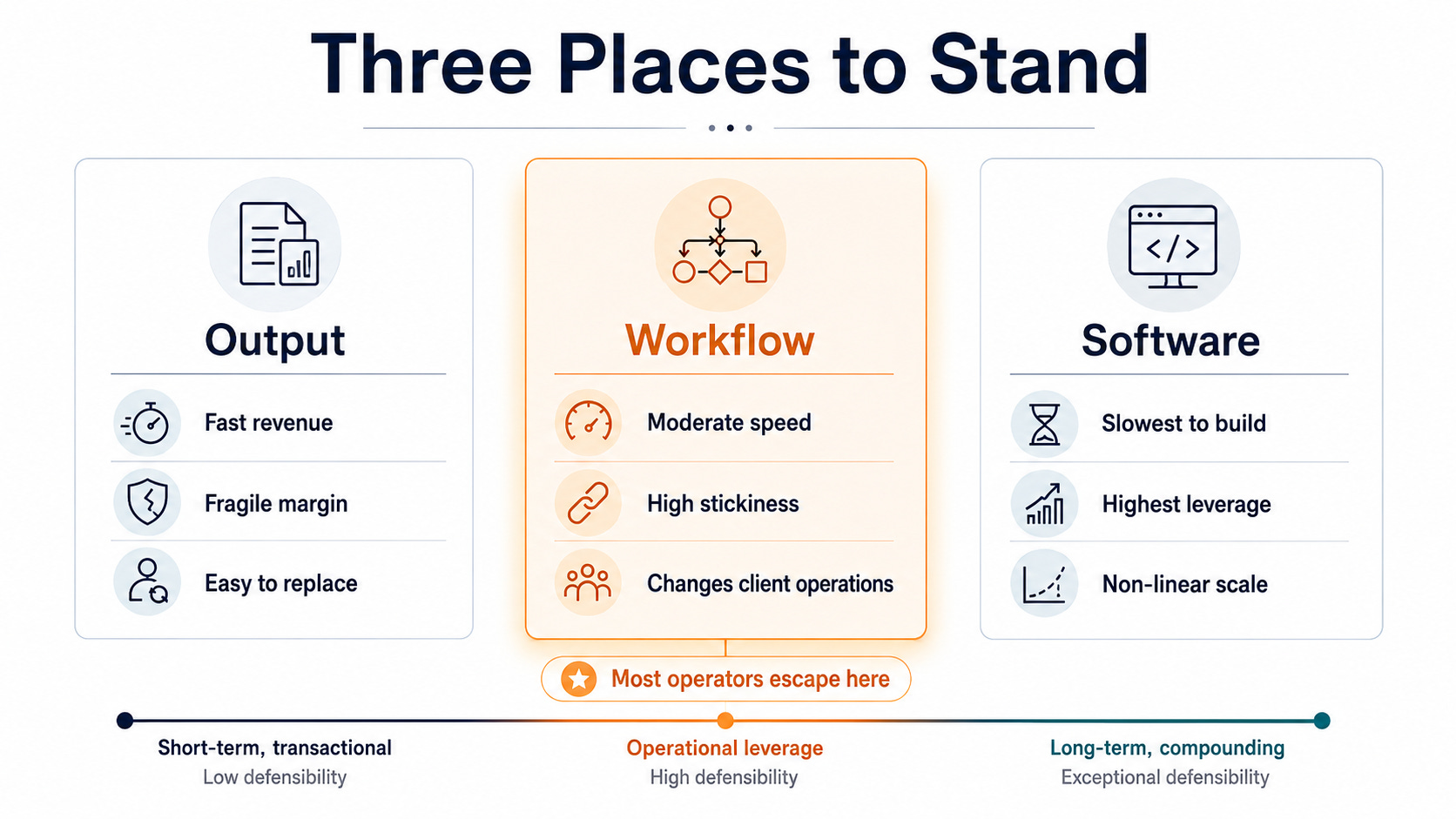
There are only three places to stand
There are only three places to stand.
You can sell output.
You can own a workflow.
Or, eventually, you can productize the pattern.
Selling output pays quickly. Productizing software may scale eventually. But owning the workflow is where most operators actually find their escape. It is the bridge between cash flow and ownership.
Take a podcast agency
A podcast agency makes the pattern easy to see.
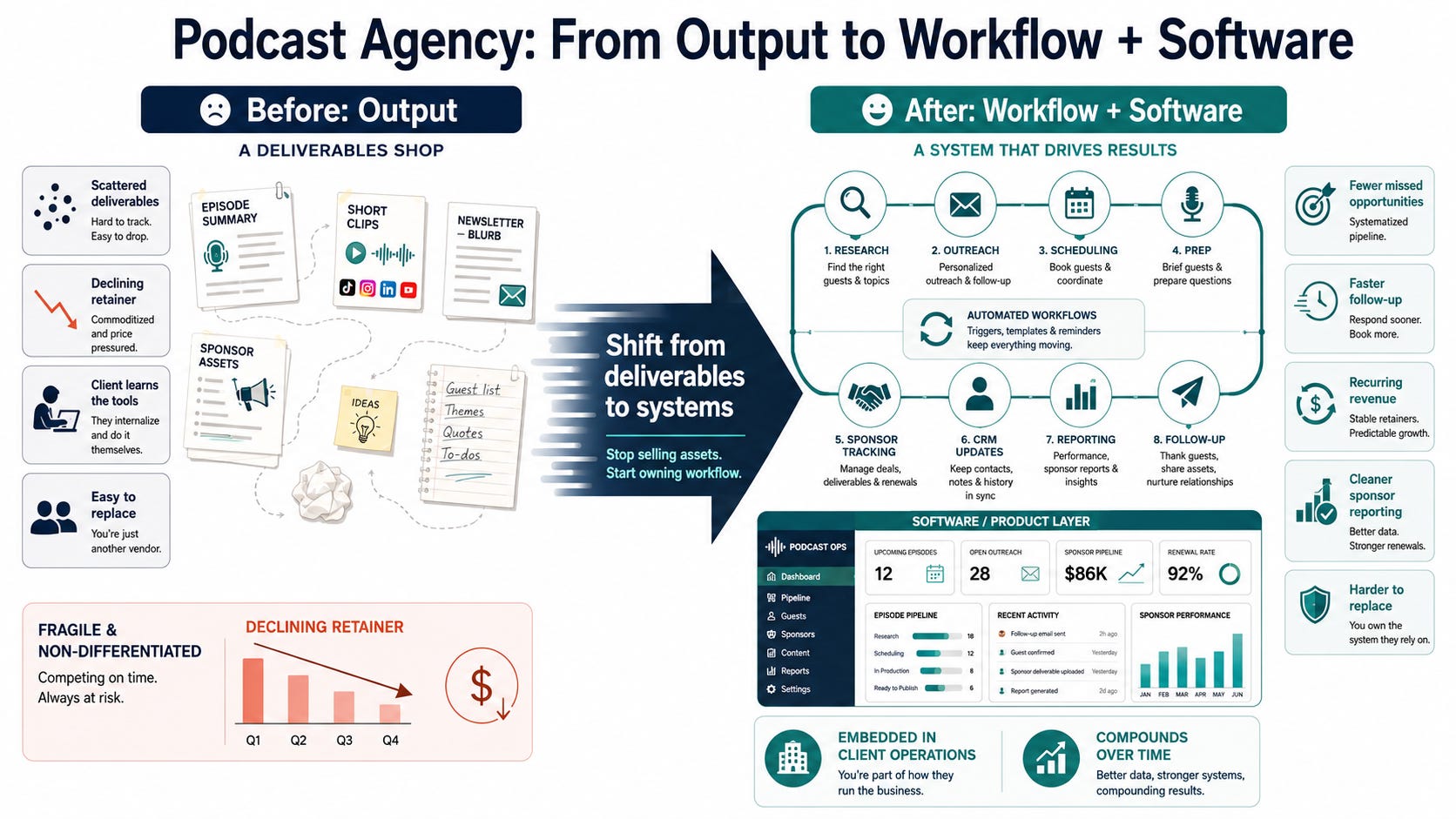
The agency starts by selling what every client thinks they need: episode summaries, short clips for social media, newsletter blurbs, and sponsor assets. The deliverables look professional. The client shares them. The numbers look fine. The client is happy to avoid learning the tools. The retainer feels safe.
Then six months later, someone on the client’s team is using the same models. The clips are still good enough. The summaries are still acceptable enough. The client starts asking why the retainer is still so high.
The agency is still working diligently The work may still be adequate It just no longer feels scarce.
That is the output business.
The stronger move is to stop selling the assets and start managing the machinery around the show: who gets contacted, when follow-up happens, what gets logged, which sponsor promises are tracked, and where the next opportunity goes. Now the agency is not just delivering assets after the episode. It is shaping what happens before, during, and after the show. The value is no longer measured in the number of clips delivered. It is measured in fewer missed guest opportunities, faster follow-up, cleaner sponsor reporting, and less manual coordination.
Replacing that kind of system does not mean swapping vendors. It means changing habits, handoffs, records, and routines.
Now the agency owns part of the workflow.
After seeing the same guest-pipeline friction across multiple B2B podcast clients, the agency productizes a narrow guest-pipeline tool.
At that point, productization becomes realistic.
The best operators do not jump from commodity services straight to software. They first move into owning the workflow.
Deliverables versus assets
A deliverable is consumed. An asset keeps working. A deliverable answers the client’s request once. An asset changes how the client’s business operates again and again.
A clip is a deliverable. A repeatable system for turning every episode into guest follow-up, sponsor reporting, and sales intelligence is an asset.
The strategic mistake is treating a paid deliverable as the business model when it should be treated as evidence of a repeatable system.
Why micro-software must be earned, not guessed
The furthest version of this approach is small, focused software. But software should be earned, not guessed.
The best micro-software does not usually come from a whiteboard. It comes from irritation. You solved the same narrow problem by hand three times. You noticed the same ugly workaround in three different accounts. If the same task is boring for you three times, it may be valuable for someone else a hundred times. That is when software starts to make sense.
Building too early is just another way to avoid the harder work of proving the pain.
A product only becomes powerful when the builder has a credible path to the next ten buyers. Repeated client pain gives you more than a product idea. It gives you a distribution map.
The right sequence is service, repetition, internal tool, then product.
The wrong sequence is idea, build, launch, and hope.
Success is hard until you build systems like this
The two tests that actually matter
Start with one uncomfortable question: could a reasonably competent client reproduce the result tomorrow with public tools?
If yes, the revenue is at risk. If yes, but with effort, the offer needs to be repositioned. If not without rebuilding how the client’s business works, you may have something defensible.
The second question is even simpler: does the work remember?
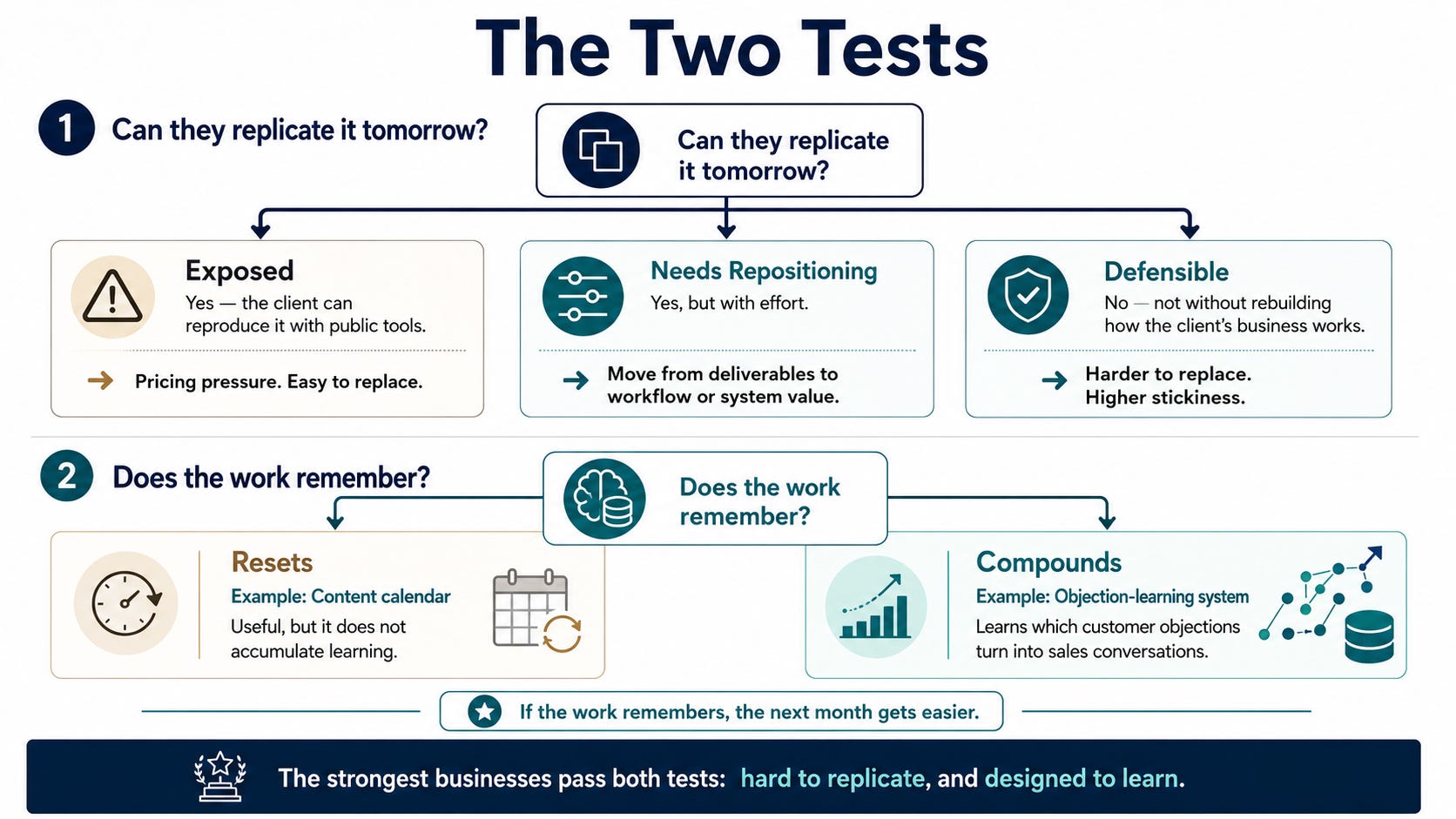
Does it accumulate rules, data, workflow logic, client history, or operating knowledge that makes the next month easier? A content calendar does not remember much. A system that learns which customer objections convert into sales conversations does.
If the work does not remember, it probably resets.
What to stop selling
This is not just a delivery change. It is a language change.
Stop selling the post. Sell the system that turns raw material into distribution.
Stop selling the prompt library. Sell the client-specific decision logic.
Stop selling the one-off automation. Sell the maintained automation layer.
Stop selling the research report. Sell the repeatable research system.
The strategic move is from pricing the artifact to pricing the operational improvement.
The audit I would run this week
The audit I would run this week. Look at your last ten paid deliverables and ask five questions.
What did the client actually buy?
Could they reproduce it with public tools?
Did the work remember anything?
Does the pain repeat across clients?
What would the more durable offer be?
Do not start with a new business plan. Start with the revenue you already have. Which pieces reset the moment they are delivered? Which pieces could become workflows? Which workflows could become tools? The exposed work will reveal itself.
How AI is breaking the SaaS business model
The fast dollar feels like freedom because it arrives quickly. But if it must be earned again from zero every month, it is not freedom. It is velocity without escape.
The real escape is work that keeps working.
The future does not belong to the fastest operator. It belongs to the one whose systems keep creating value after they leave the room.