

The Founder Bottleneck
Why Productivity Is Keeping Your Business Small

Why This Matters Now - The next generation of great companies will not be built by founders who work harder. They will be built by founders who make themselves less necessary. That shift is already underway.

After interviewing more than 30,000 founders, CEOs, investors, and operators over the last forty-five years, I’ve noticed something strange. The wealthiest people rarely obsess over time management. They obsess over removing themselves as the bottleneck.
A few years ago, I sat across from a founder who looked, from the outside, like a productivity machine. His calendar was color-coded, his inbox was clean, and his mornings were perfectly disciplined. His coffee had gone cold beside the laptop. He had read the books, installed the tools, hired the assistant, and built the kind of schedule people screenshot and post online as proof of seriousness.
Then I asked him a simple question: “What happens if you disappear for 30 days?”
He did not laugh. He did not answer quickly either.
He knew.
Sales would slow. Customers would wait. Decisions would pile up. The team would hesitate. The company would continue to exist, but it would stop moving.
That was the real business model: him.
This is the trap many high-performing founders mistake for success. They are not disorganized. They are disciplined, focused, and quietly exhausted. And they are still the bottleneck.
Most founders are not short on time.
They are running out of systems.
The Productivity Advice Is Not Wrong. It Is Just Too Small.
Founders have been fed the same productivity doctrine for years: prioritize better, time block your day, eliminate distractions, follow the 80/20 Rule, and automate repetitive tasks.
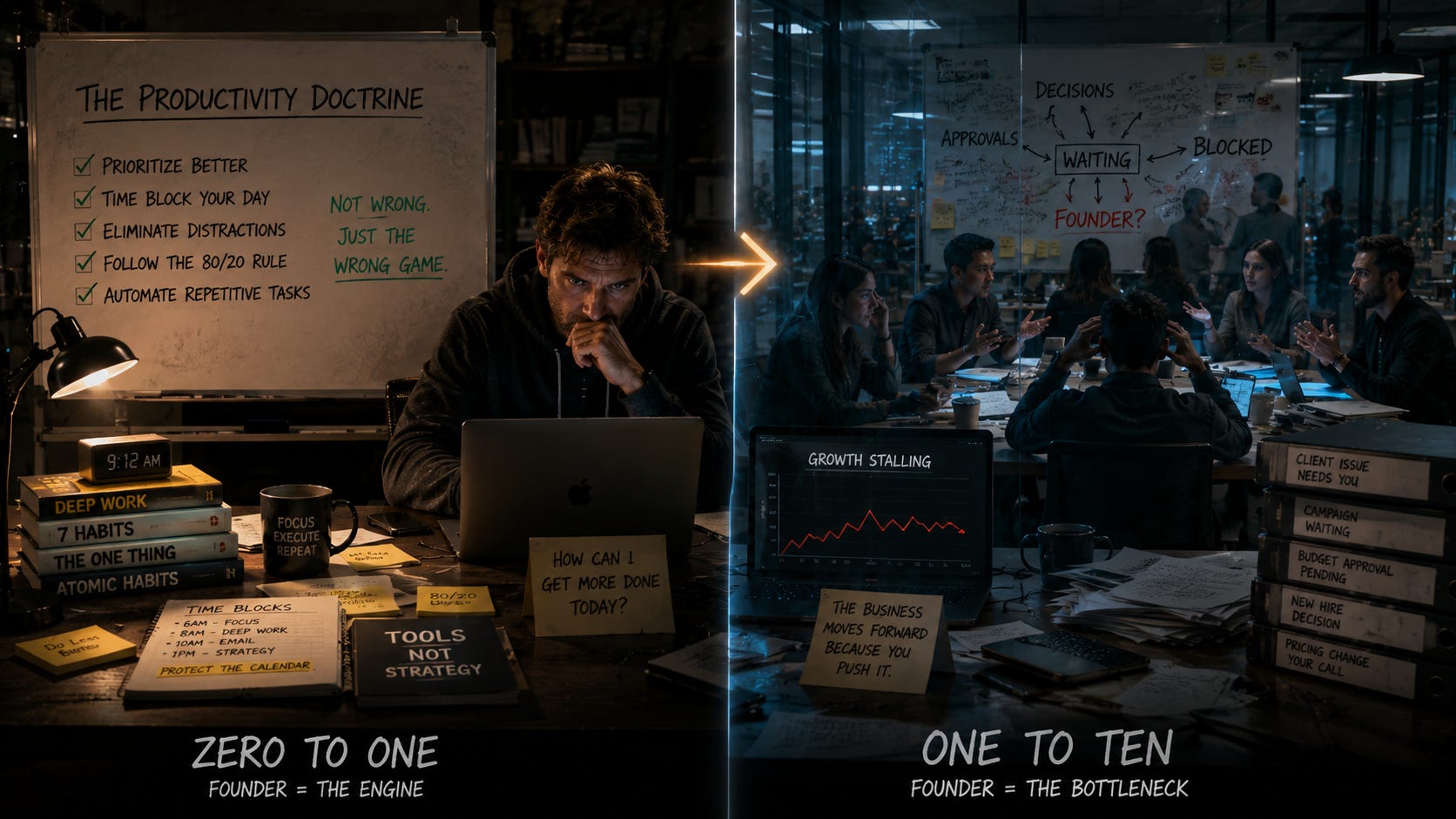
None of it is wrong.
It is just built for the wrong game.
Traditional productivity asks, “How can I get more done today?”
That is a useful question for a solo operator. It is a dangerous question for someone trying to build an organization.
Because hidden inside that question is an assumption: the business moves forward because you personally push it forward.
At the beginning, that is true. The founder closes the first customers, writes the copy, and fixes the broken processes. That intensity is what keeps the startup alive.
But the skill that gets you from zero to one can quietly sabotage you from one to ten.
At some point, the question has to change.
Not “How can I get more done?”
But “How can this get done without me?”
That single question changes everything. It separates personal efficiency from real scale.
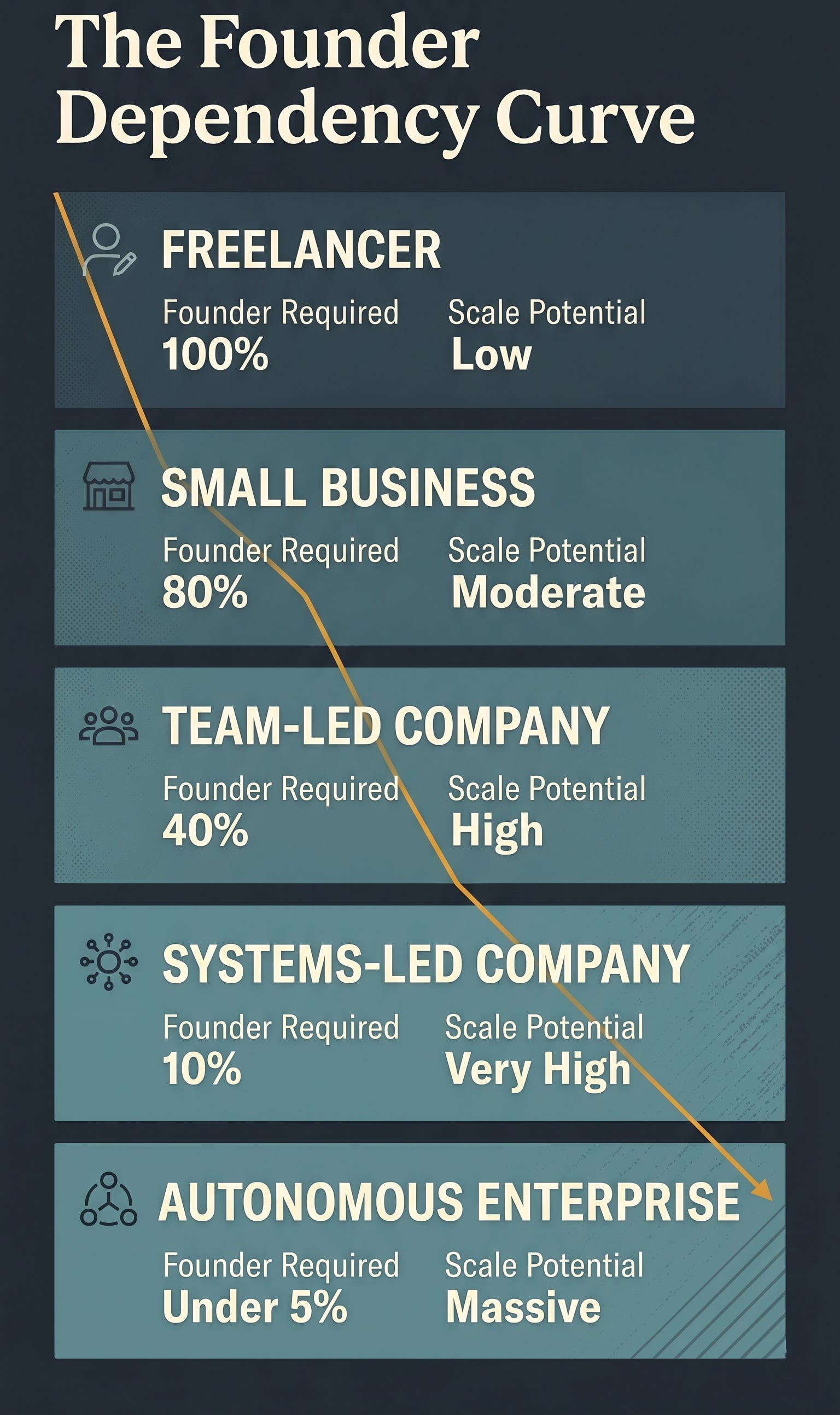
The Founder Productivity Trap
The most dangerous founder in the room is often the most productive one.
Why?

This is because extreme personal productivity can hide massive organizational dependency. When a founder becomes extraordinarily efficient at solving problems, putting out fires, and making quick decisions, nobody notices they are still the ultimate bottleneck.
The business appears to be thriving, but it is actually hyper-dependent on a single nervous system.
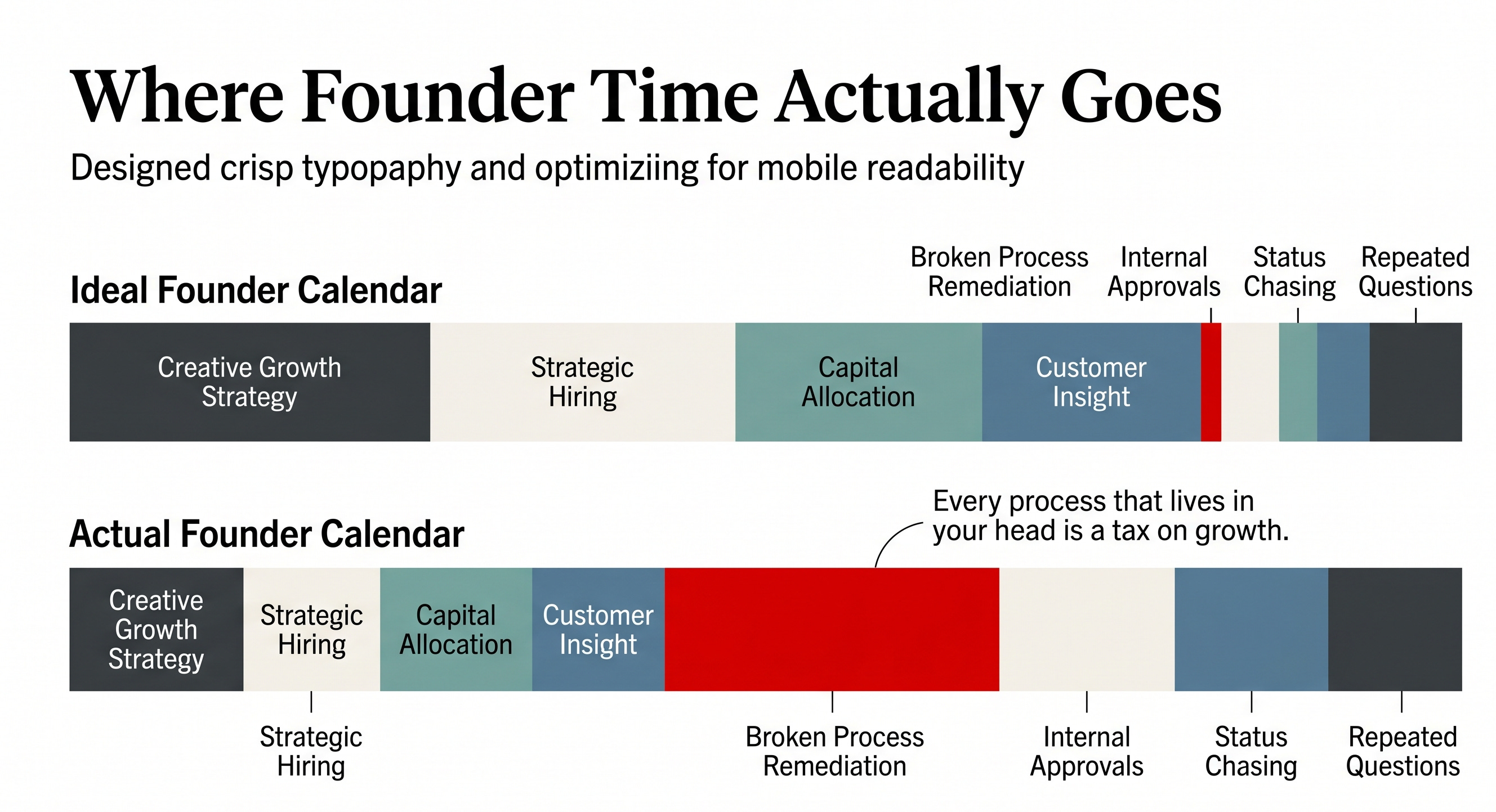
Every process that lives in your head is a tax on growth.
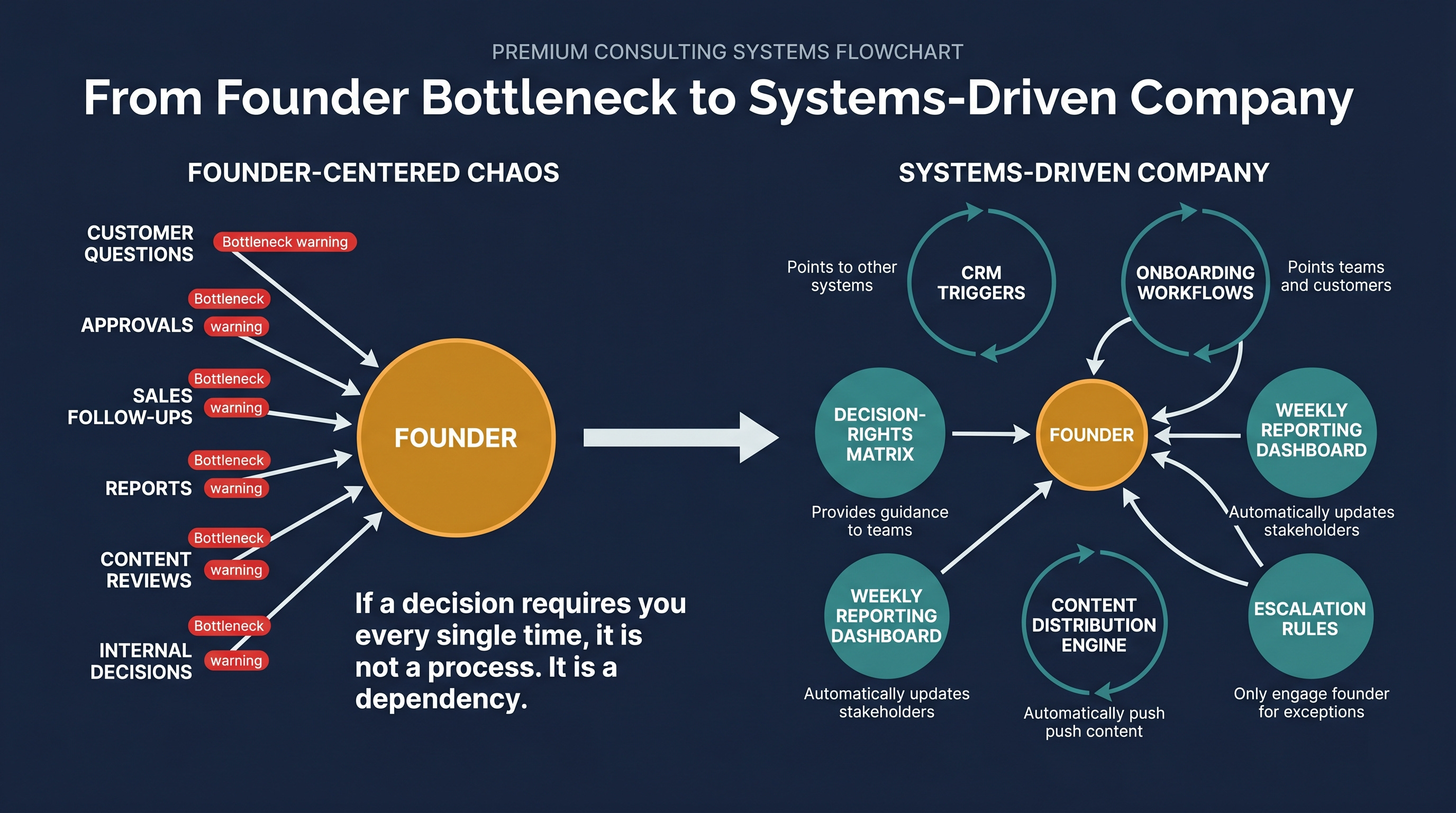
If a decision requires you every single time, it is not a process. It is a dependency.
Years ago, I interviewed a founder whose company was growing rapidly. On paper, revenue looked fantastic. But every single vacation turned into a company-wide crisis. If an enterprise client had a complaint, the founder had to step in. If a marketing campaign needed to launch, the founder had to review the creative.
The work moved fast because the founder worked fast, but the team never learned how to make a decision or execute a handoff without an approval stamp.
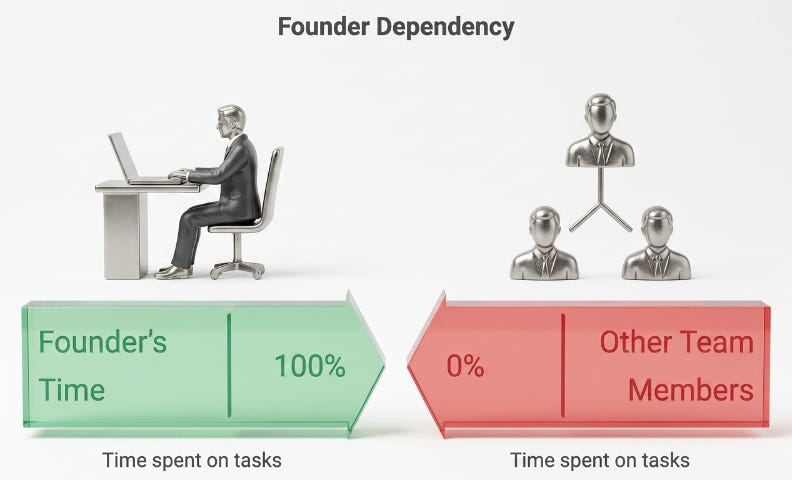
The founder had created a high-revenue job, not a self-sustaining asset.
True scale means building a company that survives your absence.
How to Operate (Keith Rabois)
The New Economics of Scale
For most of business history, growth usually required adding more bodies, more meetings, and more coordination overhead.
That equation is beginning to change.

McKinsey research estimated that generative AI and related technologies could automate work activities that currently consume 60% to 70% of employees’ time, potentially adding trillions of dollars in annual economic value across the global economy.
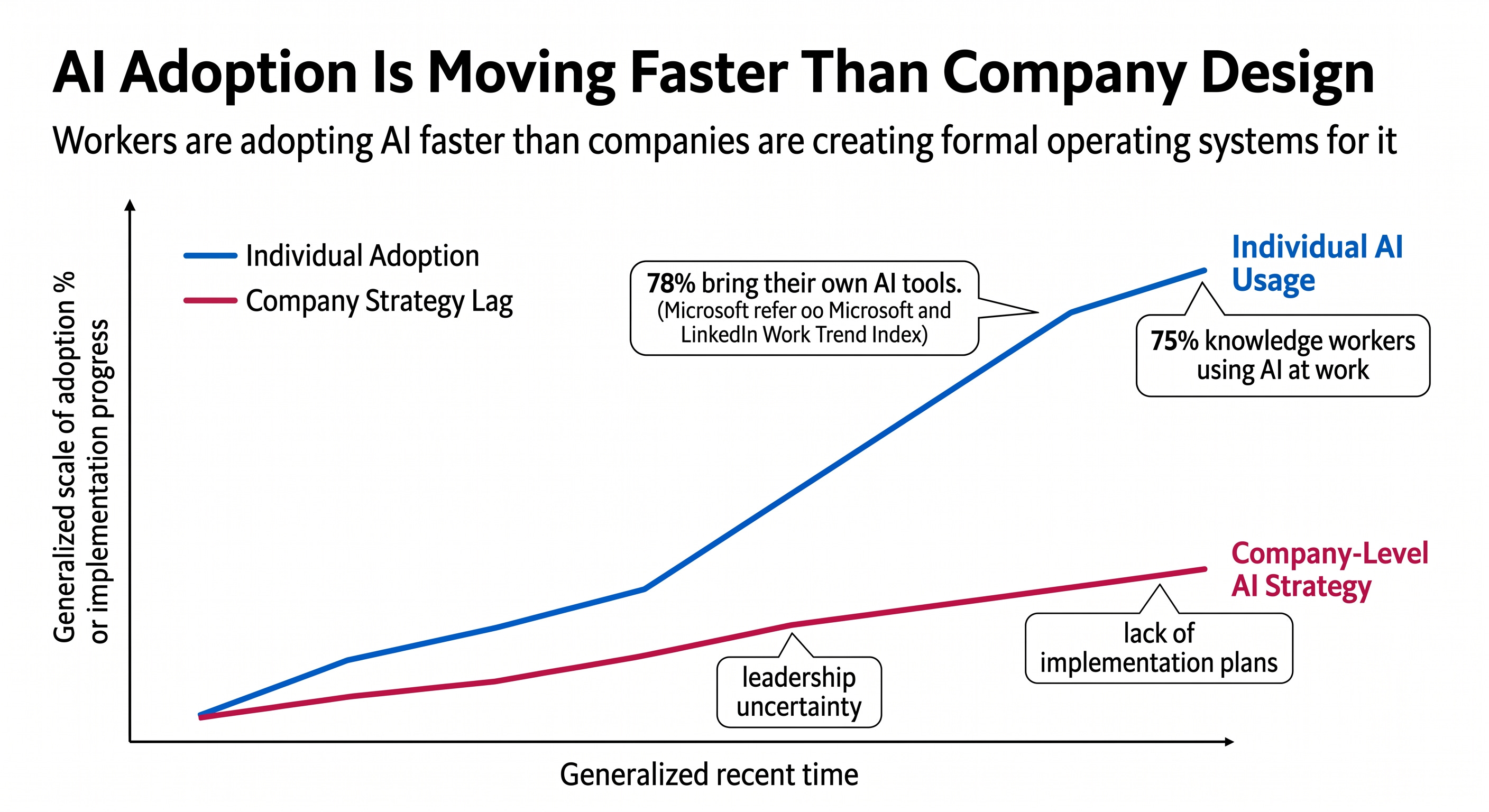
Further data from the Microsoft and LinkedIn Work Trend Index found that 75% of knowledge workers were already using generative AI at work, with 78% of those users bringing their own AI tools into the workplace.
Most founders see those numbers and think about productivity.
The smarter question is ownership.
What work can leave your desk forever?
The workforce is not waiting for official permission. The adoption curve is happening from the bottom up. But here is where many founders miscalculate: they think the opportunity is simply to make individual workers faster.
That is a shallow reading of the market.
The deeper opportunity is to redesign the company’s operating system.
AI does not fix a broken workflow. It accelerates the mess.
The winners will not be the founders who bolt AI tools onto chaos. The winners will be the operators who clean the workflow first, codify the logic, then use automation to compress cost, speed, and decision cycles.
Efficiency Saves Minutes. Systems Remove Bottlenecks.
Efficiency asks, “How can I do this faster?”
Scale asks, “Why does this require me at all?”
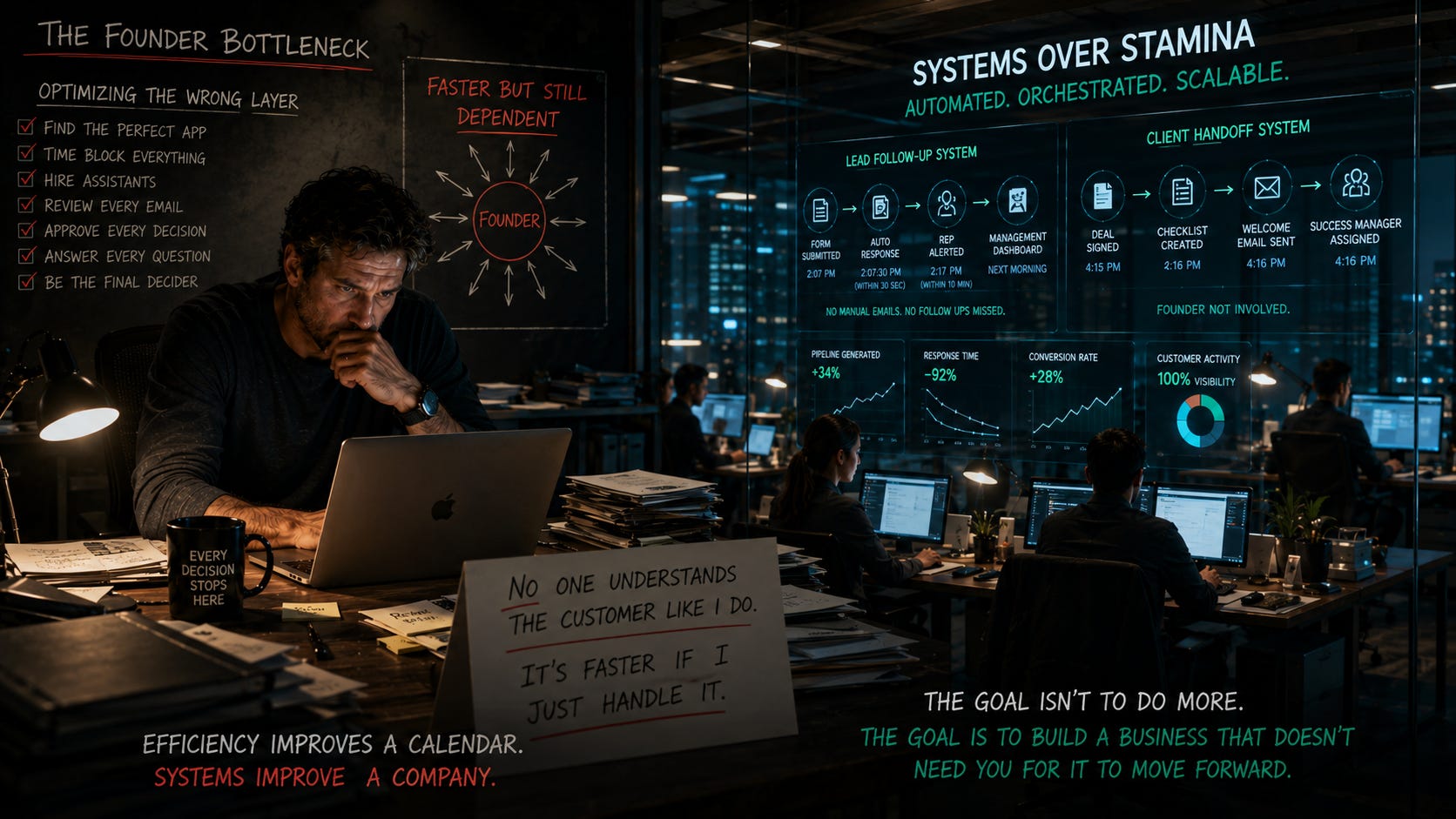
Efficiency improves a calendar.
Systems improve a company.
When you optimize the wrong layer, you spend hours choosing the perfect productivity app while still personally approving every minor decision. You hire assistants, but you still make all the final decisions yourself. The work moves slightly faster, but the dependency remains.
To understand what elite operators actually build, look at the concrete realities of a systems-driven business.
The strategy: Optimizing lead follow-up.
The reality: A prospect fills out a form at 2:07 PM. Within 30 seconds, they receive a personalized response. Within 10 minutes, the right sales rep is automatically alerted with context. By the next morning, management sees the entire activity mapped on a dashboard without a single manual email being sent.
The strategy: Managing client handoffs.
The reality: A new customer signs at 4:15 PM. By 4:16, the onboarding checklist is created, the welcome email is sent, the success manager is assigned, and the founder never sees the handoff.
The founder bottleneck is usually disguised as high standards. Founders say: “No one understands the customer like I do,” or “It is faster if I just handle it.”
High standards are valuable.
Founder dependency is expensive.
Gallup research on entrepreneurs has long pointed to delegation as a meaningful growth behavior, finding that leaders with stronger delegation talent generated significantly greater revenue than those with limited delegation talent.
The lesson is not to abdicate judgment.
The lesson is to transfer that judgment into playbooks, automated workflows, and clear decision rules.
Put Me In Coach: Hiring and Delegation At an Early Stage Startup
The Work About Work Problem
Modern teams are drowning in coordination. Asana’s research has repeatedly highlighted how much time knowledge workers lose to “work about work”: chasing updates, attending low-value meetings, switching between tools, searching for information, and managing status instead of producing real output.
That is where you should be looking.
Look at the boring, recurring parts of the operation:
• The customer onboarding sequence.
• The automated financial reporting.
• The content distribution loops.
• The proposal that waits three days because one person forgot to approve it.
• The internal question you answer nine times because no one wrote down the rule.
These are the hidden taxes on scale.
A company slows down because its operating system is full of structural friction.
The New Founder Job Description
The founder’s job is not to become absent.
It is to become less necessary for routine motion.
Great leaders still set direction, shape culture, make high-stakes calls, allocate capital, and recruit elite talent. But they stop treating personal availability as leadership. They stop measuring their importance by how many people need their permission.

Founder dependency can feel flattering. It feels powerful to be the ultimate decision-maker for every operational handoff.
Often, it is just poor design.
PwC’s Global AI Jobs Barometer highlighted that sectors more exposed to AI were experiencing far higher labor productivity growth. This points to a broader reality: market advantage is about changing the output per person.
Capital-efficient companies with small, systems-driven teams will do work that once required large departments.
The old scaling model was simple: add headcount.
The new scaling model is sharper: remove friction, codify the process, automate the repeatable, and then add talent where human judgment truly matters.
Lean does not mean underpowered.
Small does not mean weak.
A small team with clean systems can beat a large team trapped in meetings, permissions, and confusion.
The Inside Story of ChatGPT’s Astonishing Potential | Greg Brockman
Stop Worshiping the Full Calendar
A packed calendar is often a warning sign that a company has failed to distribute trust.
Every meeting is not a sign of leadership.
Sometimes it is just bad plumbing.
If the business cannot move unless you move first, you do not have an operating company.
You have a dependency machine.
Your Breakthrough Roadmap
So the practical question becomes simple: where is your company still waiting on you?
Step 1: Run a Founder Dependency Audit
What to do: For two weeks, track every task, approval, meeting, and internal question that requires your direct involvement.
Why it matters: You cannot remove a bottleneck you have not named. Most founders underestimate how much of the company relies on their personal attention.
How to start: Create a simple spreadsheet with four columns: task, frequency, time required, and reason it needs me. Log the work as it happens.
Step 2: Codify the Top Three Recurring Tasks
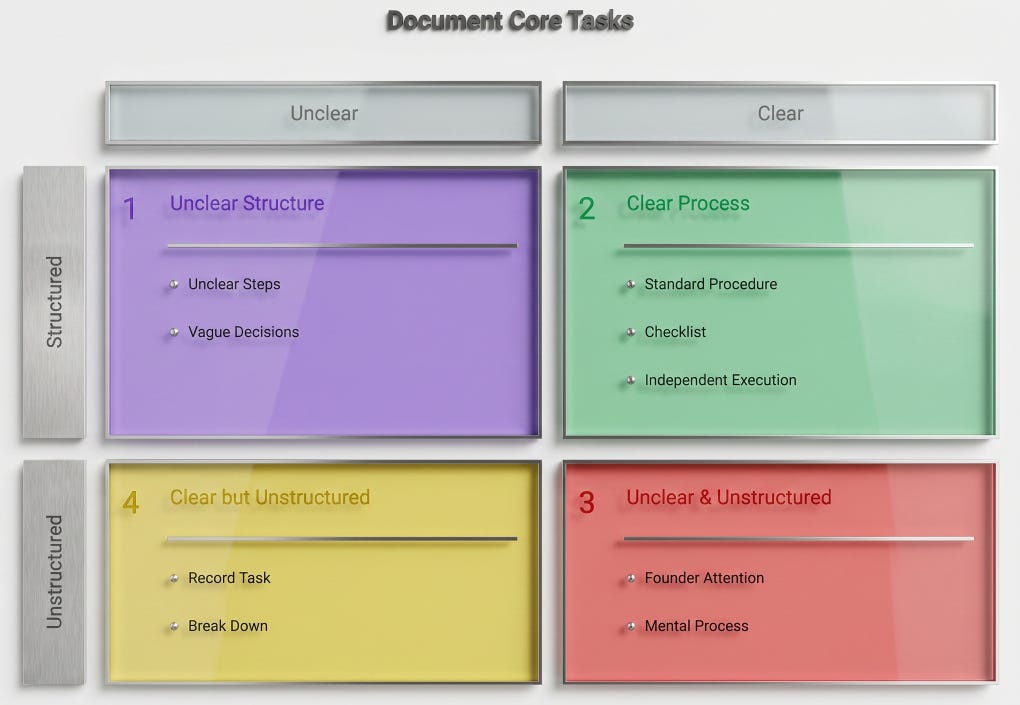
What to do: Choose the three recurring tasks that consume the most founder attention. Break each into a clear sequence of steps, decisions, inputs, and outputs.
Why it matters: A process that lives only in your head cannot scale or be delegated cleanly.
How to start: Record yourself doing the task once, then turn that recording into a checklist or standard operating procedure clear enough for a team member to run independently.
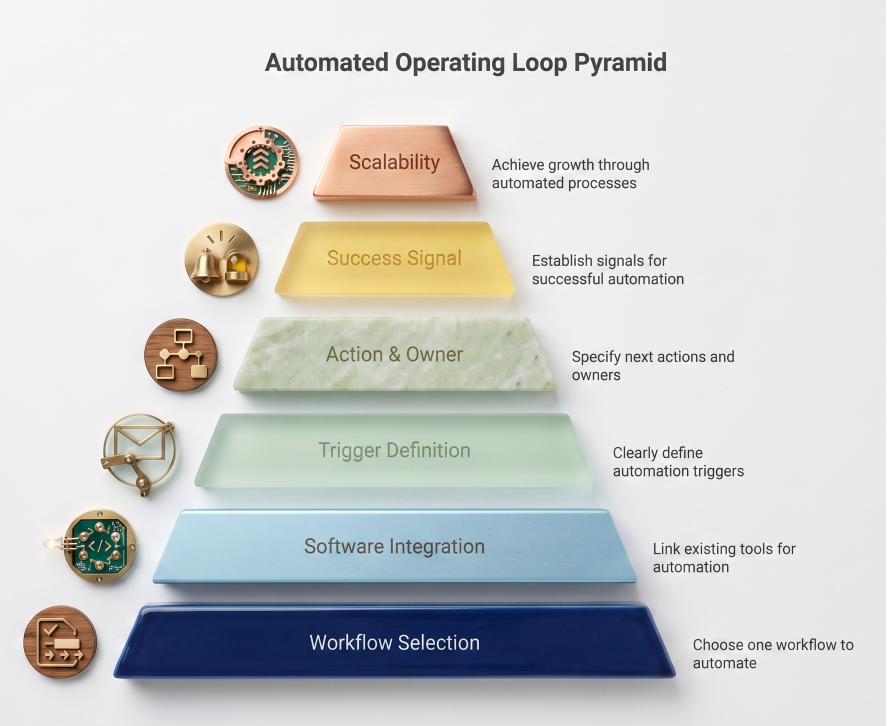
Step 3: Build One Automated Operating Loop
What to do: Pick one workflow and connect the pieces. Transition from manual tracking to an automated loop: lead capture to CRM update, leading to a follow-up email, an internal alert, and an automatic weekly report.
Why it matters: Scale starts when work moves because the system triggers it, not because a human remembers it.
How to start: Use your existing software infrastructure to link your tools. Define the trigger, the next action, the owner, and the success signal clearly.
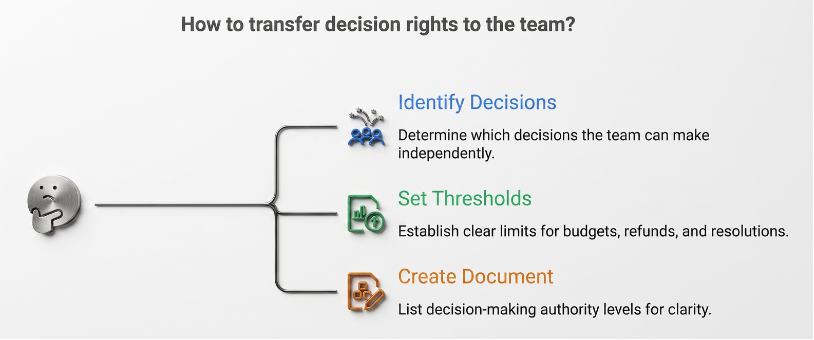
Step 4: Transfer Decision Rights
What to do: Identify decisions your team can make without you. Set clear thresholds for budgets, refunds, customer resolutions, content approvals, and project movement.
Why it matters: Delegating tasks without delegating authority creates a slower version of the same bottleneck.
How to start: Create a decision-rights document. List what the team can decide alone, what needs manager review, and what truly needs founder approval, starting with low-risk items.
Most founders spend years trying to become more productive.
The best founders eventually realize productivity was never the goal.
The goal was freedom.
Not freedom from work.
Freedom from being required.
The ultimate test of a company is not how well it performs when you are present.
It is how well it performs when you are not.
Because if the company stops moving when you stop, you do not own a business.
The business owns you.
Stop managing time.
Start building a company that can thrive without borrowing your life to do it.
Ken, this hit home for me and is so real. For most of my career, I was fortunate to work behind the scenes helping founders, inventors, and companies bring products to market. I could clearly see the bottleneck because I wasn't emotionally attached to every decision.
Now that I am building Infortum and EARNVA, I have a much deeper appreciation for how easy it is for a founder to become both the engine and the brake pedal at the same time.
Founders often believe nobody can do it as well as they can. Sometimes that's true. The problem is that eventually the company can only grow as fast as the founder's capacity.
Over 30+ years and more than 160 products brought to market, I learned something important: the goal is not to do everything. The goal is to build systems, processes, and teams that can succeed without you touching every decision.
That is easier said than done.
The founder's greatest challenge is often learning when to let go.
Not because they care less.
Because they care enough to let the company become bigger than themselves.
Excellent perspective as always, my friend.