

The Founder Discount
Why Being Indispensable Quietly Destroys Your Company’s Value


Founder dependency can generate strong income. It can also destroy transferability. The next stage is not working harder. It is building a company that no longer needs you in the details every day.
Why This Matters Now - For many buyers of founder-led service businesses, growth is no longer enough. The harder question is, how much of that growth survives when the founder steps away? Growth still matters. But growth that cannot survive the founder is fragile. Fragile growth may still produce income, but buyers discount it.
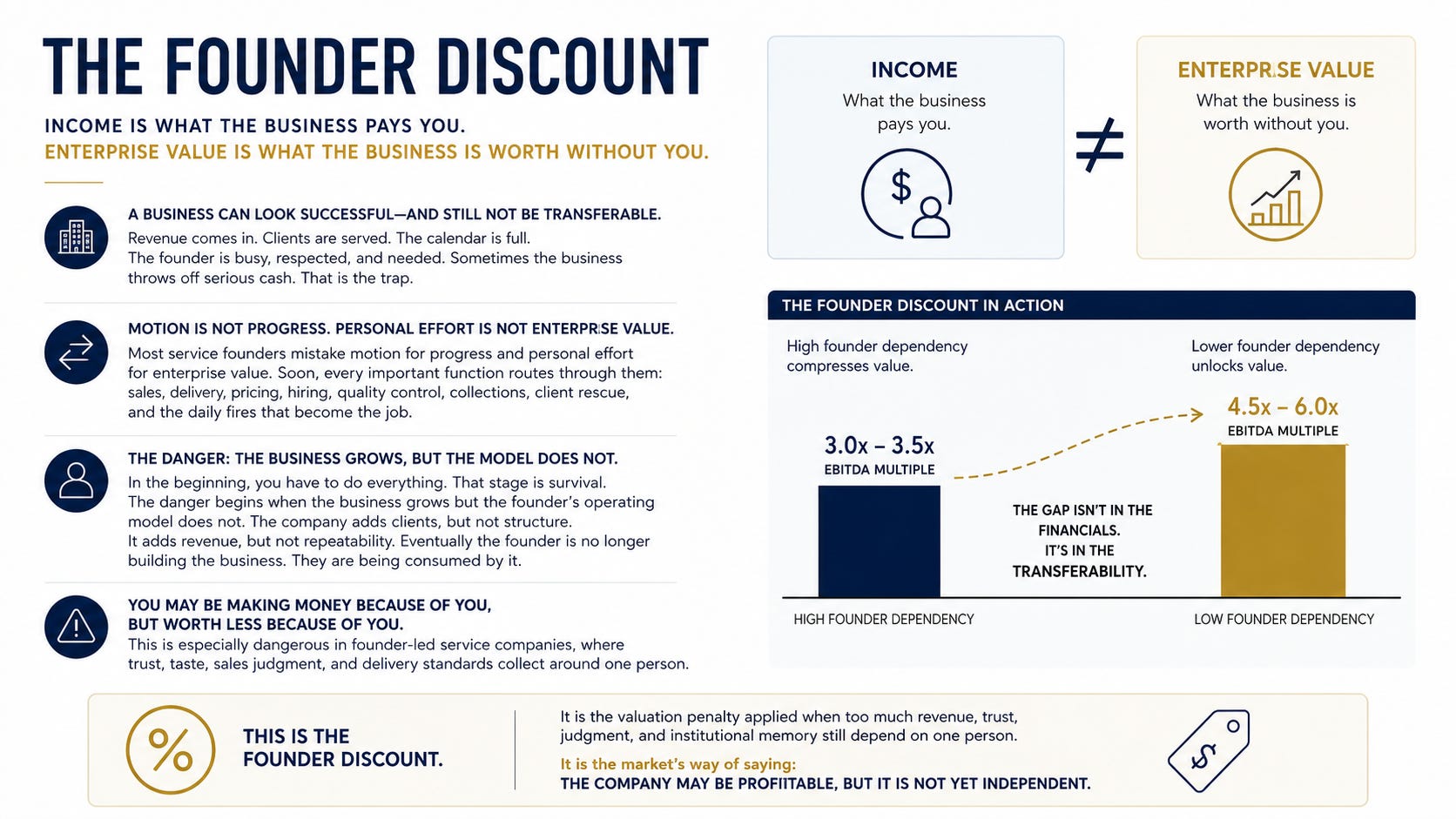
Income is what the business pays you.
Enterprise value is what the business is worth without you.
A founder-dependent business can look successful from the outside. Revenue comes in. Clients are served. The calendar is full. The founder is busy, respected, and needed. Sometimes the business throws off serious cash.
That is the trap.
A company can produce income and still fail to become a transferable asset.
Most service founders miss that distinction. They mistake motion for progress and personal effort for enterprise value. Soon, every important function routes through them: sales, delivery, pricing, hiring, quality control, collections, client rescue, and the daily fires that become the job.
This is especially dangerous in founder-led service companies, where trust, taste, sales judgment, and delivery standards collect around one person. In the beginning, you have to do everything. That stage is survival. The danger begins when the business grows but the founder’s operating model does not. The company adds clients, but not structure. It adds revenue, but not repeatability. Eventually the founder is no longer building the business. They are being consumed by it.
Your business may be making money because of you, but it may be worth less because of you.
I call this the Founder Discount.
It is the valuation penalty applied when too much revenue, trust, judgment, and institutional memory still depend on one person.
It is the market’s way of saying: the company may be profitable, but it is not yet independent.
The Real Cost of Staying Indispensable
Sophisticated buyers of founder-led service businesses do not stop at last year’s revenue. They ask: how much of that revenue walks out the door if the founder does?”
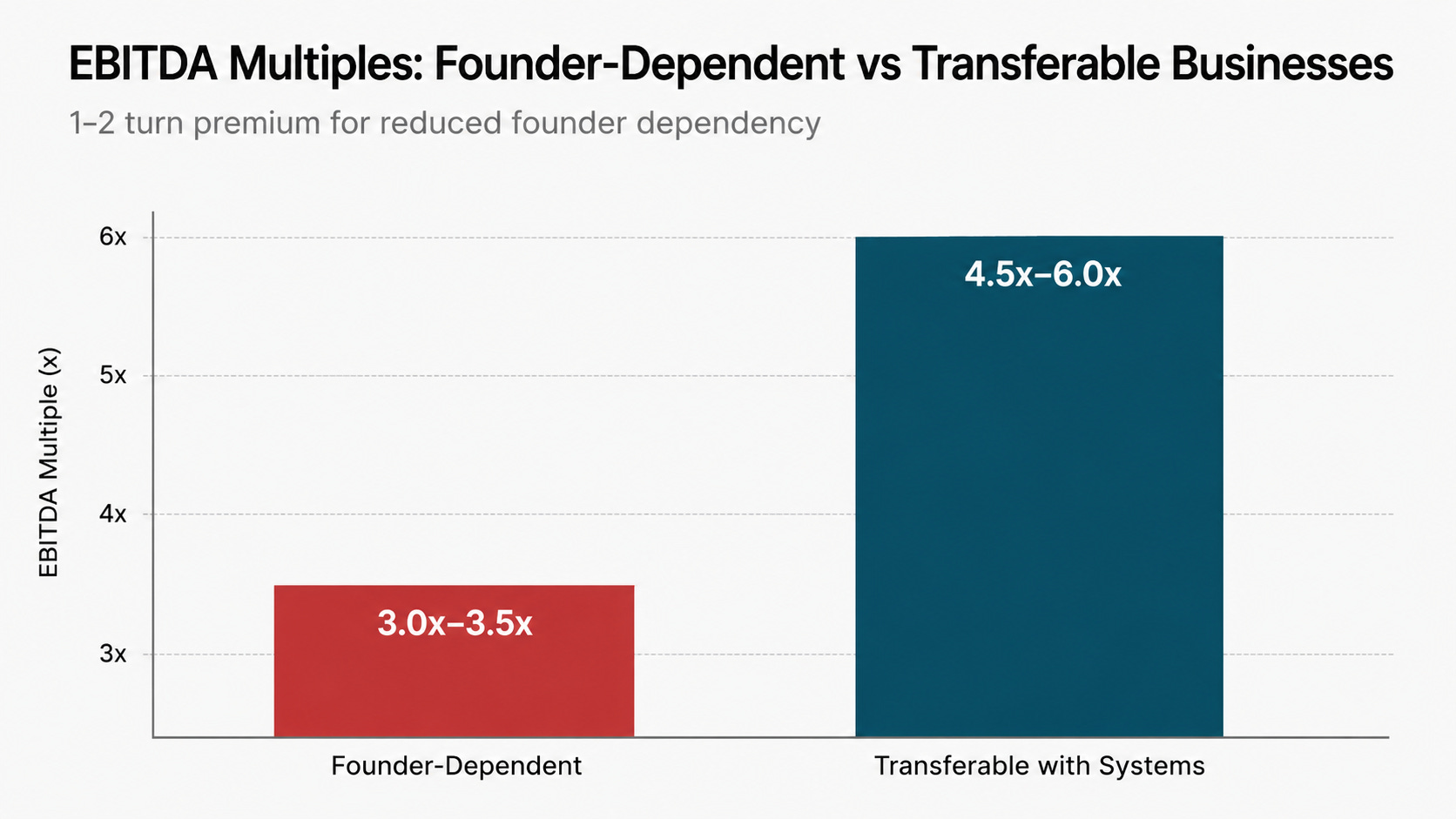
When the answer is “too much,” they respond with lower multiples, heavier earn-outs, seller financing, longer transition periods, or they simply walk away. Exit-planning advisors and valuation professionals routinely identify key-person dependency, customer concentration, and lack of management depth as risks that reduce buyer confidence and affect deal structure.
The founder may see a loyal client base. A buyer sees revenue that may need to be re-earned after closing. Loyalty attached to the founder is not the same as loyalty attached to the company.
Personal loyalty is harder to finance than a documented process. The more personal the relationship, the less transferable the revenue.
Consider a composite drawn from a familiar pattern in founder-led agencies: a strategy and brand firm doing $2.4 million in revenue. On paper, it looked healthy: referrals, loyal clients, solid margins, and a capable team. The founder still personally closed the largest deals, approved every major proposal, handled the most important client relationships, and made the final call on creative direction and pricing.
When the founder attempted to take six weeks away, the fragility became unmistakable:
Two major proposals stalled because no one else could confidently defend the pricing logic or scope.
A key client escalated an issue, and the team defaulted to “let’s wait for the founder to get back.”
The pipeline became opaque because only the founder truly understood which opportunities were real versus hopeful.
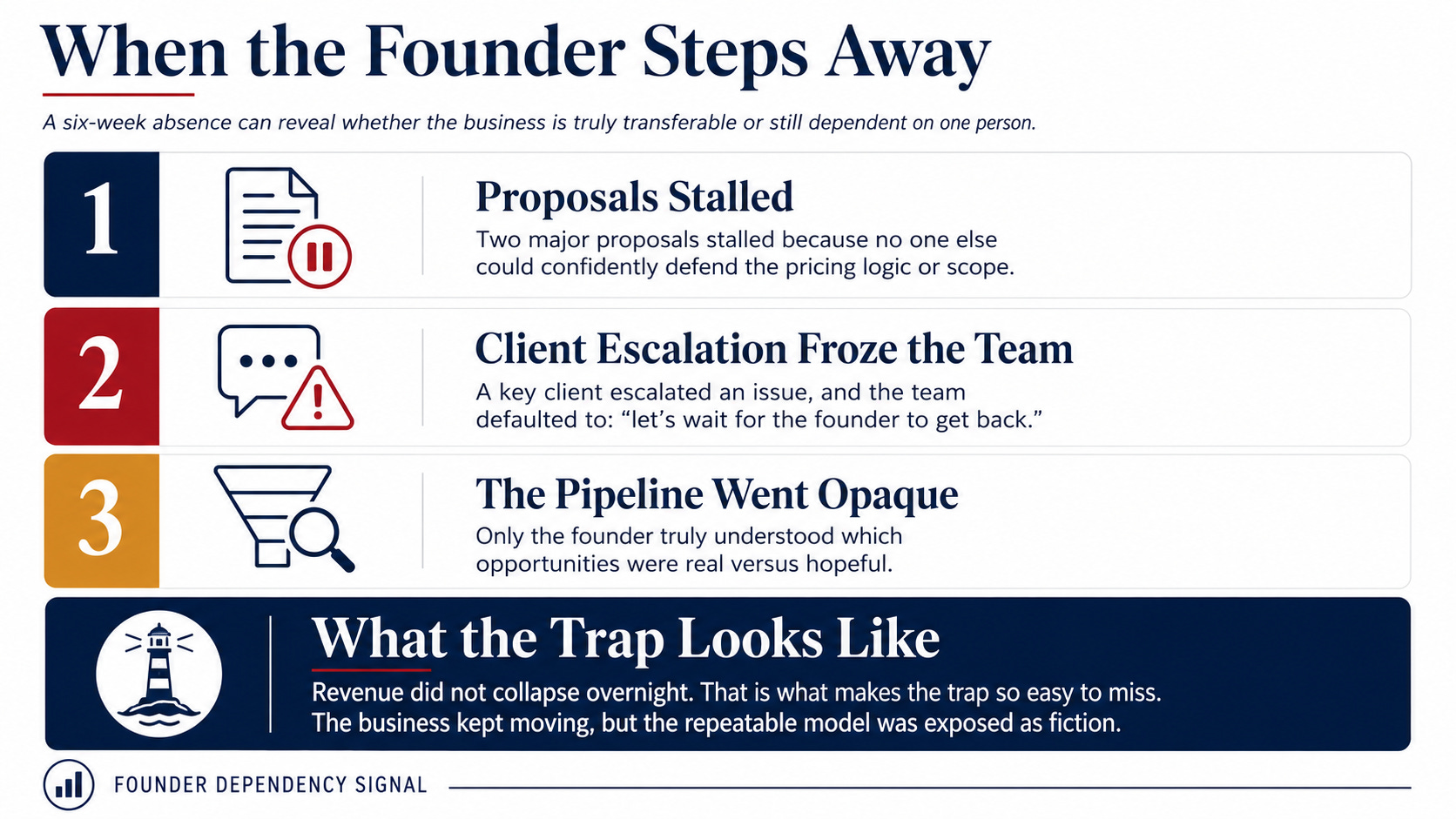
Revenue did not collapse overnight. That is what makes the trap so easy to miss. The business kept moving, but the repeatable model was exposed as fiction.
You do not need to wait for a buyer to discover this. You can test it yourself.
A founder-led boutique is not a failure. It can be profitable, respected, and intentionally small. The mistake is wanting enterprise value while operating like a personal practice. The problem is not staying small. The problem is mislabeling dependency as enterprise value.
Business Exit Strategies: The 3 Red Flags That Make Buyers Walk | Nick McLean - Pre-Sale Prep
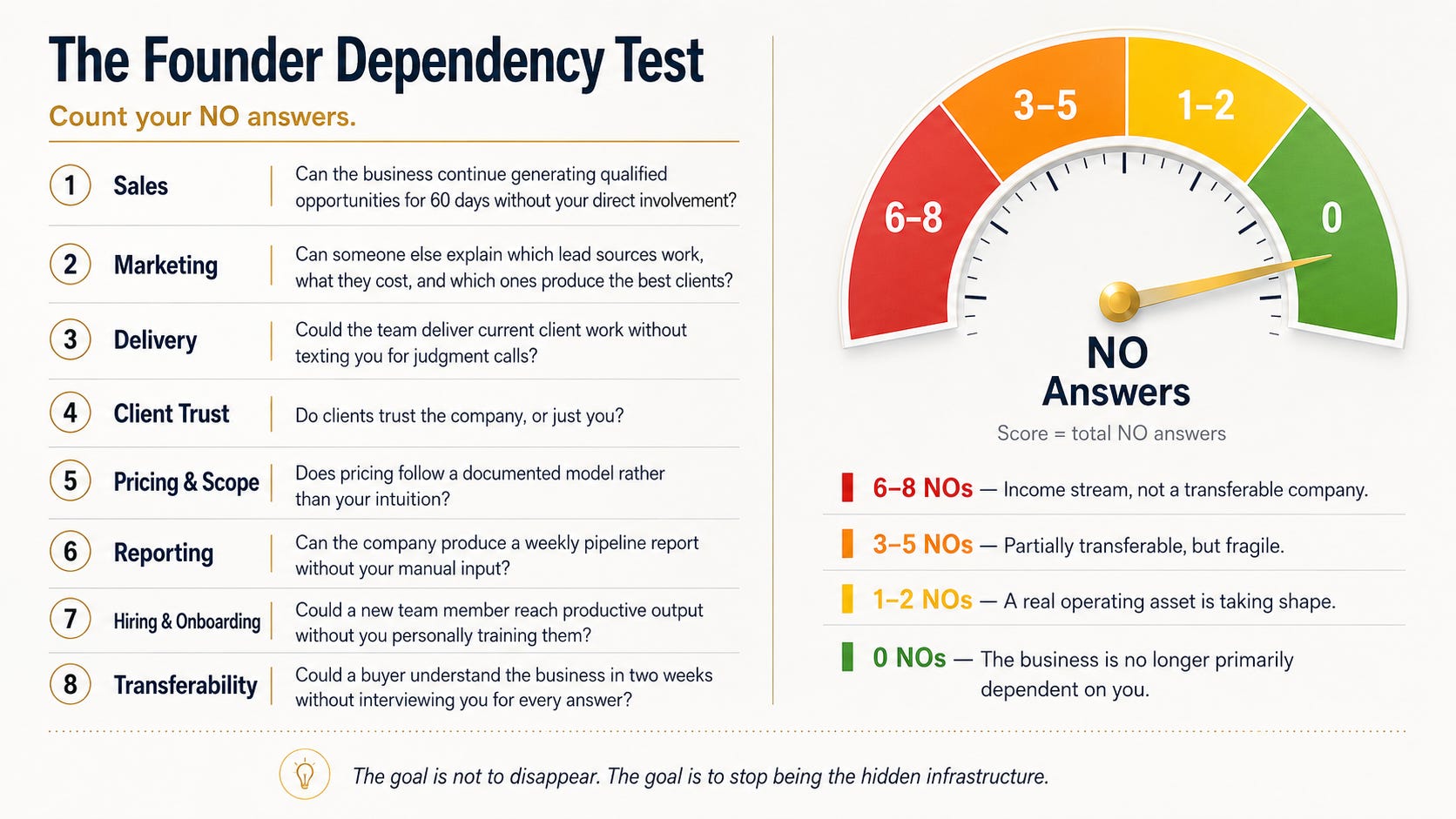
The Founder Dependency Test
Before you rebuild the business, run the uncomfortable test. Honestly assess these indicators:
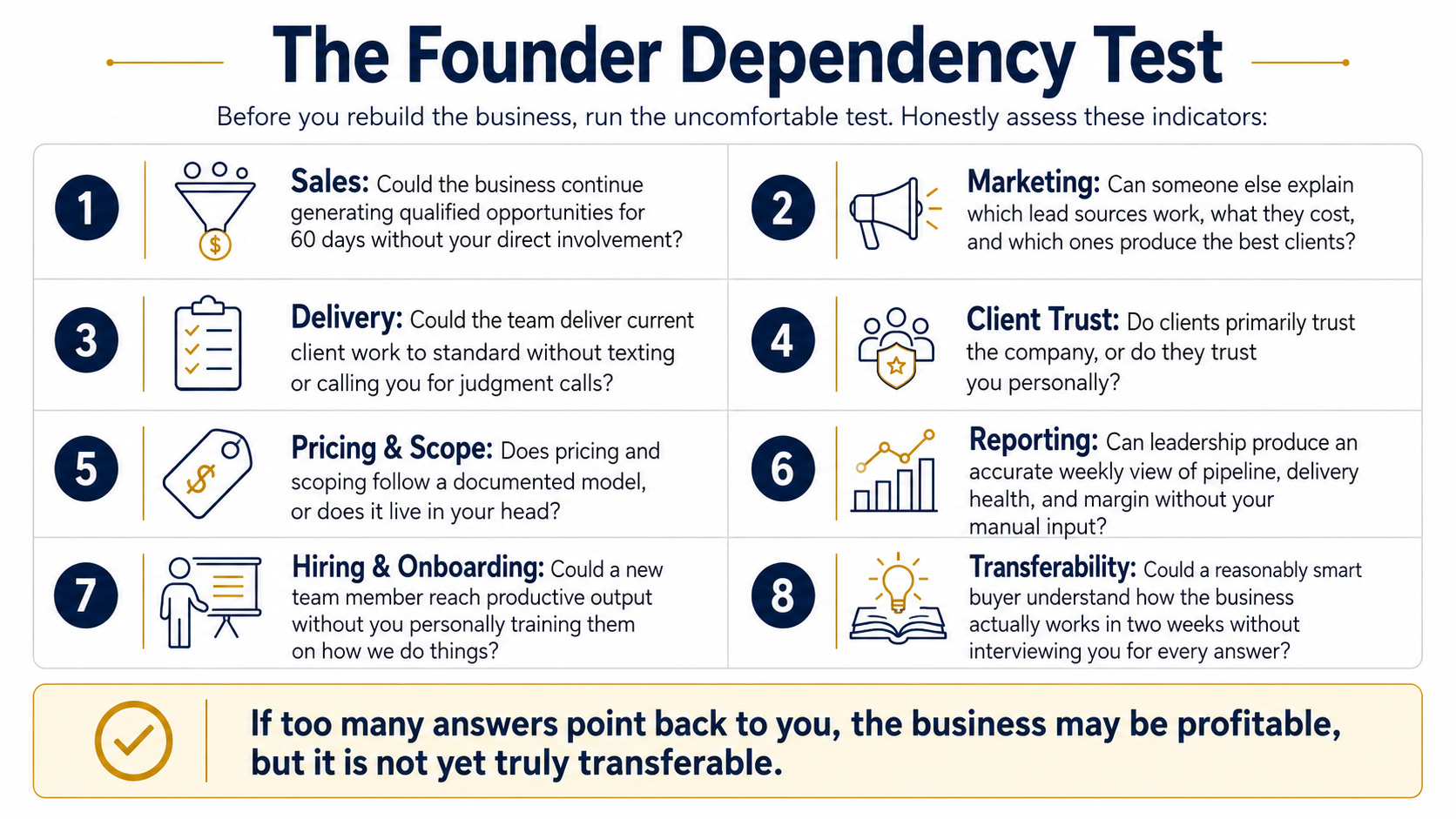
Sales: Could the business continue generating qualified opportunities for 60 days without your direct involvement?
Marketing: Can someone else explain which lead sources work, what they cost, and which ones produce the best clients?
Delivery: Could the team deliver current client work to standard without texting or calling you for judgment calls?
Client Trust: Do clients primarily trust the company, or do they trust you personally?
Pricing & Scope: Does pricing and scoping follow a documented model, or does it live in your head?
Reporting: Can leadership produce an accurate weekly view of pipeline, delivery health, and margin without your manual input?
Hiring & Onboarding: Could a new team member reach productive output without you personally training them on how we do things?
Transferability: Could a reasonably smart buyer understand how the business actually works in two weeks without interviewing you for every answer?
What the Score Means
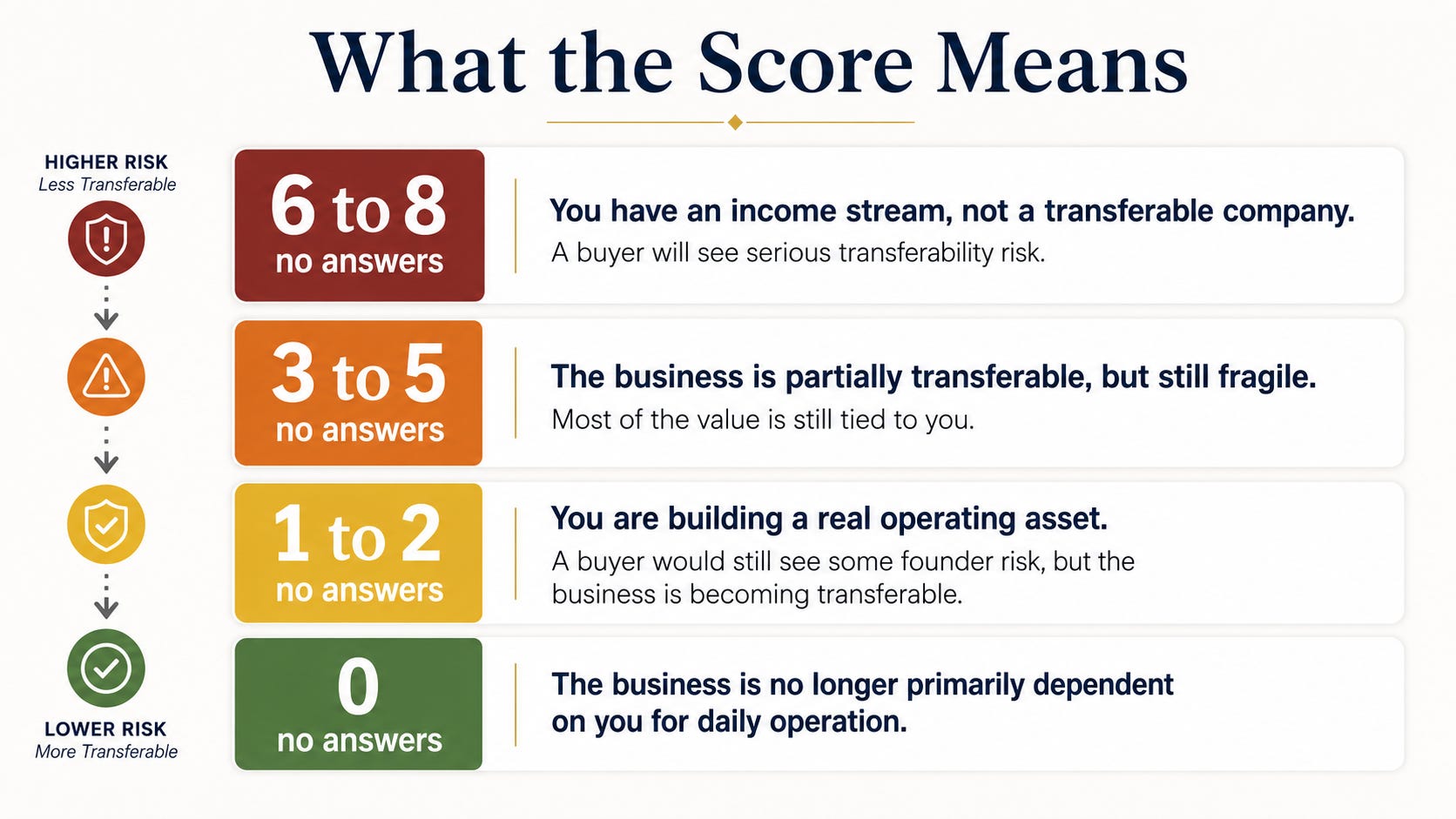
6 to 8 no answers: You have an income stream, not a transferable company. A buyer will see serious transferability risk.
3 to 5 no answers: The business is partially transferable, but still fragile. Most of the value is still tied to you.
1 to 2 no answers: You are building a real operating asset. A buyer would still see some founder risk, but the business is becoming transferable.
0 no answers: The business is no longer primarily dependent on you for daily operation.
Exit Planning Strategies: Build Transferable Value & Exit Without Exiting
The score is not a moral judgment. It is a transferability audit. The goal is not to disappear. The goal is to stop being the hidden infrastructure. Every “no” reveals knowledge that still resides in the founder rather than in the business. Move that knowledge out of your head and into four places: sales, data, delivery, and management. That is where transferability begins.
The Four Systems That Remove the Founder Discount
1. Externalize the Sales Brain
Most service businesses sell through founder instinct, relationships, and private pattern recognition that only one person possesses. The founder knows all of it. The company owns none of it.
When a founder hires a salesperson and hands over a messy CRM, the new hire struggles and the founder eventually steps back in to close the important deals. A mature operator makes the sales system explicit. It maps the buyer journey from first contact to paid invoice, defining lead sources, qualification rules, discovery questions, proposal standards, pricing guardrails, deal-stage definitions, and follow-up timing. A real sales system also defines the handoff to delivery and establishes clear disqualification criteria.
Bad-fit prospects are not harmless. They consume follow-up time, distort pricing, clog the pipeline, and teach the team to chase noise. A real sales system protects the company from the wrong revenue, not just from too few leads.
This is what allows the founder to stop being the closer and start being the architect of the growth engine. When those answers are documented, trained, and measured, sales become company knowledge instead of founder habit.
2. Make Revenue Visible
Founders often say they have a “feel” for the business. That feel becomes dangerous when it replaces visibility. A dashboard forces the business to tell the truth every week. It should answer three core questions: Are we creating enough opportunities? Are those opportunities moving? Are they profitable when they close?
Track these categories weekly:
Pipeline health: active qualified pipeline value and new qualified conversations
Sales effectiveness: proposal-to-close rate, sales cycle length, and no-decision rate
Deal quality: average contract value and gross margin by client type
Transferability risk: renewal rate, customer concentration, and founder-owned relationships
Revenue can lie.
A bad client can make the top line look better while quietly damaging capacity, morale, and margin. Not all growth increases value. Some growth only adds noise, complexity, and margin drag. The founder who tracks only revenue will keep winning the wrong work. Margin tells you which growth is worth repeating.
The goal is not more revenue. The goal is more of the right revenue.
3. Hire Into a System, Not a Void
Hiring does not solve founder dependency. Hiring into chaos usually makes the problem louder. Most founders reverse the necessary sequence: they hire first, then hope the new person will bring order.
The correct sequence is: document the process, measure the process, then assign capable people to run it. Delivery needs rails. Without rails, quality becomes a matter of founder taste. In a typical agency, that means a kickoff checklist, a client brief template, a first-draft quality review, and a final approval standard. When these exist, a manager can inspect quality and protect margin without needing to ask you what good looks like.
Once the process is clear, delegation becomes clean. “It’s faster if I just do it.” That sentence is usually the sound of a system failing.
The founder’s new job is not to be the best operator. It is to become the architect of the enterprise: inspecting the system, improving the people, protecting margins, and deciding which clients, services, and distractions the company should stop chasing.
4. Remove the Founder as the Constraint
The final choke point is rarely technical. It is the founder’s relationship with control.
Founders cling to delivery because it gives immediate proof of competence: the client is happy, the work is tangible, and the founder feels capable. Building the company itself requires delayed gratification and exposes operational gaps. So the founder retreats into the day-to-day tactical work they already know how to do well. That retreat feels productive, but it is often avoidance in work clothes.
Being needed feels like proof. Every rescue gives the founder proof that they are essential, while quietly teaching the team to wait for them. They sabotage delegation because they confuse personal control with quality control. They say the team is not ready, yet the team has never been given a real system, real authority, or clear standards.
The company will not outgrow the founder’s need to be the final answer until the founder changes their relationship with control. That requires less rescue, more inspection, and a willingness to let the company work without making you the hero.
The 30-Day Dependency Reset
The way out is not dramatic reorganization. It is a series of small transfers: judgment into process, memory into documentation, instinct into metrics, and control into management. The first month is not about fixing everything. It is about making founder dependency visible.
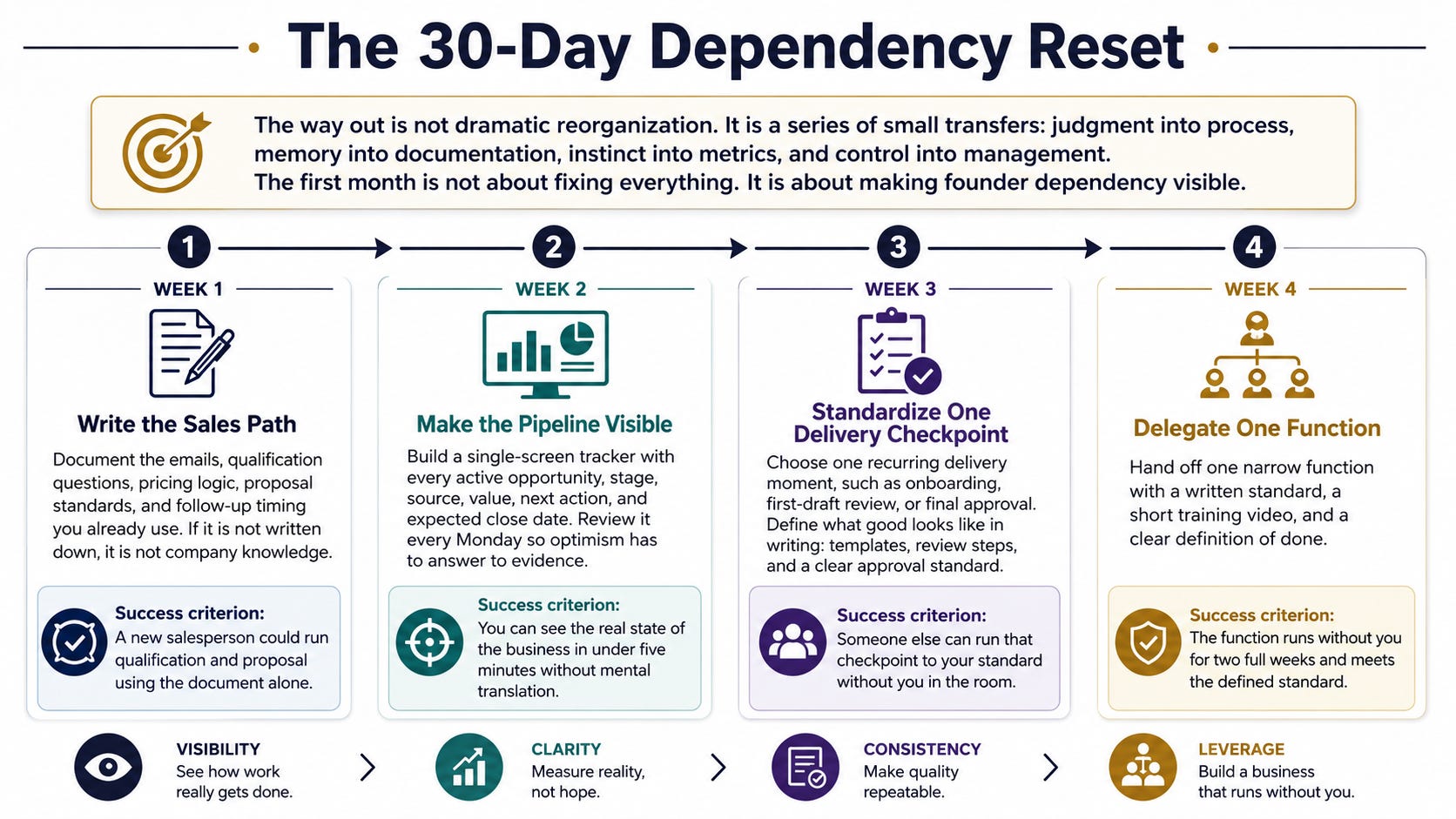
Week 1: Write the Sales Path
Document the emails, qualification questions, pricing logic, proposal standards, and follow-up timing you already use. If it is not written down, it is not company knowledge.
Success criterion: A new salesperson could run qualification and proposal using the document alone.
Week 2: Make the Pipeline Visible
Build a single-screen tracker with every active opportunity, stage, source, value, next action, and expected close date. Review it every Monday so optimism has to answer to evidence.
Success criterion: You can see the real state of the business in under five minutes without mental translation.
Week 3: Standardize One Delivery Checkpoint
Choose one recurring delivery moment, such as onboarding, first-draft review, or final approval. Define what good looks like in writing: templates, review steps, and a clear approval standard.
Success criterion: Someone else can run that checkpoint to your standard without you in the room.
Week 4: Delegate One Function
Hand off one narrow function with a written standard, a short training video, and a clear definition of done.
Success criterion: The function runs without you for two full weeks and meets the defined standard.
Understanding Key Person Risk in Business Valuation
Then audit what you reclaim. Reclaiming means taking back work you already delegated because watching someone else do it imperfectly made you uncomfortable. Track that work. It becomes your next system-building roadmap.
At the end of 30 days, you should have six concrete assets: a written sales path, a lead-source map, a live pipeline dashboard, one documented delivery checkpoint, one delegated function, and a short list of reclaimed work.
The market does not reward exhaustion. It rewards transferability.
If the business needs you everywhere, it may still be profitable. It may even look impressive. But it is not yet an asset.
It is a job with a logo.