

The Hidden Balance Sheet of Execution

The companies that win do not just move faster. They leak less value.

The most expensive problems in a company rarely show up first as financial problems.
They look like a crowded calendar. A pricing decision that has survived six leadership meetings without closure. A senior hire that everyone knows is wrong, but nobody wants to confront. A customer success team acting as emotional cleanup for suboptimal onboarding. A management layer is unclear whether they own long-term outcomes or daily tasks.
Value quietly leaks out of an enterprise not through one dramatic corporate failure but through a thousand tolerated internal frictions. The business continues to run, the team continues to work, and the dashboard still looks busy. Yet the company feels heavier every month.
That heaviness is not a cultural atmosphere. It is a tax on scale. It slows decisions, weakens morale, increases rework, and makes growth pricier. This issue matters most inside companies that have outgrown founder force but have not yet built a functioning operating system.
The most valuable leaders do not merely manage people, meetings, and priorities. They understand execution arbitrage: the spread between what a company intends to do and what its internal system actually allows it to do. That spread becomes visible as missed deadlines, repeated meetings, churn, rework, founder bottlenecks, and margin pressure. Average organizations let that spread widen with scale; disciplined organizations make it smaller than their competitors.
This is not an argument for moving slowly, cutting ambition, or worshiping process. It is an argument for making sure ambition has an operating system strong enough to carry it. Ambition without an operating system does not scale. It spills.
Every business carries an execution balance sheet. It is not recorded by accounting. It is recorded in how often the same problems return. The financial statements eventually reveal the difference, but the way the business runs shows it first:
Assets: Time becomes attention, certainty becomes commitment, decision rights become speed, quality becomes retention, and capability becomes scale.
Liabilities: Ambiguity becomes rework, whiplash becomes fatigue, omission becomes delay, customer friction becomes churn, and founder dependency becomes a ceiling.
Why This Matters Now - The market stopped subsidizing sloppy execution. After the zero-interest-rate period ended, capital stopped functioning like cheap oxygen. According to global venture funding data compiled by CB Insights, global venture funding fell to $248.4B in 2023, the lowest level since 2017, as detailed in their State of Venture 2023 analysis, while deal volume hit a six-year low. By 2025, as outlined in their State of Venture 2025 briefing, funding had rebounded sharply, but the recovery was uneven and concentrated, with AI and U.S.-based mega-rounds driving much of the headline recovery.
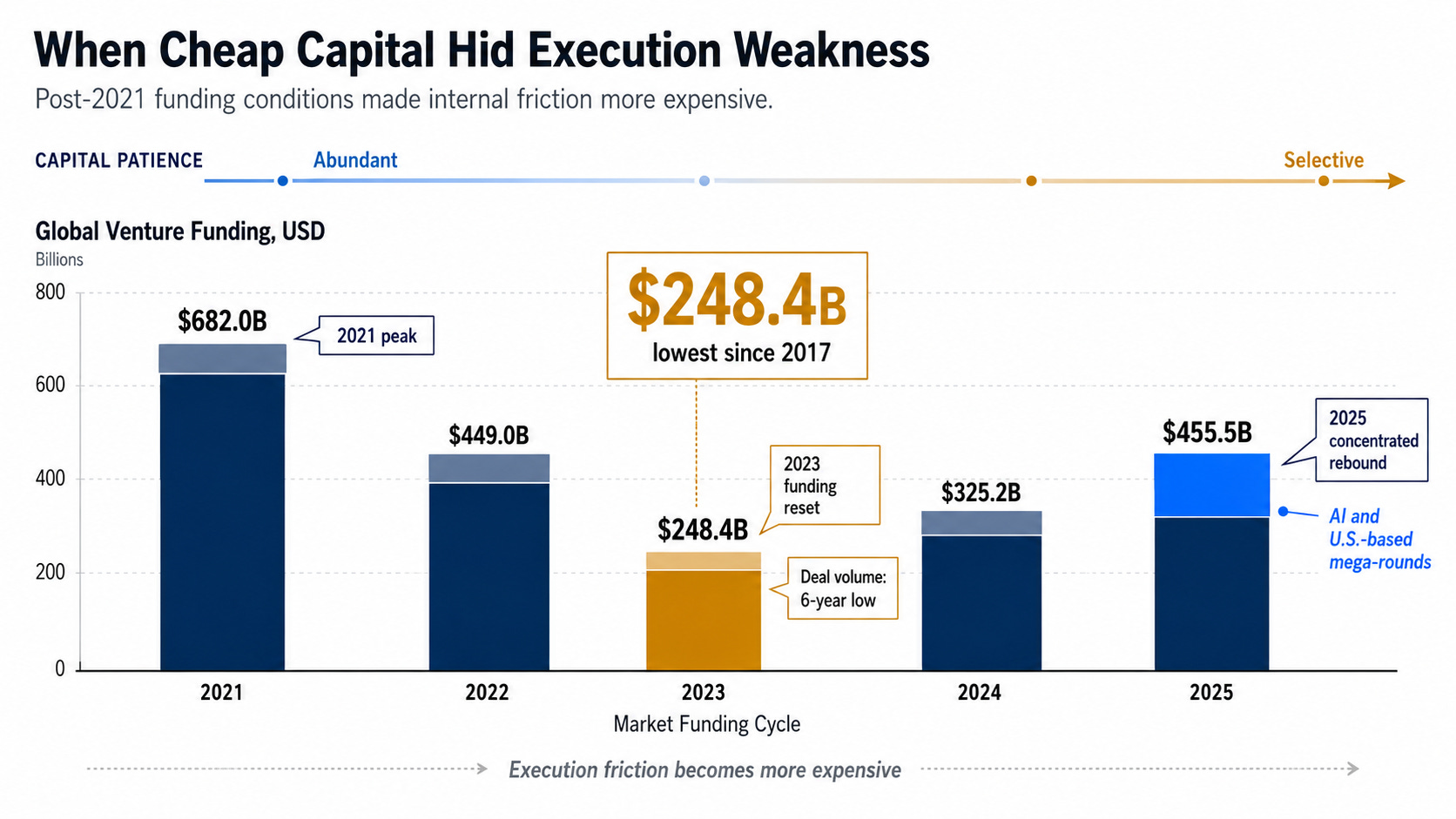
In both public and private markets, investors have become far less patient with growth that does not show a credible path to margin, cash flow, and efficiency. With acquisition channels more crowded, attribution harder, and buyers more demanding about measurable value, efficiency is no longer a preference. This is the cost of survival. In an environment where capital is expensive, internal friction is no longer harmless. It is funded by expensive capital, exhausted teams, and customers with more options.
That is why the first financial lever to inspect is the one most leaders waste without noticing: time.
Asset 1: Time (The Calendar as Capital Allocation)
Time determines what the company actually values. The calendar is where strategy is tested and validated.
Most leaders treat their calendars as containers for obligations. Disciplined operators treat them as capital allocations.
Monday morning reveals whether a team is proactive or reactive. A reactive leader begins the week by catching up, answering whatever is loudest, and letting other people’s urgency dictate the agenda. By noon, the week has a shape, but nobody designed it. Your schedule is not personal productivity; it is organizational instruction.
In their landmark study tracking executive schedules 24/7 for 13 weeks, published as “How CEOs Manage Time” in Harvard Business Review, Michael E. Porter and Nitin Nohria described CEO time as one of the company’s scarcest resources. A leader’s calendar, they argued, signals organizational priorities. Teams watch what gets protected, what gets postponed, what gets repeated, and what gets ignored.
Time Management at Stanford | Stanford Online
A CEO who says enterprise strategy is the priority but is still approving client deliverables at midnight has communicated the real strategy. A leader who says customer experience matters but never reviews product fulfillment has told the team quality is optional. The calendar always tells the truth.
The Monday Operating Brief
Before Monday starts, write a one-page operating brief with five answers:
Decisions: What three choices must close before Friday?
Protected Work: Which execution blocks cannot be interrupted?
Protected work is the work that creates future value but is the easiest to sacrifice to present noise.
Closed Loops: Which prior decisions are no longer open for debate?
Leverage: Which recurring meeting should be canceled, shortened, or made asynchronous?
Risk: What one issue could quietly hijack the week if it is not contained early?
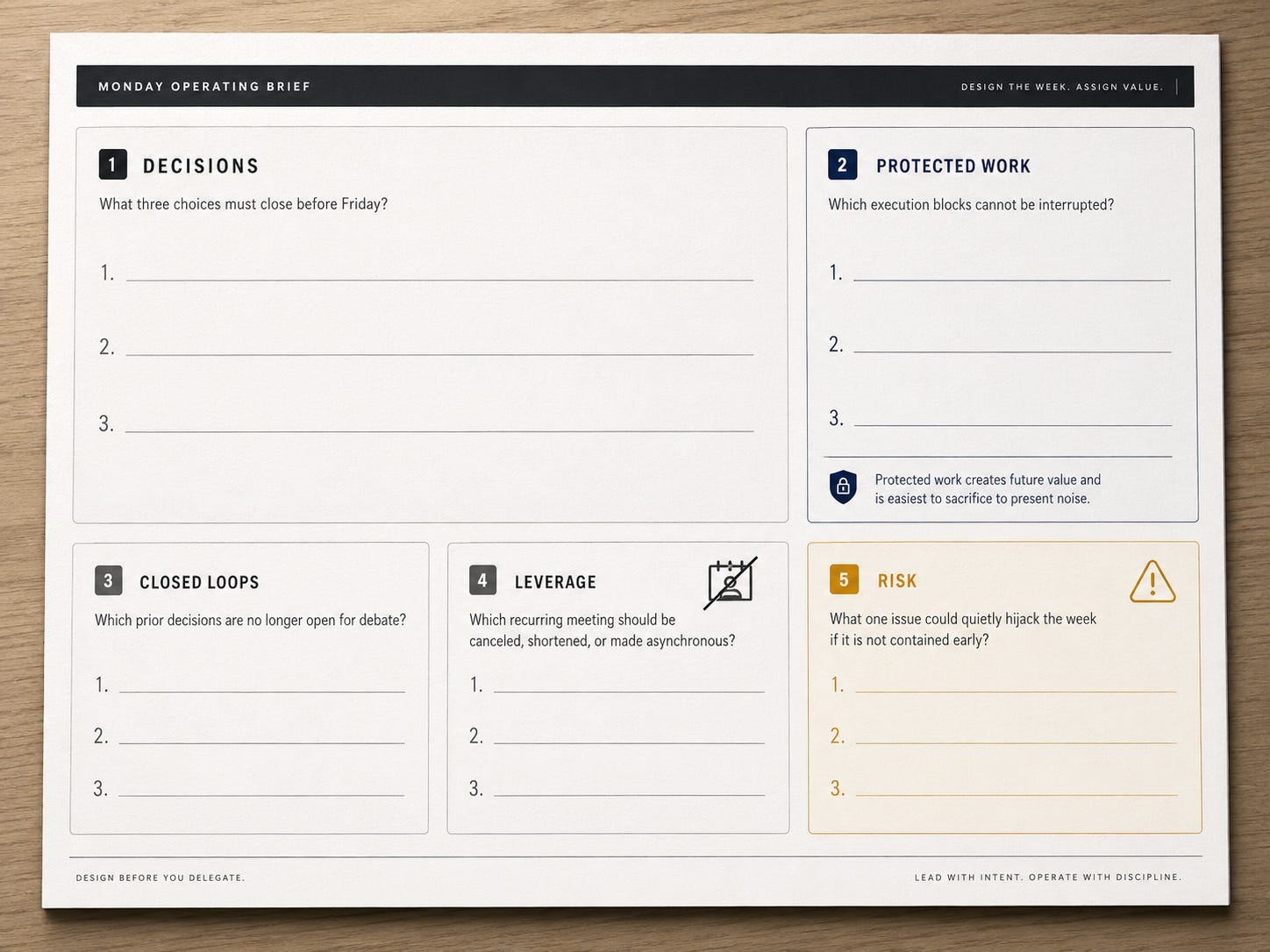
The point is not to control the week perfectly. The point is to stop letting the week assign value on your behalf.
Once attention is allocated, the next question is whether the direction deserves that attention.
Asset 2: Certainty (The Protection Against Strategic Whiplash)
Certainty determines whether the team can commit. Volatility is what happens when a leader mistakes their latest thought for the company’s next strategy.
Teams do not need a leader who pretends to predict the future. They need a leader whose operating posture does not collapse when the future changes. There is a moral component here. A leader who cannot hold a stable frame makes the team pay for their indecision.
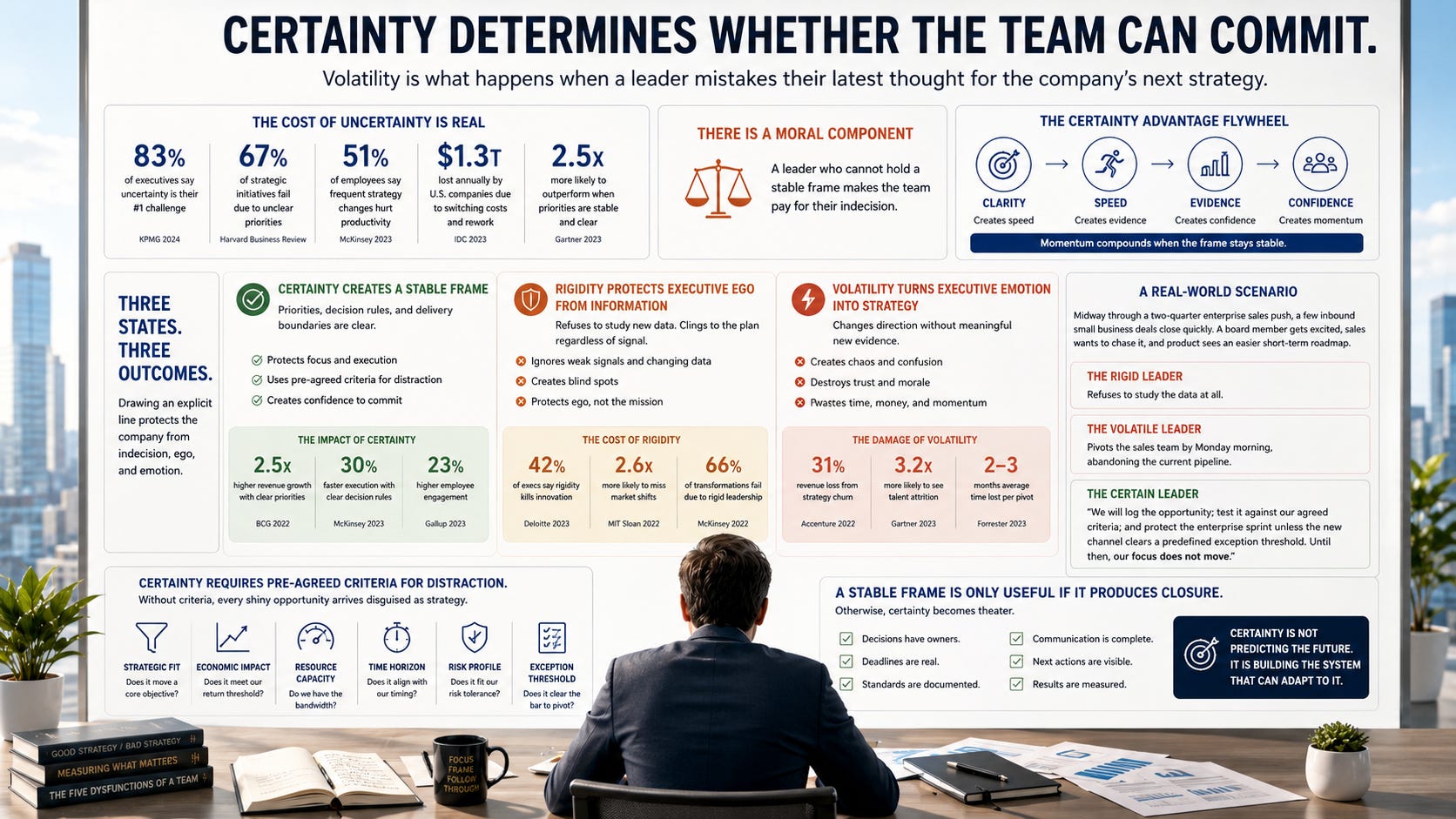
This requires drawing an explicit line between three distinct states:
Certainty creates a stable frame: priorities, decision rules, and delivery boundaries are clear.
Rigidity protects executive ego from information.
Volatility turns executive emotion into strategy, changing direction without meaningful new evidence.
Imagine a company midway through a two-quarter enterprise sales push. A few inbound small business deals close quickly. A board member gets excited, sales wants to chase it, and product sees an easier short-term roadmap.
The rigid leader refuses to study the data at all. The volatile leader pivots the sales team by Monday morning, abandoning the current pipeline. The certain leader states, “We will log the opportunity; test it against our agreed criteria; and protect the enterprise sprint unless the new channel clears a predefined exception threshold. Until then, our focus does not move.”
Certainty requires pre-agreed criteria for distraction. Without criteria, every shiny opportunity arrives disguised as strategy.
Clarity creates speed. Speed creates evidence. Evidence creates confidence. Confidence creates momentum.
But a stable frame is only useful if it produces closure. Otherwise, certainty becomes theater.
Asset 3: Decisions (The Elimination of Omission Taxes)
Decisions determine whether attention compounds or fragments. Unmade decisions do not pause the business. They quietly run it.
You can feel execution debt in a leadership meeting. Nobody calls it that. They call it alignment, follow-up, and getting more input. But the room knows. The same pricing question is back. The same senior hire is still being worked around. The same customer complaint has a new label. People take notes because it feels safer than saying the meeting preserves the discomfort.
Developing Principled Decision Makers | Stanford Graduate School of Business
Unmade decisions create six distinct organizational costs:
Attention cost: The issue keeps coming back until it dominates the meeting agenda.
Morale cost: Strong people stop pushing when nothing closes.
Speed cost: Reversible choices are dragged through irreversible processes.
Opportunity cost: Yesterday’s ambiguity keeps absorbing tomorrow’s resources.
Credibility cost: Teams judge leaders by what they avoid.
Customer cost: Customers feel the delay, inconsistency, and overpromising before leadership feels the pain.
This is the hidden cost of omission: avoiding short-term discomfort and allowing time, competitors, or entropy to decide for the company. Deciding by omission feels easier only at the beginning. Later, it becomes the most expensive path in the room.
McKinsey’s “Make faster, better decisions” points to a blunt problem: executives spend a large share of their time making decisions, and many believe much of that time is poorly used. Intelligence is rarely the problem. It is unclear ownership, excessive consensus, and failure to separate reversible decisions from irreversible ones.
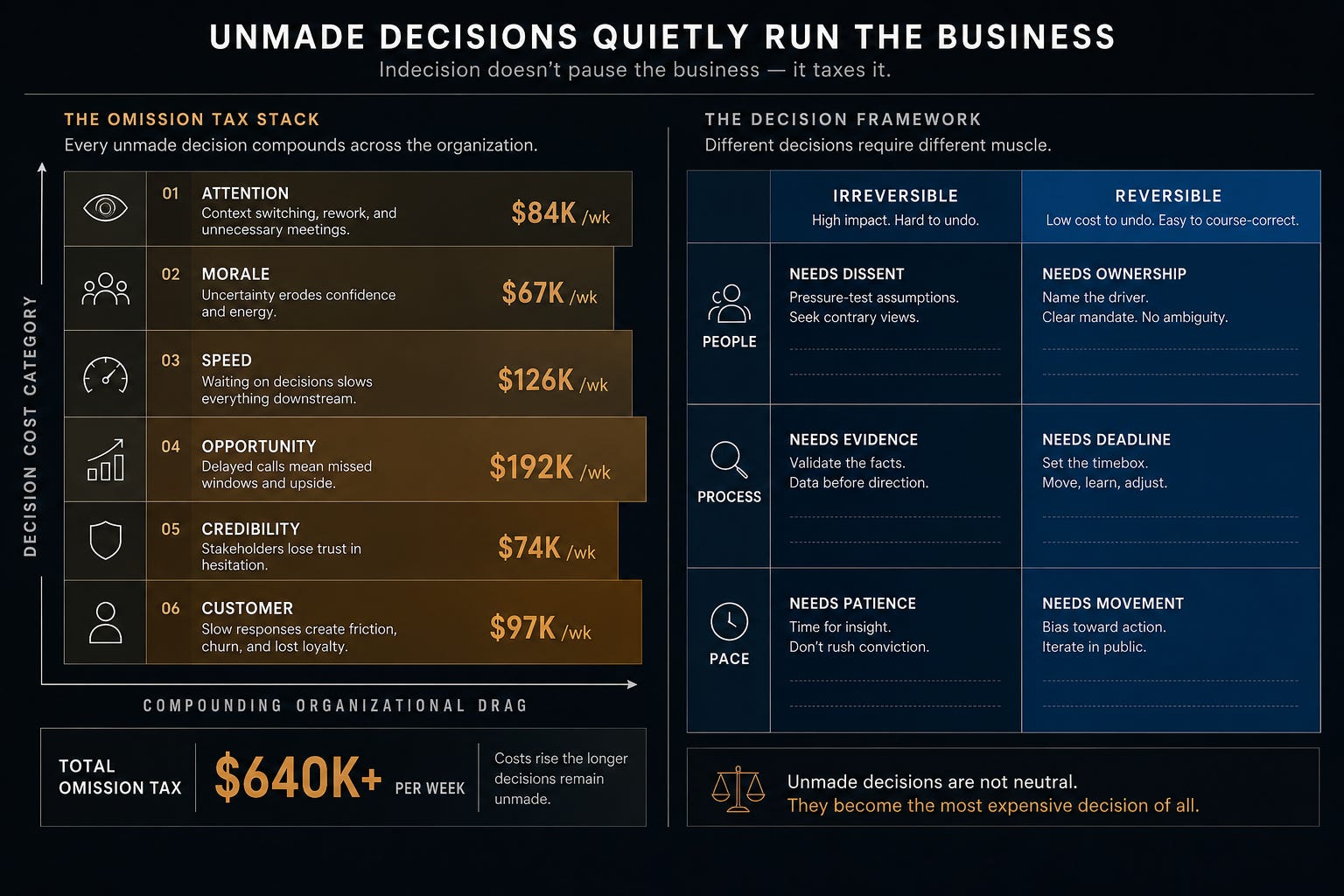
The best organizations are not fast everywhere. They are quick where speed is earned: clear owner, clear trade-off, clear next move. Irreversible decisions deserve dissent, evidence, and patience. Reversible decisions deserve ownership, deadlines, and movement. When a choice is reversible, searching for perfect data is just discomfort wearing a lab coat.
For every stalled choice, define six things: owner, deadline, decision rule, required input, accepted trade-off, and communication trail. If nobody owns the choice, the organization has chosen delay. Better operators do not try to avoid problems; they choose the specific problems they are willing to manage.
But speed has a limit. It compounds value only when the thing being scaled deserves more demand.
Asset 4: Quality (Designing the Pull System)
Quality determines whether growth becomes cheaper or more expensive. Marketing does not hide an operating weakness. It broadcasts it.
When growth slows, weak operators reach for more attention. Paid acquisition is not just a growth channel. It is an amplifier. It amplifies clarity or confusion, trust or disappointment, and repeatability or chaos.
A business can double lead volume, but if onboarding takes too long and time-to-value is unclear, growth becomes a disguised margin problem. At that point, support becomes the real product. When quality is weak, the margin does not disappear only through refunds or churn. It disappears through support load, custom exceptions, executive escalations, rework, discounts, and retention labor.
The faster a customer reaches value, the less force the company needs to apply later. When quality is strong, sales does not have to resell the business from zero every renewal cycle. Strong quality also disciplines sales. It clarifies what the business can promise, what it must refuse, and which customers it should not acquire. Quality is not just the product. It is the promise, the handoff, the onboarding, the delivery boundary, the support motion, and the moment the customer decides whether to trust the company again.
Push metrics show how hard the business is trying. Pull metrics show whether the market is moving closer after contact:
Push metrics measure effort: Paid ad spend, impressions, outbound volume, lead generation, and conversion rates.
Pull metrics measure earned demand: Net revenue retention, expansion, organic referrals, repeat purchases, shorter time-to-value, fewer support tickets, and employee retention.
How to Use Net Promoter Score (NPS) to Build Brand Loyalty
Bain & Company’s work on “The Economics of Loyalty” makes a related point: loyalty scores matter most when they are tied directly to behavior, including retention, expansion, referrals, and repeat purchases. The behavior is the proof; the score is only a clue. Quality eventually appears in the numbers: margin, churn, sales efficiency, and renewal pressure.
But quality cannot depend forever on the founder’s personal intervention. It has to become transferable.
Asset 5: Capability (Deliberate Standard Transfer)
Capability determines whether the company can scale beyond the founder. The first four assets can improve the company; the fifth determines whether the improvement survives the founder.
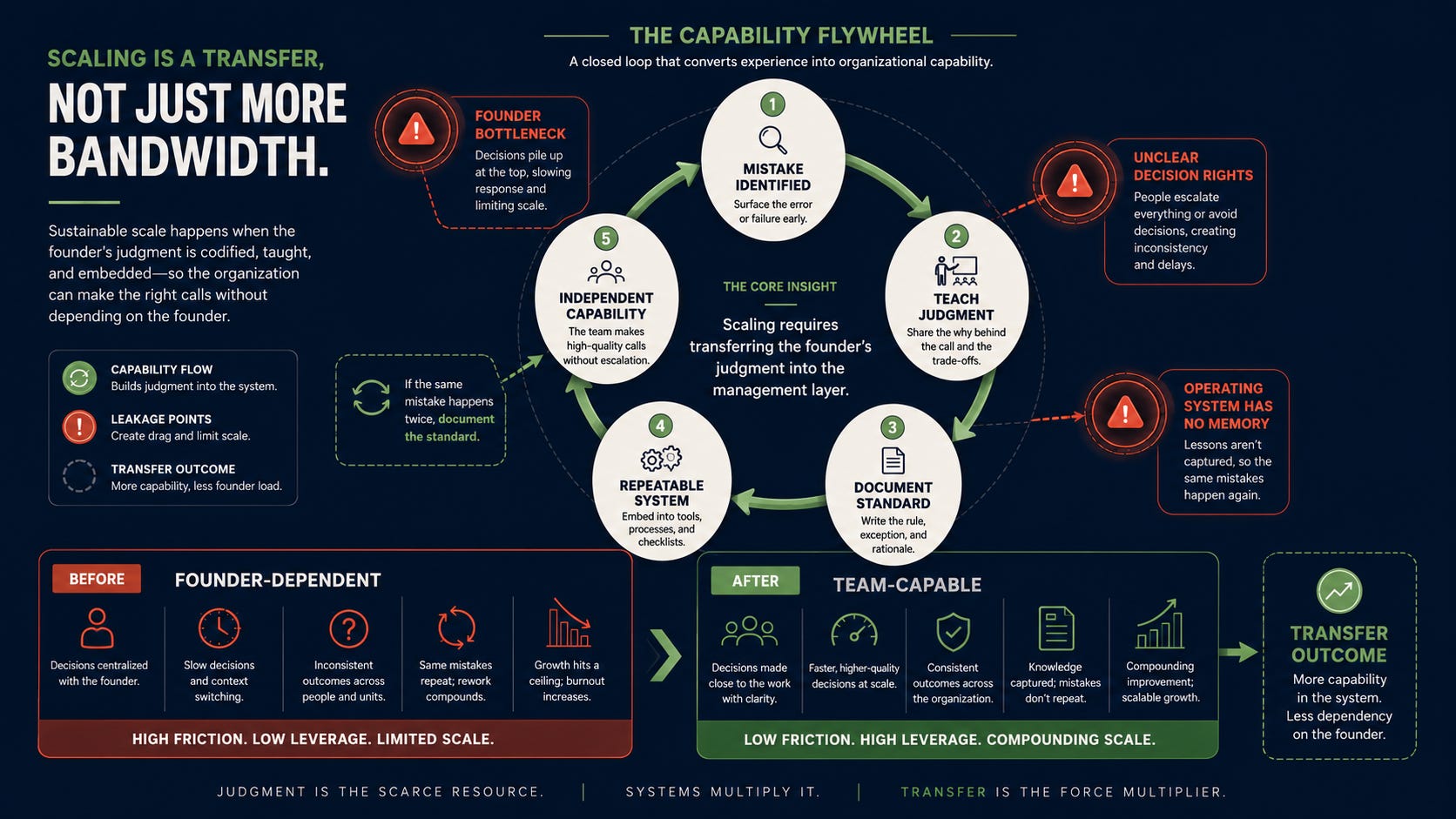
Most founder-led companies do not have a talent problem. They have a transfer problem. The standard is clear in the leader’s head but invisible to the team until it is converted into training, examples, checklists, review rituals, or decision rules.
This lack of externalization creates a predictable bottleneck. The leader complains that nobody can think strategically, but the standard has never been made visible. Every plan comes back for internal revision because the judgment pattern has never been externalized. Every decision returns to the executive desk because decision rights are unclear. Every mistake feels personal because the operating system has no memory.
At scale, leadership becomes a teaching job. Not motivational teaching. Judgment teaching. The work is to move the leader’s judgment into the management layer so the organization no longer depends on one mind.
Scolding may produce compliance in the moment, but it rarely transfers judgment. A leader rejects a client proposal because it “doesn’t feel strategic.” The employee learns only that the leader disliked it. Training begins when that leader opens the document, marks the places where activity is being confused with outcome, rewrites the first page, and explains the decision logic behind every change.
The sequence is simple: identify the mistake, teach the judgment, document the operating expectation while the lesson is still fresh, and make the system easier to repeat.
If the same mistake occurs again, please document the standard. If three people misunderstand the same process, rewrite it. If every decision escalates, clarify the decision rights. A recurring mistake is usually a process problem. More often, it is an infrastructure problem that wears an employee’s face.
The Execution Balance Sheet Audit
None of this requires a grand transformation program. The leverage is often visible. Before trying to transform the business, audit where value is already leaking:
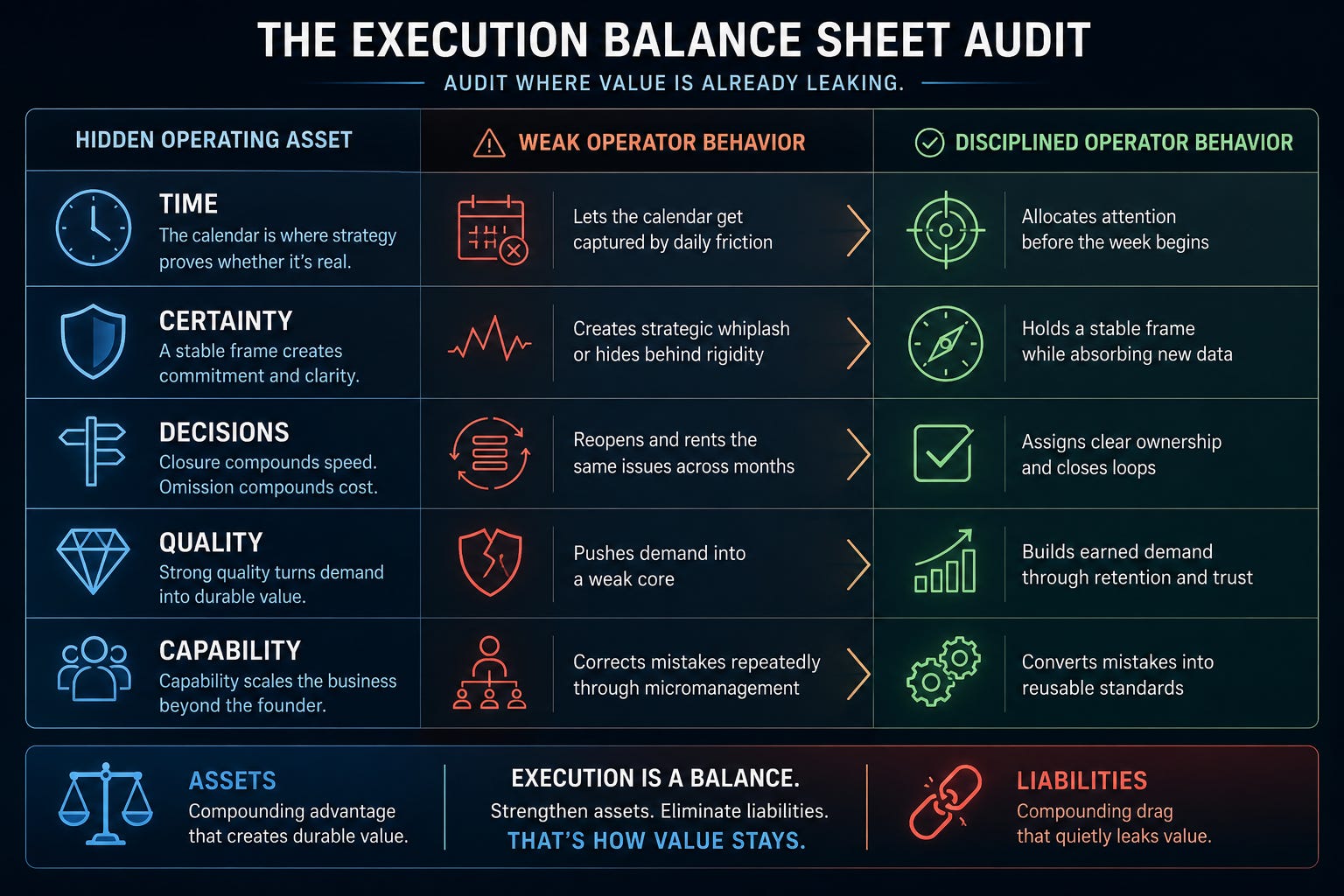
None of these assets guarantees growth. They remove the internal drag that makes growth more expensive than it needs to be.
The Trap: “We Don’t Have Time for This”
The obvious objection is time. Scaling leaders do not have time to write an operating brief, close the decision backlog, audit onboarding failures, or teach judgment to the management layer.
But that is the trap. The business is already spending the time through engineering rework, customer churn, customer success apologies for promises that should never have been made, repeated alignment meetings, and constant executive intervention. You are already paying the tax. The only question is whether you convert it into an asset.
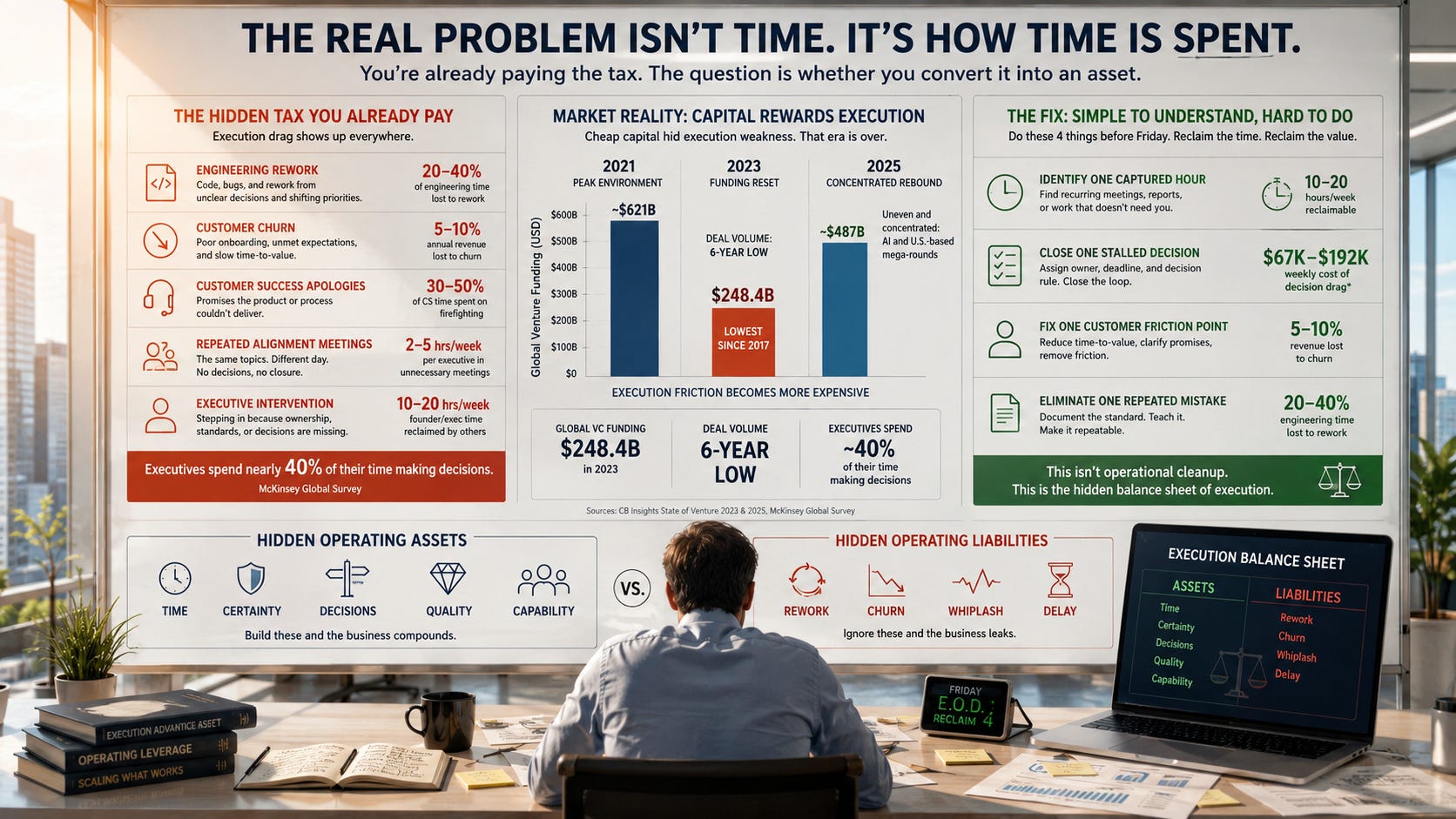
The fix is simple enough to understand, but hard enough that most companies keep postponing it.
Before Friday, identify one captured hour, one stalled decision, one customer friction point, and one repeated internal mistake. Reclaim all four. Do these tasks not because they are distractions from the work, but because they are the work.
That is not operational cleanup. That is the hidden balance sheet of execution.