

The Institutional Arbitrage
Why Mentorship Is the Ultimate Shortcut for Elite Leaders

High-impact individuals collapse time, avoid costly detours, and create enduring structures by harnessing the subtle influence of borrowed judgment.
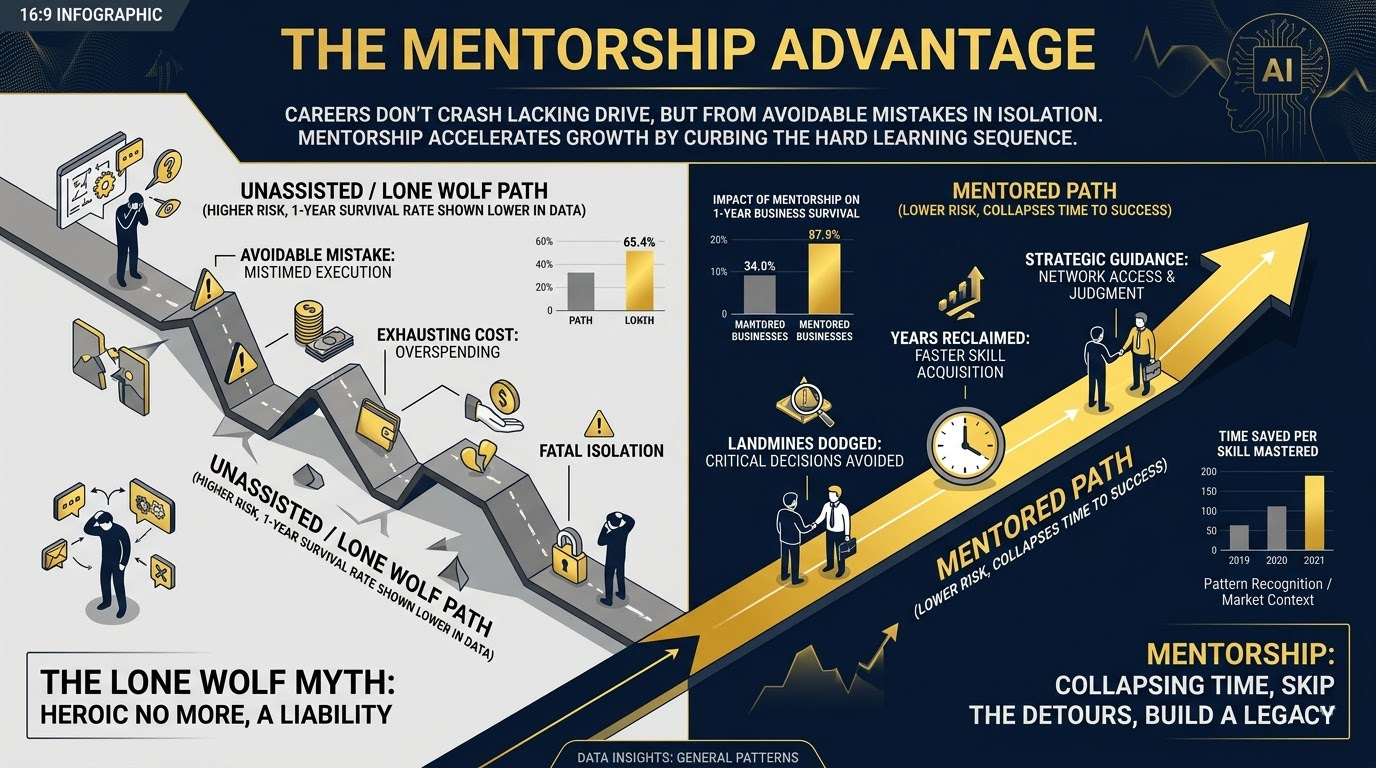
Why This Matters Now - Careers don’t usually crash because someone lacked drive. They crash because of one or two dumb, avoidable mistakes: made too soon, too expensively, and in total isolation. Mentorship changes that equation. It cuts the years you spend learning lessons the hard way, in the wrong sequence, by providing guidance and support that helps you avoid common pitfalls and accelerates your growth. In this AI-fueled, volatile world, the lone-wolf myth isn’t heroic anymore. It poses a significant risk with a high rate of attrition, particularly as many new businesses struggle to survive in their first year due to lack of support and guidance.
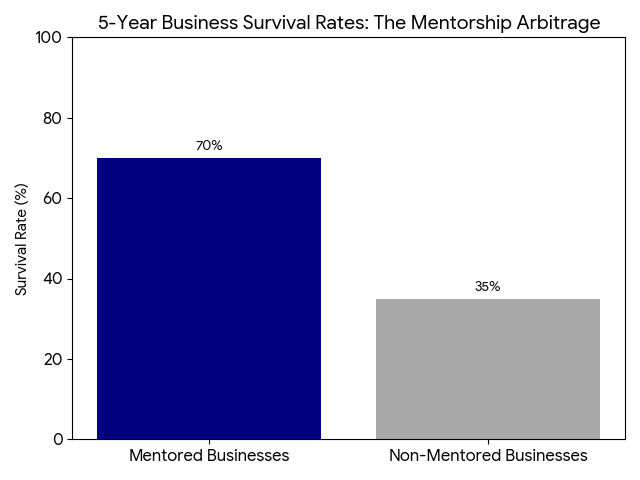
Bruises pave the road to a real legacy, but the tuition at the school of hard knocks has skyrocketed. Currently, approximately 20.4% of businesses do not survive beyond their first year (U.S.). Bureau of Labor Statistics, 2024). Yet the data keeps showing the same thing: businesses with real mentoring survive five years at about double the rate of the solo crowd, around 70% (SCORE, 2023). Hustle matters, but smart perspective borrowed from someone who’s already been there matters more, as effective mentorship can provide invaluable insights and guidance that significantly enhance a business's chances of success.
What Mentorship Actually Is: The Transfer of Judgment
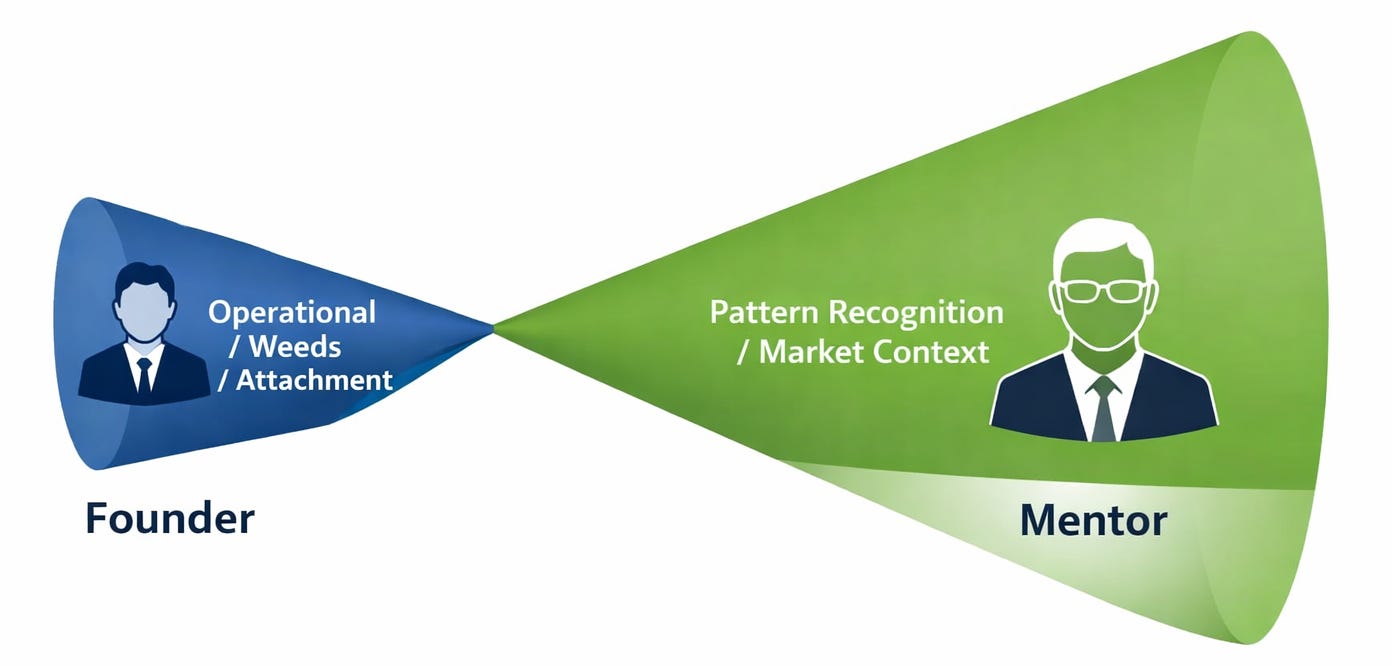
People often use the term "mentorship" as if it refers to a single concept. It’s not. An advisor fixes your current mess. A coach tunes your performance. A sponsor opens up opportunities. A real mentor? They hand over judgment: the ability to see clearly what’s noise versus what’s signal.
That is the leverage point. They don’t just hand you answers; they teach you to spot the difference between a blip and a breaking point. They help you ask sharper questions before you waste another quarter chasing the wrong one.
Lessons from the Giants: Personal Scar Tissue
I’ve been lucky. In business, Ralph Simon—the guy everyone calls the father of the ringtone—and Jay Samit became go-to voices for me. Ralph showed me how to sense inflection points early, before the herd piles in. Jay drilled in leverage thinking: don’t chase the shiny surface; dig for where real value actually gets created.
On the media side, Larry King and Peter Jennings were different but just as formative. Larry proved you don’t need volume to command a room: presence is pure attention. Peter showed editorial gravity: he said what needed to be said with weight, but he never got stiff about it. None of them handed me scripts. They elevated the standard by allowing me to observe genuine judgment in action.
Watch: Barbara Corcoran breaks down what makes someone truly coachable and why the “bounce-back” muscle is the single best predictor she’s seen in decades of investing
The First Advantage: Time Compression
Experience incurs costs because life bills you in real time. Without a guide, even sharp people repeat the classics: building too much before proving demand or running hard in circles thinking it’s progress.
A good mentor short-circuits that. Paul Graham’s advice to Airbnb—"do things that don’t scale"—prevented them from becoming a beautiful theory with no users. He pushed the team to go meet hosts face-to-face before detachment set in. Tesla? Same story. They didn’t reinvent manufacturing from scratch; they absorbed hard-won discipline from auto-industry vets and skipped the graves where so many others ended up.
The Reciprocity Loop
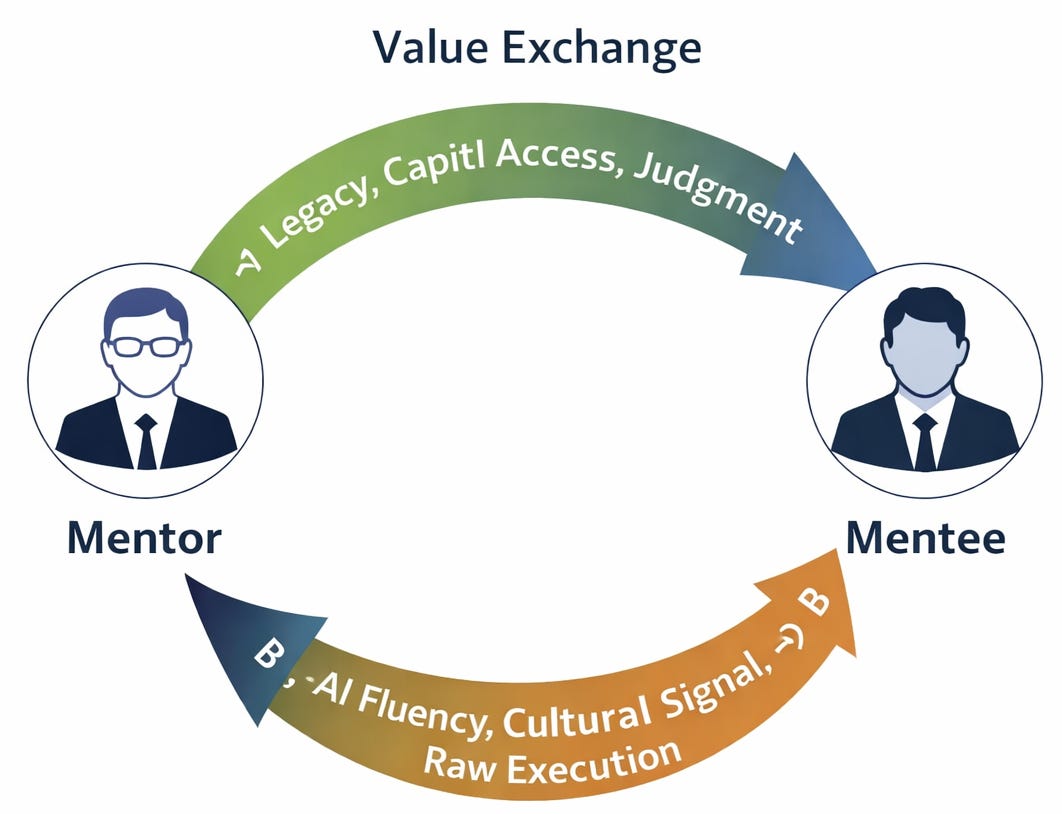
The strongest mentoring relationships aren’t one-way. The mentor brings decades of pattern-matching; you bring eyes on what’s breaking right now: new tools, cultural undercurrents, and AI shifts. Mark Cuban talks about this openly. He tells young engineers to jump into smaller shops where their AI chops can move the needle fast. He stays in those conversations himself to keep his own radar fresh. It’s a partnership, not charity.
Watch: Mark Cuban’s take on AI’s speed and why the next wave of builders holds the real edge in today’s market
Avoiding the “Experience Trap”
Not every gray hair comes with wisdom worth borrowing. Watch for these red flags:
The Nostalgia Mentor: Everything filtered through “back in my day” glasses with no update cycle.
The Comfort Mentor: All pats on the back, no strategic friction. You feel good, but you don’t get better.
The Identity Thief: Wants you to sound like them instead of helping you find your own voice.
Your Breakthrough Roadmap
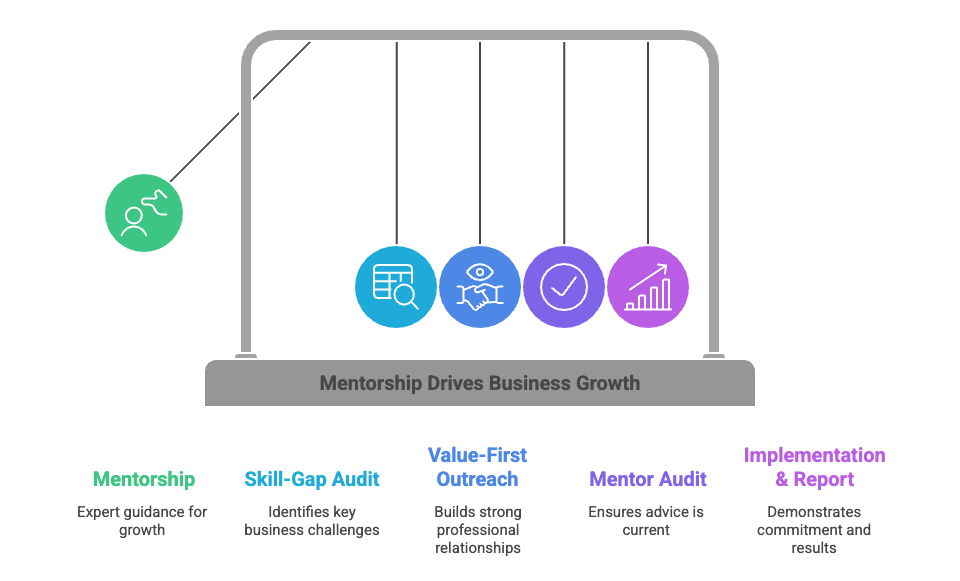
Skill-Gap Audit: Nail down the one choke point killing your momentum: fundraising, operational scaling, or AI execution. Hunt a specialist who’s beaten that specific dragon, not a general cheerleader.
Value-First Outreach: Pick three names. No “pick your brain” ask. Send a short, sharp note: “I read/watched X, applied it this way, and got Y result. Thought you’d find this trend interesting from the front lines.”
Audit the Mentor: Test early: is the advice current or stuck in slogans and old war stories? If it’s the latter, they’re an anchor, not a sail.
Implement and Report: Move fast on what they say. Nothing kills a high-level relationship quicker than ghosting their input. Circle back quick with: “Tried it. Here’s what happened.” Results are the primary currency of mentorship.
The Real Payoff
Mentorship isn’t a hack for quick wins; it’s insurance against wasted decades and a shortcut to judgment you can’t Google. In a world moving this fast, going it alone is the riskiest bet you can make. Borrow the eyes that have seen the turns already. Audit where you’re stuck, reach out with real value, and start the transfer. The work you’re building, and the legacy it leaves, will be better for it.