

The Leapfrog Pattern
Why Structural Freedom is the Ultimate Global Edge

Why This Matters Now - Emerging markets are no longer “catching up” to advanced economies; they are routing around them. While Western firms are locked into aging pension systems, regulatory capture, and labor rigidity, innovators in the Global South are competing on degrees of freedom, not marginal efficiency. If your product cannot function with intermittent connectivity and zero formal identity, you aren’t building a global company. You’re building a regional one.
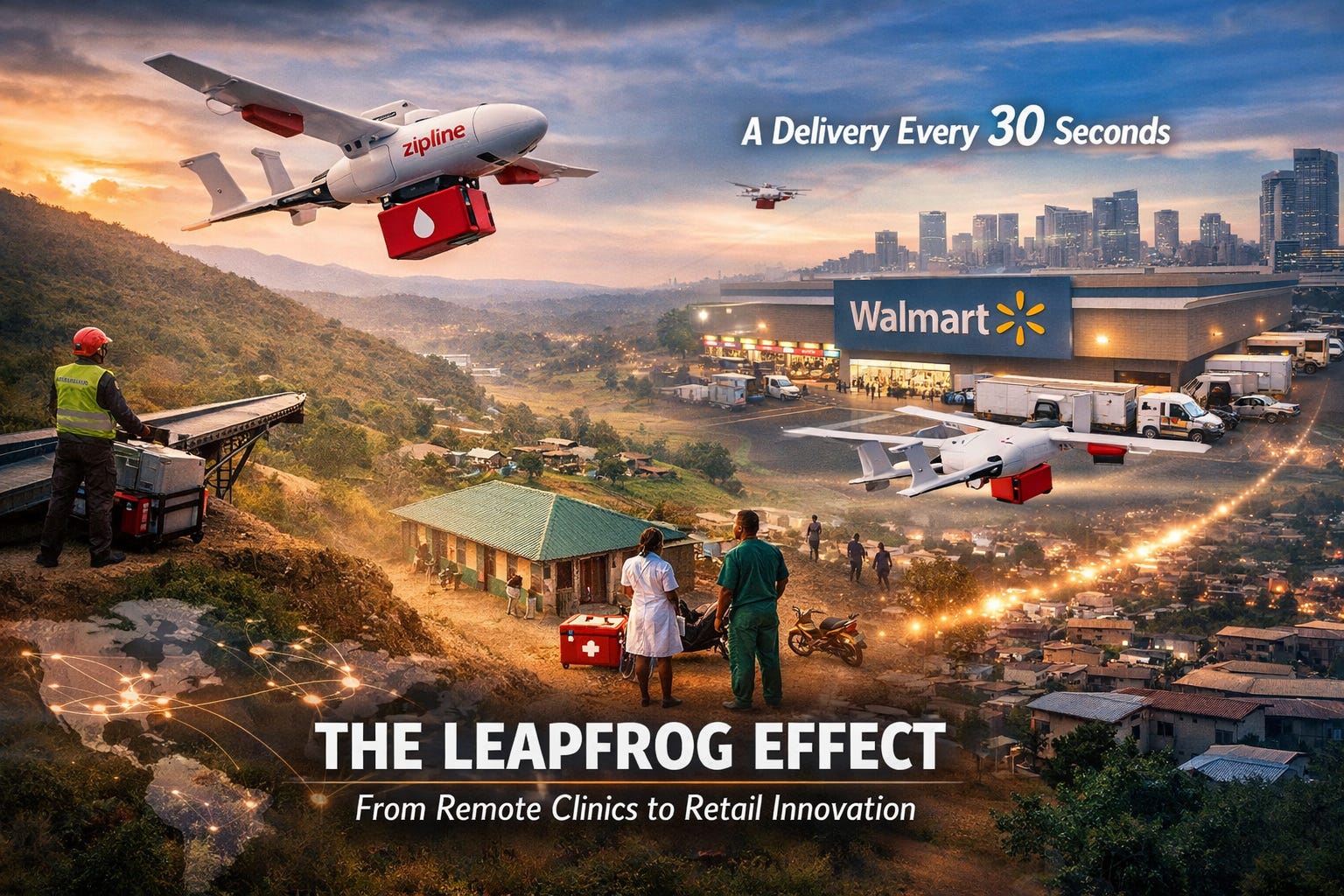
Imagine delivering life-saving blood to a remote clinic in under 30 minutes without a single paved road. This is the daily operational reality for Zipline, an American robotics firm that has now surpassed 2 million commercial deliveries worldwide. Founded in the U.S. but proven at scale in Rwanda, Zipline didn’t just solve a local logistics problem; it built an autonomous ecosystem now redefining U.S. retail. In 2026, this technology is scaling through partnerships with Walmart, handling a delivery somewhere in the world every 30 seconds (Zipline Fact Sheet, 2026).
The result is the Leapfrog Effect: the ability of agile firms to bypass failing or non-existent legacy infrastructure to build businesses that are leaner and more profitable by design. When this effect repeats across sectors, it stops being a story. It becomes a pattern.
The Architecture of Asymmetry
The core advantage of emerging-market innovation is not lower cost. It’s lower structural inertia. Cost advantages can be copied. Structural freedom cannot. Growth is no longer a function of capital intensity; it is a function of the architectural choices made before scale.
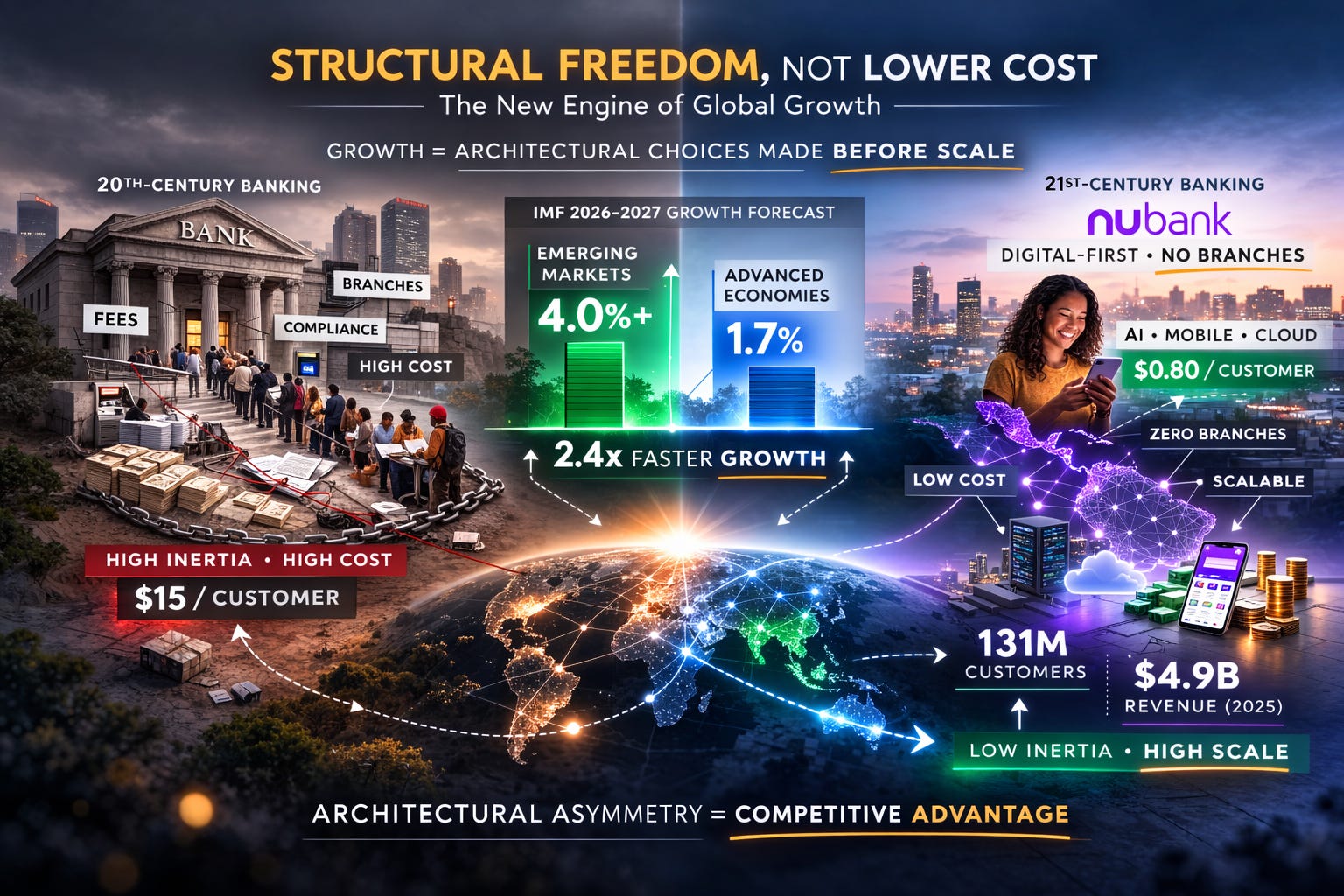
According to the IMF’s January 2026 World Economic Outlook, emerging market and developing economies are projected to grow at over 4.0% through 2027—more than double the 1.7% forecast for advanced economies. That gap is the result of what I call Architectural Asymmetry: building systems that never had to optimize for 20th-century requirements in the first place.
The math at Nubank makes this concrete. Traditional Latin American banks built their entire profit model around physical branches and high-fee safety nets. Nubank built its model around their absence.
By Q4 2025, Nubank had reached 131 million customers with record revenues of approximately $4.86 billion (Reuters, 2025). Their cost-to-serve sits at roughly $0.80 per active customer—a figure Nubank highlighted explicitly in their Q2 2025 financial disclosures—while traditional incumbents typically exceed $15.00.
Run the numbers: serving 131 million customers at $15.00 per head requires nearly $2 billion annually in servicing costs alone, before a single loan is issued or a single branch is staffed. Nubank wins not because it out-executed legacy banks, but because it never built what they built.
The Leapfrog Pattern: A Repeatable System
The same playbook keeps surfacing across banking, logistics, commerce, and energy. That’s not a coincidence—it’s a system. The Leapfrog Pattern runs through three distinct stages:
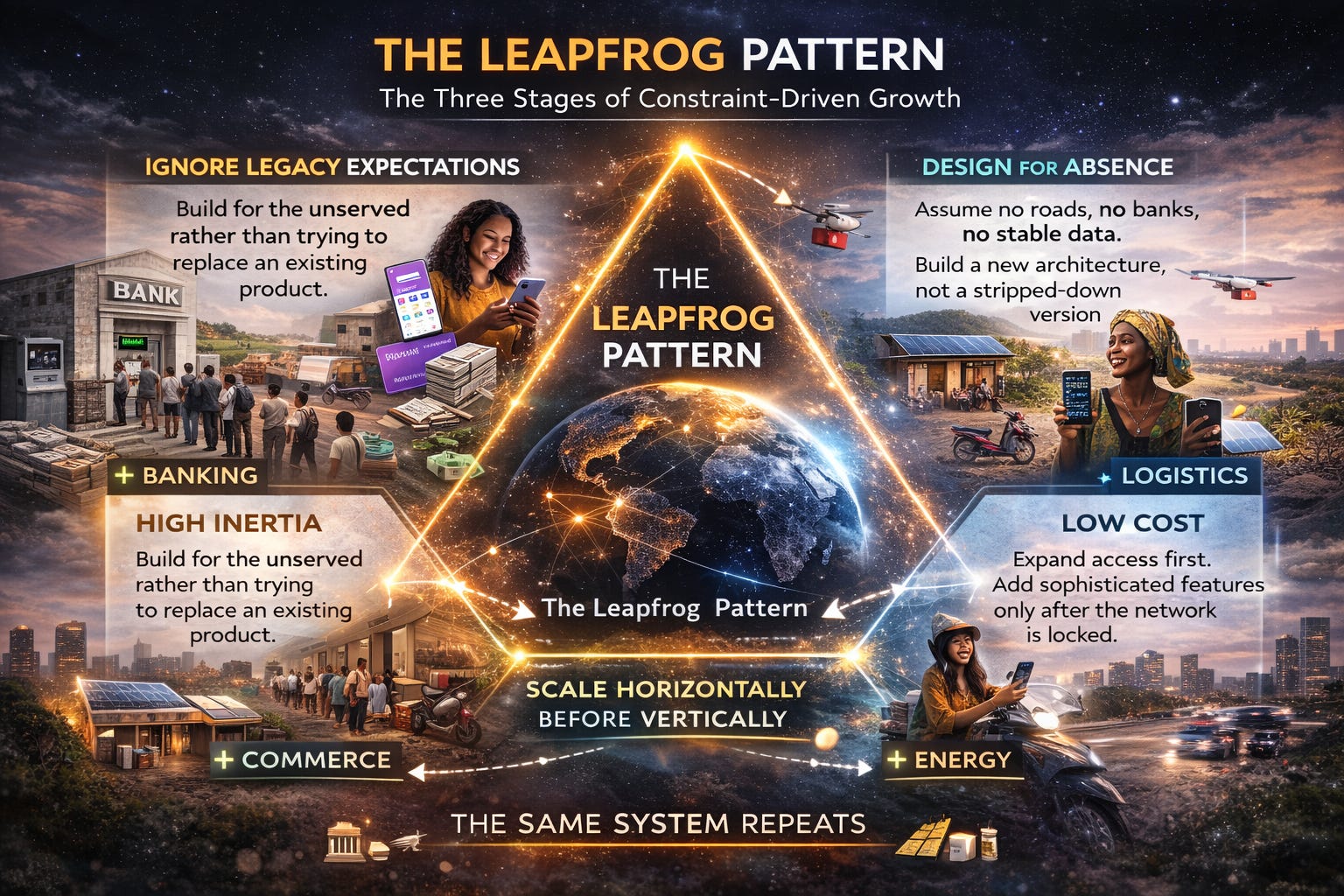
Ignore Legacy Expectations. Build for non-consumption—the unserved—rather than trying to replace an existing product.
Design for Absence. Assume no roads, no banks, and no stable data. This isn’t a stripped-down version of a Western product; it’s an entirely different architecture.
Scale Horizontally Before Vertically. Expand access to the masses first. Add sophisticated features only after the network is locked.
Evidence: Kasha and Gojek
Kasha, the Rwanda-born health and commerce platform, built its retail network around low-connectivity realities rather than waiting for smartphone penetration. Customers order via SMS and USSD codes—no app required, no home address required. By late 2024, Kasha had grown from $1 million in revenue in 2020 to over $50 million, expanding into seven African countries by designing for a customer their competitors literally could not see.
In Southeast Asia, Gojek skipped the single-use app phase entirely. Designed for a fragmented logistics landscape with no dominant incumbent, they became a Super-App—a digital operating system for millions of users. They didn’t set out to build a better ride-hailing app. They set out to build a trust layer in a low-trust economy.
Field Evidence: This is not a marketing video. It is an operating manual. Watch Kasha founder Joanna Bichsel explain their offline retail architecture:
Scaling Through Autonomous Infrastructure
The Leapfrog Effect is most visible in physical logistics. Zipline, now valued at $7.6 billion, is expanding across North America not by competing with delivery vans, but by competing with the idea that a van needs a road at all.
Zipline co-founder Keller Rinaudo Cliffton has said plainly that “the next generation of logistics will not look like a van on a road.” Their system, which handles a delivery every 70 seconds, is now embedded in the supply chains of Walmart and Cleveland Clinic. That technology was not developed in a suburban test facility. It was developed where it was the only viable option.
Field Evidence: If you only watch one thing after reading this, watch this operational cycle. It shows how a solution born from geographic necessity moves upstream to disrupt established markets:
The Two Dividends of the Leapfrog Effect
By 2035, 80% of the new global consumer class will come from emerging markets. That creates two dividends that most incumbents are structurally unprepared to capture.
The Consumption Dividend. The “Leapfrog Class”—consumers in Southeast Asia and Sub-Saharan Africa moving directly from no electricity to solar, from no bank to mobile-first fintech—represents the largest untapped market in modern history. According to S&P Global Market Intelligence (2024), tech-related exports and digital services in these regions are projected to grow 12% annually through 2027. That growth will not flow to firms dependent on credit scores and long-term contracts; those systems were built for stability, not velocity.
The Talent Dividend. The fastest teams in 2026 don’t work harder. They never stop. By integrating tech-native workforces in hubs like Lagos or Ho Chi Minh City, firms break the monopoly of time zones and gain a 24-hour development cycle—plus something harder to quantify: a product team that lives inside the world’s fastest-growing consumer market.
Your Breakthrough Roadmap: The Exposure Audit
To compete in a Leapfrog economy, you have to stop defending what you’ve built and start auditing what’s holding it back. These four steps are not an optimization checklist. They are an exposure audit.

The Scarcity Prototype. Within 30 days, build a version of your product that requires zero high-speed data and zero formal identity. If it fails immediately, your business model is a regional hostage, not a global contender.
The Legacy Baggage Audit. Don’t compare your margins to your local competitors. Compare them to a Leapfrog leader like Nubank. If their cost-to-serve is 90% lower than yours, locate the specific layer of overhead—manual compliance, physical infrastructure, legacy billing—that can be replaced by an automated, decentralized architecture. If a competitor can automate it, it isn’t a process. It’s a liability.
Deploy a Follow-the-Sun R&D Hub. Don’t outsource. Fully integrate a core engineering team in an emerging tech hub—Lagos, Nairobi, or Ho Chi Minh City. The goal isn’t cheaper labor. It’s ensuring your product is being built by people who live inside the world’s most active growth markets.
Adopt Pay-As-You-Go Revenue. Study d.light, which reports 209 million lives transformed and approximately 40 million products sold. As of February 14, 2026, d.light introduced an industry-first 5-year warranty on solar systems—a direct signal that the PAYG model has matured into a trust anchor, not just a pricing tactic. If you require a credit score to sign a customer, you are voluntarily ceding the next billion users to someone who doesn’t.
The map of global business has been redrawn. Success no longer belongs to those with the most history but to those with the fewest inherited constraints. In ten years, when your market is crowded and margins collapse, will you be explaining why your system couldn’t change—or why you never needed it to?