

The Longevity Arbitrage
A strong balance sheet matters most when everyone else runs out of choices.

Why This Matters Now - For more than a decade, cheap capital allowed companies to postpone difficult questions about cash generation, debt maturity, customer concentration, and operating resilience. Once interest rates rose and external financing became more expensive, those hidden weaknesses began determining which companies could still make choices and which had to surrender them.

In the late autumn of 2022, two companies looked at the same tightening economy and faced radically different futures.
The first was Carvana, the online used-car dealer known for its glass car towers. The second was Constellation Software, a Toronto-based acquirer little known outside investment and corporate-finance circles.
For nearly fifteen years following the 2008 financial crisis, capital was unusually cheap. If a business had a strong growth rate, capital markets were willing to finance it on generous terms. But by November 2022, the Federal Reserve was midway through its steepest rate-hiking cycle in forty years, and Carvana’s options shrank.
Carvana had built its expansion on low-cost debt and aggressive performance marketing. When it filed its third-quarter earnings report that November, the numbers were stark: $6.6 billion in long-term debt liabilities and negative cash flow from operations of $585 million over nine months.
What followed was a steady narrowing of possibilities:
November 2022: Third-quarter results expose accelerating cash burn, triggering a sharp decline in debt valuations.
December 2022: Bondholders representing over 70% of senior unsecured notes form an ad hoc steering committee.
May 2023: Carvana offers $2.0 billion in real estate and vehicle inventory collateral to back debt-exchange offers.
July 2023: Management enters a debt restructuring agreement that extends maturities, reduces the principal face value of outstanding debt by $1.2 billion, and commits to a billion dollars in annualized cost reductions to preserve cash.
Advising the bondholder group during the proceedings, Moelis & Company managing director Julia D. Tyler captured the leverage shift: when the liquidity window closes, operating strategy stops being a management decision and becomes a lender consent process.
How Carvana’s Stock Crashed | WSJ What Went Wrong
Now look at Constellation Software.
During that same November, while Carvana was managing creditor demands, Constellation held $1.26 billion in operational cash flow, up 36% from the previous year. Constellation did not need to call an ad hoc committee of creditors or pledge its real estate. Instead, over the next twenty-four months, Constellation remained an active buyer, deploying more than $1.5 billion in cash consideration for dozens of small, specialized vertical-market software companies during the broader technology valuation contraction.
In his letter to shareholders that spring, Constellation founder Mark Leonard noted the shift:
“We continue to find attractive opportunities to acquire vertical market software businesses at reasonable valuations... While the broader market faces tighter credit and declining equity values, our decentralized operating structure and cash flow allow us to remain active acquirers when others are forced to slow down.”
The Greatest Capital Allocator No One Knows About | Mark Leonard of Constellation Software
The fundamental difference between Carvana and Constellation was not simply asset intensity, founder ambition, or technical skill. It was a metric that no balance sheet explicitly measures.
It was a function of strategic time.
The Growth Trap
We tend to think of financial resilience as a defensive virtue. We talk about saving for a rainy day, holding cash, and keeping leverage low. It sounds prudent, but during boom times, holding cash looks inefficient.
Consider the software expansion of 2020 and 2021. Across the Bessemer Venture Partners Cloud Index, a collection of public cloud software companies, the median enterprise-value-to-forward-revenue multiple peaked above twenty times. The highest-performing operators traded at thirty times revenue or higher.
Public markets sent a powerful signal that growth could outweigh nearly every other operating metric. Under those rules, holding extra cash buffers looked like an executive unnecessarily depressing returns on equity. Market commentary heavily favored top-line expansion, often giving far less attention to the durability of gross margins or customer-acquisition economics.
And then credit conditions tightened.
As interest rates rose, public software multiples contracted by over 75% in twelve months, bottoming out around five times forward revenue. Companies burning cash and carrying heavy debt found new capital prohibitively expensive. Raising equity meant accepting severe, permanent dilution.
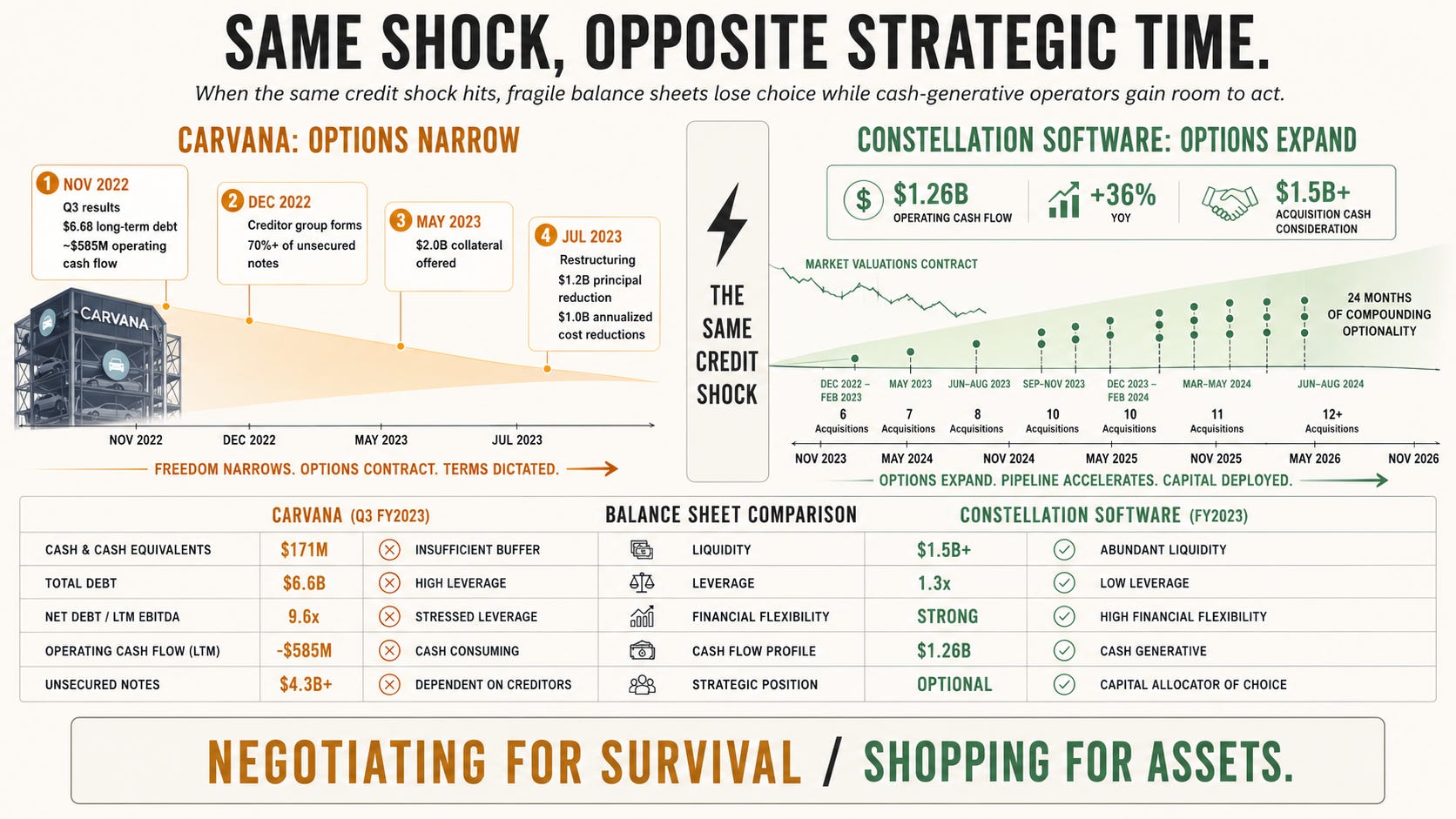
This shift reveals a recurring dynamic: financial markets price growth continuously, but they price resilience discontinuously.
When capital is abundant, resilience is treated as a carrying cost. But when credit markets freeze, resilience can become the condition that determines whether everything else still matters.
This asymmetry creates what can be described as longevity arbitrage.
Longevity arbitrage is an analogy, not a literal risk-free trade. The return is uncertain and depends on management preserving flexibility and then deploying it well. It is the uncertain return earned from preserving capabilities that competitors discard when those capabilities appear costly.
The mechanism operates in four steps:
During a boom, resilience appears costly, so competitors eliminate operational buffers to maximize near-term returns.
A macroeconomic or sector shock occurs, rapidly increasing the real-world value of operational flexibility.
Fragile companies lose freedom of action and spend critical energy negotiating for survival.
The resilient company deploys capital into temporarily mispriced assets, hires displaced talent, buys customer accounts at distressed prices when competitors cut service, or wins market share directly.
The return does not come from predicting the exact timing of a downturn. It comes from securing strategic decision time when competitors are forced to surrender theirs.
Distress does not automatically create value. A cheap asset can remain a bad asset, and customers abandoned by a competitor may be costly to retain or serve.
Runway Is Not Strategic Time
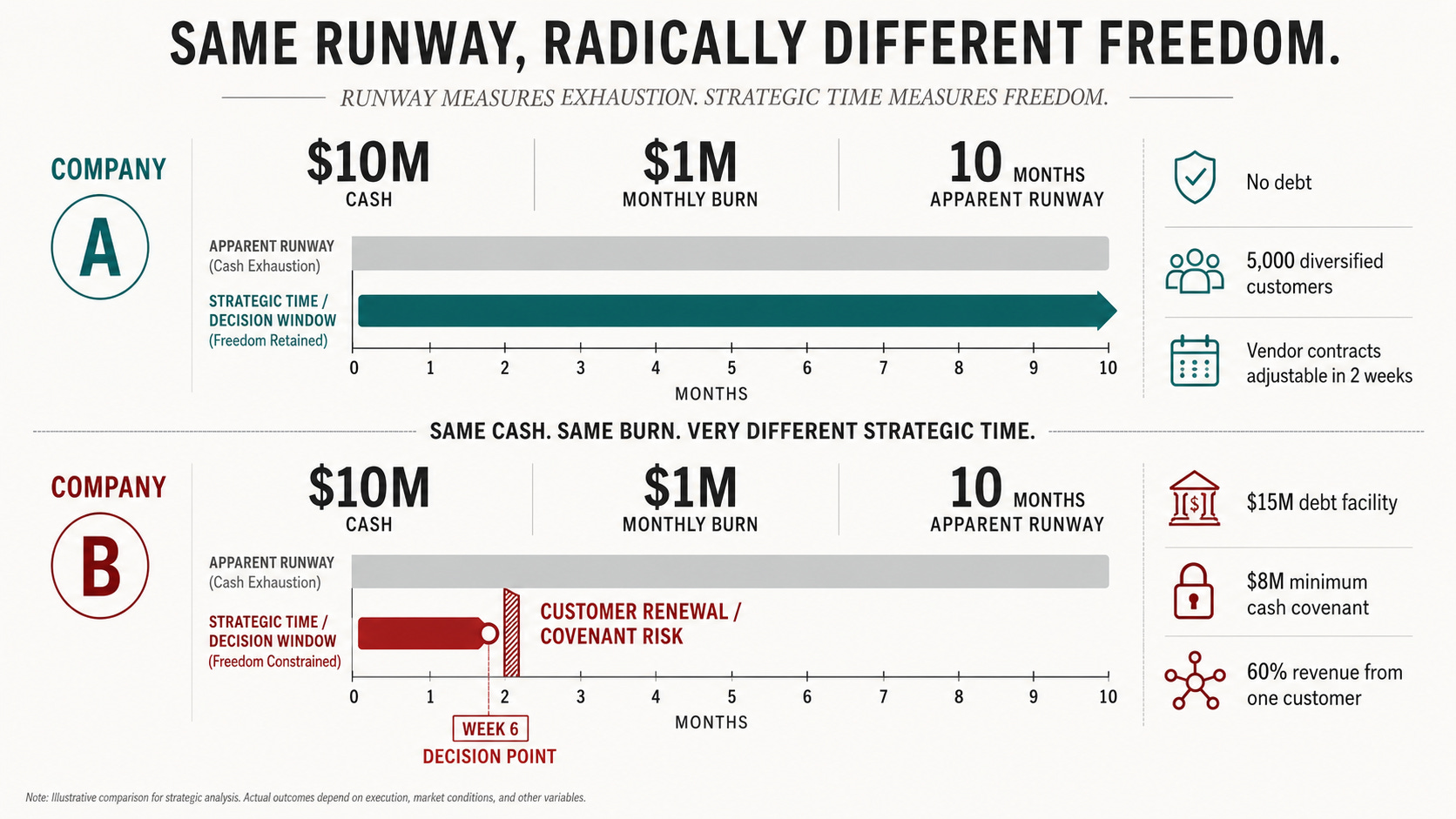
Runway asks how long the company can continue. Strategic time asks how long management can still choose what happens next. A company may have twelve months of cash but only six weeks of strategic time if a covenant test, regulatory deadline, or customer renewal can remove its freedom first.
To see the difference, imagine two companies, both with $10 million in cash and a monthly net burn of $1 million. Both appear to have ten months of runway.
Company A has no debt, a diversified base of five thousand small-business customers, and vendor contracts that can be modified with two weeks’ notice.
Company B has a $15 million debt facility with a bank covenant requiring it to maintain at least $8 million in cash at all times. Furthermore, 60% of its revenue comes from a single enterprise client whose contract is up for renewal in sixty days.
Does Company B really have ten months of runway? If cash falls below the covenant floor, management’s options become subject to lender remedies and consent. Company B does not have ten months of runway. It has roughly six weeks of unforced choices left.
The Durability Spectrum
Runway: The time remaining until cash is fully exhausted at current spending levels.
Resilience: The operational capacity of a business to absorb an unexpected shock.
Strategic Time: The window during which management retains freedom of choice before creditors, investors, or dominant customers control the decision.
Longevity Arbitrage: The return captured by taking offensive action while competitors are constrained.
Preserving room to maneuver carries real costs. Holding cash lowers return on equity during expansionary periods, and maintaining secondary suppliers increases unit costs.
Furthermore, optionality can become its form of paralysis. In markets that reward early commitment, preserving every option can lower returns by delaying the investment required to build scale, trust, or technical superiority.
Strong balance sheets create another danger: management may mistake freedom for judgment and pursue weak opportunities simply because competitors cannot bid. Strategic time creates freedom of choice. It does not improve the quality of the choice.
Strategic time is valuable only when management uses it to act.
The Four Conditions of Strategic Time
Financial and operating capacity create options. Governance determines whether lenders, investors, and the board permit management to use them. A company may hold ample cash on paper yet need lender consent before reallocating capital.
1. True Liquidity
True liquidity is unencumbered capital. The relevant question is not how much cash appears on the balance sheet, but how much management can actually use without triggering another constraint.
If cash is pledged as collateral or trapped behind a covenant wall, it is not operational liquidity. It is a security deposit for someone else.
2. Duration Alignment
Funding long-term technical research with short-term debt destroys strategic time. The correct financing structure depends on the predictability, liquidity, and collateral value of expected cash flows, not on the label attached to the project.
3. Economics of New Growth
If customer acquisition produces negative contribution margins after accounting for true variable costs, expanding sales accelerates a loss of freedom. Every business model has a specific cost perimeter that must be strictly accounted for:
SaaS: Sales commissions, onboarding, implementation labor, hosting infrastructure, and customer support.
Commerce: Payment processing fees, fulfillment labor, freight, customer service, and product returns.
Services: Direct delivery labor, subcontractors, billable travel, and project rework.
Manufacturing: Raw materials, variable plant labor, freight, channel commissions, warranty repairs, and field service.
4. Recoverability and Decision Speed
Recoverability is the capability to reverse a failed commitment before it impairs the core business. Cash is a buffer. Supplier-switching ability is a capability. A buffer absorbs a defined loss, while a capability changes what the company can do next.
Recoverability determines whether the company can reverse failure. Decision speed determines whether it can exploit the time recovered.
Decision speed requires timely information, clear authority, execution capacity, and prepared counterparties. Fast approval of a plan the organization cannot execute creates no advantage. Strategic time creates value only when decision speed exceeds the decay rate of the opportunity.
A Plan Is Not a Strategy
Maintaining operational slack carries real costs, and redundancy must be evaluated pragmatically. Two suppliers do not create real redundancy if both rely on the same port, precursor, cloud region, or financing bank.
Redundancy is justified when plausible disruption losses materially exceed its recurring cost, or when failure would cause irreversible damage that prevents the company from serving customers.
When Patience Still Requires Scale
Longevity arbitrage is an effective strategy, but it is not a universal law. Some markets do not force a choice between scale and endurance. They require both.
High-CapEx Manufacturing
In industries defined by high infrastructure thresholds, capital efficiency cannot replace minimum scale and sustained technical investment.
ASML’s progress required patient capital, sustained R&D, technical coordination, and long-term customer commitment from chipmakers such as Intel, TSMC, and Samsung to develop Extreme Ultraviolet lithography systems.
ASML demonstrates that strategic time can also be built through long-duration capital deployed at enormous scale.
Network Tipping Points
In two-sided digital marketplaces, early scale establishes critical local liquidity, brand recognition, and supplier density.
Uber raised tens of billions of dollars across private equity rounds, debt financings, and its public offering. Part of that capital funded driver payouts and rider incentives designed to establish local driver density and user habits in major metropolitan hubs before local rivals could match its supply.
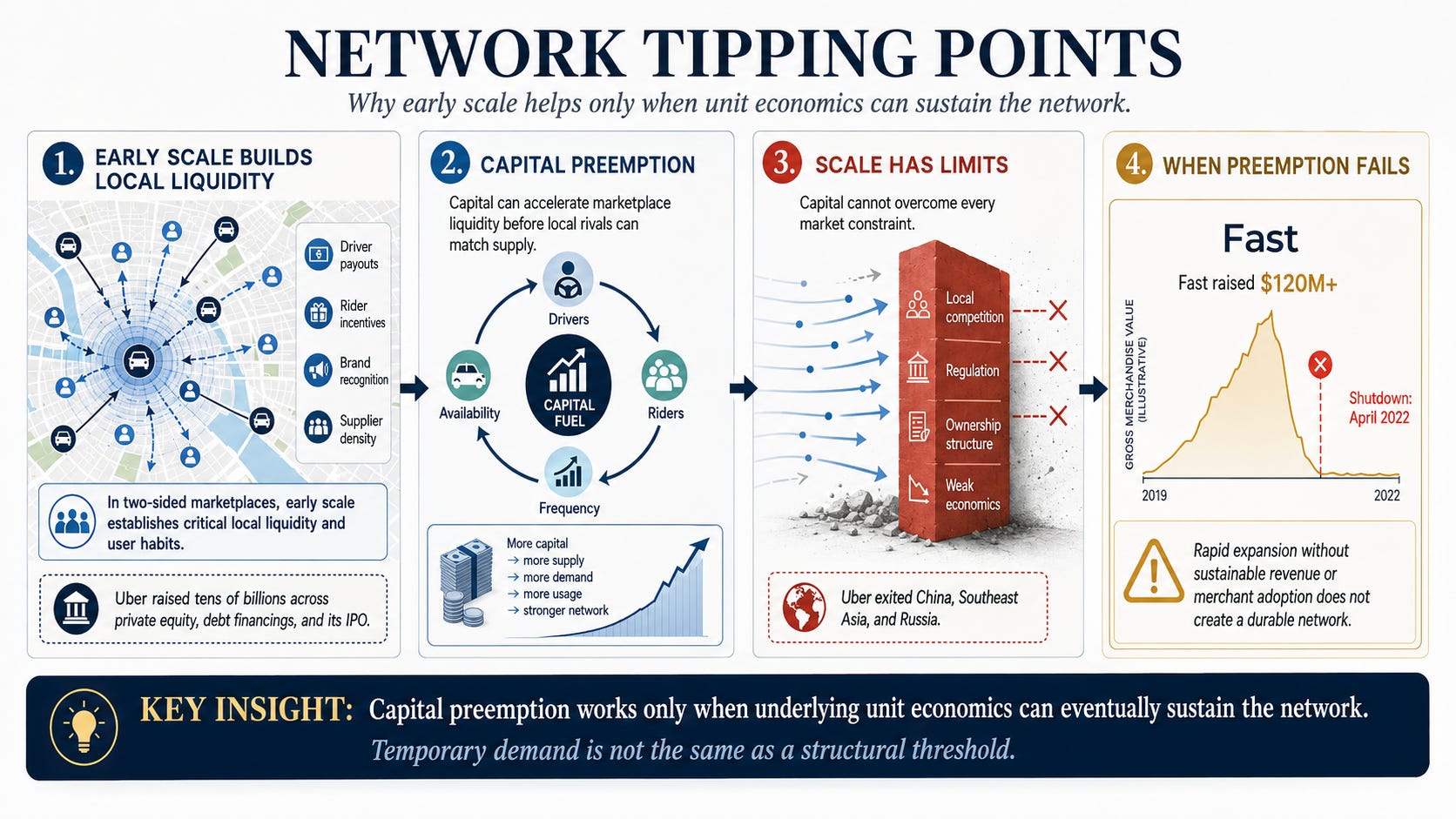
However, Uber’s regional exits in China, Southeast Asia, and Russia show that capital cannot overcome every combination of local competition, regulation, ownership structure, and weak economics.
Capital preemption fails when spending merely purchases temporary demand without crossing a structural threshold. Fast, the one-click checkout startup that raised over $120 million, expanded rapidly before reaching sustainable revenue or merchant adoption, forcing a complete shutdown in April 2022.
Capital preemption accelerates marketplace liquidity only when underlying unit economics can eventually sustain the network.
How Institutions Create Room to Act
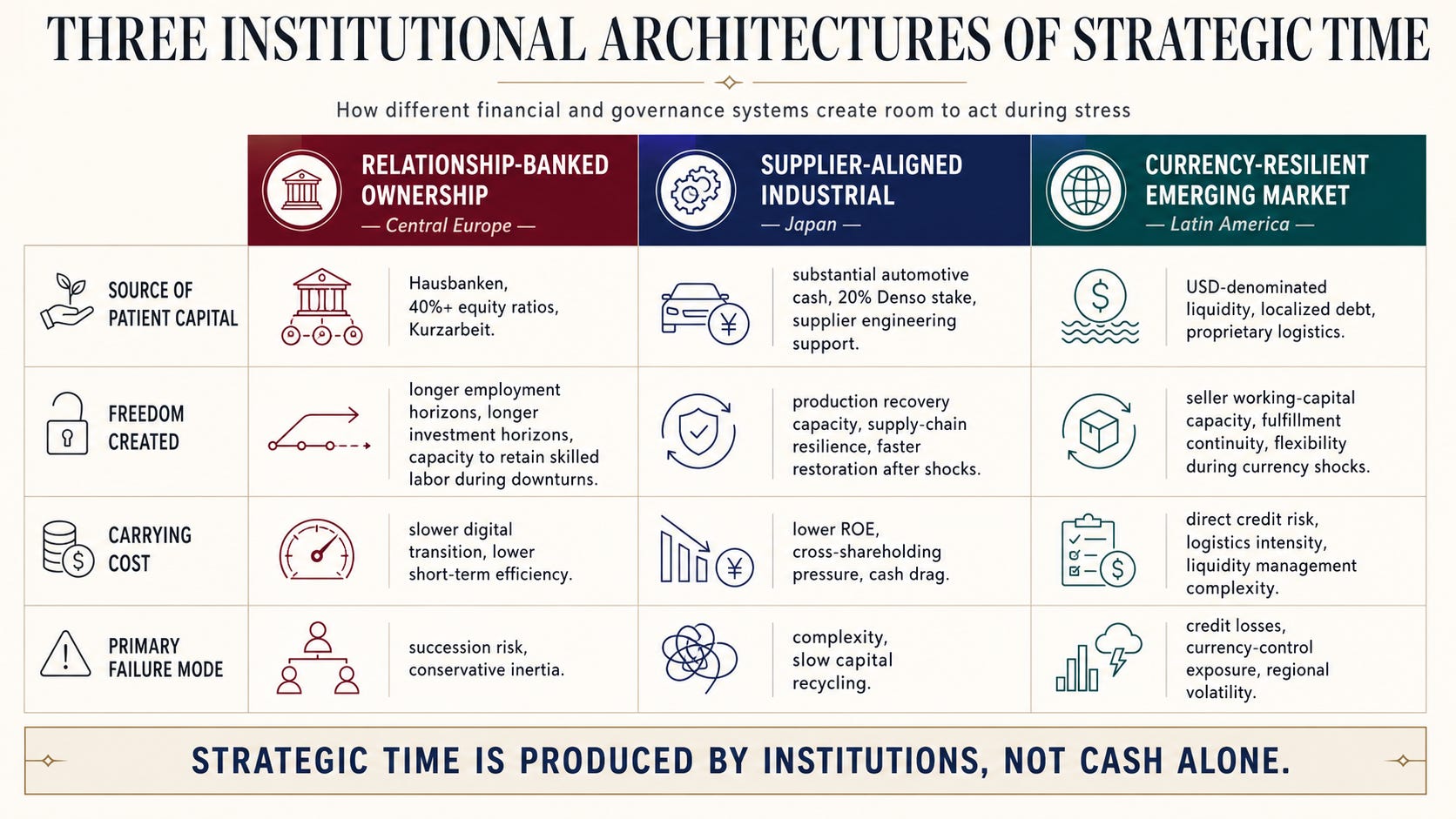
The structure of strategic time varies across global financial and corporate-governance systems.
1. Relationship-Banked Ownership Model
In Germany, Austria, and Switzerland, specialized industrial engineering firms known as the Mittelstand rely on long-term bank relationships, or Hausbanken, and are less dependent on public equity markets.
According to Deutsche Bundesbank corporate-finance studies, well-capitalized Mittelstand manufacturing companies frequently maintain equity ratios above 40%, compared with 28.5% for large listed European firms. During global downturns, many use government-supported short-time work programs, known as Kurzarbeit, and labor-time accounts to retain skilled engineers.
Conservative capital structures can delay digital upgrades or leadership transitions, but they grant these firms longer decision horizons during cyclical downturns.
2. Supplier-Aligned Industrial Model
In Japan, industrial groups use cross-shareholdings and supplier-financing networks to build resilience.
Toyota Motor Corporation maintains automotive-segment cash reserves exceeding 5.5 trillion yen alongside a 20% equity stake in key tier-one supplier Denso. During severe supply shocks, such as the March 2011 Tōhoku earthquake and tsunami, Toyota exercised this structural capacity by advancing payment schedules and dispatching more than 1,000 corporate engineers to restore tier-two and tier-three supplier facilities.
Carrying higher cash balances can lower return on equity during economic booms, but it provides substantial capacity to absorb supply shocks.
3. Currency-Resilient Emerging-Market Model
In emerging markets, strategic time depends on currency structure as much as local debt leverage.
MercadoLibre reports substantial cash and investments denominated in U.S. dollars, manages dollar-debt exposure through localized debt issuances, and built its own logistics network, Mercado Envíos, across major Latin American markets.
When regional currency shocks hit competitors relying on cross-border credit, MercadoLibre uses localized infrastructure to maintain fulfillment capacity and extend seller working-capital credit through Mercado Pago.
The tradeoff is direct credit-loss exposure if merchant defaults rise during a regional recession.
Testing Your Room to Act
To translate these principles into management practice, executive teams should evaluate their organization against this audit tool.
Management should review these domains monthly and boards quarterly, using scenarios calibrated to the company’s volatility, concentration, and financing structure. Board review should move to monthly once a defined liquidity, covenant, or concentration threshold is breached.
For some businesses, stress scenarios might include an industry shock, a severe company-specific failure, a combined revenue and collection shock, and a reverse stress test identifying the exact point at which a covenant is breached or cash is exhausted.
Card 1: Liquidity
Question: How many months of operational runway remain under a sector-specific revenue and margin stress scenario?
Watch for: Stressed runway dropping below the time required to reach the next major milestone; debt maturing before refinancing can be secured.
Action and owner: Categorize cost levers into immediately reversible and structural tiers. CEO and CFO, monthly management review and quarterly board review.
Card 2: Growth Economics and Concentration
Question: What is the gross-margin-adjusted CAC payback period relative to customer retention, and what percentage of revenue comes from top accounts?
Watch for: Slow acquisition payback where CAC approaches or exceeds expected retention; dangerous revenue concentration where the loss of one client impairs baseline profitability.
Action and owner: Prioritize customer segments with fast payback and low service complexity. CRO and CFO, monthly management review and quarterly board review.
Card 3: Dependencies
Question: Is the business dependent on a single supplier, cloud host, regulatory permit, or technical integration?
Watch for: A single vendor outage or regulatory change interrupting more revenue than the company can absorb.
Action and owner: Establish dual-sourcing or secondary fallback architectures. COO, monthly management review and quarterly board review.
Card 4: Decision Constraints
Question: Do debt covenants, investor-consent rights, or board terms restrict the company’s ability to redirect investment?
Watch for: Downside scenarios that breach interest-coverage or liquidity covenants and require lender consent to reallocate capital.
Action and owner: Renegotiate debt terms or expand governance capital buffers. CEO and board, quarterly review or monthly after a stress trigger.
Card 5: Reversibility and Decision Speed
Question: How quickly can management reverse a failing initiative, and how long does internal approval take once a stop-loss trigger is reached?
Watch for: Severe contractual penalties for halting a project; approval latency exceeding the market opportunity window.
Action and owner: Establish explicit stop-loss criteria, named decision authority, and streamlined sign-off protocols. Executive committee, monthly management review and quarterly board review.
Card 6: Downturn Opportunities
Question: If primary competitors became capital-constrained tomorrow, which assets, people, or customer accounts would the company pursue?
Watch for: No pre-approved target list, valuation ceilings, integration leader, customer-retention assumptions, or post-transaction liquidity requirements. Distress alone does not create a good asset.
Action and owner: Maintain a pre-approved target list with valuation caps, contract-transferability checks, servicing-cost estimates, retention probabilities, covenant headroom, minimum post-transaction runway, maximum payback periods, and named integration leadership. CEO and board quarterly review or monthly after a stress trigger.
Strategic Time in Practice
Consider an illustrative mid-market enterprise software firm facing a macroeconomic slowdown.
During a quarterly review, the CFO models a stress scenario combining a 20% drop in new bookings with a 60-day collection delay. Stressed runway falls from eighteen months to nine, below the twelve months required to launch the company’s next-generation software platform.
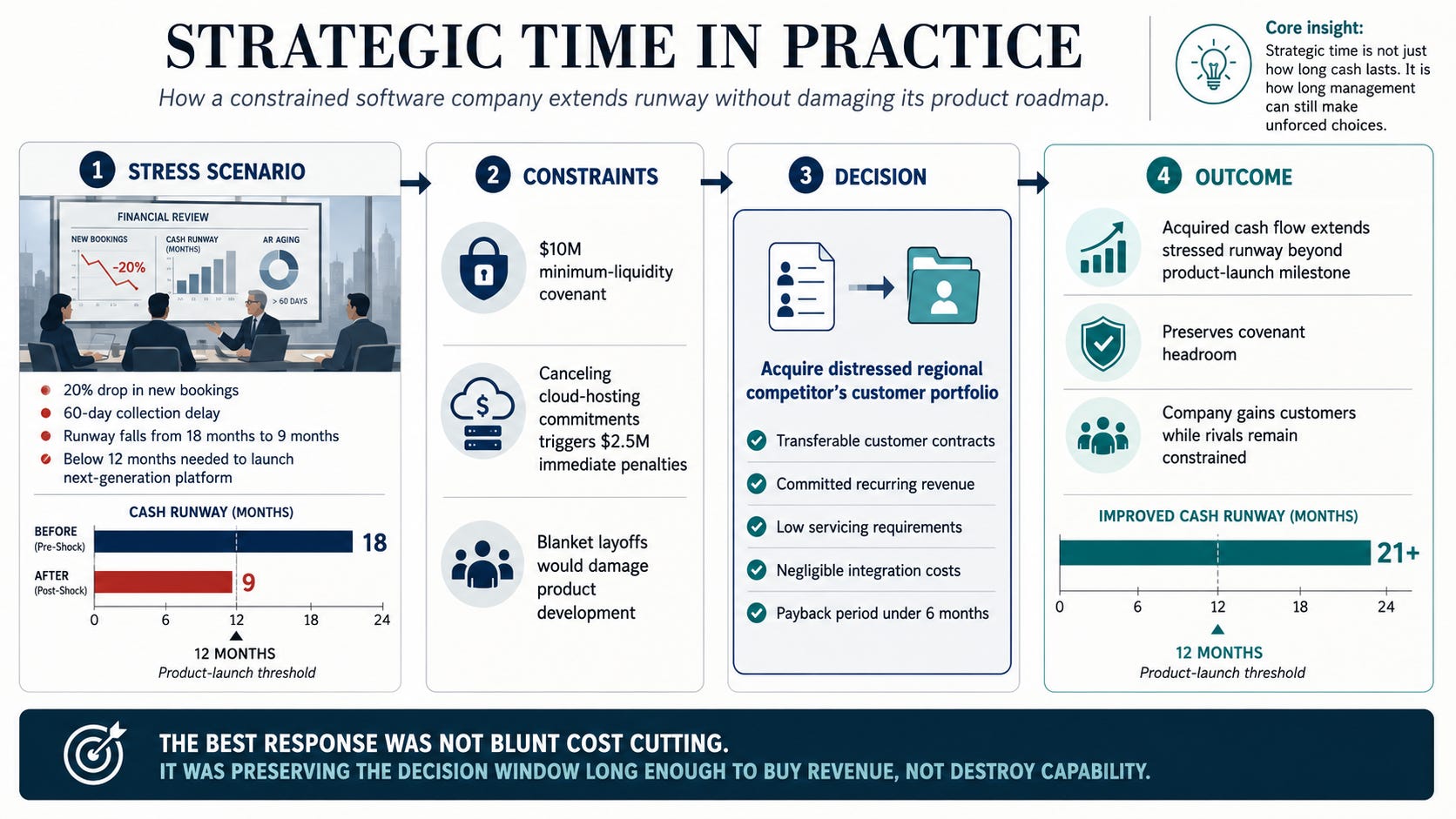
The company also has a $10 million minimum-liquidity covenant. Canceling several cloud-hosting commitments would trigger $2.5 million in immediate penalties, limiting the value of a simple cost-cutting response.
Instead of executing blanket layoffs that would damage product development, the executive team identifies a distressed regional competitor whose funding has run out. It acquires a transferable customer portfolio with committed recurring revenue, low servicing requirements, negligible integration costs, and a payback period below six months.
The acquired cash flow extends the stressed runway beyond the product-launch milestone while preserving covenant headroom. The company gains customers while its rivals remain constrained.
Choosing the Moment
Preserving strategic time is never free. It requires discipline when everyone else is celebrating rapid growth. It means accepting lower returns on equity during expansionary booms, carrying cash balances that look inefficient on paper, and maintaining operational redundancy.
Preserved time matters only if management already knows what it will do when competitors run out of choices.
When credit markets tighten, the underlying reality of corporate finance becomes clear.
One company enters the downturn negotiating for survival. The other enters it shopping.
The strongest company is the one that preserves enough room to maneuver so that when the moment arrives, it gets to choose.