

The Margin Defense System
Why the Best Founders Are Trading Vanity Metrics for Economic Gravity


A few years ago, people measured startup success by speed. How fast could you hire people? How fast could you raise capital? How fast could you buy customers?
For a while, that formula worked. Money was cheap, investors rewarded growth above almost everything else, and founders treated profitability as a problem for a future version of the company.
Then the market changed. Interest rates rose. Venture funding slowed. Public-market investors stopped applauding unprofitable expansion. Suddenly, businesses that looked unstoppable discovered that revenue growth alone could not save them from weak economics.
The founders thriving in this environment are not necessarily building better products; many are simply running better systems. They understand something that much of the startup world spent a decade ignoring: growth is only valuable when it creates durable value. If every new customer costs more to acquire than they eventually return, scale becomes a liability rather than an advantage.
This realization is forcing founders to confront the baseline math of their business: positioning is not marketing polish; it is a margin defense system. When a company cannot clearly explain why it is distinct, it loses pricing power, its sales cycles stretch out, and its underlying economics crumble.
The Revenue Mirage
Revenue is one of the most celebrated metrics in business. It is also one of the easiest to misunderstand. A company can post record sales while quietly destroying shareholder value. A startup can double its revenue, but this may come at the cost of its long-term prospects.
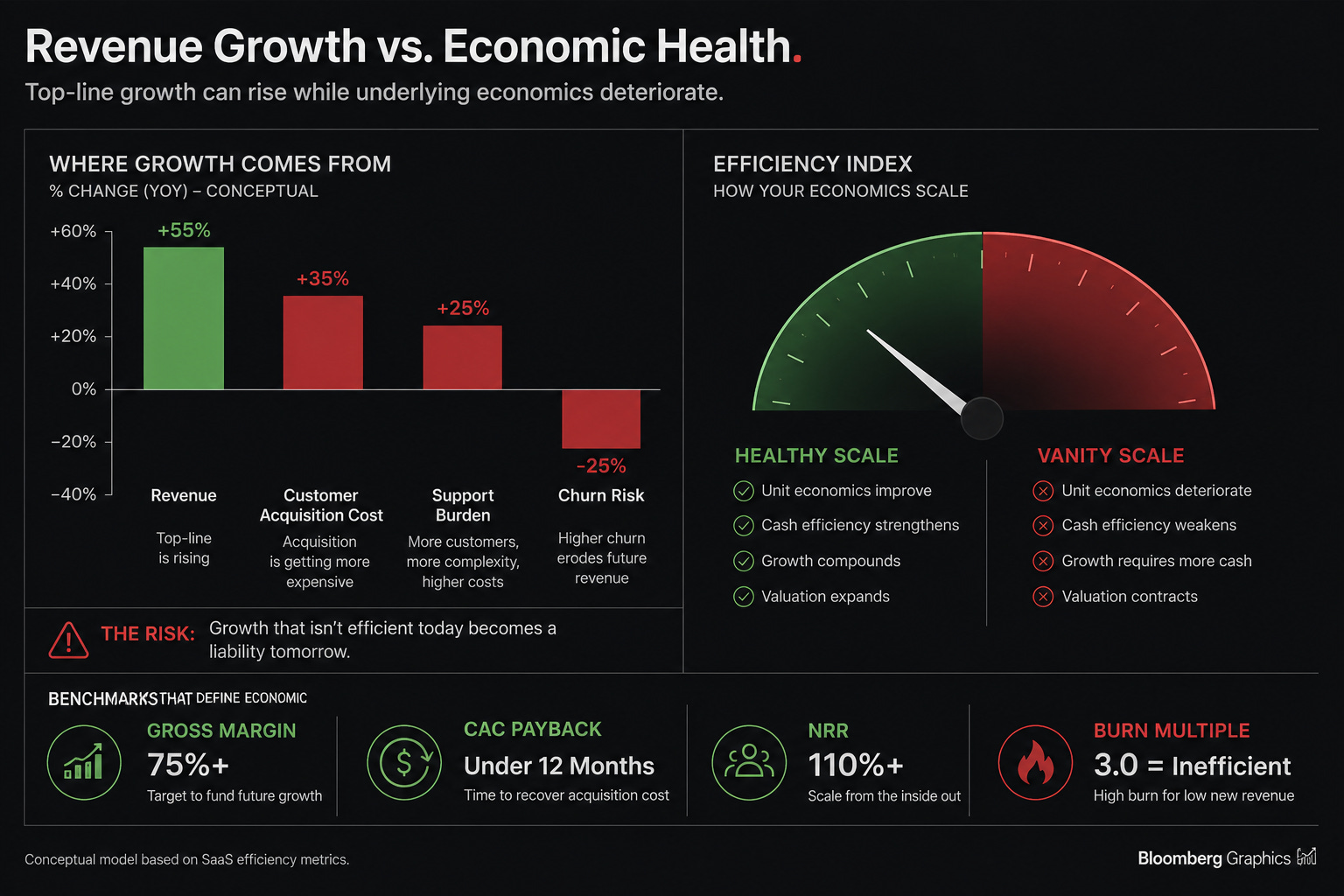
The reason is simple: revenue tells you money came in, but it does not tell you whether the economics behind that growth are sustainable. Usage data often reveals what revenue alone cannot. You might pull in a year’s worth of subscription revenue up front, but if those buyers stop opening the software, they will churn the moment that contract expires.
The collapse of Shyp illustrates the danger. The on-demand shipping startup raised over $60 million on a vision of simplifying consumer logistics. Yet its core transactions had broken unit economics, resulting in losses on the vast majority of its deliveries. As volume increased, losses increased alongside it. Growth amplified the weakness instead of fixing it, forcing the company to shut down. Scaling a broken model does not repair the model; it accelerates the failure.
The corporate graveyard is filled with businesses that mistook top-line velocity for economic health. WeWork achieved a $47 billion private valuation by treating real estate expansion as a tech play, racking up billions in long-term lease commitments. Every new location increased reported growth, but it also increased the company’s exposure to long-term lease obligations.
Many founders believe cash buys growth. In reality, cash often hides broken economics long enough for them to become catastrophic. When scale is fueled by vanity metrics rather than real efficiency, a company is simply building a larger house on sand.
Core Startup Metrics (Startup Mini-Series)
Experienced operators spend less time celebrating top-line sales milestones and focus deeply on four hard metrics:
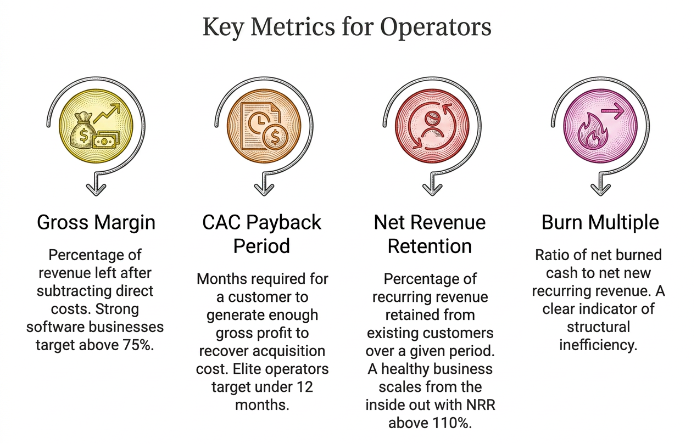
Gross Margin: The percentage of revenue left after subtracting the direct costs of delivering the service. Many strong software businesses target gross margins above 75% to fund future operations.
CAC Payback Period: The number of months required for a customer to generate enough gross profit to recover the cost of acquiring them. Elite operators target a payback window of under 12 months.
Net Revenue Retention (NRR): The percentage of recurring revenue retained from existing customers over a given period, including expansion and upgrades. A healthy business scales from the inside out with an NRR above 110%.
Burn Multiple: The ratio of net burned cash to net new recurring revenue. If a startup burns $3 million to add $1 million in revenue, its Burn Multiple is 3.0: a clear indicator of structural inefficiency.
Cash Runway and the Reality of Capital Control
Every founder talks about runway, but far fewer understand what it represents. Cash runway is not simply the number of months before money runs out; it is the amount of room a company has to steer its destiny.
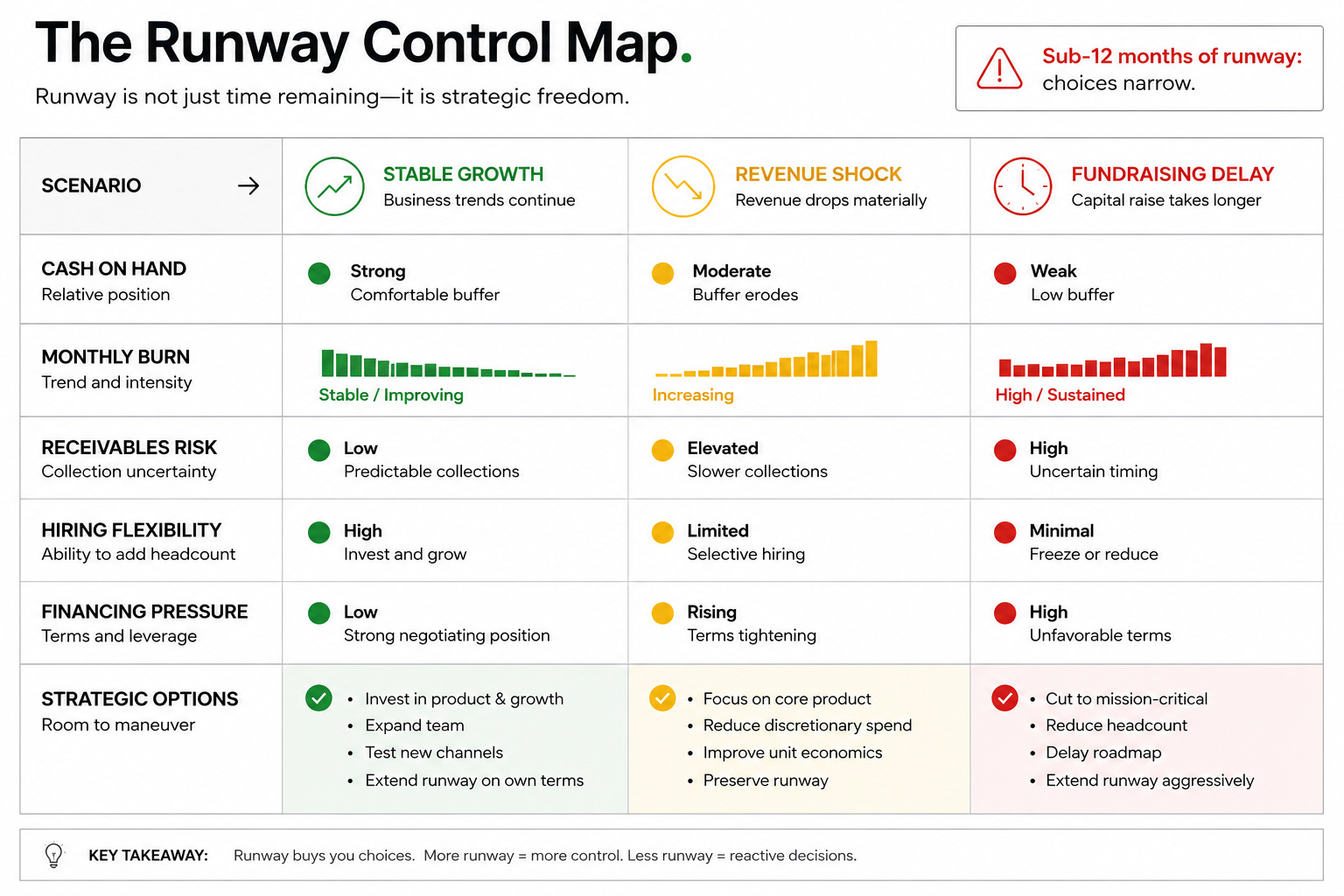
Organizations with a healthy runway can make thoughtful adjustments. They can improve their product, test lower-cost marketing channels, and survive market turbulence without panic. When the runway shrinks to less than 12 months, choices disappear. Decisions become reactive. Product roadmaps contract, hiring freezes occur, and future financing rounds happen under disadvantageous terms.
To maintain control, disciplined companies regularly model multiple futures using their bank transactions and accounting data. They calculate their current burn rate by evaluating expenses over a typical quarter to smooth out uneven purchases. Then they look directly at the worst-case scenarios: What happens if sales drop by half? What happens if fundraising takes nine months longer than expected? What happens if customer churn rises unexpectedly?
Running these calculations does not create pessimism; it creates simple preparedness. The founders who survive downturns are rarely the ones with the most optimism. They are usually the ones with the clearest, most unapologetic understanding of their numbers.
Financial clarity bridges the gap between capital preservation and market positioning. When cash is tightly managed, a company’s marketing strategy must become equally precise, and this clarity of message serves as an essential defense mechanism.
The Financial Impact of Clear Positioning
When money was cheap, loose positioning could be overcome by throwing capital at the problem. If a landing page was confusing, a founder could simply double their advertising budget to force growth. Today, that approach is a fast way to burn capital without learning much.
Positioning directly dictates a company’s financial efficiency. When buyers instantly understand why a product is different, sales cycles shorten, conversion rates improve, and pricing pressure decreases. The company no longer has to compete on price because its unique value is obvious.
Conversely, when a company’s message is vague, every sale becomes a grueling negotiation. The sales process stretches out as teams spend months trying to educate confused prospects. Discounting becomes routine just to get deals over the finish line. Worse, poor positioning acts as an open invitation for bad-fit users to enter the ecosystem. These customers demand custom engineering modifications, drain technical support resources, and eventually churn anyway, driving up your CAC payback period and destroying your net revenue retention.
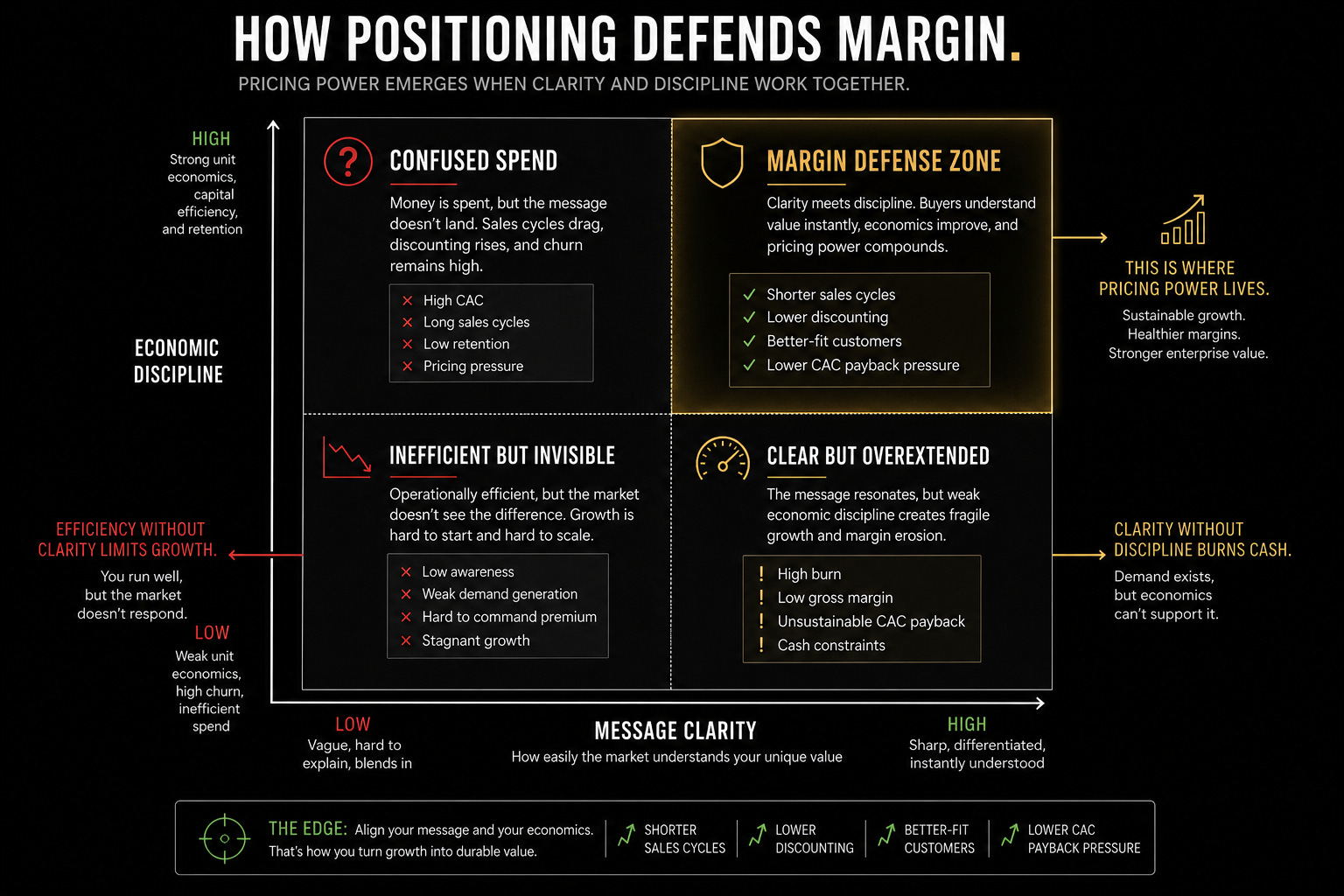
The most effective companies are not merely competing against direct rivals; they are competing against market confusion. Atlassian built an enterprise giant by treating clear positioning and product utility as its primary sales engine.
By keeping its products focused on solving specific collaboration problems for software developers, Atlassian reduced its reliance on a traditional top-down sales motion. Its clear position drove high organic adoption, allowing the company to spend a fraction of its revenue on marketing while maintaining industry-leading gross margins.
Bootstrapping to IPO, product-led growth & scaling SaaS with Atlassian’s Scott Farquhar
This efficiency is what allows a business to step off the venture capital treadmill. When your message is sharp, your product can do the heavy lifting, pulling users into the ecosystem naturally and setting the stage for a unified metric that drives long-term usage.
The Value Engine Under the Hood
Many organizations accidentally create conflicting internal incentives. Marketing celebrates lead volume. Sales celebrates bookings. Engineering celebrates feature releases. Customer success celebrates renewals. Everyone works hard, yet the company drifts in multiple directions simultaneously because teams exist in isolated silos.
The strongest product organizations solve this problem by shifting away from lagging revenue targets and identifying a single behavioral signal that predicts long-term customer success. This guiding metric measures the core value delivered to the user. Tracking revenue tells you what happened yesterday; tracking core engagement tells you if your customer will remain tomorrow.
Spotify offers a clear example of this principle. While the company tracks a broad collection of metrics, listening engagement remains critically important because users who build consistent listening habits tend to remain customers longer and derive more value from the platform.
If a subscriber pays but stops listening, they are a clear churn risk. By focusing on listening habits rather than just monthly billing status, the company can actively optimize for customer satisfaction before a cancellation occurs.
This focus transforms a company from a feature factory into an efficiency engine. When every team aligns around real usage, product value naturally increases, and the software itself becomes your primary vehicle for growth.
Turning Product Usage into Distribution
The most expensive way to grow is to purchase every customer individually through paid acquisition. The most efficient way to grow is to build distribution directly into the product itself, turning standard usage into a natural marketing engine.
Consumer Startup Metrics | Startup School | Y Combinator
Dropbox demonstrated these principles beautifully during its initial scaling phase. Instead of relying on traditional, high-cost advertising, the company rewarded users with additional cloud storage space when they referred friends. The mechanism was simple, but the underlying economics were extraordinary: customers became the primary marketers, and growth became embedded in standard product utility.
This referral program became one of Dropbox’s most important acquisition channels, helping the user base scale from 100,000 users to 4 million in just over a year.
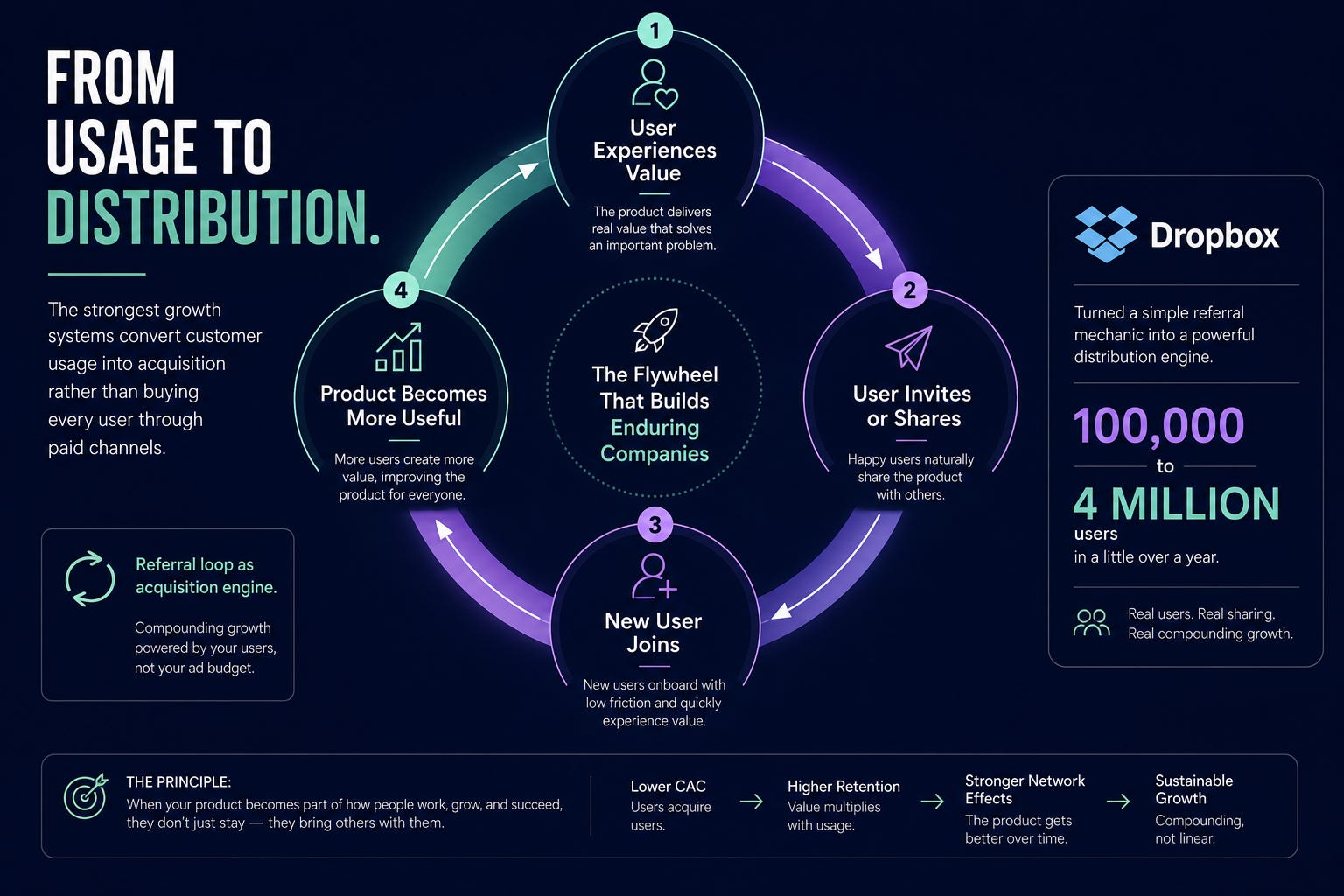
The strongest growth systems generate momentum from existing users rather than requiring endless, linear marketing spend. Attention purchased through advertising disappears the moment spending stops, while attention earned continues to compound.
The Communication Flaws That Mimic Product Failures
Positioning problems rarely announce themselves directly. They show up indirectly through subtle, damaging business patterns that founders frequently misdiagnose as product development issues. Operators must look for these five organizational red flags:
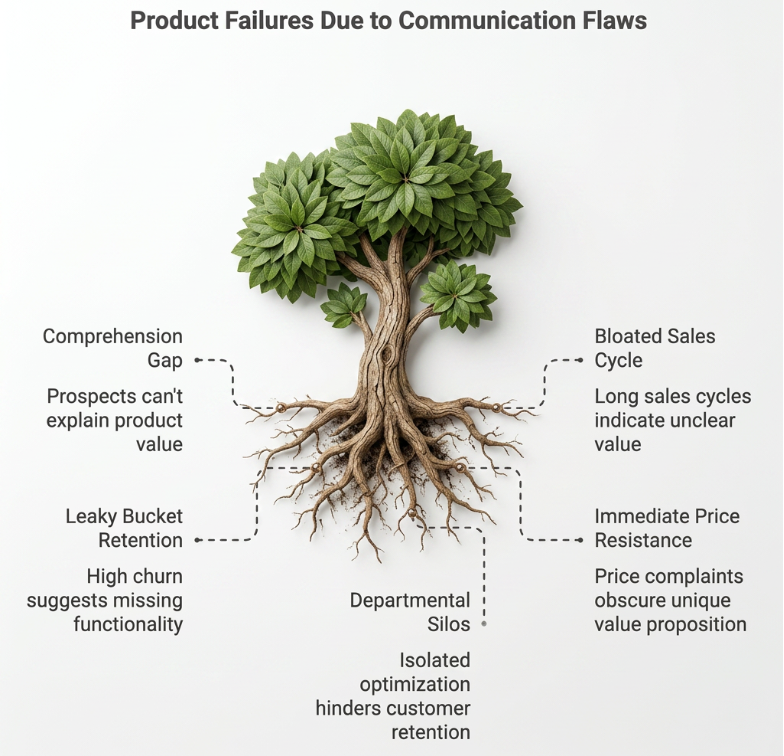
The Comprehension Gap: Existing power users express deep enthusiasm for your solution, yet new, qualified prospects struggle to explain what your company actually does within thirty seconds of visiting your site.
The Bloated Sales Cycle: Sales conversations drag out for months, prospective buyers demand endless custom feature modifications before signing, and sales teams must routinely rely on deep discounting to close deals.
The Leaky Bucket Retention Profile: Customer accounts systematically churn shortly after onboarding, or your technical support channels are flooded with complaints regarding missing functionality that your product roadmap was never intended to include.
Immediate Price Resistance: Target accounts consistently complain that your prices are too high, which is a lagging indicator that your unique value proposition is obscured against competitive alternatives.
Departmental Silos: Your marketing team celebrates record lead generation while your sales team starves for quality bookings, indicating that departments are optimizing for isolated vanity metrics rather than real customer retention.
The New Competitive Advantage
For years, startup culture celebrated companies that could spend the fastest. The next decade will reward companies that learn the fastest.
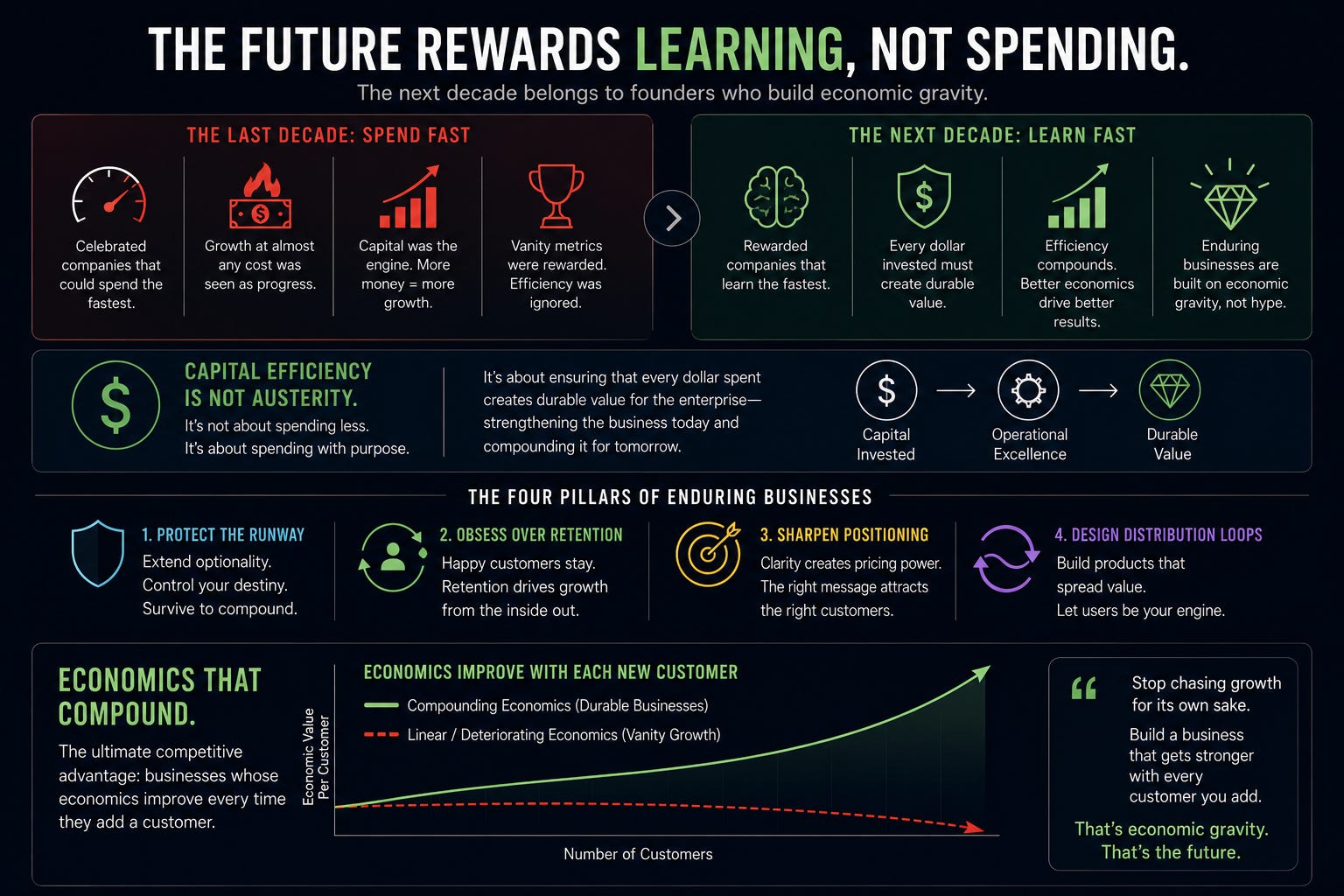
Capital efficiency is not about austerity. It is not about a refusal to invest in the future. It is about ensuring that every dollar spent creates durable value for the enterprise.
The founders building enduring businesses understand this distinction. They protect their runway, obsess over retention, sharpen their market positioning, and design products that carry structural distribution loops. Most importantly, they stop chasing growth for its own sake.
For most of the last decade, founders treated capital as the engine of growth. The next decade will reward something less glamorous and far more durable: businesses whose economics improve every time they add a customer.
Appendix: The Execution Playbook
Moving from growth-at-all-costs to capital-efficient scale is not a motivational shift. It is an operating shift. To build a business whose economics strengthen as it grows, leaders must focus on four things: cash, product, positioning, and distribution.
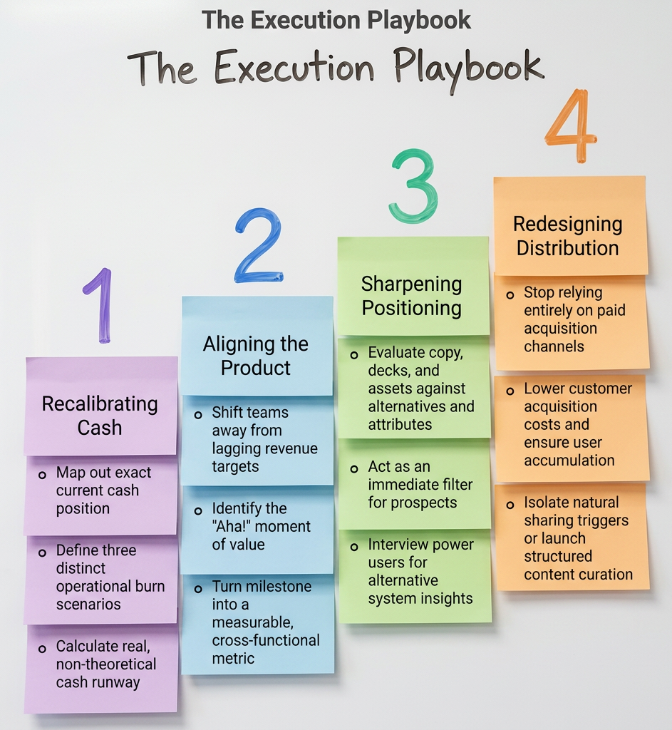
Recalibrating Cash: Map out your exact current cash position by adding total cash on hand to realistic upcoming receivables, then subtracting fixed payables and tax commitments. Define three distinct operational burn scenarios: minor cost adjustments, strategic talent restructurings, and aggressive capital preservation. Divide your true cash position by your average monthly expenses to establish your real, non-theoretical cash runway.
Aligning the Product: Shift your product and marketing teams away from lagging revenue targets and align them around a single, time-bound behavioral signal that predicts long-term customer success. Review your user analytics data to identify the exact behavioral milestone where a customer experiences their “Aha!” moment of value. Turn that specific milestone into a measurable, cross-functional metric, ensuring every operational hour drives customer utility.
Sharpening Positioning: Evaluate your customer-facing copy, enterprise sales decks, and marketing assets against your actual competitive alternatives, unique attributes, and demonstrable product value. Sharp positioning acts as an immediate filter, repelling bad-fit prospects who drain support resources while allowing ideal customers to recognize your value instantly without demanding discounts. Interview five of your most successful, long-term power users to discover what alternative system they would deploy if your company ceased to exist, and use their real-world answers to redesign your messaging.
Redesigning Distribution: Stop relying entirely on paid acquisition channels to fuel your pipeline. Redesign your workflows to build distribution mechanics directly into your product experience or content strategy, lowering your customer acquisition costs and ensuring that your company continues to accumulate attention and users even when marketing budgets are restricted. Isolate a natural sharing trigger within your software or service layout, or launch a highly structured content curation process that synthesizes complex industry insights, positioning your brand as a primary knowledge hub for your target market.
Ken, this is one of the most overlooked lessons in business. Most founders spend their time chasing growth. Very few spend enough time protecting margin.
After more than 30 years of developing products and bringing them to market, I learned that revenue can hide a lot of mistakes. Margin exposes them.
I have seen companies celebrate record sales while quietly losing money on sourcing, fulfillment, returns, customer acquisition, and operational inefficiencies. On paper they looked successful. In reality, they were running faster and faster on a treadmill going nowhere.
One of the first things I look at when evaluating a product is not how much it can sell.
I ask how much it can keep.
Can we improve sourcing?
Can we reduce freight?
Can we increase perceived value?
Can we create recurring revenue?
Can we improve retention?
Those questions often matter more than the next marketing campaign.
As I build Infortum, EARNVA, 247FirstCare, and QmpleteRx, I think about margin differently than I did twenty years ago, even ten years ago. Margin is not just profit.
Margin creates resilience.
It gives companies the ability to innovate, survive market changes, invest in growth, and continue serving customers when others are forced to cut back.
Growth gets the headlines.
Margin keeps the lights on.
Excellent perspective, my friend.