

The Math of Ambition
Why the World's Best Founders Don't Rely on Luck

Stop gambling on your business. Here is the precise mathematical framework you need to build a legacy that lasts.

Take the common scenario of a well-funded software founder walking into a board meeting radiating absolute confidence. Top-line revenue is growing rapidly, and initial customer acquisition costs look brilliant on paper. The founder feels the momentum. Then, an investor asks to see the cash flow timing against the customer acquisition cost (CAC) payback period.
The resulting math is brutal.
It takes 14 months to recover the cost of acquiring a single user, but the company only has nine months of capital runway remaining. The startup is efficiently scaling its own bankruptcy. Confidence is completely irrelevant because the underlying math of the business is broken.
Ambition is ultimately an expected value problem. The most formidable leaders do not rely on luck or blind hustle. They understand that success requires identifying, pricing, and reducing avoidable risk. By mapping the exact probabilities of your environment, you can systematically reduce variance and raise your expected value.
The Odds Are Not Fixed
There is a pervasive myth in the entrepreneurial ecosystem that success is an ethereal combination of perfect timing and serendipity. The assumption that external forces will fix their odds of survival causes millions of capable founders to fail.

This approach is statistically dangerous. The CB Insights Startup Failure Report, which analyzed over 483 post-mortems, finds that the number one reason companies collapse is that they build something the market simply does not need. This type of problem accounts for roughly 42% of failures. That is not a matter of bad luck. That is a fundamental mapping failure: a lethal disconnect between perceived demand signals and execution reality. Conversely, startups that rigorously validate market need possess a survival rate two to three times higher than those that build in a vacuum.
To build a lasting legacy, you must embrace “Probability Hacking.” You identify the variables of your goal and actively tilt the math in your favor.
Consider the brutal arithmetic of basic unit economics. If your CAC is $40 and your gross profit per customer is $120, you can afford a specific payback period. If a marketing funnel converts at 2%, you know exactly that you need 500 leads to secure 10 customers. When you understand the numbers better than your competitors, you gain an insurmountable edge.
The Architecture of the Success Diagram
To hack your probabilities, you must make the invisible visible. Instead of relying on a vague business plan, ambitious operators utilize a “Success Diagram.” This visual map exposes exactly which actions, resources, and environmental factors are pulling your odds up or dragging them down.

Probability Hacking relies on five specific levers you can actually pull:
Increase shots on goal: Leverage volume to overcome low conversion odds.
Improve conversion per shot: Enhance skill, positioning, or offers.
Increase the payout per win: Maximize pricing power or strategic partnerships.
Reduce downside risk: Extend runway and eliminate single points of failure.
Speed up learning loops: Reduce feedback latency to adapt faster.
The EV Formula Cheat Sheet To mathematically evaluate any new initiative, utilize this core expected value formula:
EV = [ P(success) × Payout ] - [ P(failure) × Cost ]
If the resulting number is not overwhelmingly positive, the initiative is a statistical vulnerability.
Real-World Probability Hacks
When the success diagram reveals that the odds of a single attempt working are low, volume becomes your primary weapon. You cannot finesse a mathematical improbability, but you can override it with overwhelming action. Rejection is expected; volume reduces variance.
Consider the early days of Spanx. Sara Blakely did not rely on a single lucky break. Recognizing that the odds of securing retail distribution as an unknown founder were incredibly low, she bypassed traditional gatekeepers and physically flew to Neiman Marcus headquarters to pitch buyers face-to-face. She understood that a higher volume of direct, high-impact pitches inherently improved her chances of a localized breakthrough.
Watch how Sara Blakely navigated rejection and utilized overwhelming action to pitch Spanx to Neiman Marcus:
This principle applies equally outside of the technology sector. Real estate investor Barbara Corcoran utilized a similar philosophy regarding lead generation. She treated real estate leads purely as a numbers game. By publishing the Corcoran Report and leveraging media attention, she widened the top of her funnel to capture massive market share. She understood that volume without a scoreboard is just exhaustion, so she measured the exact impact of her media presence against her inbound client metrics.
How Momentum Compounds
Success rarely occurs in a vacuum. It is highly sensitive to momentum. Securing small, early victories mathematically multiplies your resources, your market authority, and your statistical chances of achieving a larger goal.
Tobi Lütke built Shopify not by attempting to overthrow global software giants on day one, but by solving a highly localized point of friction. He simply wanted to sell snowboards online and found the existing software infrastructure lacking. By building a tool that solved his own immediate problem, he secured a functional, measurable win. That small win compounded. Every new merchant that joined his platform provided vital data, capital, and feedback. This compounding logic systematically raised Shopify’s expected value.
Watch how Tobi Lütke leveraged an incremental, localized problem into compounding momentum for Shopify:
Leveraging Unfair Edges
Stop trying to win on an even playing field. The concept of fair competition is an academic theory, not a viable business strategy. To raise your expected value, you must identify your natural strengths and unfair advantages (distribution access, regulatory fluency, or community trust) and use them to tilt the scales.
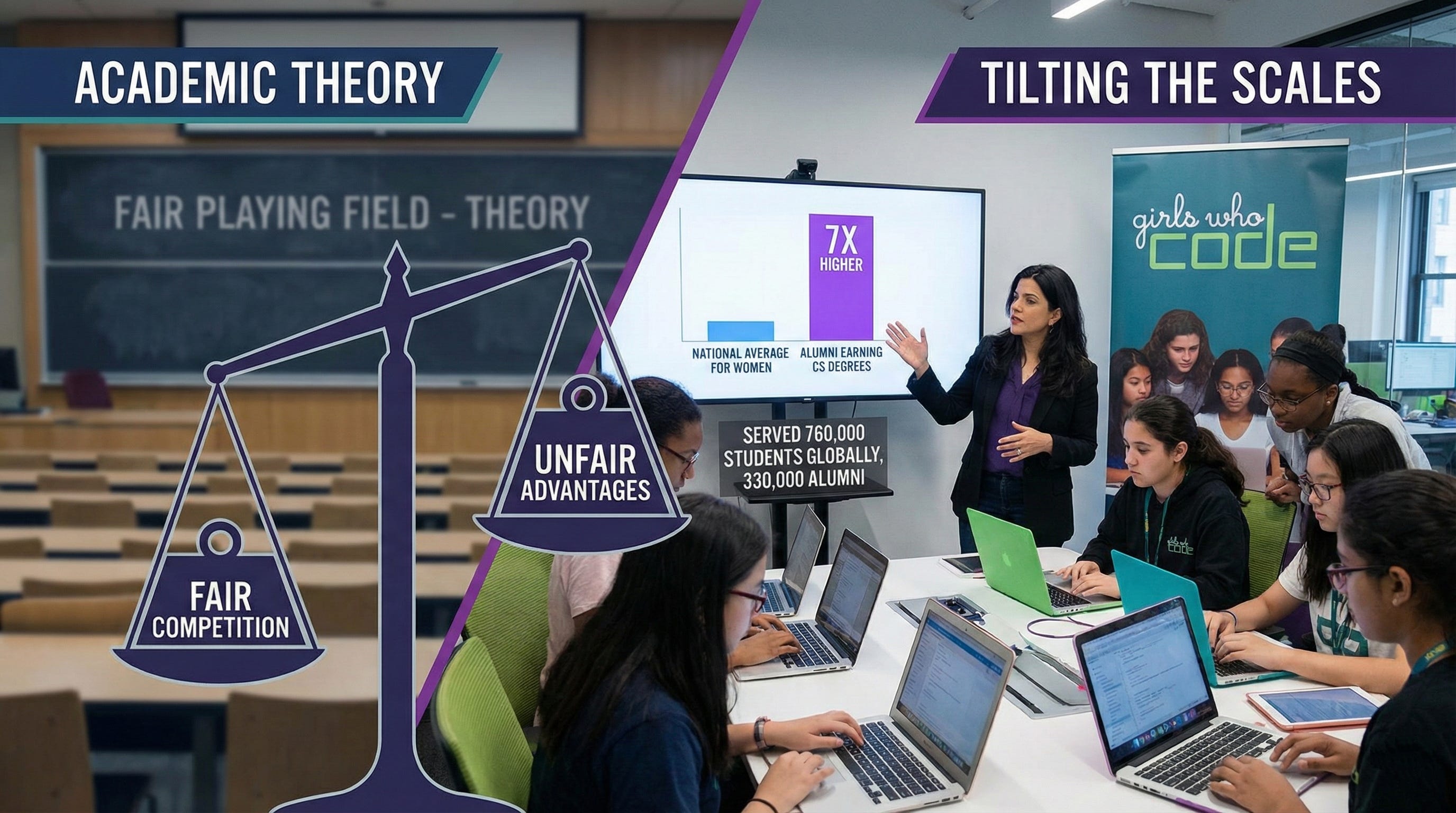
Reshma Saujani recognized a massive structural disparity in the technology sector. Instead of simply advocating for change, she leveraged her unique background in law, politics, and public policy to launch Girls Who Code. She used her specific edge in community organizing to hack the talent pipeline. Today, the organization’s annual reports note they have served 760,000 students globally, with 330,000 alumni. The mathematical impact is undeniable: their alumni earn computer science degrees at seven times the national average for women.
Removing Future Friction
To maintain high expected value over time, you must anticipate the roadblocks that will stand in your way and dismantle them proactively.
NVIDIA CEO Jensen Huang frequently discusses his preference for targeting “zero-billion-dollar markets.” These are emerging spaces with no obvious customers yet, where the foundational technology is still being built. By investing early and mapping out the precise computational variables required for AI to scale, NVIDIA removed future friction before competitors even realized it existed.
Watch NVIDIA CEO Jensen Huang explain the immense strategic advantage of investing in zero-billion-dollar markets:
Patagonia took a radical approach to removing future friction regarding brand loyalty. In 2022, the company fundamentally restructured its ownership, transferring voting stock to a purpose-driven trust and declaring, “Earth is now our only shareholder.” By legally binding their environmental mission to their corporate structure, Patagonia permanently secured the trust of their core demographic.
The Art of Strategic Quitting
Perhaps the most critical element of probability hacking is knowing when to walk away. Continuing to pour resources into a statistically doomed venture is not perseverance; it is financial negligence. Strategic quitting allows you to preserve your capital.

Consider global icon and entrepreneur Rihanna. In 2019, she partnered with LVMH to launch a luxury fashion house, Fenty. However, navigating complex supply chain variables and shifting consumer habits severely damaged the model’s expected value. Rather than bleeding capital to force the brand to work, she executed a brilliant strategic quit by pausing the fashion line entirely. This allowed her to reallocate her resources and double down on Fenty Beauty and Savage X Fenty, where her core unfair advantages (inclusive sizing and makeup shades) were generating massive, compounding momentum.
Whitney Wolfe Herd executed a similar maneuver when she left Tinder amid internal conflicts. Rather than fighting a losing battle within an environment that no longer served her, she exited entirely. She launched Bumble in 2014, fundamentally changing the core variable of the user experience by requiring women to make the first move. She took the company public by 2021, proving that quitting a bad mathematical setup allows you to construct a dominant new market edge.
Watch Whitney Wolfe Herd detail her decision to walk away and build Bumble’s dominant market edge:
Your Breakthrough Roadmap
Understanding the math of expected value is only the beginning. To transform these principles into a tangible business reality, execute this four-step implementation plan:
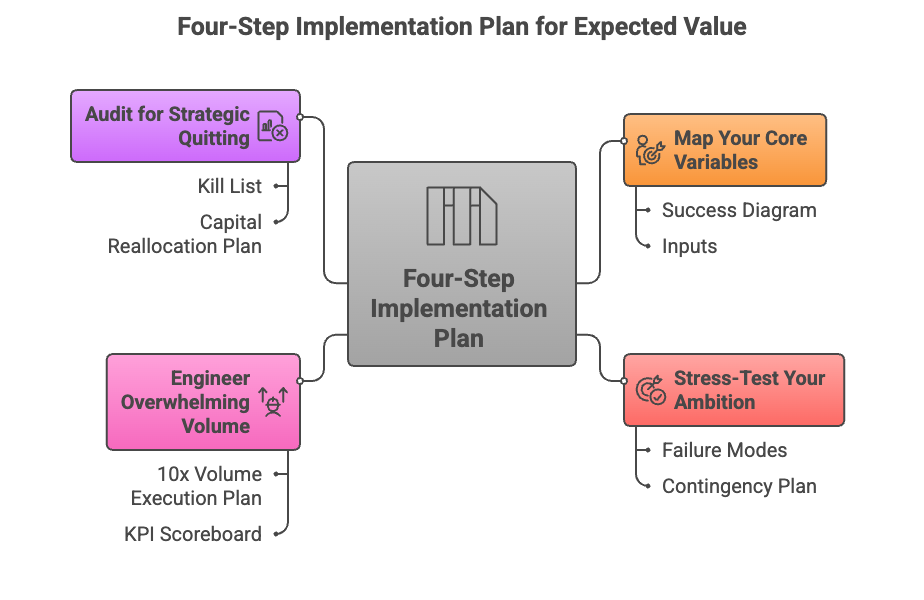
Map Your Core Variables: Identify the single biggest goal for your organization this quarter. Write down every required action, resource, and external factor. Output: A one-page Success Diagram clearly separating inputs that raise your probability from inputs that lower it.
Stress-Test Your Ambition: Implement a mandatory review session with your leadership team. Dedicate one hour entirely to tearing down your current business plan to find the vulnerabilities. Output: A documented list of your top three failure modes alongside an immediate contingency plan for each.
Engineer Overwhelming Volume: Review your current output metrics. Find your highest-leverage activity and scale the system to multiply that action tenfold. Output: A 10x volume execution plan attached to a strict KPI scoreboard.
Audit for Strategic Quitting: Evaluate all current projects against a strict mathematical threshold. Identify what is draining resources without producing compounding momentum. Output: A definitive “kill list” with a corresponding plan to reallocate recovered capital.
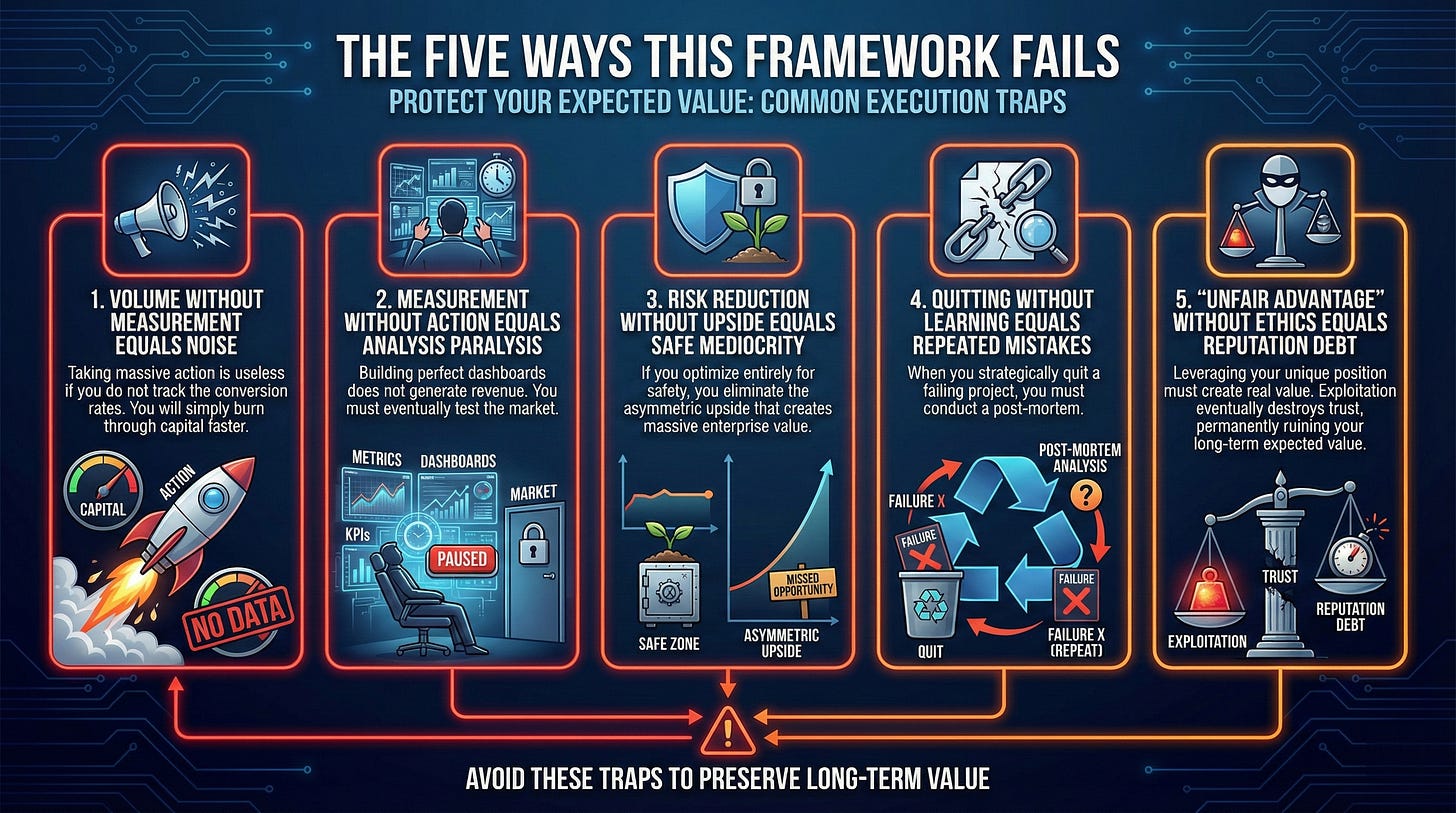
Appendix: The Five Ways This Framework Fails
Protect your expected value by avoiding these common execution traps:
Volume without measurement equals noise: Taking massive action is useless if you do not track the conversion rates. You will simply burn through capital faster.
Measurement without action equals analysis paralysis: Building perfect dashboards does not generate revenue. You must eventually test the market.
Risk reduction without upside equals safe mediocrity: If you optimize entirely for safety, you eliminate the asymmetric upside that creates massive enterprise value.
Quitting without learning equals repeated mistakes: When you strategically quit a failing project, you must conduct a post-mortem.
“Unfair advantage” without ethics equals reputation debt: Leveraging your unique position must create real value. Exploitation eventually destroys trust, permanently ruining your long-term expected value.
Master this math, and ambition becomes inevitable.