The Narrative Algorithm
How Founders Are Weaponizing Storytelling to Hack Growth

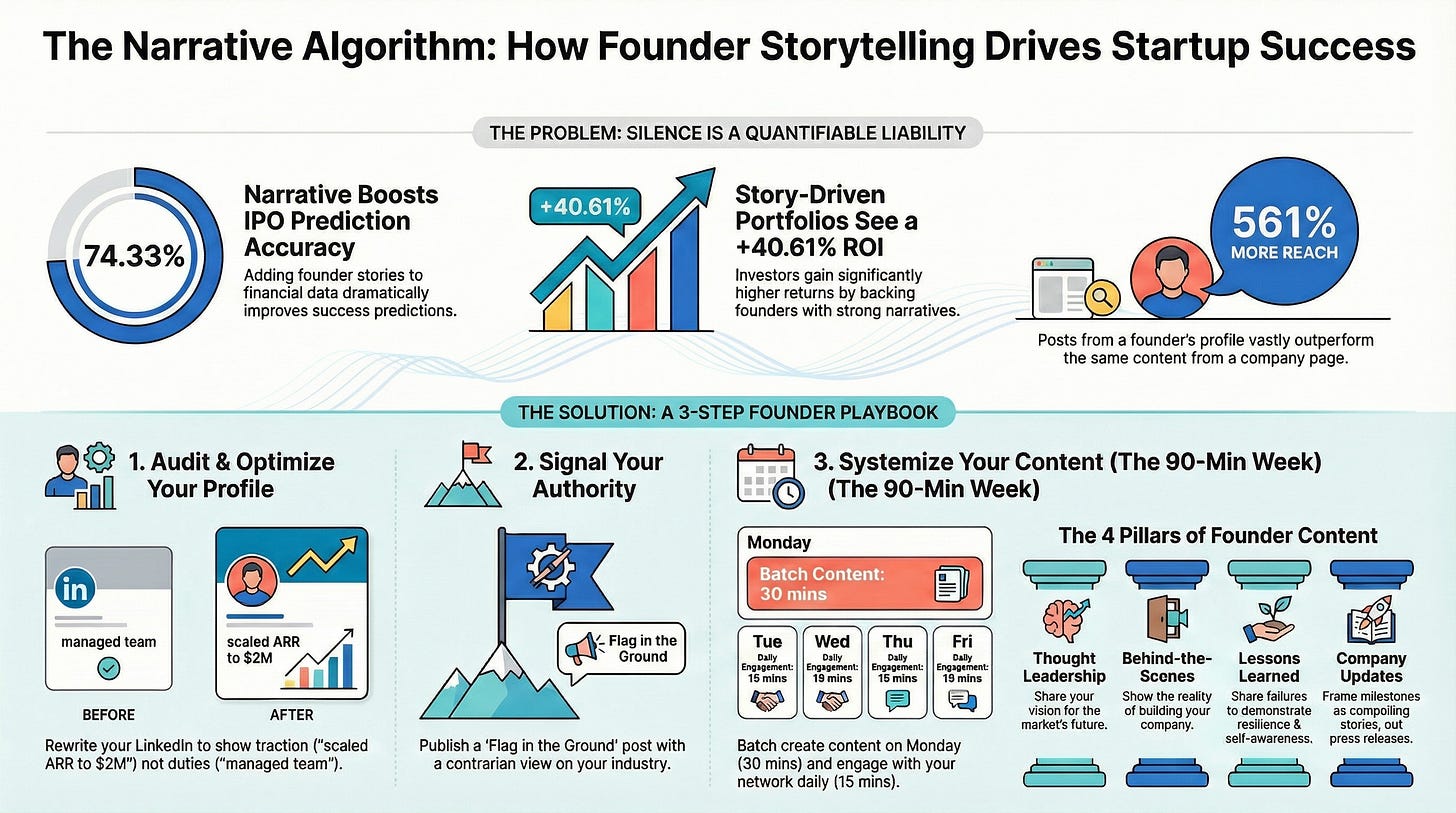
Why This Matters Now - The era of the “stealth mode” startup is dead. In a landscape dominated by algorithmic due diligence, silence is a liability. Your digital footprint is no longer just a reputation metric; it is a quantifiable predictor of valuation, funding success, and market longevity.

For decades, business schools taught that fundamentals (cash flow, burn rate, and customer acquisition costs) were the sole arbiters of a startup’s destiny. They were wrong. While fundamentals remain the engine, new data reveals that narrative is the fuel.
In the high-stakes arena of modern entrepreneurship, the distinction between a “founder” and a “CEO” is often the ability to control the public narrative. Platforms like Crunchbase and LinkedIn have evolved from passive directories into dynamic, predictive ecosystems. The founders who understand these dynamics are not just posting content; they are engineering the very signals that algorithms and investors use to predict the future.
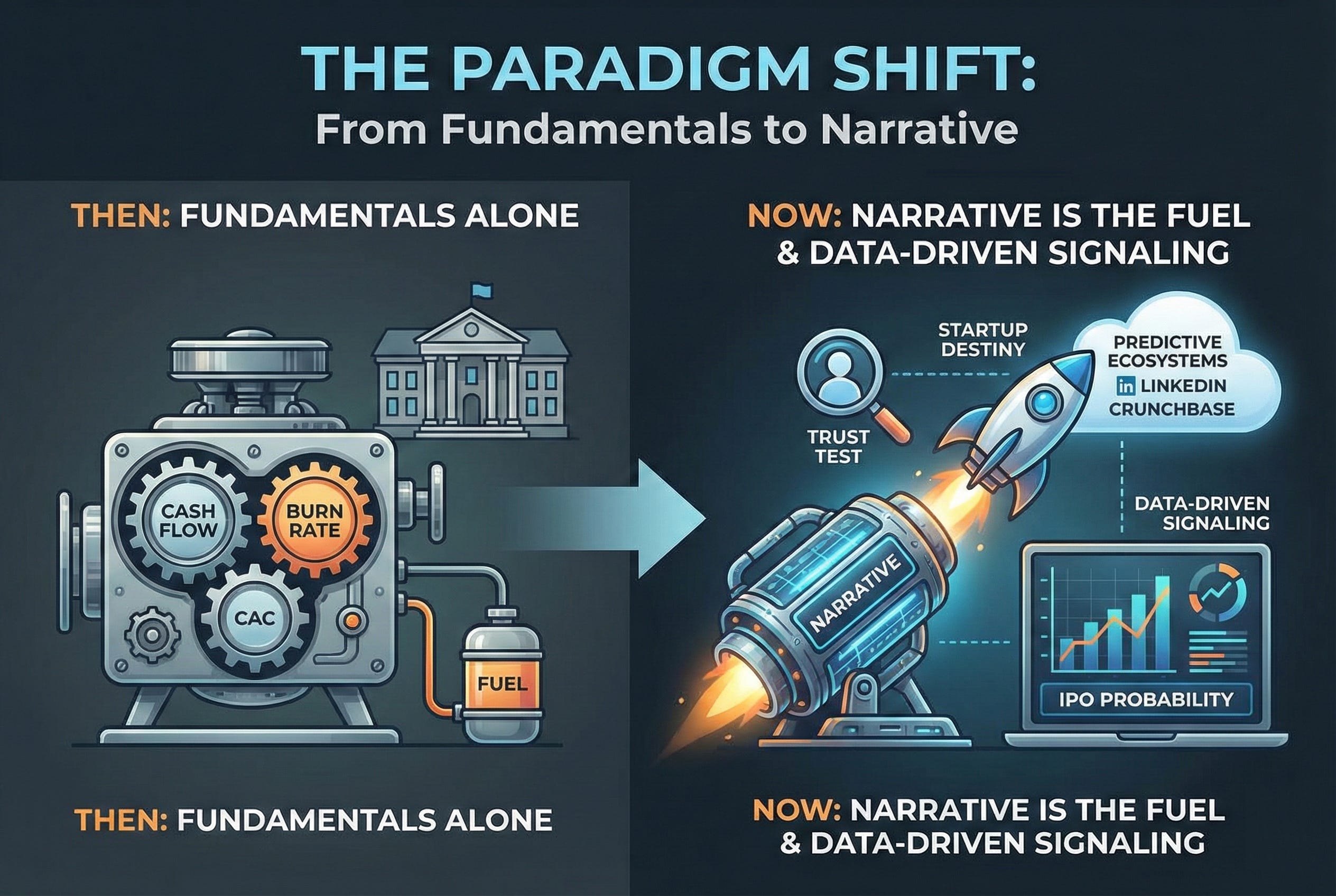
This is not about “personal branding” in the vanity sense. It is about data-driven signaling. It is about understanding that a machine learning model can predict your startup’s probability of an IPO based on how you describe your company in text and that a venture capitalist will likely disqualify you before the first meeting if your digital presence fails the “trust test.”
I. The Quantifiable ROI of Narrative
We often view storytelling as a “soft skill,” but recent academic research utilizing fused Large Language Models (LLMs) has hardened it into a rigorous metric. A comprehensive analysis of 20,172 startup profiles on Crunchbase revealed a startling truth: a venture’s textual self-description (the words used to define its mission and innovation) is a statistically significant predictor of success.
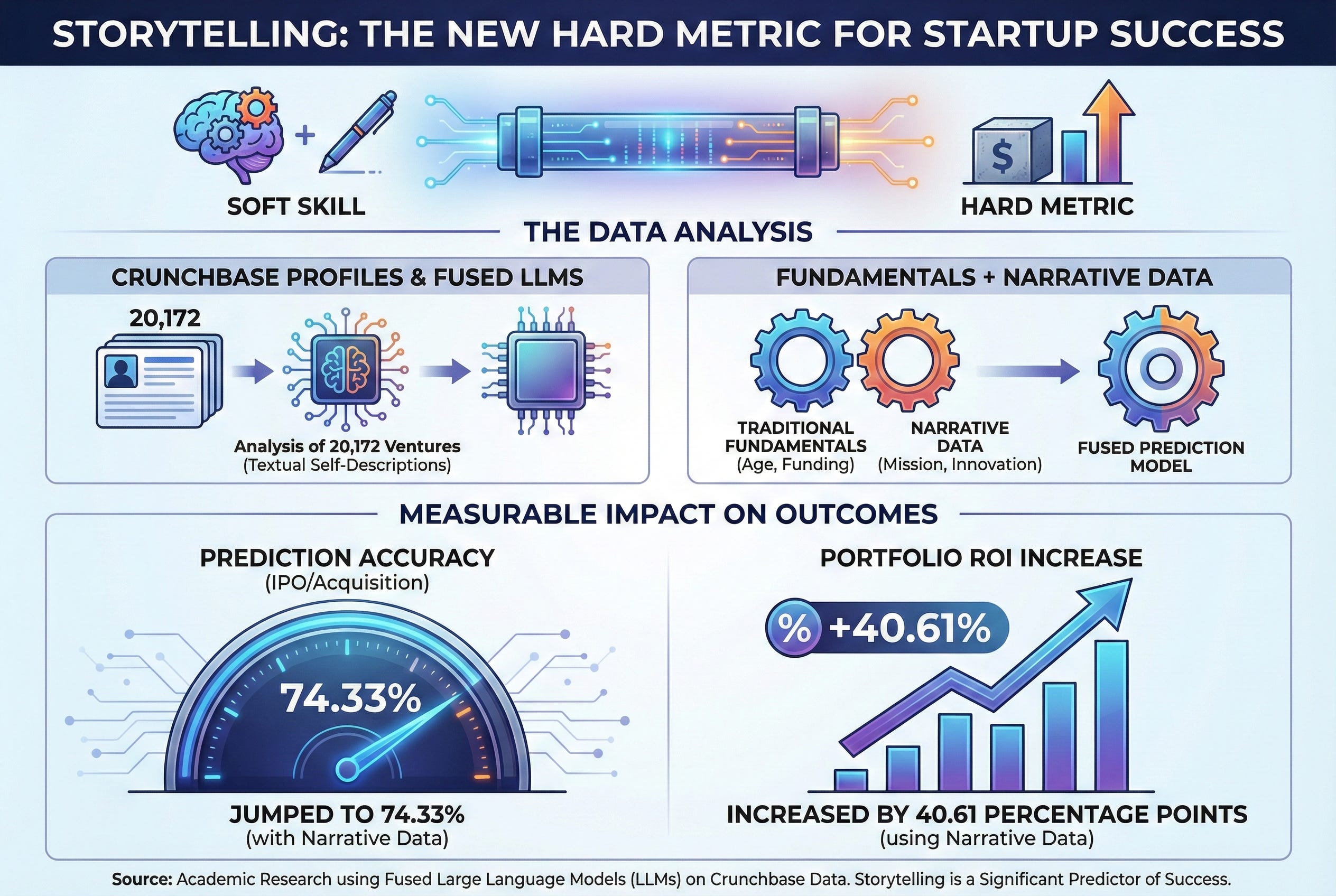
When researchers combined traditional fundamental variables, such as startup age and funding history, with these textual descriptions, prediction accuracy for IPOs or acquisitions jumped to 74.33%. More importantly, the Return on Investment (ROI) for portfolios constructed using this narrative data increased by 40.61 percentage points.
Consider Tesla. Before it was a manufacturing giant, it was a narrative construct. Elon Musk’s “Master Plan” was a textual description of a future energy ecosystem that allowed the company to command a valuation divorced from its early production struggles. The narrative didn’t just describe the business; it bought the time and capital required to build it.
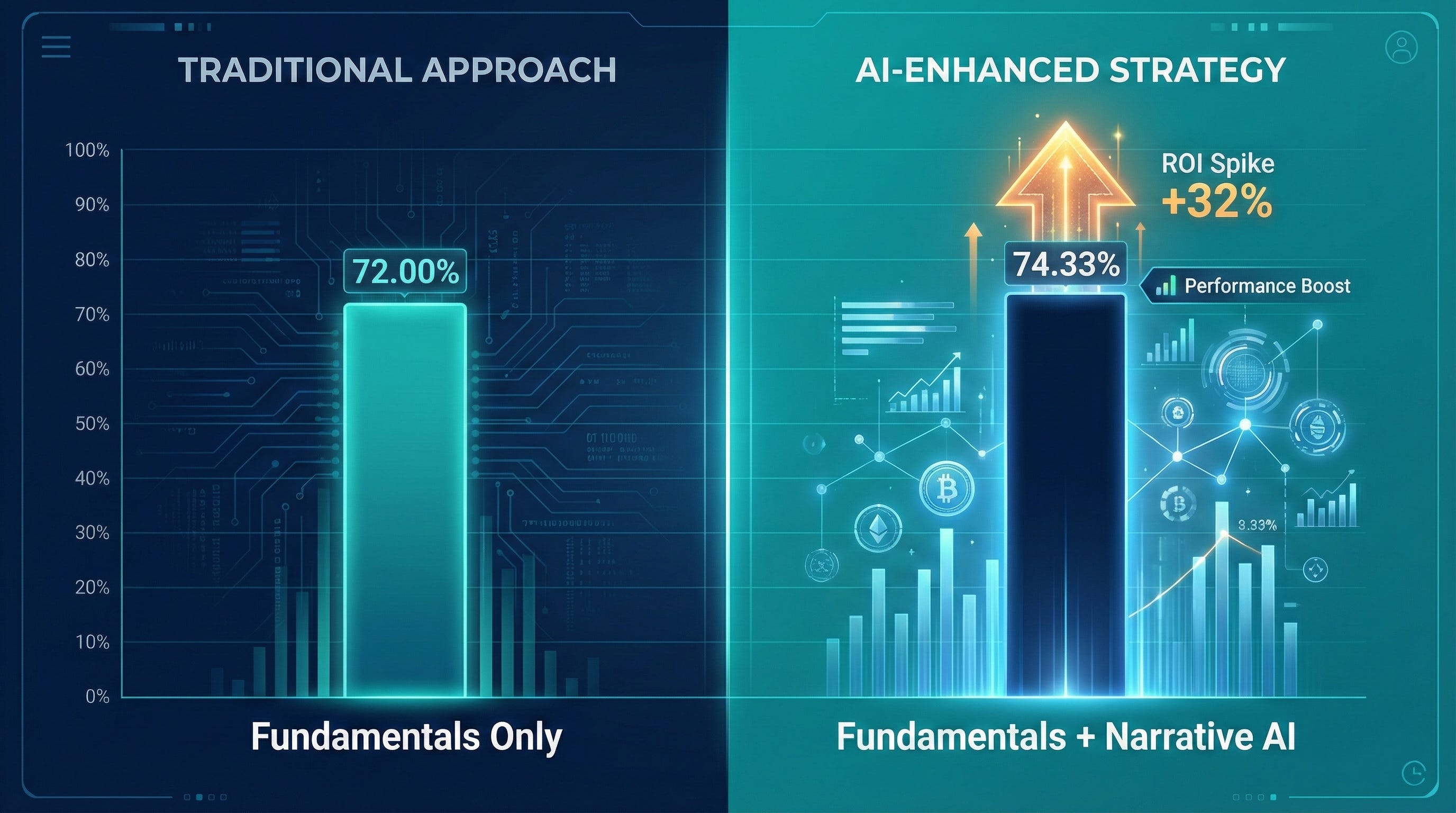
The lesson is clear: The algorithm is reading your story. If your company’s description on platforms like Crunchbase or LinkedIn is generic, you are voluntarily lowering your probability of success in the eyes of both machine and human evaluators.
II. The Digital Boardroom: LinkedIn as an Operating System
While Crunchbase provides the passive signal, LinkedIn is the active battlefield. It has ceased to be a resume repository and has become the primary operating system for B2B commerce and venture capital.
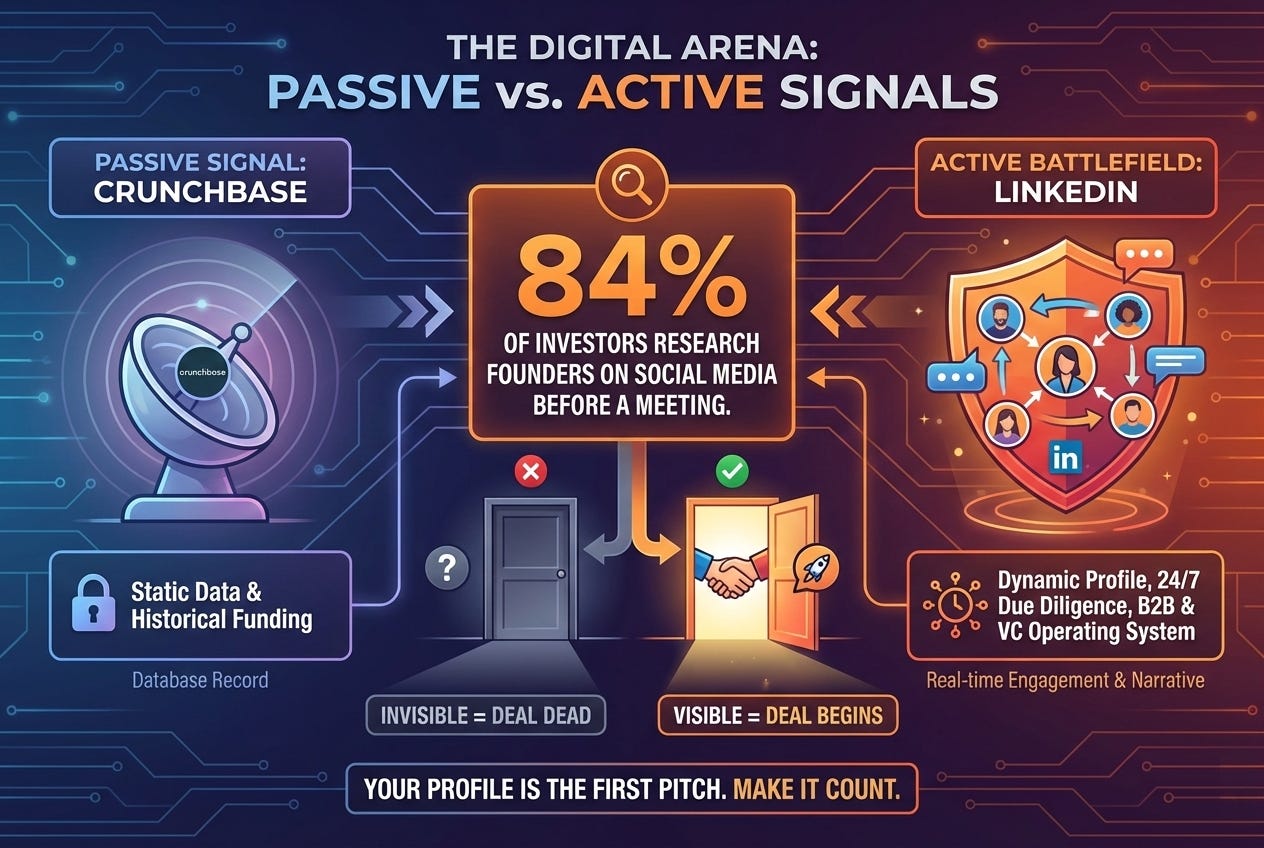
Data indicates that 84% of investors research founders on social media before taking a meeting. In this context, your profile is a 24/7 due diligence room. If you are invisible, or if your digital presence contradicts your pitch deck, the deal often dies before it begins.
Barbara Corcoran, the real estate mogul and Shark Tank star, frequently notes that she invests in the entrepreneur rather than just the business model. In the digital age, that assessment happens asynchronously. A founder’s LinkedIn activity (how they articulate thoughts, handle comments, and present their journey) serves as a proxy for their leadership capability.
The “Trust Gap” and the Founder Premium
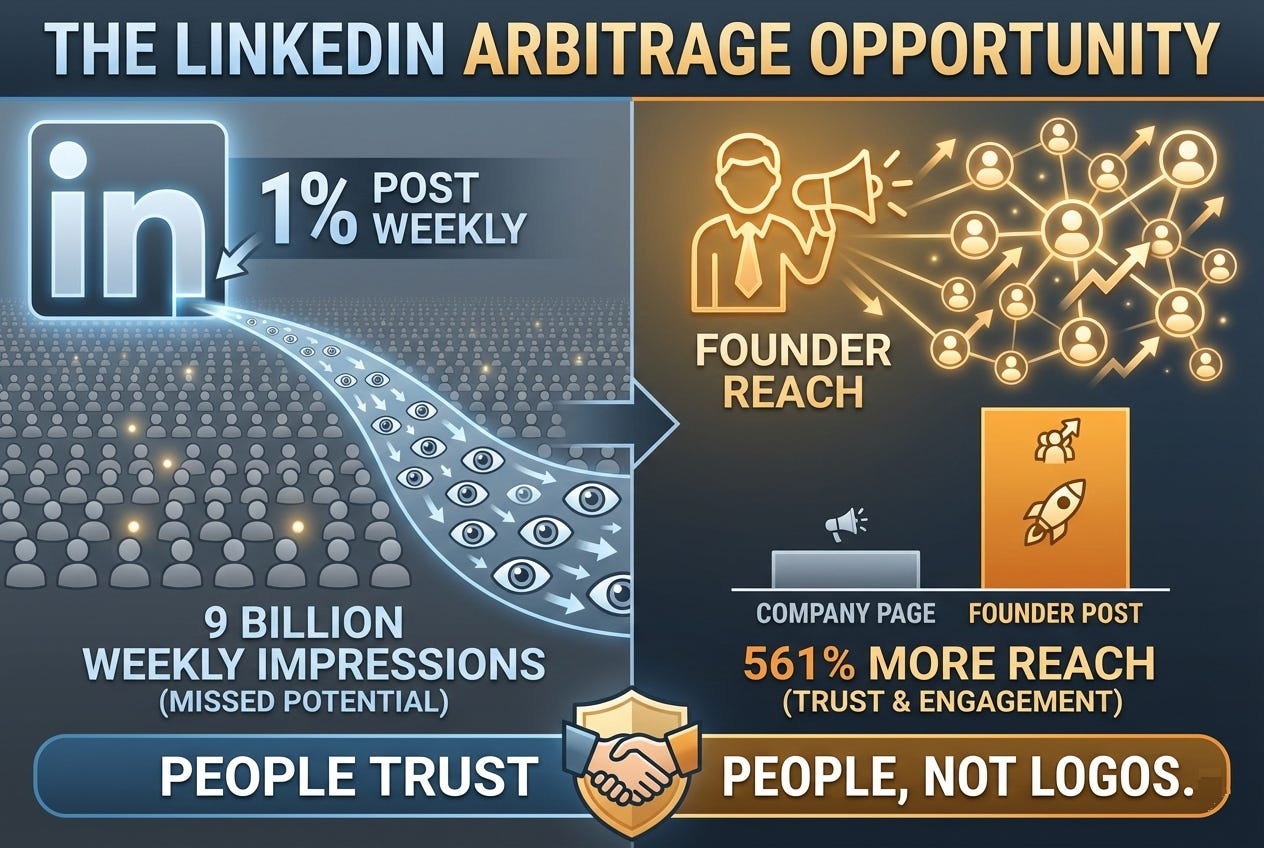
There is a massive arbitrage opportunity currently available: only 1% of LinkedIn users post content weekly, yet the platform generates 9 billion impressions a week. Furthermore, content posted by a founder receives 561% more reach than the exact same content posted by a company page.
People trust people, not logos.
Sara Blakely, founder of Spanx, built a billion-dollar empire by ignoring corporate gloss. Her strategy was raw authenticity: showing the failures, the messy middle, and the human side of leadership. This technique creates a “belonging” effect, explained by social identity theory, which significantly reduces uncertainty for early-stage investors and customers.
III. The “Minimize Search” Protocol
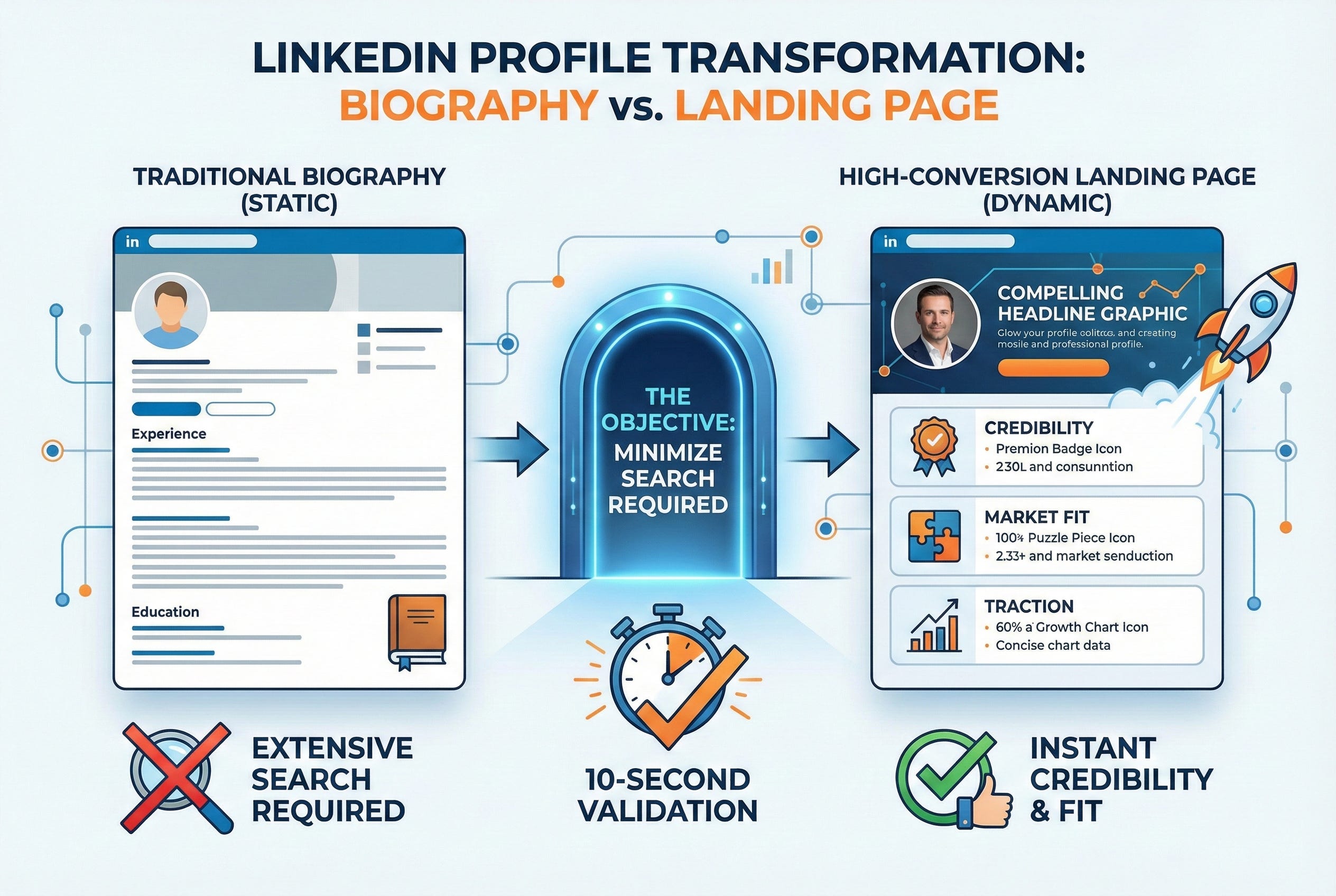
To capitalize on this, ambitious leaders must treat their LinkedIn profile not as a biography, but as a high-conversion landing page. The objective is to Minimize Search Required. An investor or partner should be able to validate your credibility, market fit, and traction within 10 seconds.
The Anatomy of a High-Conversion Profile:
The Headline as Caller ID: You have 220 characters. The first 60 are the only ones visible in a Direct Message. Stop using “Founder at Stealth Mode.” Use the formula: [Role] + [Company] | [Who You Help] | [Hard Proof Point].
The Visual Billboard: The banner image (1584x396 pixels) is the most underutilized real estate in business. It should scream your value proposition.
The Traction Experience: In your Experience section, do not list job duties. No one cares what you were “responsible for.” List traction. “Scaled ARR from $0 to $2M in 18 months” tells a story; “Managed sales team” does not.
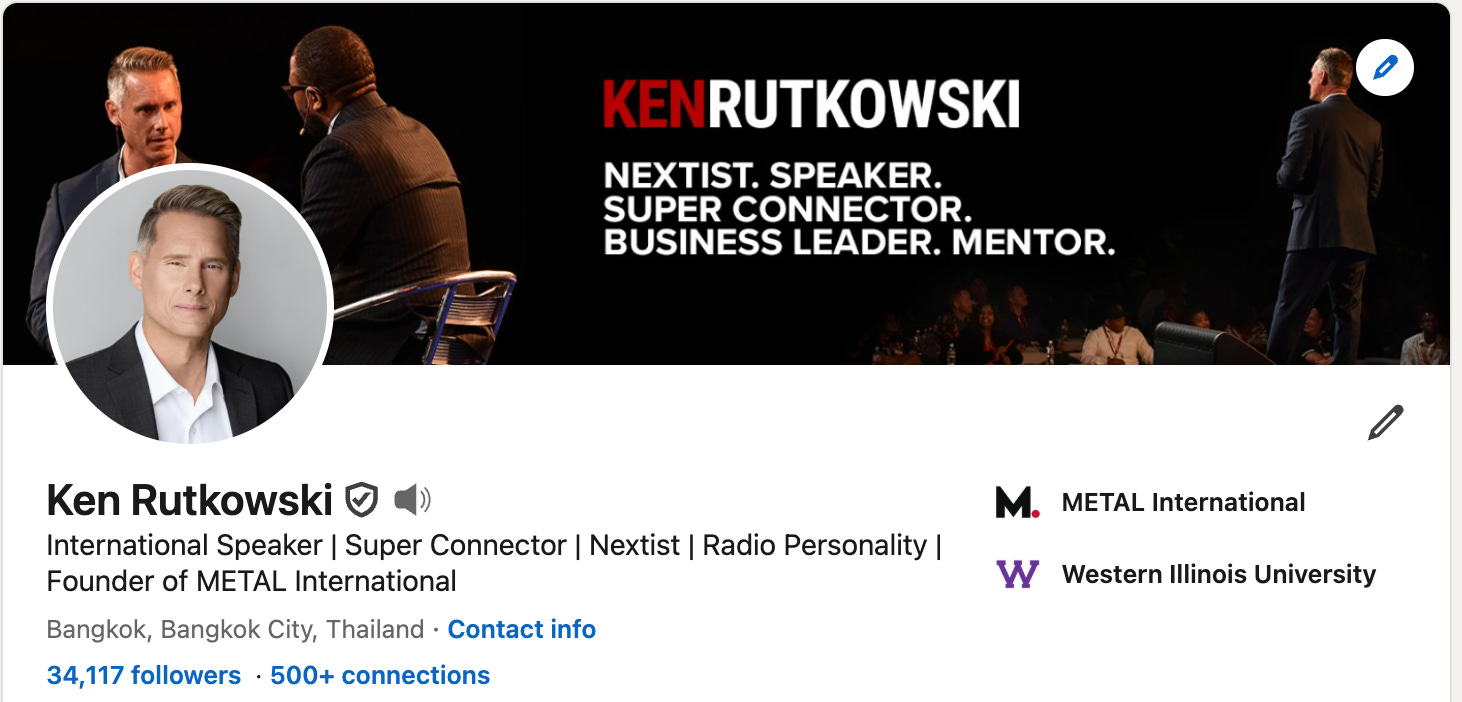
A prime example of this execution is myself - Ken Rutkowski (https://www.linkedin.com/in/kenrutkowski/). I’m a veteran broadcaster and business strategist; I’ve engineered my profile to serve as my primary source for lead generation. By clearly articulating my value proposition and demonstrating consistent thought leadership, I bypass traditional gatekeepers. My profile does not just list his history; it actively converts traffic into high-value business opportunities, proving that a strong personal signal cuts through the noise of global markets.
Watch how effective personal branding accelerates trust in high-stakes environments:
Watch how Gary Vaynerchuk explains why storytelling and context are the only things that matter in modern business
IV. The Content Supply Chain: The “90-Minute Week”
The most common objection from founders is time. “I’m too busy building the business to tweet.” This is a false dichotomy. Building the narrative is building the business. However, it requires a system to prevent burnout.
The “90-Minute Week” strategy allows you to maintain a dominant presence with minimal operational drag:
Monday (30 Mins): Batch creation. Write two high-value posts.
Daily (15 Mins): Engagement. This is the “Social” in social media.
The Four Pillars of Founder Content
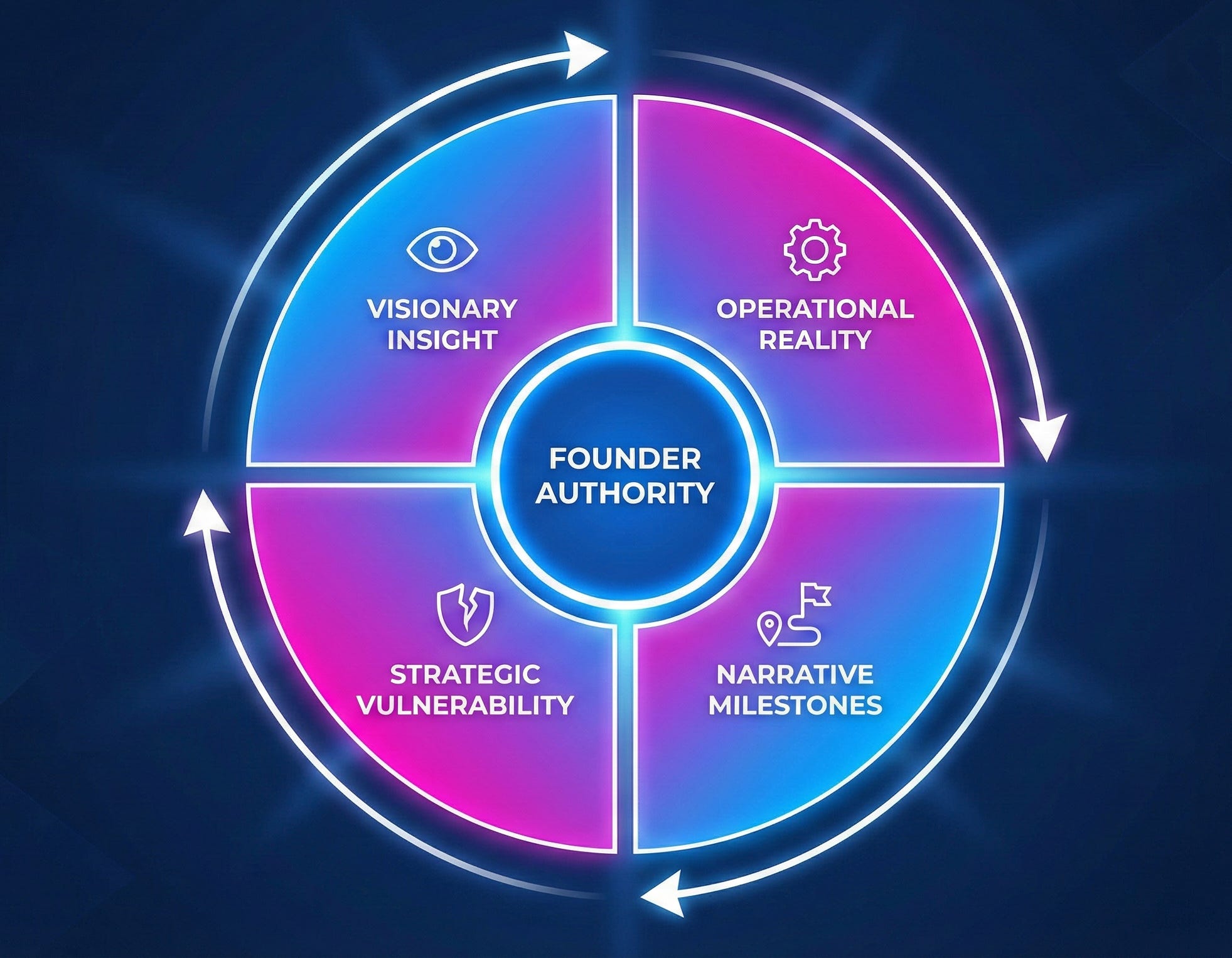
To maintain authority without becoming a “content creator,” rotate through these four themes:
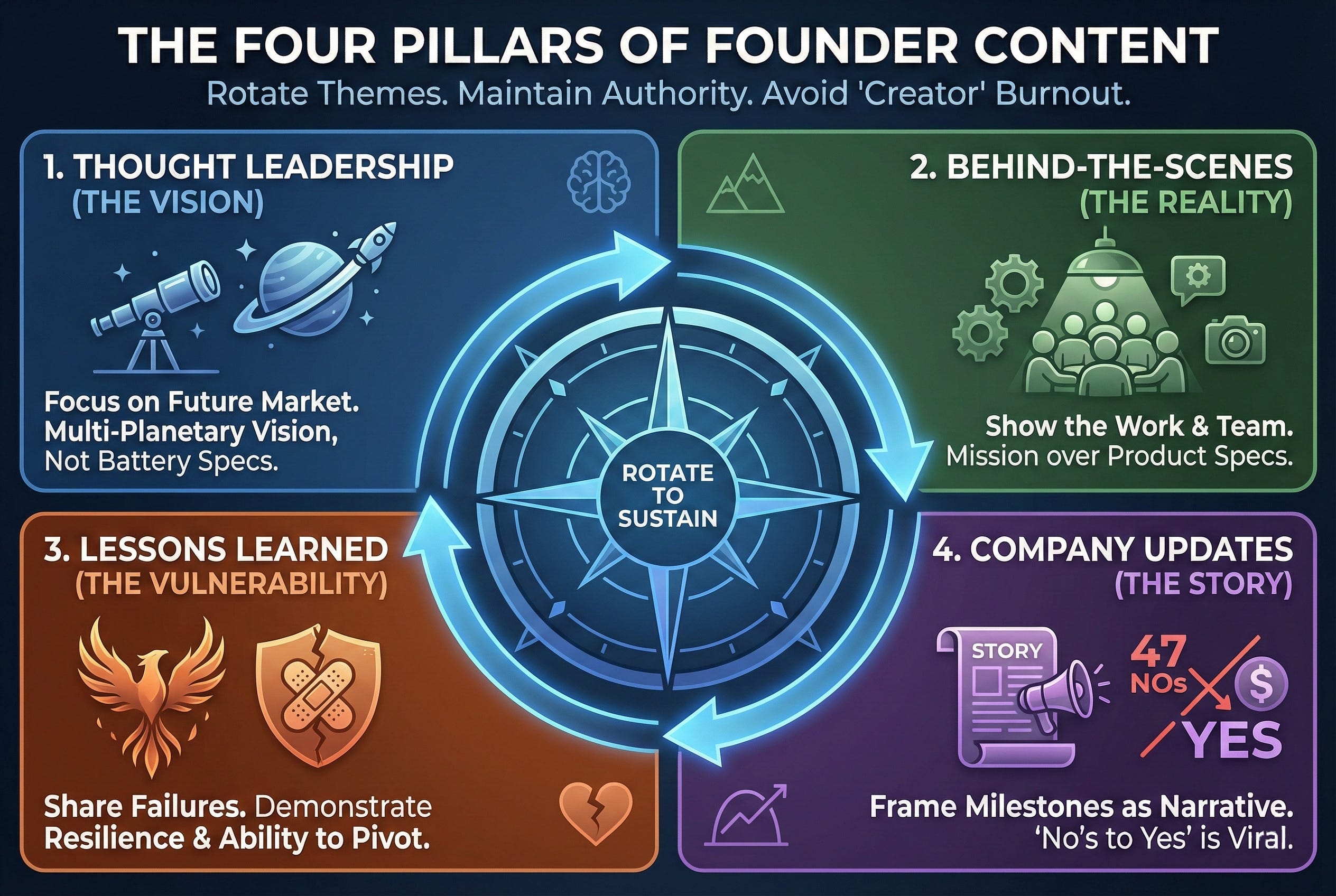
Thought Leadership (The Vision): Where is the market going? Elon Musk does not tweet about the specs of a battery; he tweets about the necessity of a multi-planetary species.
Behind-the-Scenes (The Reality): Show the team, the office, the late nights. Patagonia excels here by focusing on the mission and the work rather than the product specs.
Lessons Learned (The Vulnerability): Share a failure. Investors love this because it demonstrates resilience and self-awareness (key indicators of a founder’s ability to pivot).
Company Updates (The Story): Never post a press release. Frame every milestone as a narrative. “We raised $5M” is boring. “We heard ‘no’ 47 times before we found the partner who understood our vision” is viral.
V. Strategic Execution: From Profile to Profit
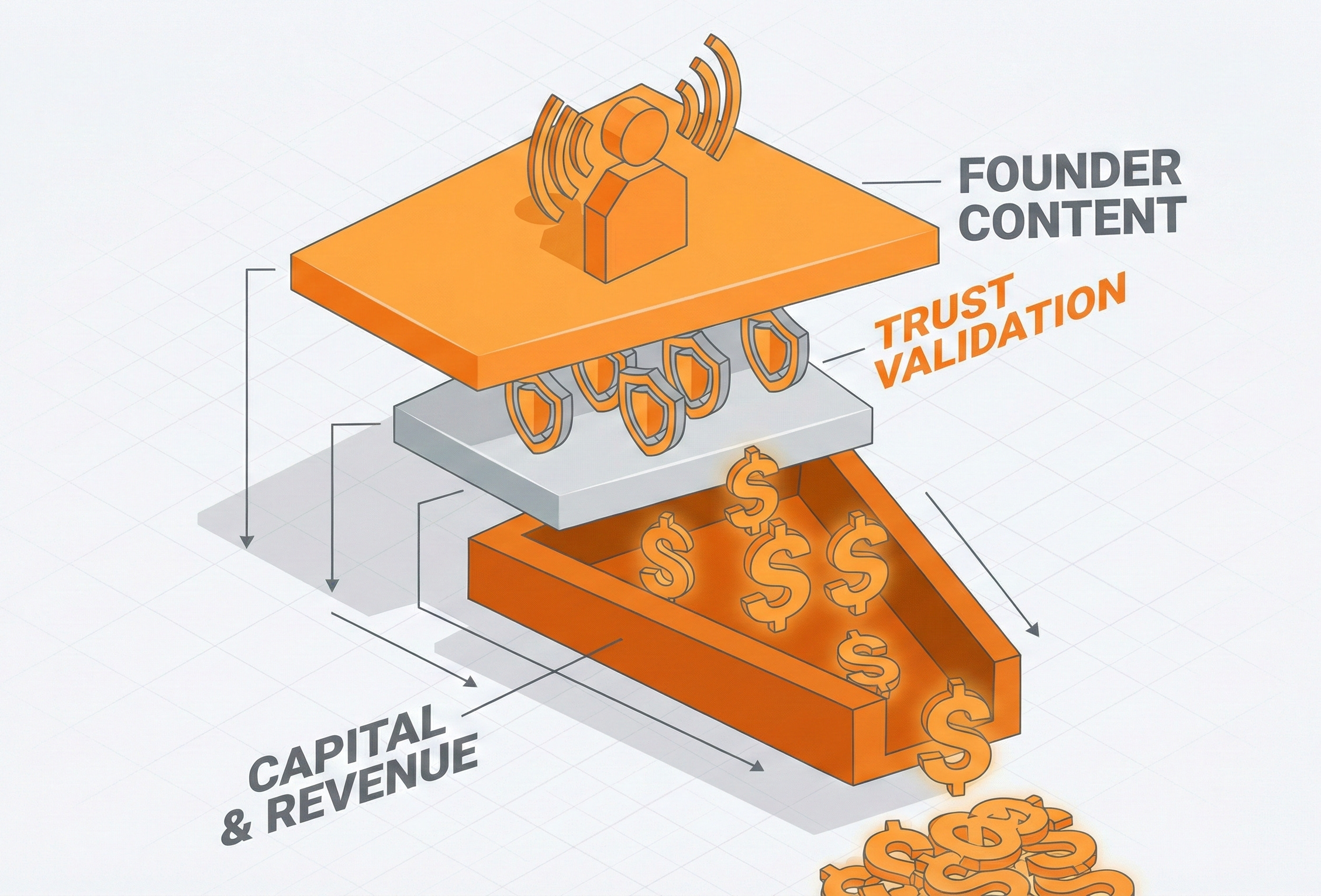
When you align algorithmic optimization (Crunchbase) with human-centric storytelling (LinkedIn), you create a flywheel that impacts the bottom line.
Fundraising: The “Ask for Advice” Maneuver
Fundraising is a sales process. Kevin O’Leary of Shark Tank creates value by forcing entrepreneurs to know their numbers, but he invests when the story aligns with the metrics. A powerful tactic on LinkedIn is the “Advice Paradox”: Ask for money, and you get advice. Ask for advice, and you often get money.
Strategy: Target senior founders or executives who are 2-3 steps ahead of you. Reach out not for capital, but for “feedback on a specific roadblock.”
Result: You validate your competence through the conversation. If they are impressed, they often open their checkbook or their network. This utilizes the Mushroom Effect: finding one angel often reveals a connected colony of others.
B2B Sales: The Tipping Point
For SMBs, the “Tipping Point” occurs at the 11th employee, where budgets for services triple. At this stage, buying committees expand, and risk aversion rises. Your LinkedIn content serves as the “trust bridge” for these committees. B2B buyers are often 70% of the way through their decision process before they contact a vendor. If your founder profile provides the insights they were looking for during that silent research phase, you win the deal before the pitch deck is opened.
Watch how Mark Cuban breaks down the necessity of “grinding” and being the most prepared person in the room.
VI. The Algorithm of Authenticity
We are witnessing a bifurcation in the market. On one side are founders who treat social platforms as distractions. On the other are those who recognize them as high-leverage assets.
The data from the fused LLM study proves that the words you choose matter. The engagement metrics from LinkedIn prove that your presence matters. Whitney Wolfe Herd of Bumble didn’t just build an app; she built a narrative around women making the first move. That narrative differentiated the product in a crowded market and drove it to a massive IPO.
You do not need to be an extrovert. You do not need to be a “guru.” You simply need to be the Chief Storyteller of the empire you are building.

Your Breakthrough Roadmap
You have the data. Here is your four-step execution plan to implement immediately:
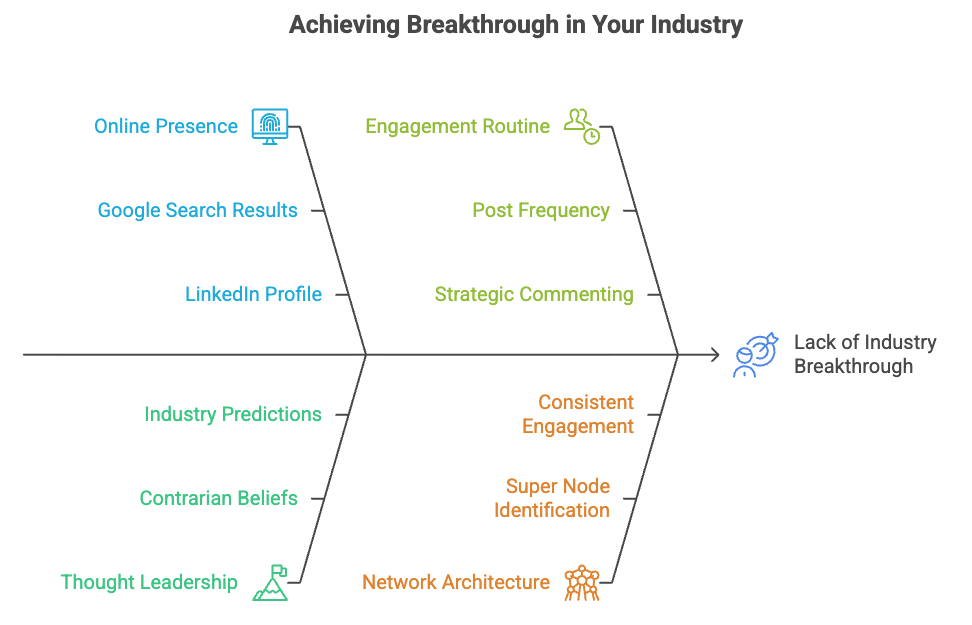
The Audit (24 Hours): Google yourself. If the first result isn’t a pristine LinkedIn profile or a Crunchbase entry with a compelling, keyword-rich textual description, fix it. Rewrite your LinkedIn headline to solve a problem, not state a job title.
The Signal (Week 1): Draft your “Flag in the Ground” post. This is a thought leadership piece articulating a contrarian belief or a major prediction about your industry. This signals to investors and talent that you are a player rather than a spectator.
The Routine (Ongoing): Block 30 minutes on Monday morning. Write two posts. Block 15 minutes daily (coffee time) to comment on 5 posts from high-value prospects or peers. Do not doom-scroll; engage strategically.
The Network Architecture (Monthly): Identify 5 “Super Nodes” (people in your industry who have the audience you need). Do not pitch them. Engage with their content consistently for 3 weeks, then send a personalized connection request referencing a specific insight they shared.