

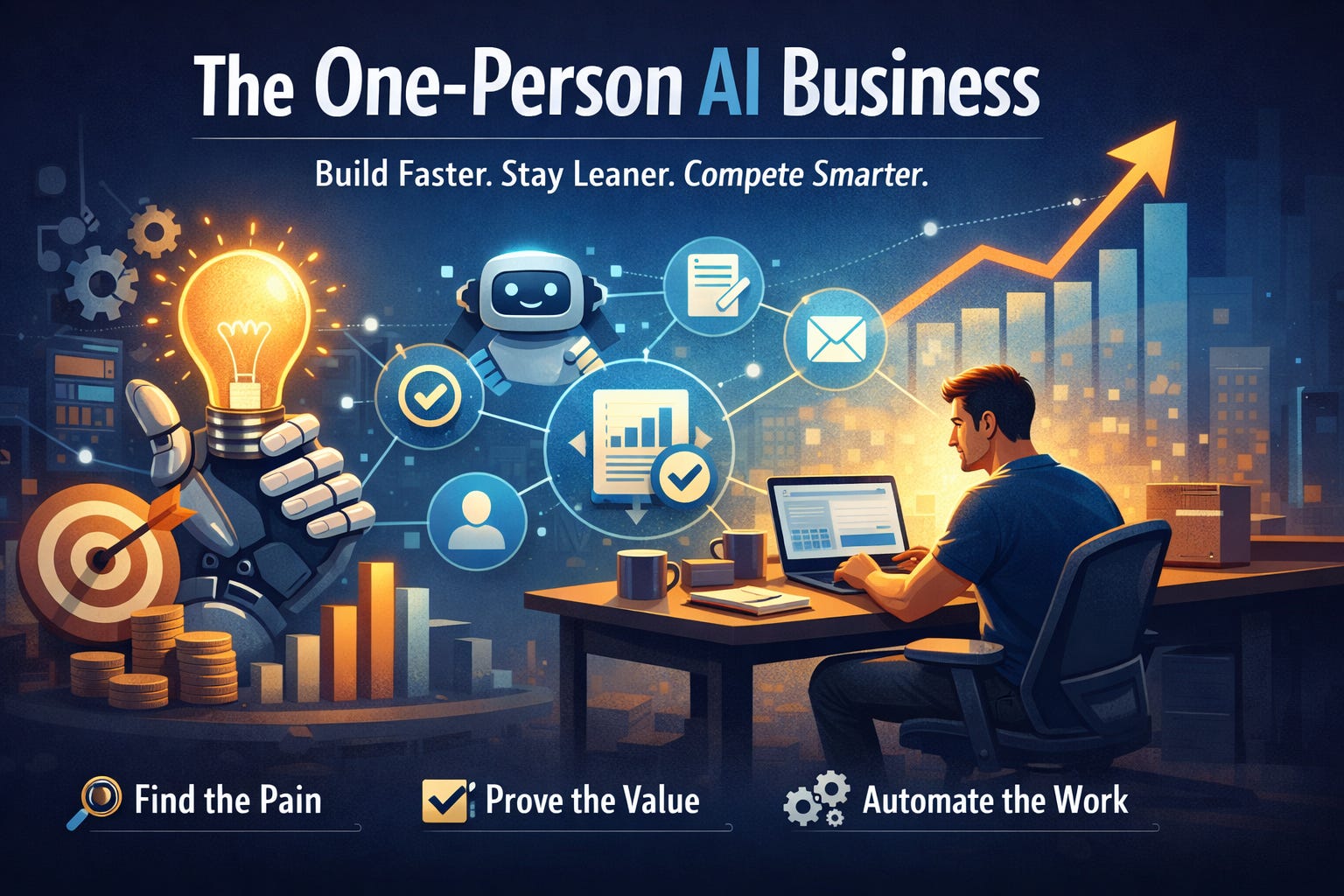
The One-Person AI Business
How founders can use AI to build faster, stay leaner, and compete far above their weight

The entrepreneurial playbook is changing.
Not because ambition has changed. Not because markets have become easier.
Because leverage has changed.
For decades, growth followed a predictable script: more customers required more hires, more hires required more management, and more management brought more overhead, meetings, coordination, and inevitable drag. That model is now cracking under new pressure.
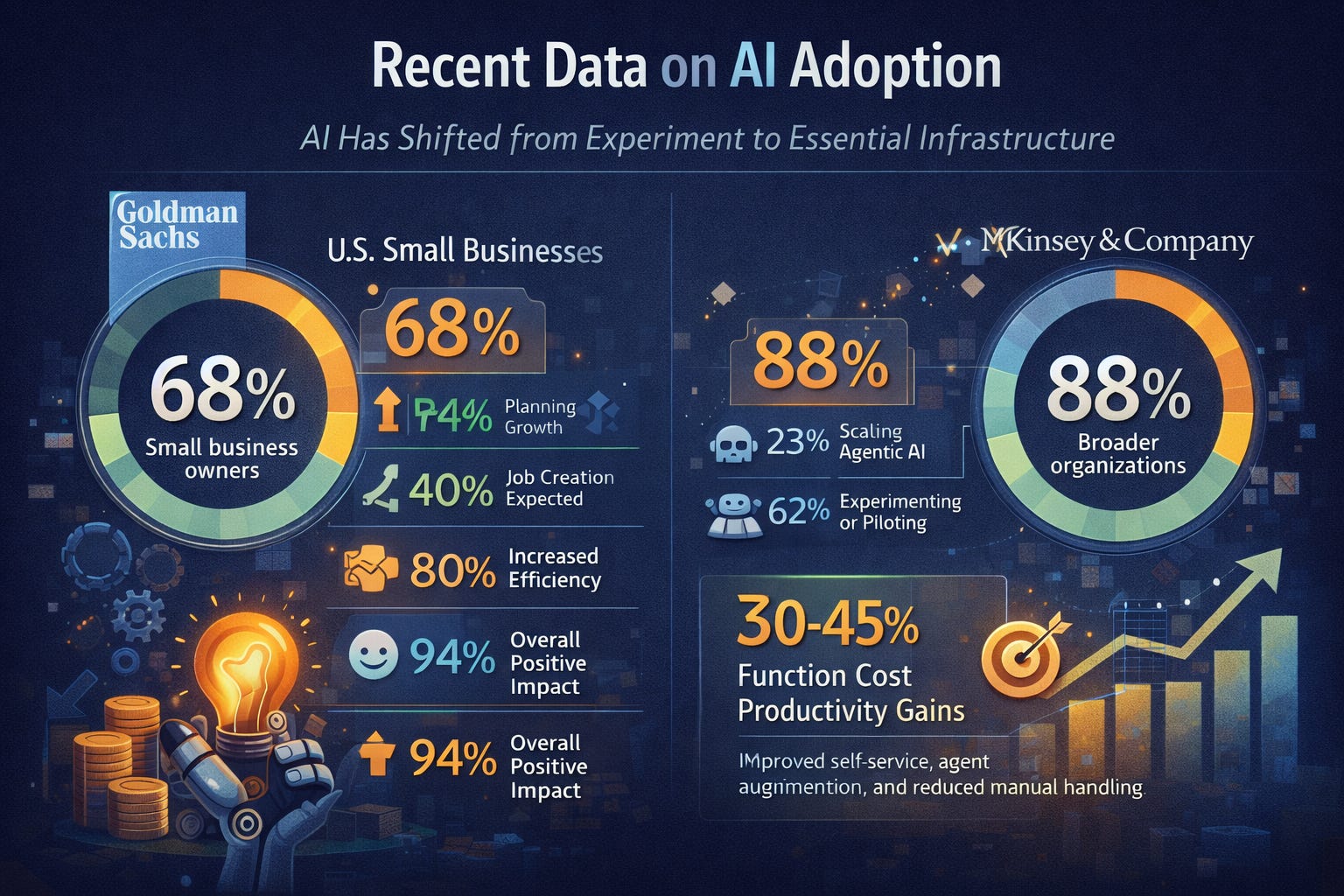
Recent data makes the shift unmistakable. Goldman Sachs’ 2025 survey of small-business owners found that 68% are already using AI, up sharply from 51% two years earlier, with 74% of adopters planning business growth in the coming period and nearly 40% expecting AI to enable new job creation rather than displacement. Among users, 80% report increased efficiency and productivity, and 94% describe the impact as positive overall. McKinsey’s State of AI 2025 global survey shows 88% of organizations now using AI in at least one business function (up from 78% the prior year), with generative AI adoption surging and agentic systems gaining traction: 23% of respondents report scaling agentic AI somewhere in the enterprise, while 62% are experimenting or piloting.
These numbers differ in scope (one centers on small businesses, the other on broader organizations), but the direction is clear: AI has transitioned from experiment to essential infrastructure. It no longer merely speeds tasks. In targeted workflows like customer operations, generative AI can deliver productivity gains equivalent to 30–45% of current function costs through improved self-service, agent augmentation, and reduced manual handling.
The core shift is simple yet profound: a single capable founder can now generate far greater output, with consistency, responsiveness, and lower friction, than was possible without a team. Judgment, taste, sales skill, trust-building, and domain expertise remain non-negotiable. No solo operator will overnight replace a full company with code. But one focused builder can now achieve dramatically more with far less.
What AI Leverage Actually Looks Like
AI is not magic. It is force multiplication.
The fundamentals endure: choose the market, identify the pain, and earn the payment. Those barriers have not vanished. If anything, they matter more now that execution is cheaper.
Once those pieces lock in, AI compresses the surrounding labor. Research accelerates, drafting sharpens, iteration tightens, support lightens, follow-up becomes reliable, and knowledge retrieval becomes instant. The dozens of small frictions that once eroded half a week begin to vanish.
The highest-leverage applications live in recurring, unglamorous workflows:
Summarizing calls and extracting action items
Drafting personalized outreach and sequences
Generating first-pass marketing assets
Organizing internal knowledge bases
Triaging inbound questions
Spotting patterns in feedback or demand
Automating clean handoffs between tools
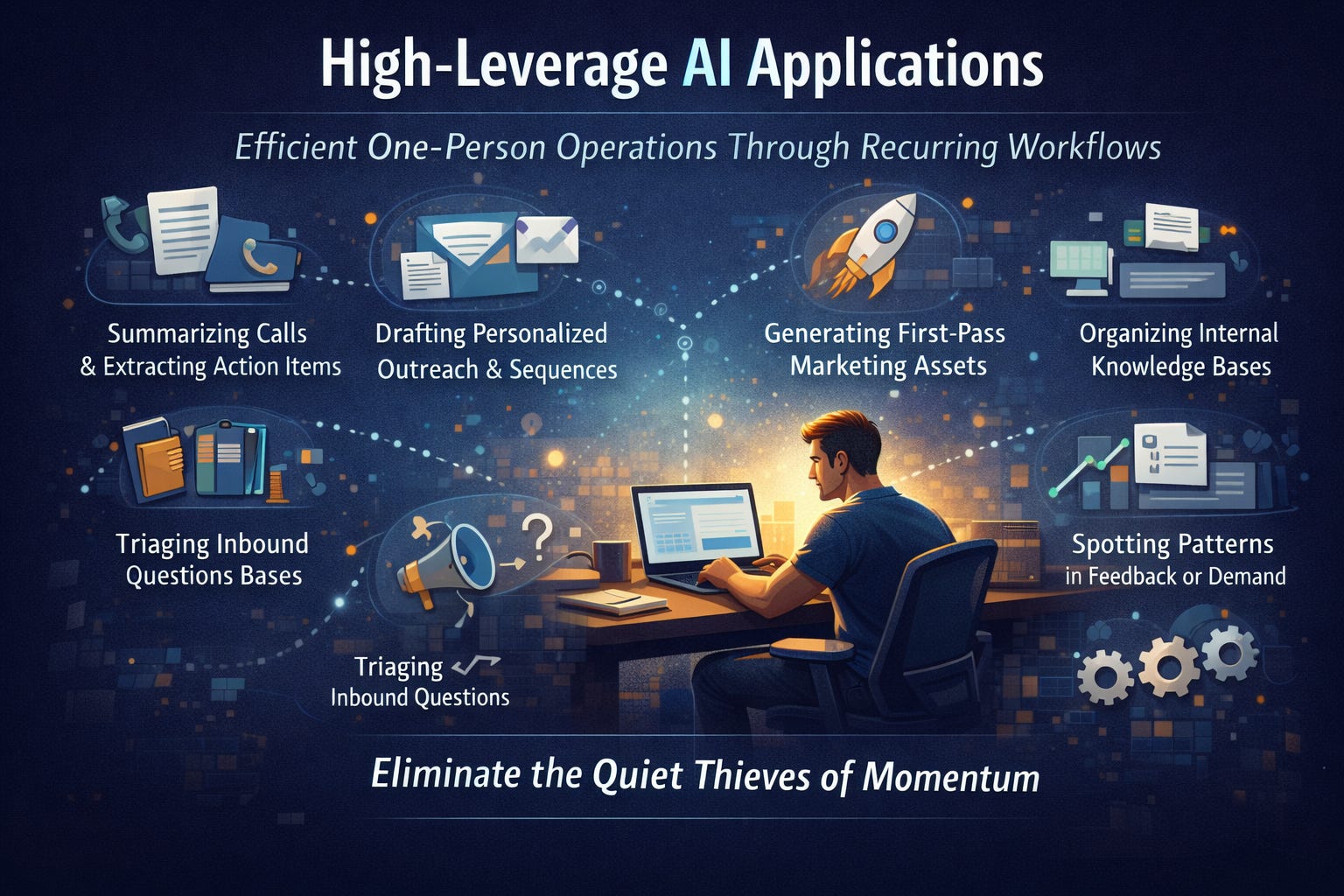
These are the quiet thieves of momentum. Eliminate enough of them, and a one-person operation starts performing with the velocity and polish of a larger team.
McKinsey’s 2025 findings reinforce the pattern: adoption spreads rapidly, but disciplined, enterprise-wide execution lags. Many organizations experiment in silos; few convert it into a coherent advantage. That execution gap is the exact opening for agile, lean founders who can test, learn, and redesign faster.
Why This Moment Favors Lean Founders
Large organizations possess resources and inertia. Approvals, legacy systems, handoffs, politics, and processes optimized for consistency over speed create drag.
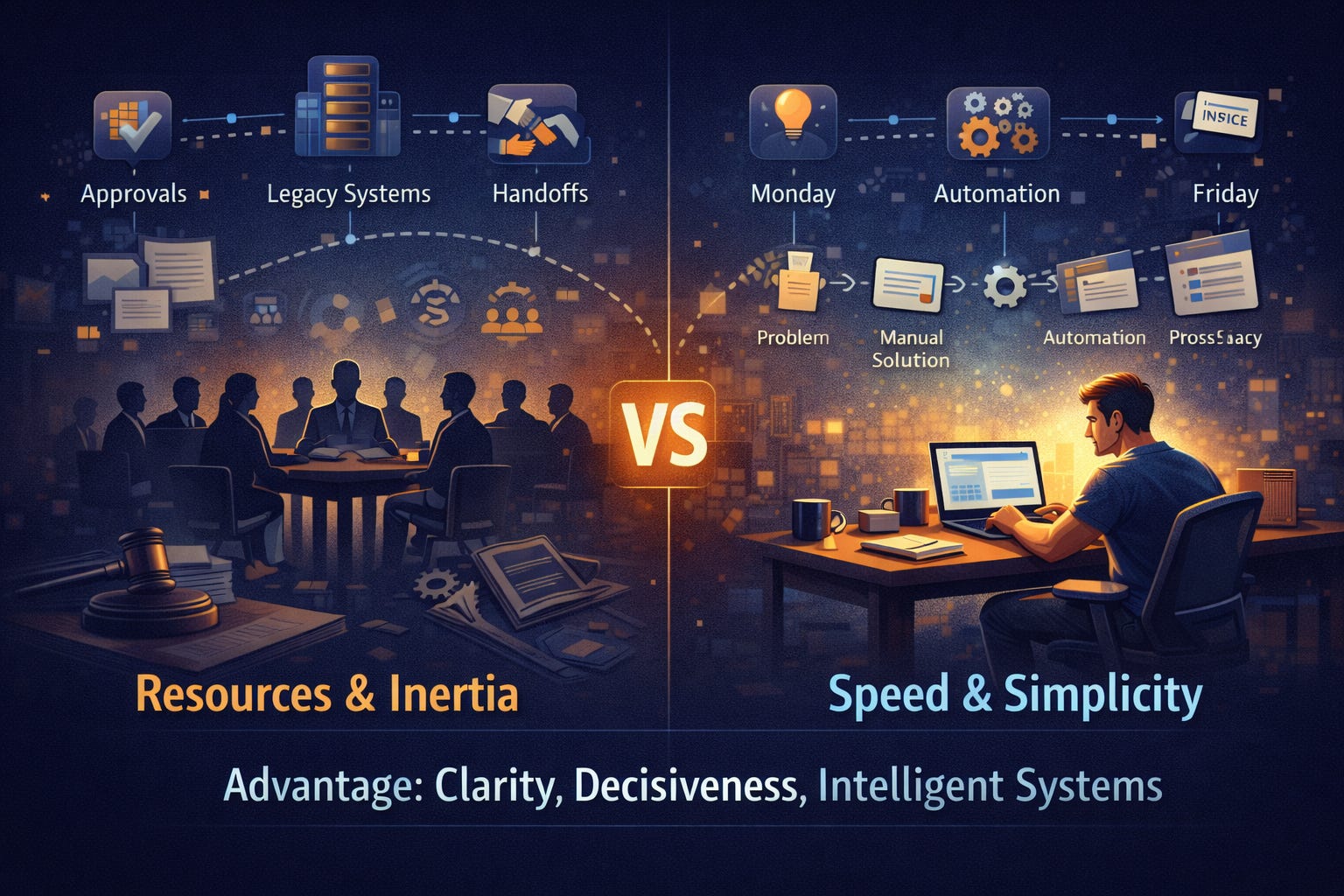
A solo founder has fewer resources but also fewer layers between insight and action.
In an AI-rich environment, that asymmetry compounds. The founder who identifies a painful workflow on Monday, delivers a manual solution Tuesday, automates Thursday, and invoices Friday operates on a different timescale from the committee still debating standards. Small does not always win. But clarity, decisiveness, and ruthless simplification now compound aggressively when paired with intelligent systems.
Lessons from Larger Companies
Iconic brands reveal direction, not blueprints to copy.
Tesla embeds AI deeply into vehicles and software. By the end of 2025, active Full Self-Driving (Supervised) subscriptions reached 1.1 million, a 38% year-over-year increase from roughly 800,000, with monthly subscriptions more than doubling during the year. Over-the-air updates create continuous improvement loops: vehicles evolve, data accumulates, and software revenue compounds. The principle is clear. AI can transform products into living, recurring-value assets.
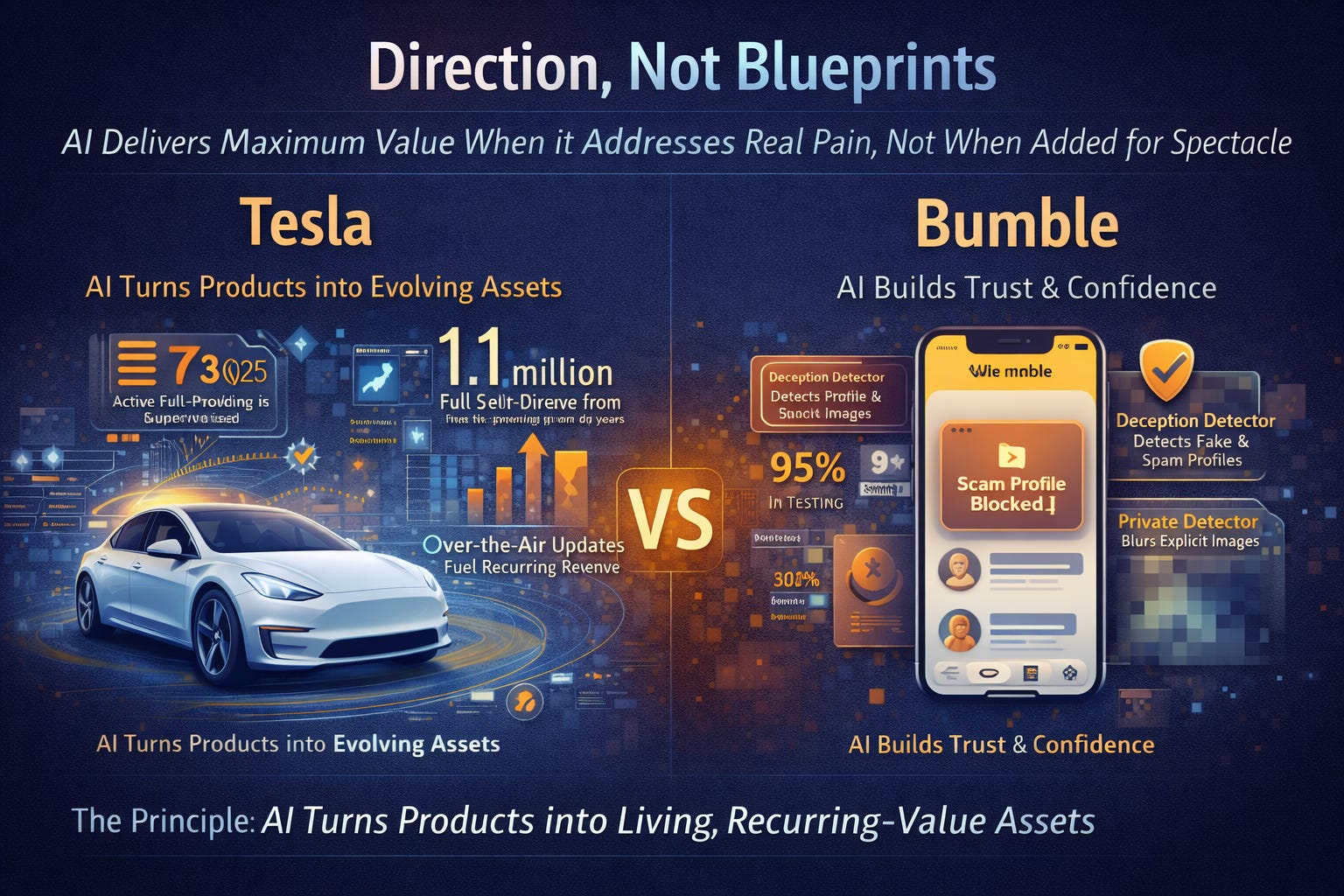
Bumble applies AI to trust and safety, two core user concerns. Deception Detector uses machine learning to detect and block fake, spam, or scam profiles (automatically handling ~95% in testing), while Private Detector blurs explicit images before viewing. These tools reduce friction around authenticity and confidence, reinforcing what users already value most. The deeper lesson: AI delivers maximum impact when it solves real, felt pain, not when added for spectacle.
A Realistic Framework for Building a One-Person AI Business
Too much advice leaps from inspiration to fantasy, skipping the disciplined middle where businesses actually form. A stronger model is sequential and restrained.
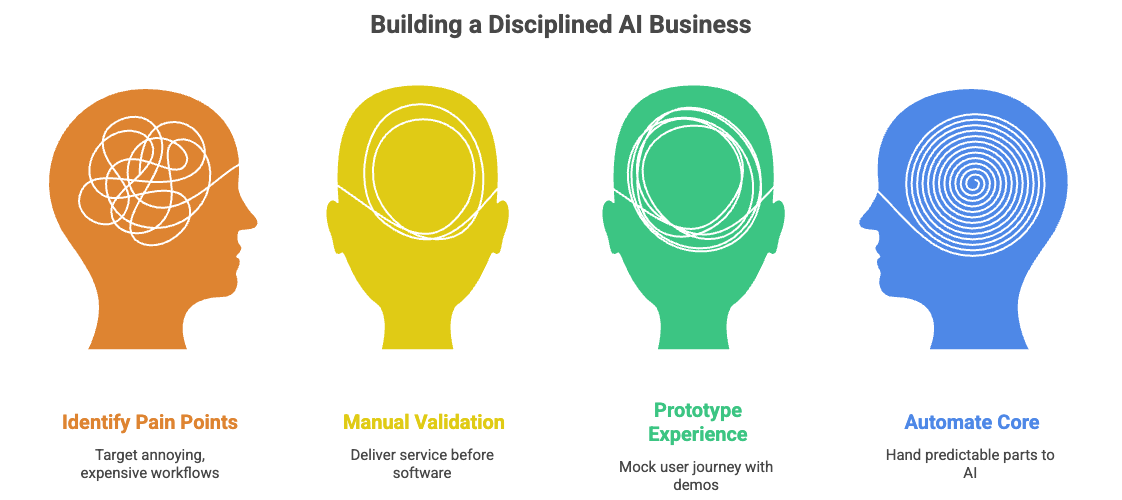
1. Start with pain, not tools
Fall in love with the problem. Target annoying, expensive, repetitive, time-sensitive, error-prone, compliance-heavy, or messy workflows. Customers already spend (time or money) fixing them imperfectly with spreadsheets, contractors, email chains, and brute force.
Ask: What recurs endlessly? What drains energy? What already has budget?
Painkillers beat vitamins. Urgency beats novelty.
2. Validate manually before automating
Service before software. Workflow before agent. Revenue before scale.
Deliver by hand first. A simple offer (clear problem, concrete promise, defined timeline, fair price) reveals what customers truly buy. Solve for 2–3 paying customers: you stop guessing and learn with proof.
AI accelerates delivery; it cannot salvage a weak problem.
3. Prototype the experience, not the fantasy
Mock the user journey with clickable demos, no-code flows, or guided walkthroughs. Expose hesitations, misunderstandings, and real value.
Most early failures stem from clutter, not smallness. Nail one clear wedge: solve the pain so obviously that value is immediate. Simplicity is the product.
4. Automate the repeatable core
Only after validation: hand predictable parts to AI. Intake, scheduling, first-draft content, triage, CRM updates, summaries, knowledge retrieval, follow-ups.
The founder protects judgment for high-leverage work; repetition disappears.
5. Add agents with restraint
Agentic AI advances (23% scaling somewhere, 62% experimenting), but maximalism risks failure. Start where workflows are stable, inputs structured, risks low: internal ops, lightweight outbound, structured support, repetitive content.
Avoid high-liability areas until trust is proven. The goal is reliable leverage, not total automation.
Where One-Person AI Businesses Thrive
Strongest categories share traits: a clear problem, a repetitive flow, measurable value, fast decisions, and trust earned without a massive brand.
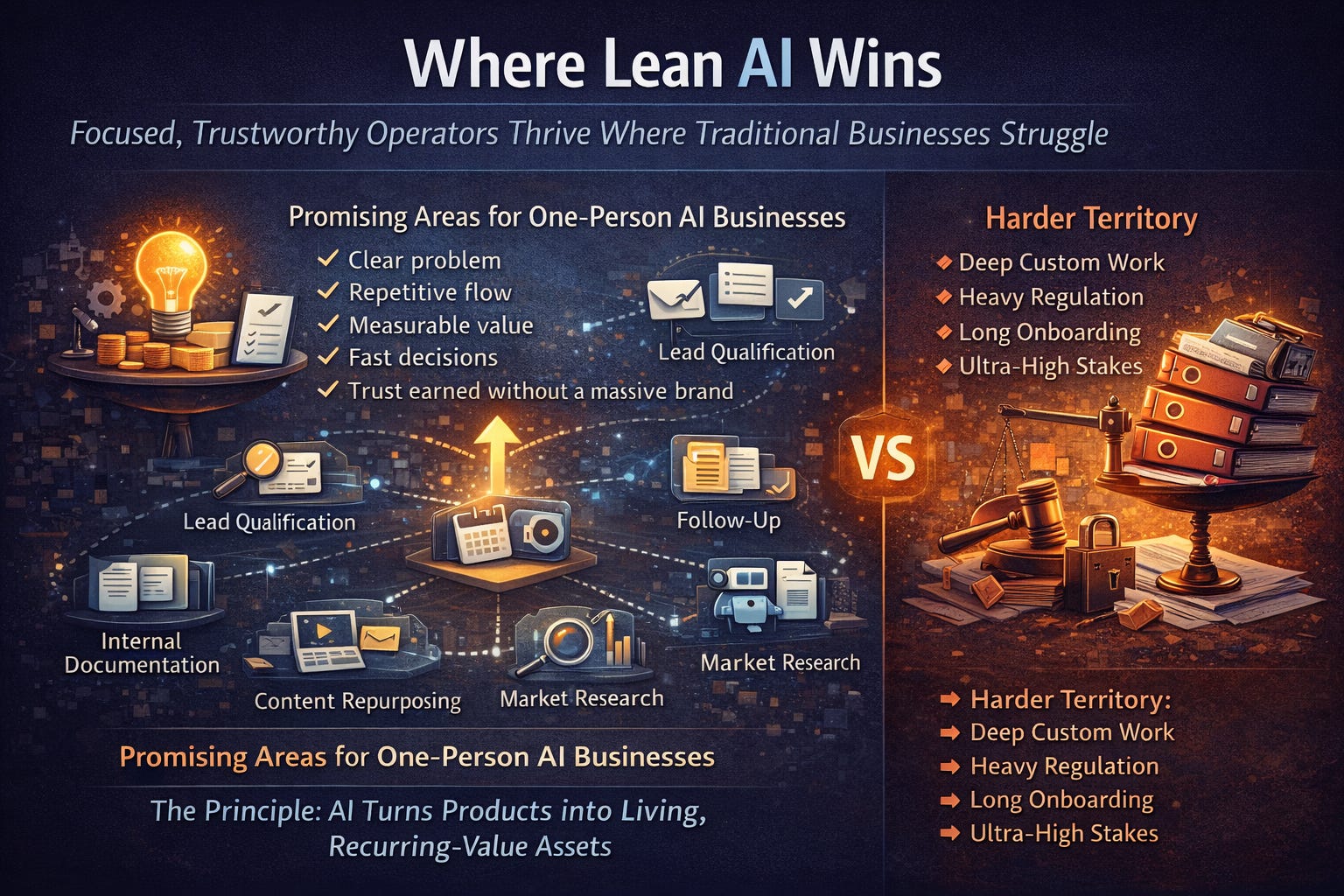
Promising areas include lead qualification, appointment setting, follow-up, internal documentation, content repurposing, market research, creator operations, recruiting coordination, and niche back-office support.
Harder territory: deep custom work, heavy regulation, long onboarding, and ultra-high stakes.
The Bottleneck Is No Longer Access
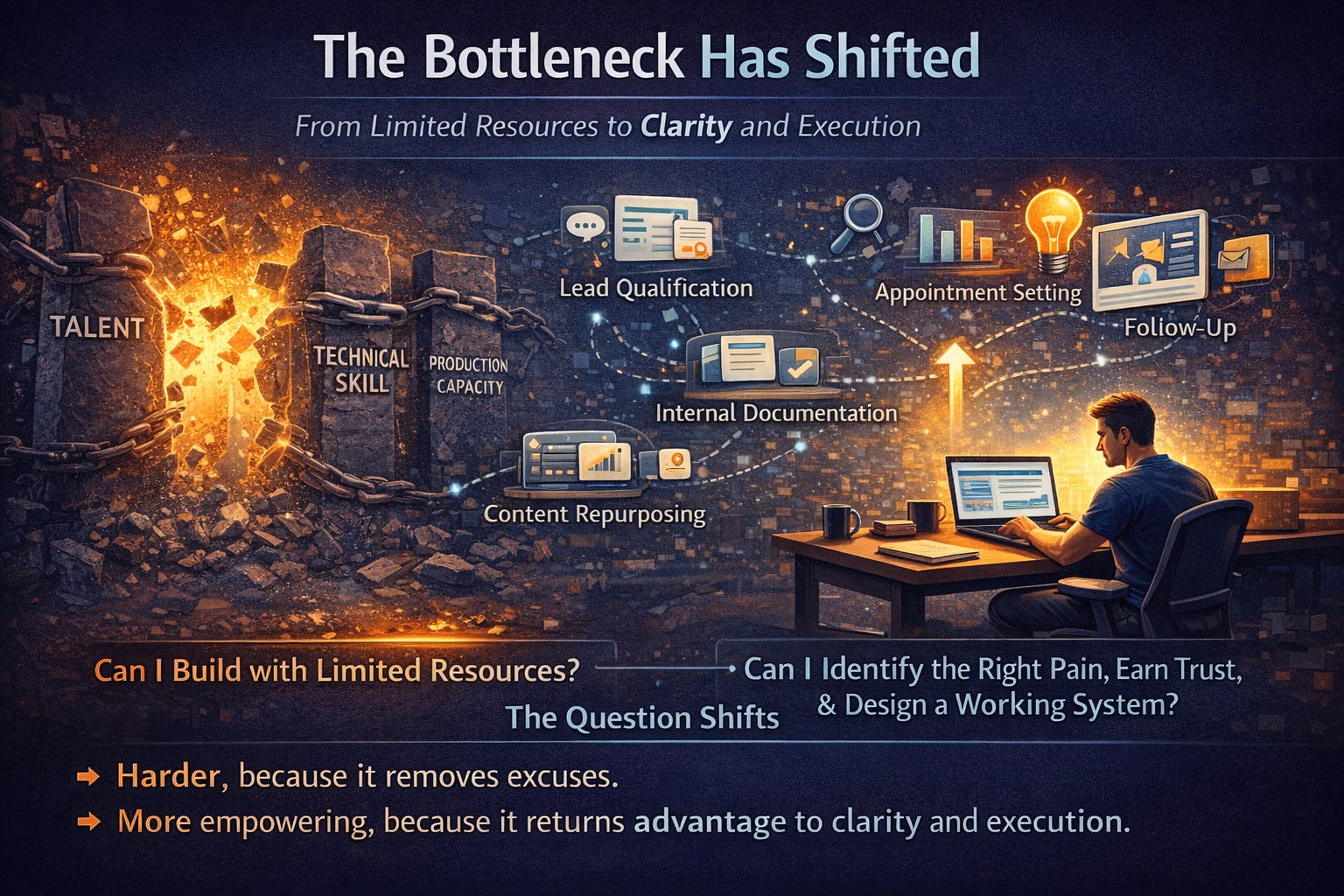
Talent, technical skill, and production capacity once gated execution. Those barriers have weakened. A founder can now create assets, analyze data, prototype, and operate without large teams.
The question shifts. Not “Can I build with limited resources?” but “Can I identify the right pain, earn trust, and design a working system?”
Harder, because it removes excuses. More empowering, because it returns advantage to clarity and execution.
The Fundamentals That Endure
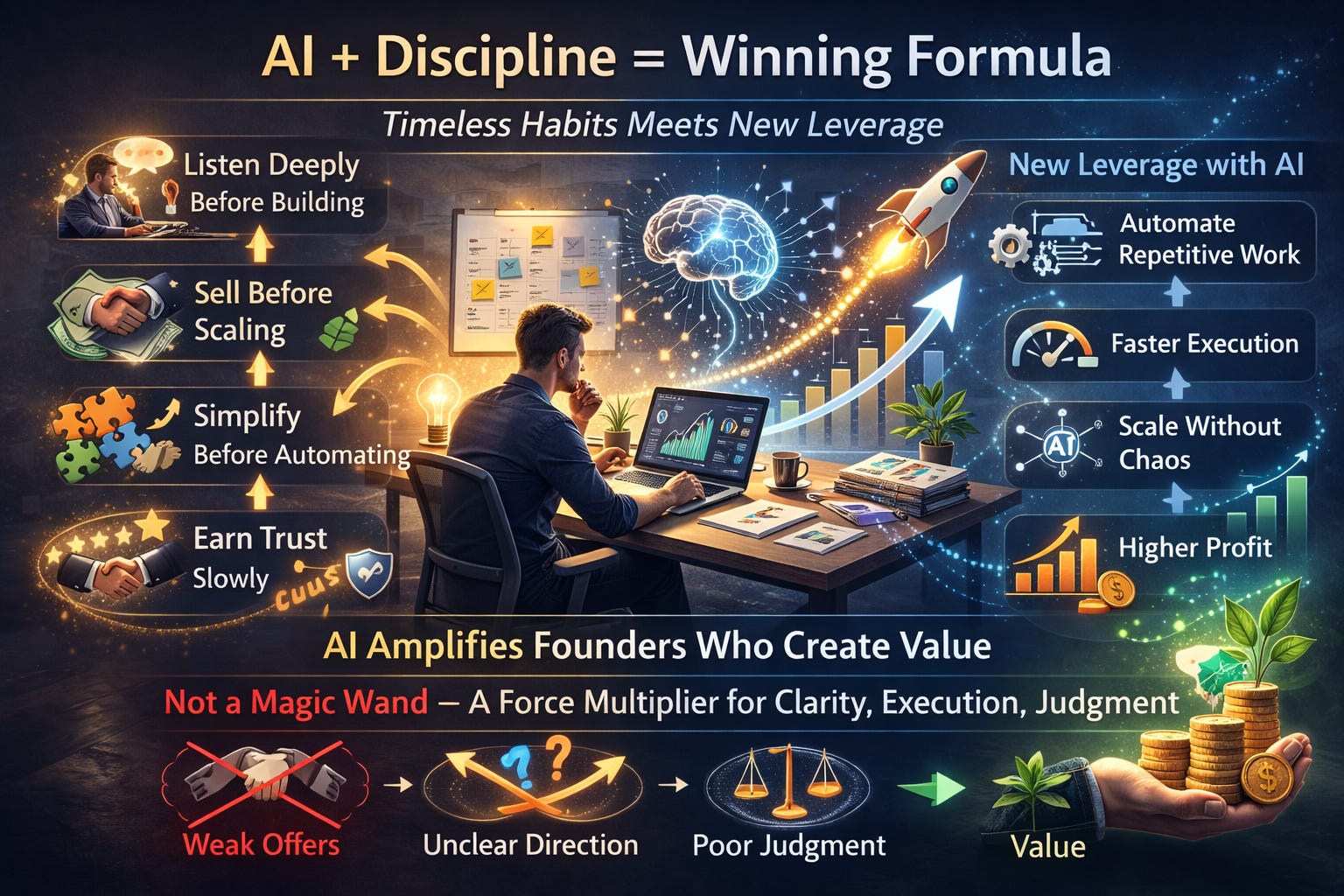
AI does not erase discipline. Winners combine timeless habits with new leverage:
Listen deeply before building
Sell before scaling
Simplify before automating
Earn trust slowly. It outlasts hype.
AI makes lean businesses faster and more scalable. It cannot fix weak offers, unclear direction, or poor judgment. It amplifies founders who already know where value lives.
The New Playbook
Choose one painful problem in one market. Talk to prospects until their language is unmistakable. Deliver manually and get paid. Prototype only what proves value. Automate the proven core. Add agents carefully. Stay lean until economics demand otherwise.
Modular. Iterative. Leverage-driven. Resilient.
The Takeaway
The AI revolution is not about replacing people. It is about amplifying those who operate with ruthless clarity. One founder, with a validated pain point, manual revenue proof, clean prototype, and disciplined agents, can now out-execute organizations burdened by process and delay. The constraint is no longer tools or access. It is the willingness to choose ruthlessly, validate relentlessly, and simplify aggressively. Master that, and leverage compounds exponentially.
In this era, winners will not hire fastest. They will learn fastest, simplify fastest, and build systems that endure.
Your Roadmap
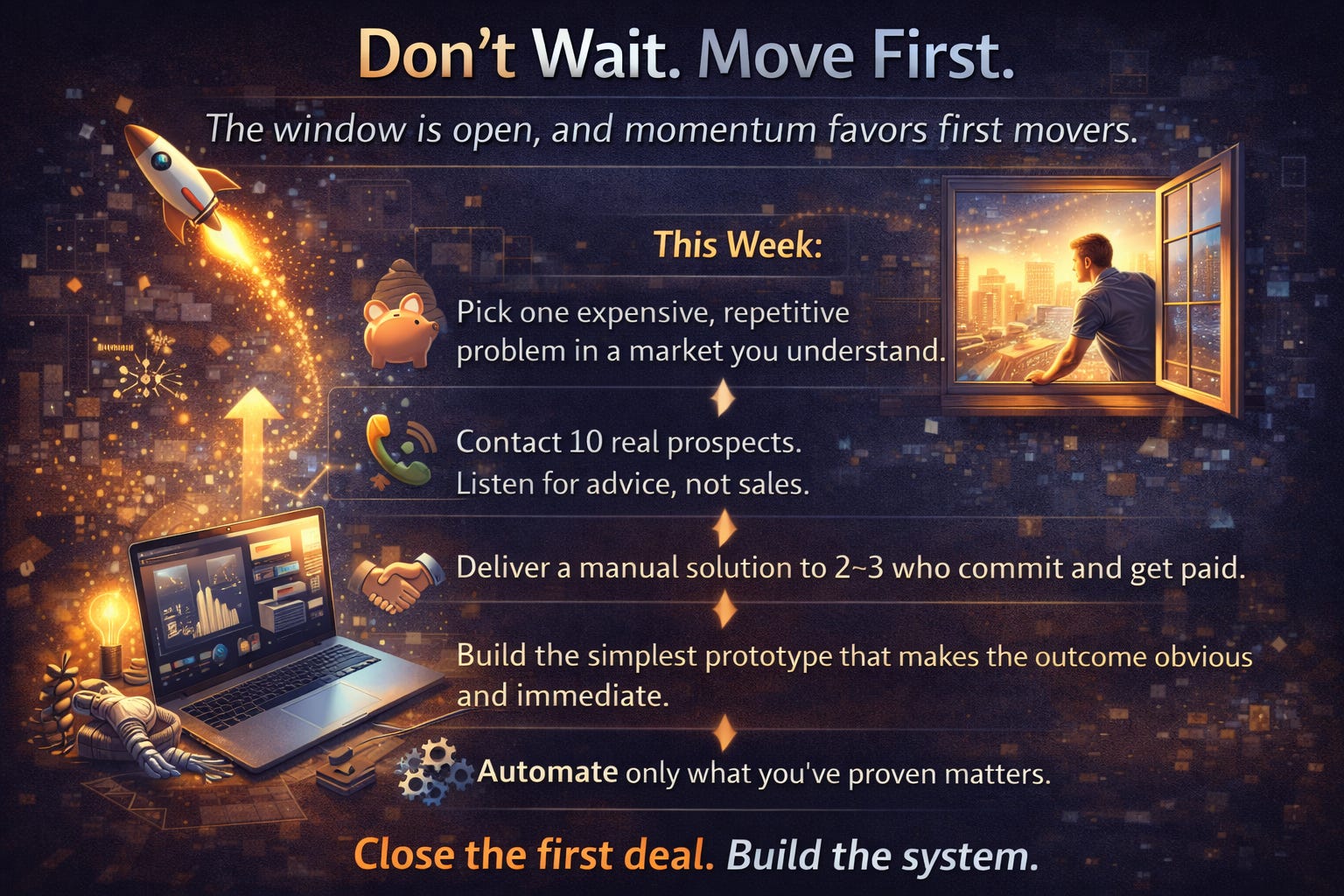
Do not wait for perfection or permission. The window is open, and momentum favors first movers.
This week:
Pick one expensive, repetitive problem in a market you understand.
Contact 10 real prospects. Listen for advice, not sales.
Deliver a manual solution to 2–3 who commit and get paid.
Build the simplest prototype that makes the outcome obvious and immediate.
Automate only what you’ve proven matters.
Close the first deal. Build the system.
You will not just ride the shift. You will define it.
Start today. The future belongs to the builders who act now.