

The Precision Pivot
A Framework for Disciplined Scaling

Companies don’t die from bad ideas; they die from scaling a process that worked once but was never meant to sustain a legacy. The most dangerous moment in a company’s life isn’t the launch—it’s the moment headcount hits 30. When you scale an inefficient process, you aren’t growing a business; you are merely compounding a disaster.
The Reader Contract
This is NOT for: Blitzscalers or venture-backed founders focused on growth-at-all-costs to satisfy a short-term liquidity event.
This is for: Founders and operators leading teams of 10–50 who have achieved product-market fit but feel the “operational wheels” beginning to loosen.
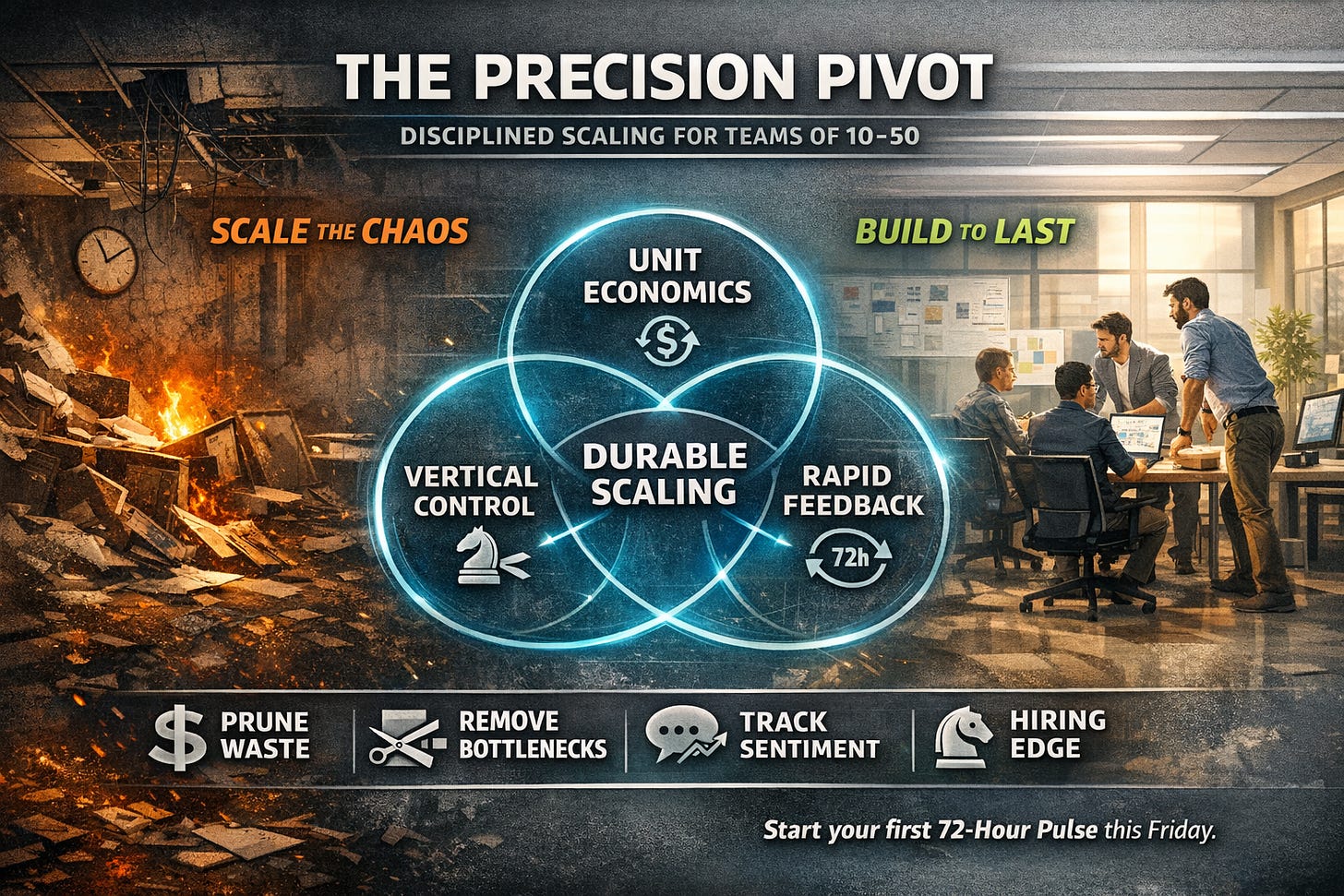
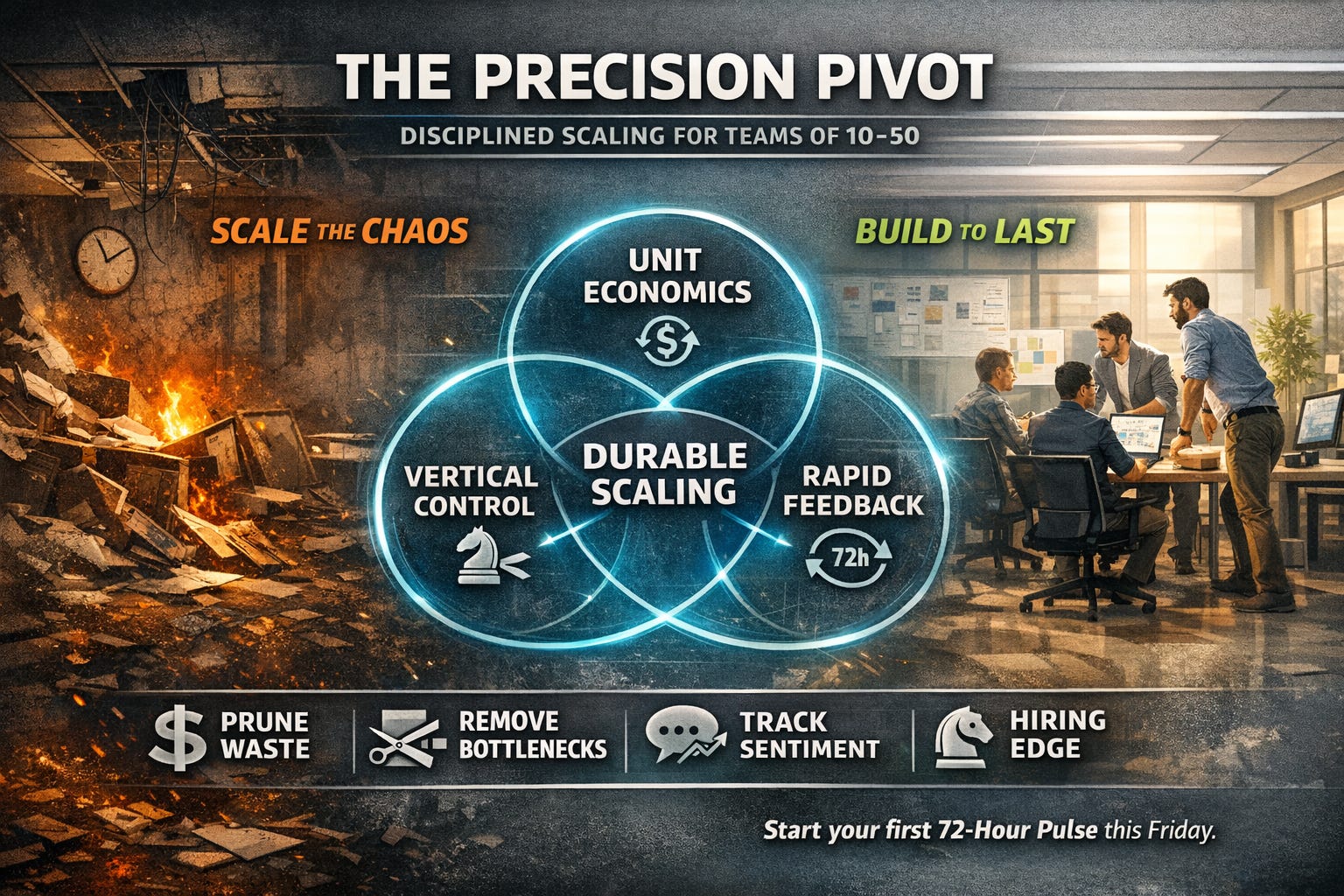
The Scale Mirage vs. The Precision Pivot
In the Scale Mirage, leaders mistake increased activity for increased value. They hire to solve problems created by poor systems, leading to a state of permanent “founder drag.” This phenomenon, often termed the “Founder’s Trap,” occurs when the leader remains the primary engine for every decision.
As headcount grows, the CEO’s personal bandwidth becomes a hard ceiling on growth. Without a system to offload this centrality, the firm plateaus while the team remains busy but unproductive. It caps growth at the CEO’s bandwidth.
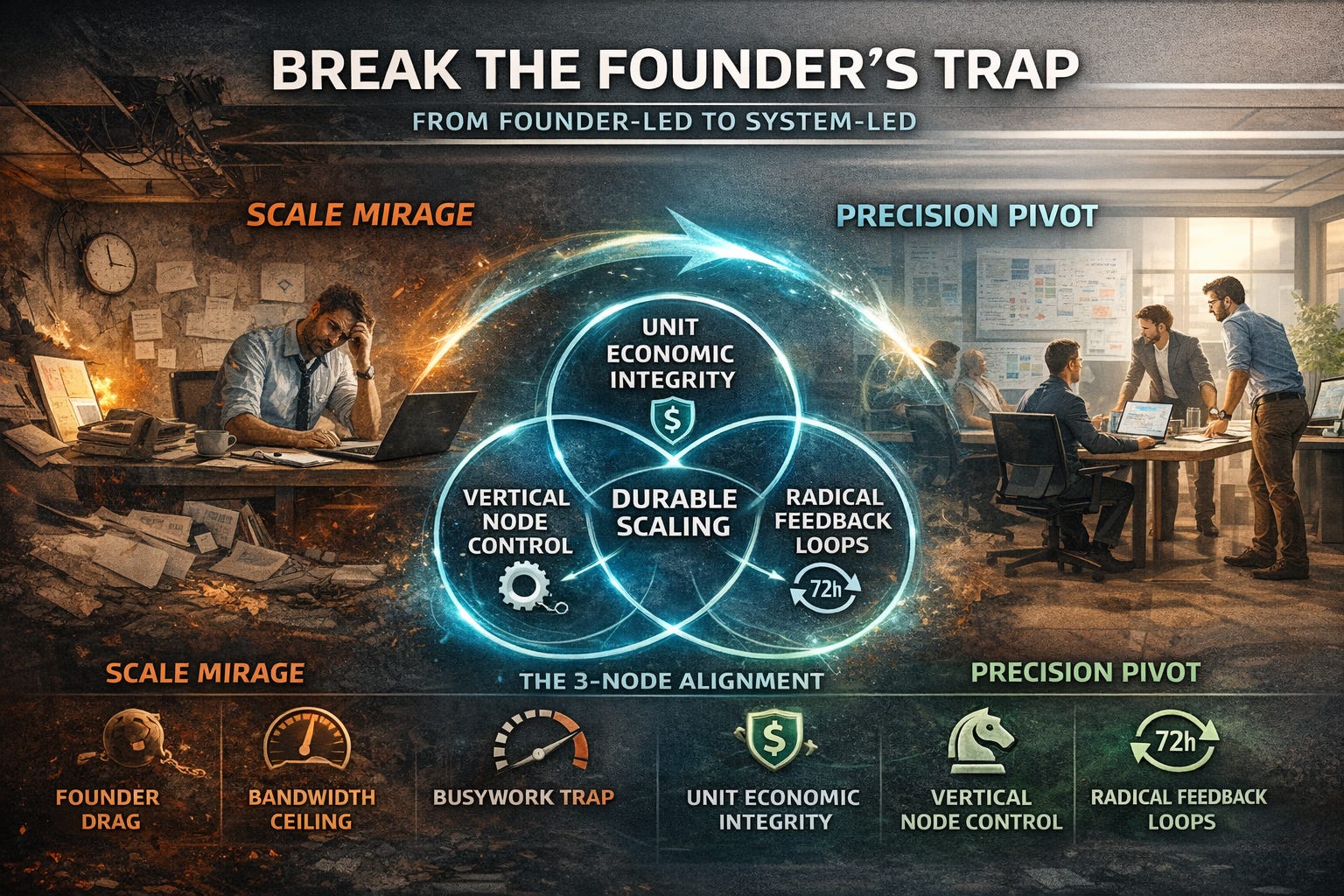
A pivot changes direction. A Precision Pivot changes the business model that funds it. To navigate the transition from a founder-led startup to a system-led enterprise, a leader must master the 3-Node Alignment:
Unit Economic Integrity: Ensuring first-order profitability on every transaction.
Vertical Node Control: Owning the value chain stages that dictate quality.
Radical Feedback Loops: Short-circuiting the distance between customer friction and leadership.
Node 1: Unit Economic Integrity (The Margin Defense)
True Unit Economic Integrity means every single transaction is profitable on a first-order basis—before you factor in speculative “future upsells.” Many founders mask poor economics by averaging cohorts, but the reality is unforgiving.
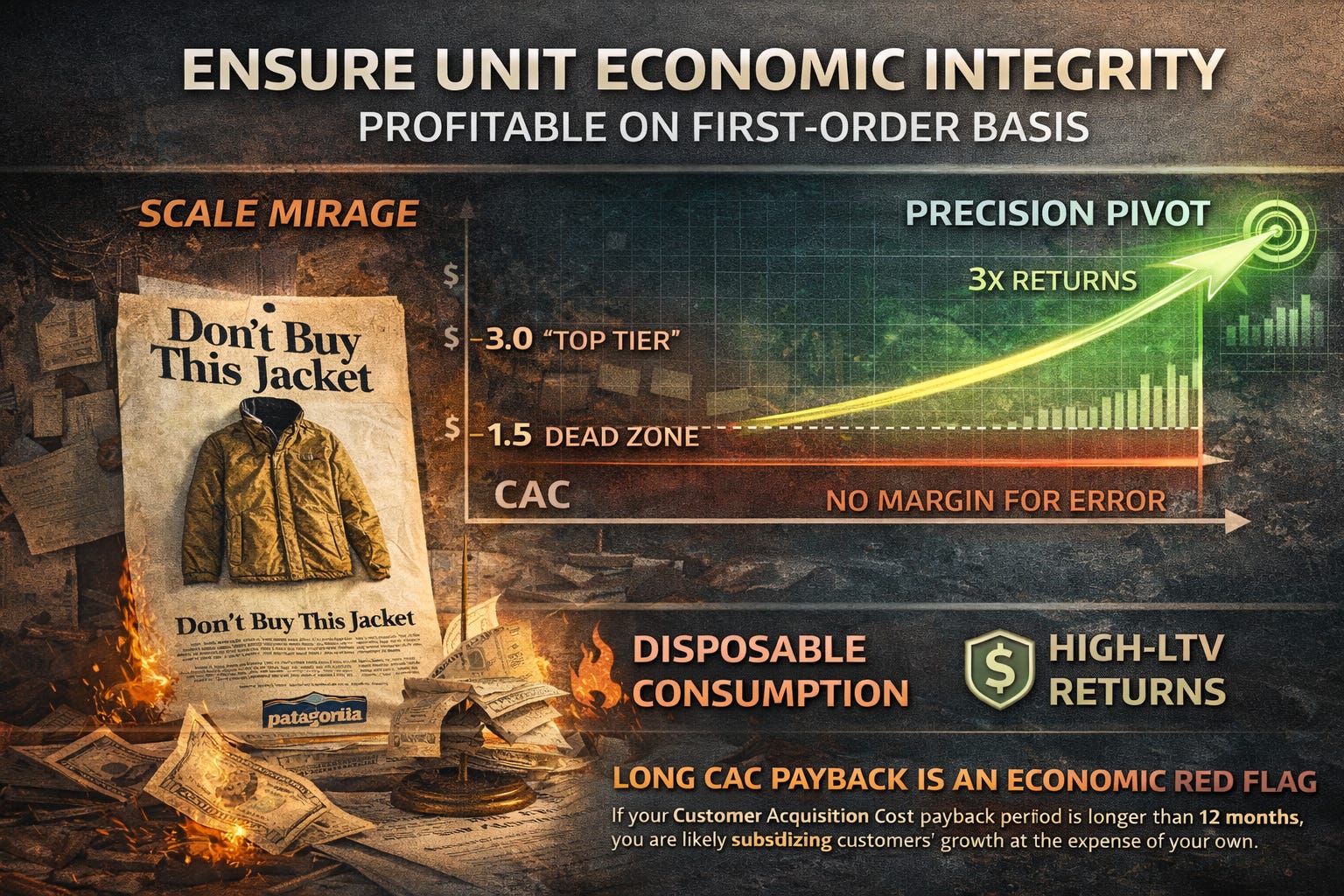
Benchmarks from Bessemer Venture Partners (detailed in their SaaS Ten Commandments) show that top-tier companies maintain an LTV/CAC ratio of 3.0 or higher. Many mid-market firms operate in the “dead zone”—an LTV/CAC ratio below 1.5—which leaves no margin for error during hiring spikes or demand shocks.
The Case Study: Patagonia Patagonia’s 2011 “Don’t Buy This Jacket” campaign acted as an “economic filter.” By discouraging frequent, low-quality purchases, they intentionally reduced short-term transaction volume to focus on high-margin, high-LTV customers.
The Mechanical Reality: This was a margin play. It reduced the operational “noise” of high-volume returns and support tickets. For the operator, the diagnostic is simple: If your fully burdened CAC (Customer Acquisition Cost) payback period is longer than 12 months, you are likely subsidizing your customers’ growth at the expense of your own.
Node 2: Vertical Node Control (The Tesla Constraint)
The common narrative suggests Tesla won because of brand hype. The operational reality is that Tesla won because they owned the constraint. While legacy automakers historically outsourced up to 70% of their components, Tesla pivoted to bring software and battery chemistry in-house.
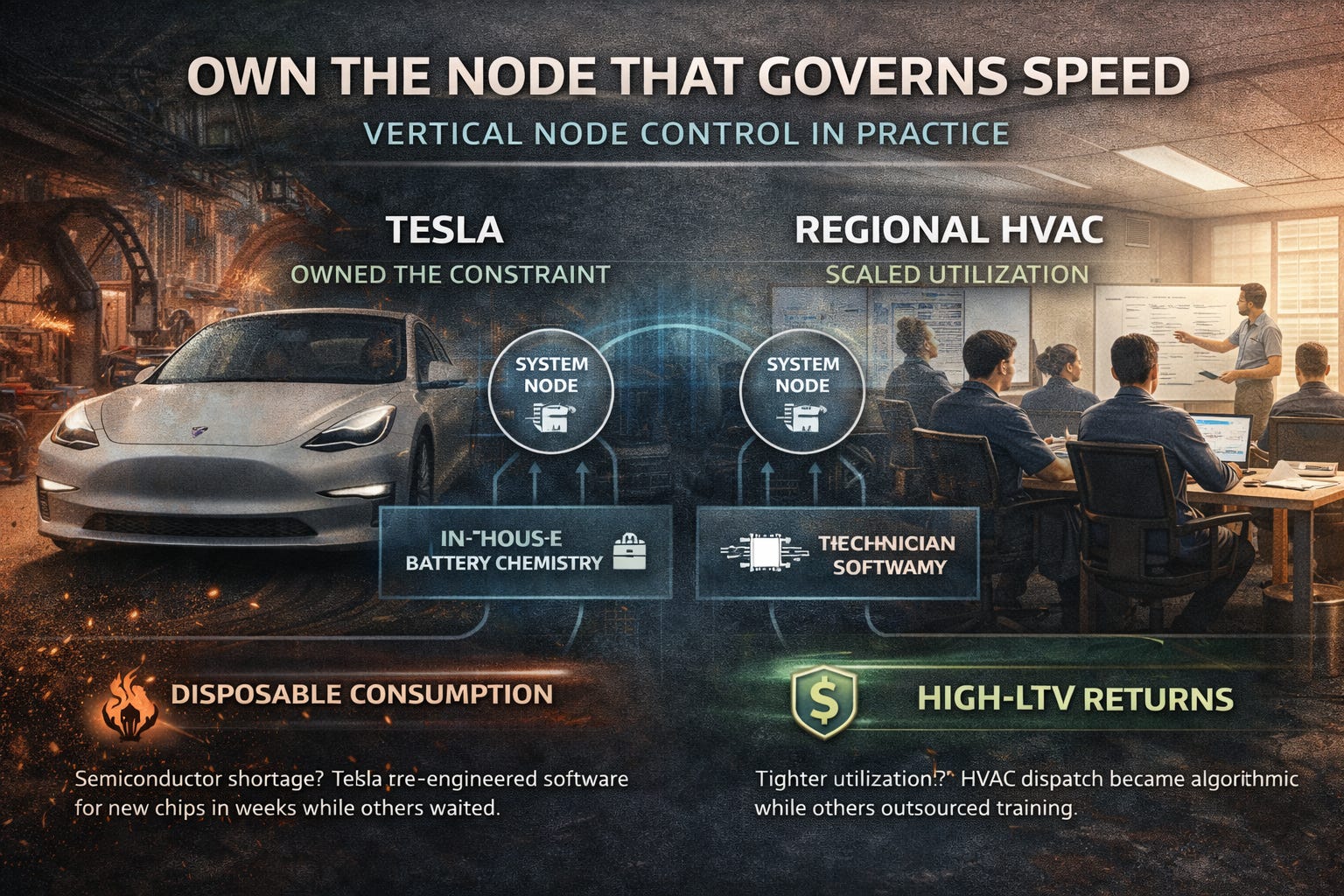
When the 2021 semiconductor crisis hit, Tesla’s engineers rewrote firmware for alternative chips in weeks. Their competitors, tied to rigid supplier contracts, sat idle. Tesla didn’t move faster because they were smarter; they moved faster because they owned the nodes that governed their speed.
The Grounded Example: Regional HVAC Consider a regional HVAC provider that grew from 10 to 40 technicians. Most competitors use generalist dispatch software and outsource technician training, creating a “quality ceiling.” This provider executed a Precision Pivot by building an in-house “Technician Academy” and a custom dispatch algorithm.
They had a 30% higher utilization rate than their competitors because they owned both the Talent Node (training) and the Efficiency Node (dispatch). This allowed them to pay technicians more while maintaining higher margins—a moat that competitors couldn’t bridge by simply spending more on marketing.
Node 3: Radical Feedback Loops (The 72-Hour Pulse)
Scaling a flawed model is the fastest way to “quiet bankruptcy”—a state where revenue grows but profit vanishes into operational friction. According to CB Insights, 35% of businesses fail because there is “no market need,” a misalignment that usually stems from a broken feedback loop between the market and the boardroom.

The 72-Hour Pulse is a repeatable ritual that prevents information silos:
The Mechanism: Every Thursday, a designated “Signal Owner” submits a one-page “Friction Report” on the top three customer complaints.
The Review: A 15-minute standing meeting on Friday where leadership decides: Is this noise or a signal?
The Action: If it’s a signal, an owner is assigned to a “Sprint Fix” by the following Tuesday.
The Proof: An anonymized 22-person SaaS team implemented this pulse after seeing churn hit 12%. By identifying and fixing one onboarding friction point weekly—based on direct call transcripts and support tickets—they saw a 22% margin lift in 90 days.
“The 72-Hour Pulse is the first step. It costs nothing and reveals everything.”
Your Breakthrough Roadmap: Order of Operations
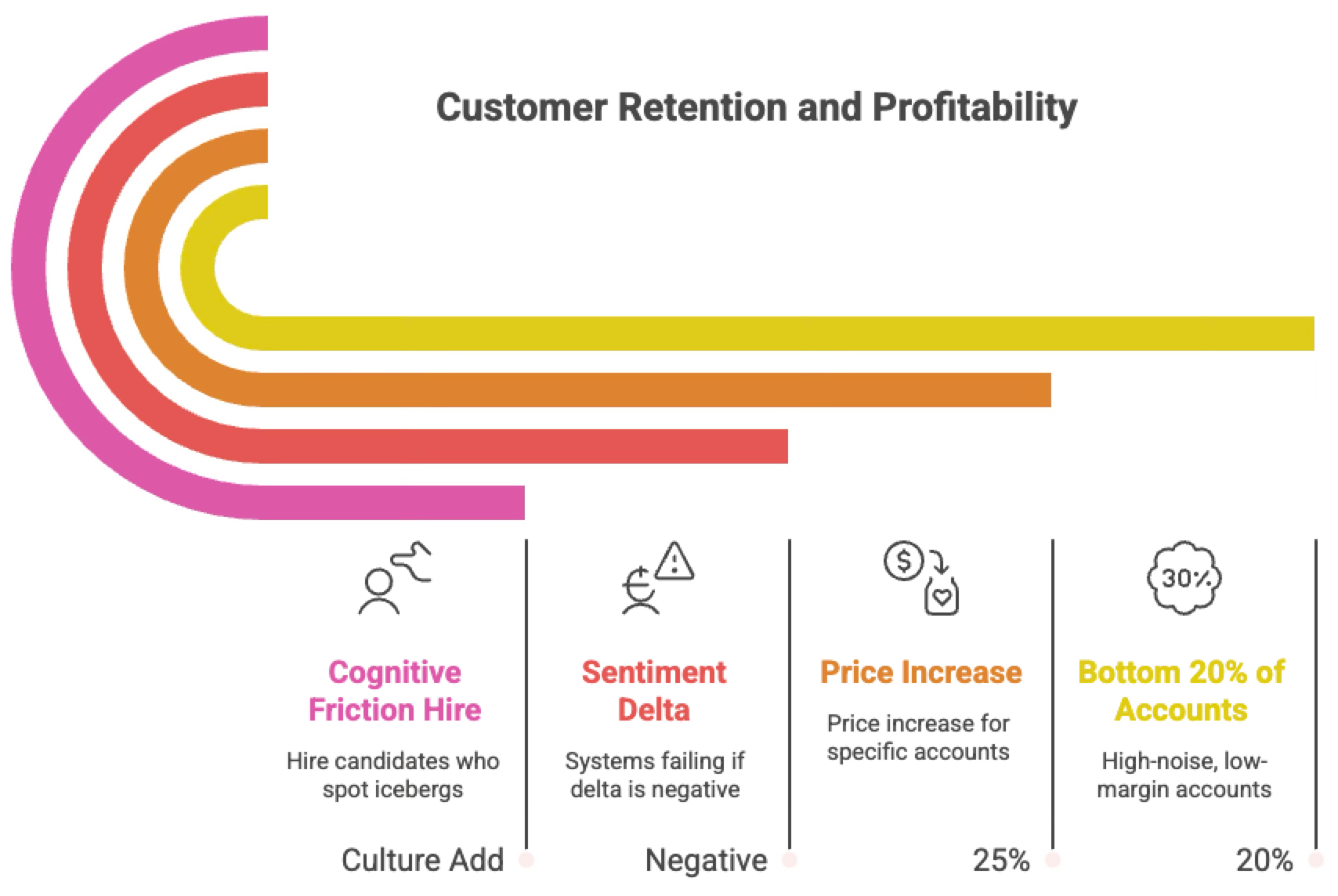
Phase 1: Stabilize (The 20/80 Profit Pruning) List every client/product by Gross Margin vs. Operational Bandwidth. Identify the bottom 20% of high-noise, low-margin accounts. Data from Paddle (formerly ProfitWell) suggests that companies that aggressively prune their bottom-performing customers see significant profit increases by freeing up team capacity.
The Action: Increase prices by 25% for those specific accounts. If they leave, you have recovered the capacity to focus on “A-Players.”
Phase 2: Decentralize (The SOP Ghosting Test) Remove the “Founder Bottleneck.” Attempt to remove yourself from all internal communications for 72 hours.
The Action: Note every process that stalled. Create a Decision Matrix empowering team leads to spend up to a specific threshold (e.g., $500) without your sign-off, provided it follows a documented SOP.
Phase 3: Validate (The Sentiment Delta) This is the quantitative measure of your delivery health. Tools like MonkeyLearn or simple keyword tracking in your CRM make this measurable in under an hour.
The Action: Use sentiment analysis on support tickets and NPS comments to compare the tone of a customer’s first interaction with their fifth. If the delta is negative, your systems are failing.
Phase 4: Future-Proof (The Cognitive Friction Hire) Shift your criteria from “Culture Fit” to “Culture Add.”
The Action: Hire candidates who can describe a time they used data to disagree with a superior. You need people who spot icebergs before impact.
The Precision Pivot requires a shift in identity: moving from being the most productive person in the room to being the architect of the system itself. Start your first 72-Hour Pulse this Friday.