


In 2021, mobile developers confronted a dependency many had not fully priced into their businesses. Mobile developers depended on Apple for several distinct functions, including app distribution, payment processing, discovery, and advertising attribution. When Apple introduced its App Tracking Transparency framework, it demonstrated its control over one of those critical layers.
By requiring developers to obtain explicit permission before linking user or device data across other companies’ apps and websites or accessing the device advertising identifier, Apple unilaterally changed the tracking information available to advertisers and developers across iOS. The economic effect varied significantly by business model, user base, and advertising dependence, but the allocation of authority was unmistakable: Apple set the tracking rules, while developers absorbed the consequences.
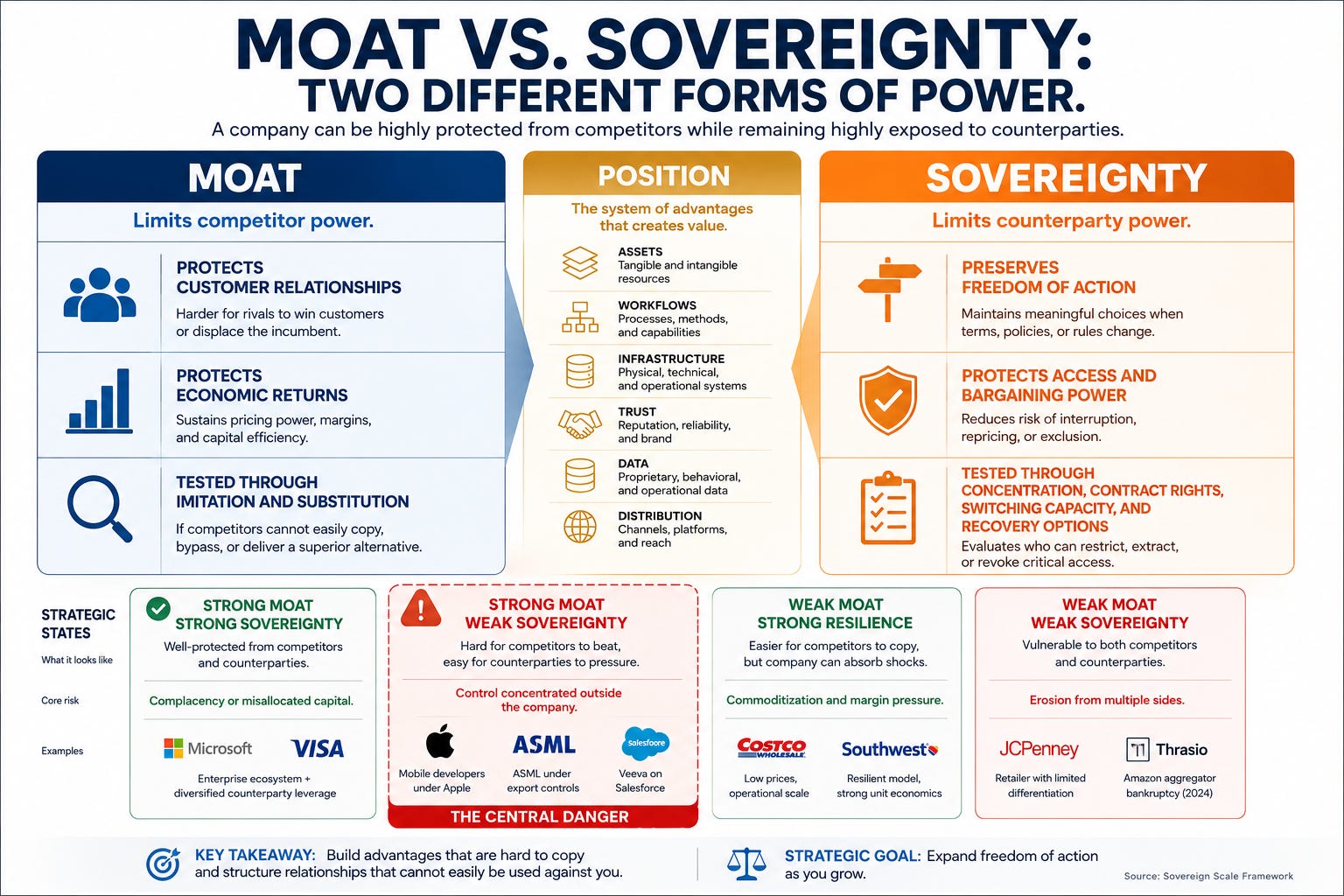
A moat limits the power of competitors. Sovereignty limits the power of counterparties. A company may have one without the other.
Apple vs. Facebook: Why iOS 14.5 Started a Big Tech Fight
Strategic sovereignty is the preservation of meaningful choice when an important supplier, platform, financier, regulator, or customer changes its terms. It is measured by the ability to make critical decisions involving pricing, distribution networks, the product roadmap, data access, supplier selection, financing alternatives, and company ownership or exit.
Sovereignty is domain-specific. A company can control its product roadmap while remaining exposed in distribution, financing, regulation, manufacturing, or data access. A defining risk of the next decade is not simply imitation, but dependency concentration. Production is democratizing while attention, distribution, and infrastructure remain concentrated among a limited number of providers.
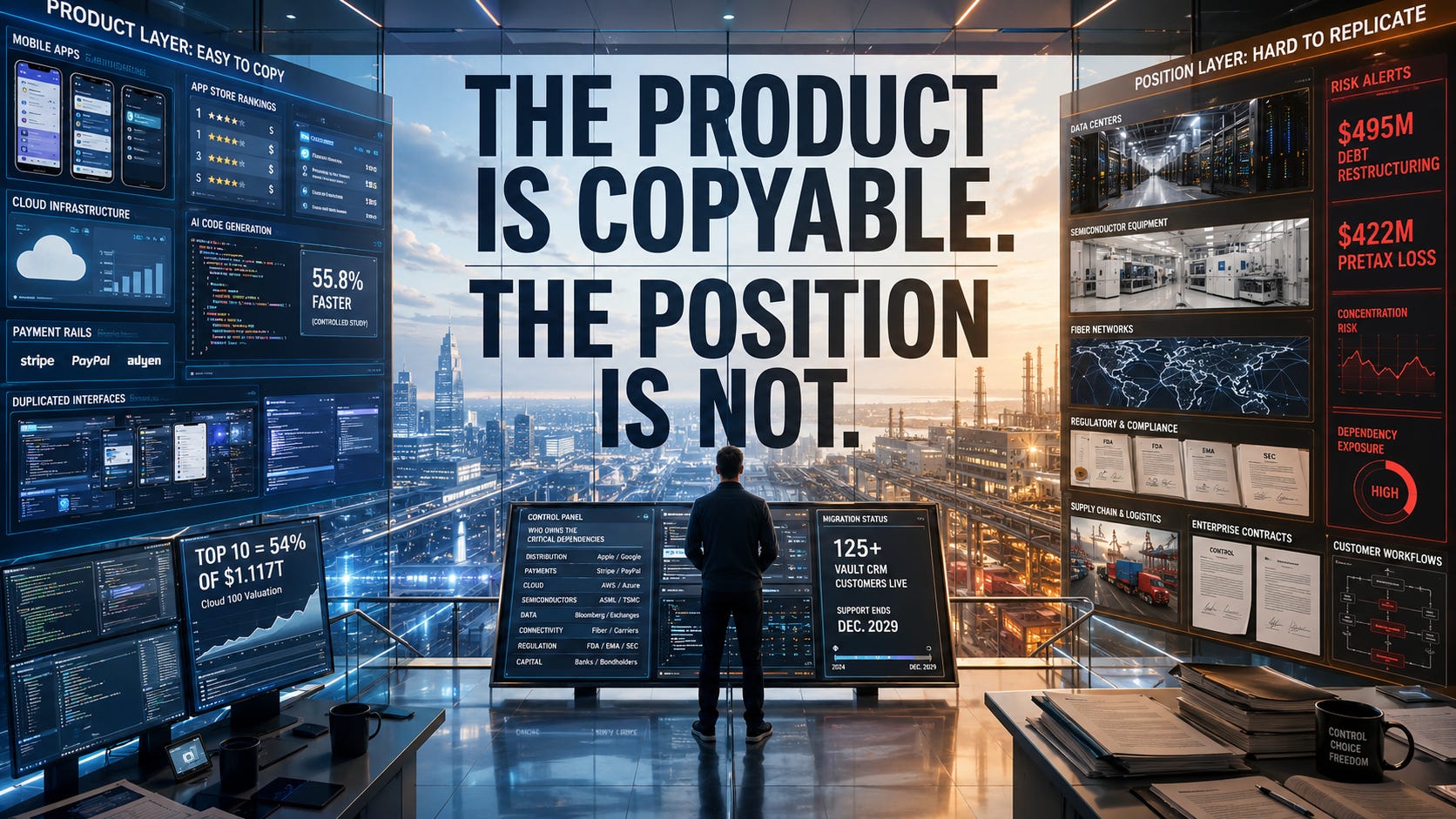
These forces reinforce one another. When the visible product becomes easier to reproduce, companies rely more on less visible advantages, such as distribution networks, proprietary workflows, infrastructure, data, and institutional trust. Yet those advantages often sit on systems controlled by someone else.
Sovereign Scale measures whether growth expands the company’s freedom of action, not merely its size or defensibility.
The cost of building software has fallen. The cost of building a durable company has remained constant. A small team can now use managed cloud infrastructure, open libraries, and artificial intelligence coding assistants to reduce the time required for defined programming tasks.
In one controlled experiment, developers using GitHub Copilot completed a bounded JavaScript coding task 55.8% faster than a control group. Research on broader development practice has found more uneven results, particularly where work requires integration, review, security judgment, or knowledge of a multi-file proprietary codebase.
When the tools of production become widely available, access to them stops being a meaningful advantage. A polished interface can be copied, a common feature can be reproduced, and an early lead can disappear quickly when competitors use the same models, clouds, and libraries.
The Difference Between a Product and a Position
The product is the immediate offering the customer buys. The position is the surrounding system of assets, relationships, knowledge, and economic advantages that allows the company to keep earning attractive returns even after competitors notice it.
The relevant question is not only whether the position exists but also what it costs each year to keep it from decaying. A true position should eventually appear in observable business performance, manifesting as stronger retention, lower acquisition costs, improving unit economics where scale permits, or superior returns on the capital the model requires.
When every company can produce more features, those features lose their signaling power. Features reveal less about a company’s underlying capability when competitors can reproduce many of them quickly.
The strongest companies use widely available technology to build advantages that are not widely available. They make software the interface to something far harder to reproduce.
Higher financing costs have increased scrutiny of retention, payback periods, and capital efficiency. The Federal Reserve raised its target range from 0 to 0.25% in 2021 to 5.25% to 5.5% by July 2023, holding that range until September 2024, when it began a series of rate reductions.
Meanwhile, the ten most valuable companies in Bessemer’s 2025 Cloud 100 Benchmarks Report represented 54% of its $1.117 trillion aggregate valuation. That concentration is not proof of durability, but it shows how heavily investors have concentrated expectations in a small group of perceived winners.
The Cost of Reducing Dependency
Reducing dependency introduces clear tradeoffs. The pursuit of sovereignty requires an organization to pay a premium today through higher near-term spending, greater architectural complexity, and slower time to market to preserve choices under future disruptions.
Building redundant supply chains, architecting technically portable infrastructure, or establishing direct distribution channels creates substantial cost and organizational complexity.
Dependency is not inherently a defect. A powerful counterparty may supply the infrastructure, trust, distribution, capital efficiency, or customer access that allows the company’s own advantage to compound. Reducing dependence can therefore damage the very advantage the company is trying to protect.
A sovereignty move should be evaluated from both sides of the relationship. Control gained by the company can become a migration cost, reduced choice, or operational disruption for the customer.
Sovereignty is therefore relational. One company’s successful effort to gain control may become another company’s concentrated dependency. A vendor can increase its freedom by forcing customers into migration, proprietary formats, reduced interoperability, or a narrower set of alternatives.
The move must therefore be judged by the control gained and the dependence transferred.
Sovereignty concerns the choices available before and during pressure. Resilience concerns whether the company can continue operating after the pressure becomes disruptive.
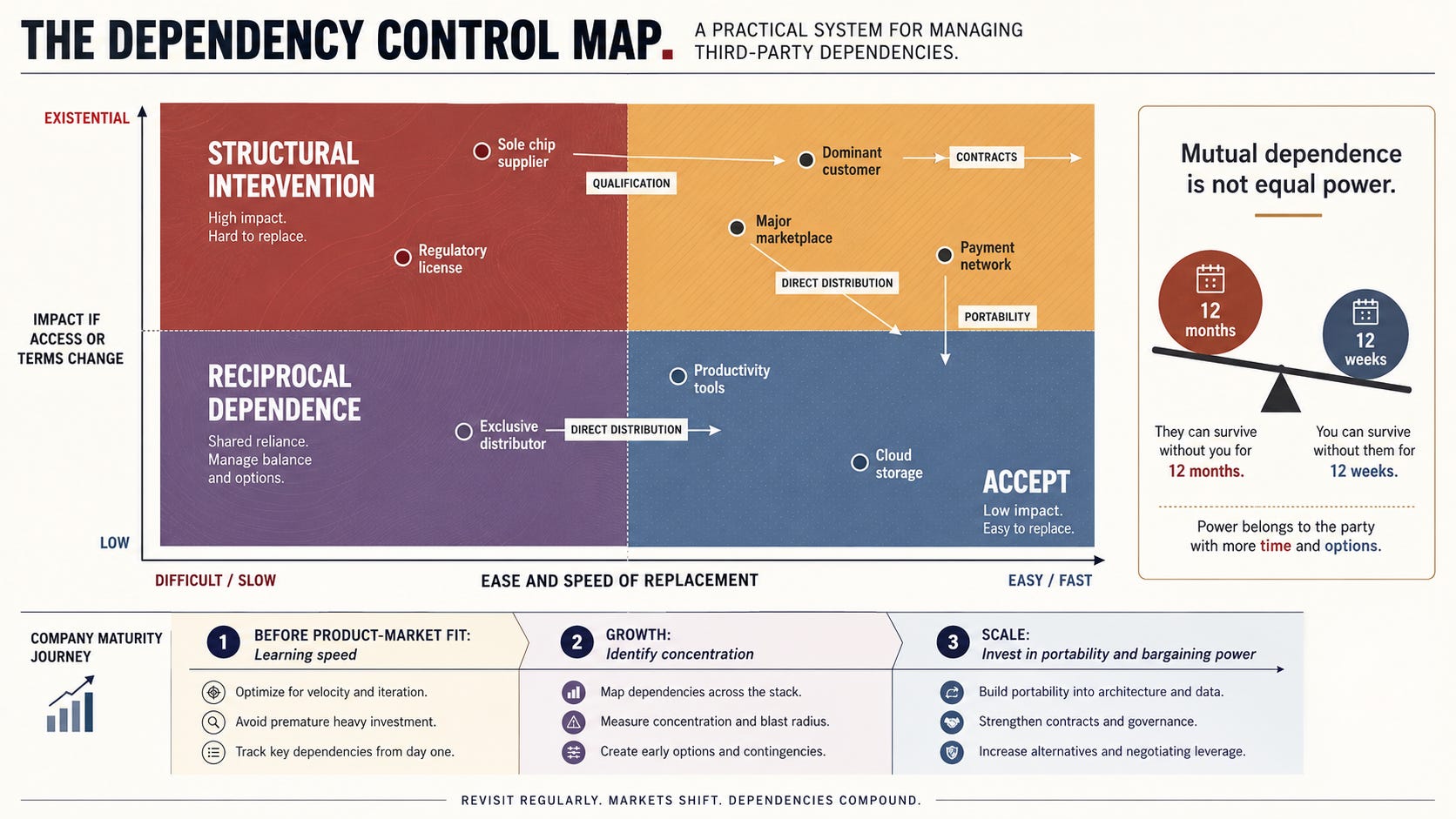
The objective is to secure control only where losing it could materially damage the business. Operators must evaluate dependencies across four conditions.
Dependencies worth accepting: Noncritical inputs that are available from several substitutable providers and have negligible switching costs, such as standard productivity tools.
Dependencies worth insuring: Critical inputs that can be managed through contractual protections, backups, or verified secondary-provider readiness, such as a cloud service with verified exportability and a tested recovery path.
Dependencies stabilized by reciprocal dependence: Relationships where both parties would suffer significantly from separation and neither can easily dictate terms. Reciprocal dependence is stabilizing only when the cost, speed, and survivability of separation are reasonably balanced. If one party can survive the loss for twelve months and the other cannot survive twelve weeks, the relationship is mutual, but not the bargaining power.
Dependencies requiring structural intervention: Single points of failure where an external counterparty holds disproportionate power to restrict access, alter economics, or interrupt a critical function without a viable alternative.
A framework must also account for company maturity. Before product-market fit, prioritize learning speed. A startup that has not proven demand should not spend scarce capital solving hypothetical sovereignty problems.
During growth, identify concentrated dependencies. At scale, invest selectively in portability, reciprocal leverage, and institutional ownership.
Six Mechanisms of Compounding Power
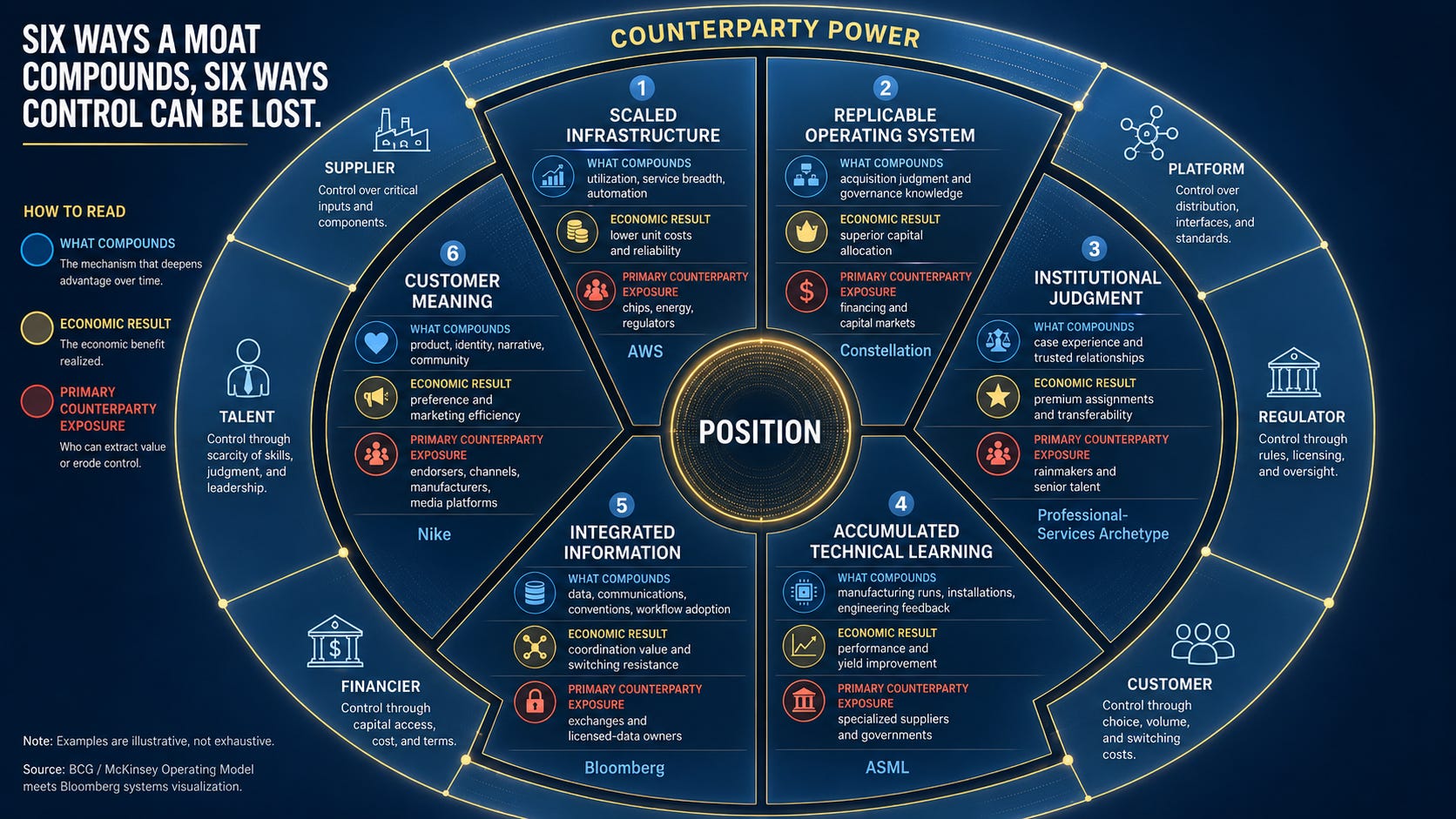
The following mechanisms show different ways a competitive advantage can compound. The sovereignty analysis begins only after asking who owns, licenses, finances, distributes, regulates, or can interrupt that advantage.
For each mechanism, ask which counterparty can interrupt or reprice the advantage, how quickly it could do so, and what tested response the company has.
1. Scaled Infrastructure
This mechanism builds advantage through infrastructure whose scale, reliability, geographic reach, and operating complexity become increasingly difficult to reproduce.
Amazon Web Services turned data-center investment into an on-demand computing platform. Its position rests on service breadth, reliability, security, global reach, and the cost of migrating enterprise workloads, particularly where customers have built around provider-specific managed services.
Advanced chips represent a critical exposure because capacity expansion depends on a small number of designers, fabricators, memory producers, packaging suppliers, and networking-equipment manufacturers with their own production constraints.
Spreading platform-development costs across a broad customer base improves the economics of each additional service, creating room for lower prices or higher margins.
Sovereignty prompt: Which chip suppliers, energy providers, regulators, property constraints, or concentrated customers can materially alter the infrastructure owner’s economics?
2. Replicable Operating System
This mechanism focuses on capturing vertical or operational niche dominance through a repeatable approach to acquiring and governing specialized businesses.
Constellation Software illustrates this pattern by systematically acquiring vertical-market software companies and operating them through a decentralized system focused on durable niche economics, capital allocation criteria, and product autonomy.
The mechanism compounds only if the parent improves its acquisition and governance judgment faster than portfolio complexity grows.
The core risk is illustrated by Thrasio, which filed for Chapter 11 in February 2024 under an agreement intended to eliminate roughly $495 million in debt. The case shows how a roll-up can become dependent simultaneously on financing conditions and the commercial rules of the marketplace on which its acquired brands operate.
Sovereignty prompt: How dependent is the acquisition model on favorable purchase multiples, available financing, and a continuing supply of attractive targets?
A Plan Is Not a Strategy | Harvard Business Review
3. Institutional Judgment
Presented as an operating archetype, this mechanism converts pattern recognition and specialized expertise into institutional capability.
Professional-services firms attempt to accomplish this transformation through apprenticeship, shared methods, accumulated case knowledge, and distributed client ownership. The model becomes durable only when client relationships and commercial value can survive the departure of individual partners.
Sovereignty prompt: How much bargaining power do individual senior partners and relationship owners retain, even as they can depart with their teams?
4. Accumulated Technical Learning
This mechanism creates an advantage rooted in complex science, physics-based engineering, or specialized manufacturing processes.
ASML is currently the only company producing commercial extreme ultraviolet lithography systems for advanced chip manufacturing. Its suppliers remain critical, but ASML is equally critical to them. Its sovereignty comes from reciprocal dependence and from serving as the central integrator of components that competitors cannot easily assemble.
Governments are not ordinary counterparties. They can constrain commercial choice through law, licensing, and export controls even when the company possesses overwhelming market power. ASML’s export permissions and shipment options remain shaped by the legal regimes under whose jurisdiction it operates.
Moat test: Can a rival reproduce the supplier network, engineering knowledge, manufacturing capability, and customer validation required for EUV?
Sovereignty test: Which governments or specialized suppliers can restrict ASML’s ability to manufacture or sell its systems?
Why The World Relies On ASML For Machines That Print Chips
5. Integrated Information
This mechanism improves client decisions by capturing and using accurate, differentiated information that is part of user workflows.
Bloomberg combines data, analytics, news, communications, and tools embedded in daily financial work. As institutions standardize around that environment, each additional participant expands the usefulness of shared communications, integrations, identifiers, and conventions.
The advantage compounds through coordination as well as information. A competitor must replace an entire working environment, not merely a dataset.
The principal risk is assuming that superior information about one part of a system eliminates uncertainty in the parts the data does not capture.
This failure mode is illustrated by the wind-down of Zillow Offers, which in the third quarter of 2021 recorded a $422 million pretax loss. Information about housing demand could not remove the forecasting, renovation, timing, and balance-sheet risks of owning physical inventory.
Sovereignty prompt: Which data providers, exchanges, clearinghouses, or institutions retain control over the information Bloomberg requires?
6. Customer Meaning
This mechanism creates a position in which product, identity, language, community, and distribution reinforce customer preference.
Nike demonstrates that cultural recognition can survive operating weakness. Cultural meaning can improve marketing efficiency and create powerful recognition, but it does not renew itself automatically.
Cultural advantage must be rebuilt continually through relevant products, athlete relationships, distribution, and marketing.
The failure mode is confusing temporary demand spikes with permanent category attachment. Peloton expanded its supply chain and cost base during the pandemic surge, then restructured as hardware demand normalized.
Sovereignty prompt: Which athletes, retail channels, manufacturers, media platforms, or cultural institutions can materially affect the brand’s relevance or access to customers?
The Framework in Practice: Veeva’s Platform Transition
In practice, these mechanisms overlap. The task is not to choose a single label, but to understand which mechanism carries the company’s economics and which dependency could interrupt it.
Consider Veeva Systems, a cloud software company built specifically for the life sciences industry. Veeva provides applications spanning clinical, regulatory, quality, safety, data, and commercial functions.
The position
Veeva’s primary advantage is its position inside regulated life sciences workflows. Veeva reinforces that position with accumulated industry knowledge.
The dependency
Historically, Veeva built its initial CRM applications on the Salesforce application platform.
While Veeva possessed a highly defensible customer product, it faced a concentrated application-platform dependency. As the commercial agreement neared expiration, Veeva faced a consequential choice: remain on Salesforce’s platform or accept the cost and execution risk of moving CRM to Vault.
The test
Veeva chose to pay the premium for greater control. It began a multiyear transition to move its CRM applications onto its existing Veeva Vault platform. Vault CRM became the go-forward product for new customers in 2024.
As of March 2026, Veeva reported that more than 125 customers were live on Vault CRM. That company-defined figure shows adoption, but not how much of the Salesforce-based installed base has completed migration.
Existing customers are moving through a multiyear transition. In March 2026, Veeva advanced the end-of-support date for the Salesforce-based product from September 2030 to December 2029.
By moving CRM to Vault, Veeva expects greater control over release timing, integration, and platform economics.
The transition should be evaluated across three categories:
Customer: migration pace, retention, implementation burden, retraining, integration rebuilding, and temporary workflow disruption.
Economics: transition expense, support burden, margin effects, customer concessions, and any platform costs that the transition avoids, to the extent those figures are disclosed.
Strategy: release speed, integration, product development, and competitive outcomes against other life science CRM products.
The customer-side test is equally important: whether the unified Vault environment creates enough additional value to justify concentrating more workflow, data, and switching cost around Veeva.
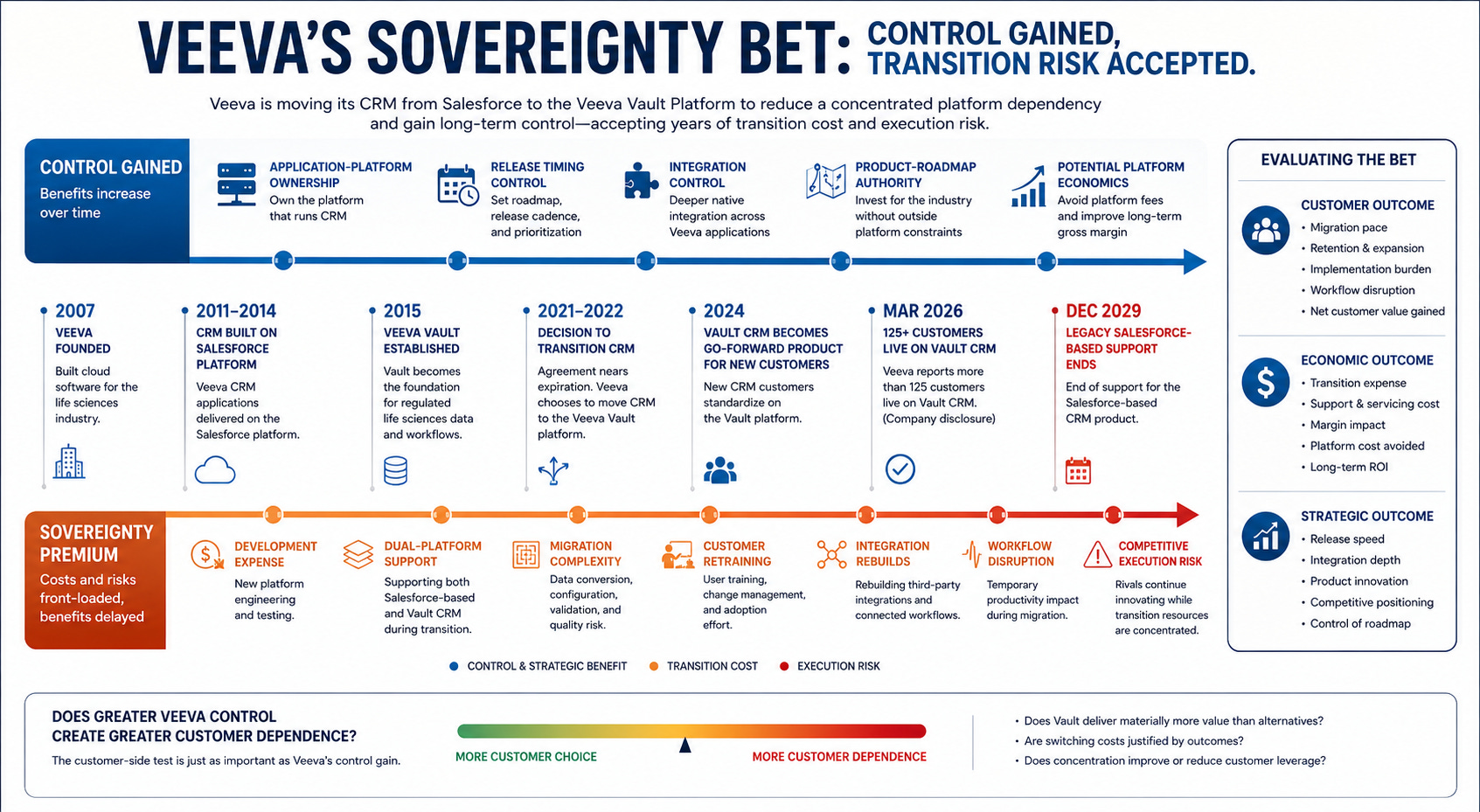
Veeva is therefore not proof that reducing dependency automatically creates value. It is a live test of the framework: a highly defensible vertical software company accepting years of transition risk to reduce one concentrated platform dependency.
The Sovereign Scale Audit
To transform strategy from a philosophy into a diagnostic tool, evaluate the business through six core questions. Treat any materially weak dimension independently rather than allowing strength elsewhere to conceal it.
Detailed scoring guidance and extended metrics belong in the companion scorecard rather than inside the argument itself.
1. Customer value
Does the capability produce a concrete price, performance, convenience, status, or risk outcome that materially influences purchase and renewal?
Look for win rates against lower-priced alternatives, realized pricing, renewal or expansion at stable economics, and depth of use in the core workflow.
2. Compounding utility
Does the advantage strengthen with every operational cycle, transaction, deployment, or user?
Identify what input increases with scale, what output improves, who receives that improvement, and what evidence establishes the causal connection.
3. Imitation and substitution
What structural barriers remain after a competitor copies the visible product, offers a different architecture, or benefits from a regulatory change that restricts or devalues the advantage?
Migration friction is defensible only when it reflects integration, workflow learning, trust, or accumulated customer value. Obstacles created by intentionally withholding data or obstructing exit may produce short-term retention while increasing resentment and regulatory risk.
4. Economic returns
Does the advantage generate an attractive incremental return after accounting for the capital, operating expense, and recurring renewal investment required to maintain it?
A moat that costs more to renew than it returns is brittle.
5. Dependency exposure
Can a single counterparty, geographic bottleneck, or regulatory jurisdiction interrupt access, supply, demand, financing, or operation?
Examine concentration, contract rights, switching time, qualification requirements, and the availability of tested alternatives.
6. Value capture
As the business grows, which counterparty gains the ability to claim a larger share of the economics or reprice the relationship?
Dependency exposure concerns interruption or loss of access. Value capture concerns economic extraction. A company may face one without the other.
The Operating Sequence
To reduce concentrated dependency and strengthen strategic choice, execute six steps.
1. Diagnose the competitive position
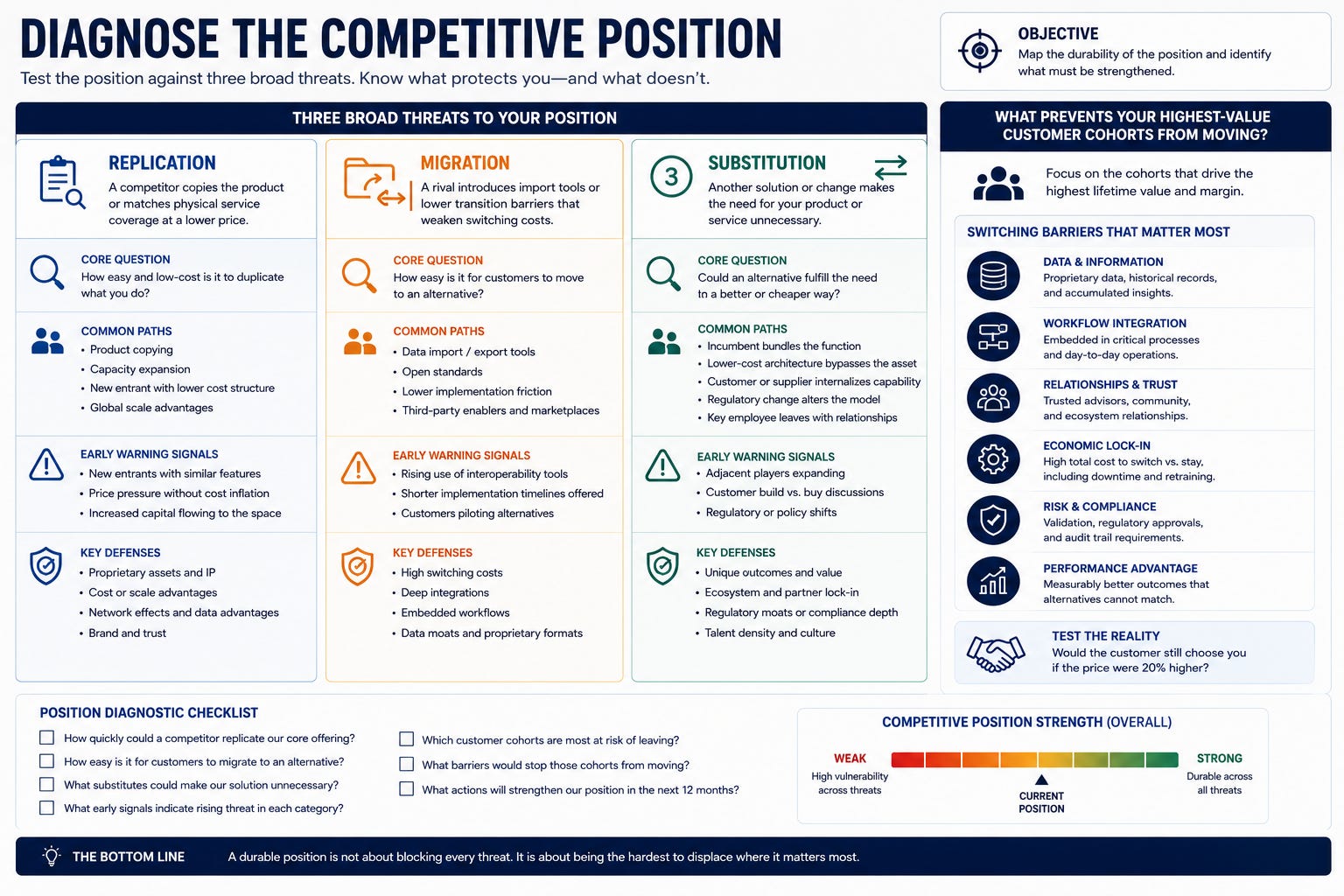
Test the position against three broad threats.
Replication: A competitor copies the product or matches physical service coverage at a lower price.
Migration: A rival introduces import tools or lower transition barriers that weaken switching costs.
Substitution: An incumbent bundles the function, a lower-cost architecture bypasses the asset, a customer or supplier internalizes the capability, a regulator changes the permissible model, or a key employee leaves with relationships.
Identify what prevents the highest-value customer cohorts from moving.
2. Select the compounding mechanism
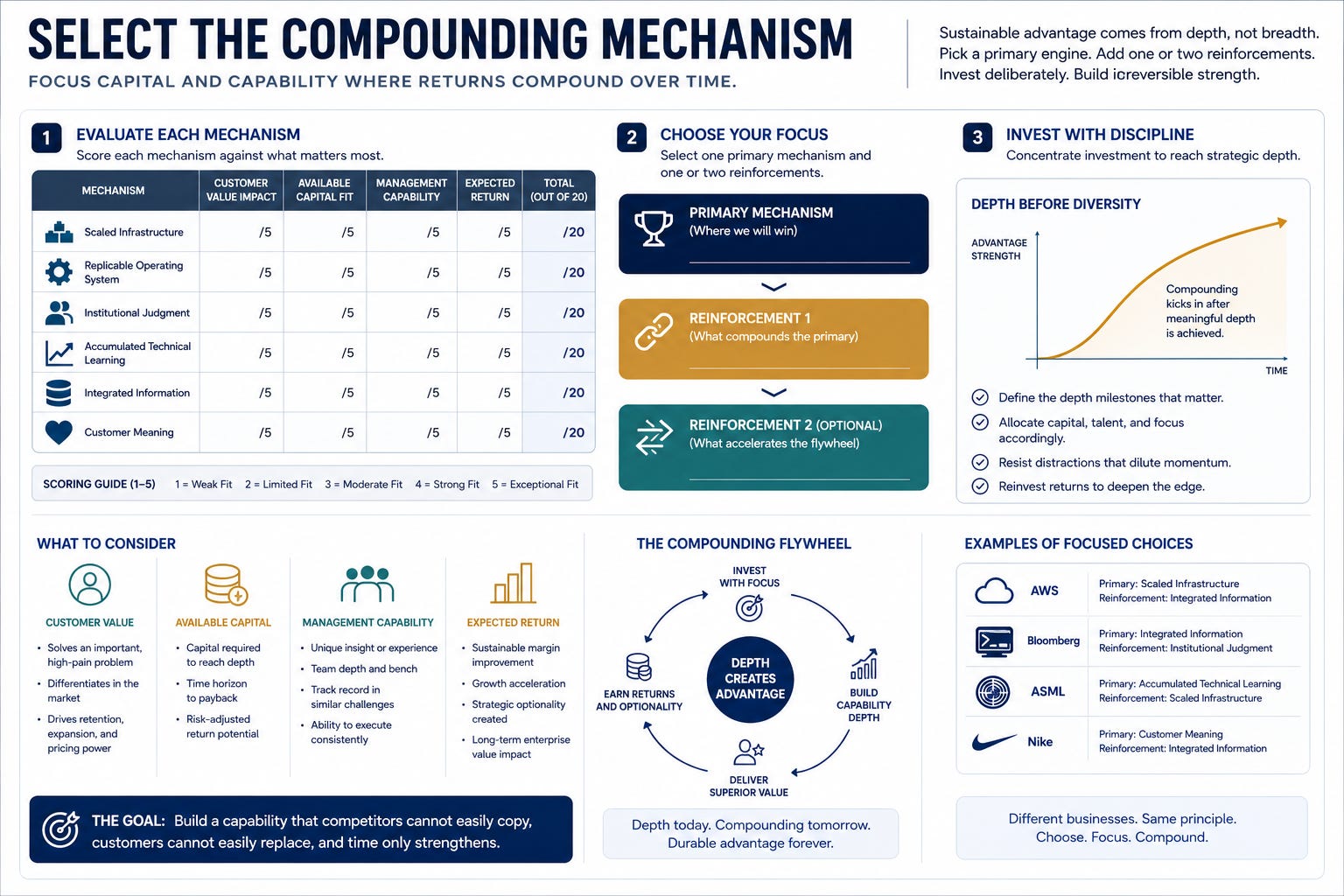
Choose one primary mechanism and one or two reinforcements based on customer value, available capital, management capability, and expected return.
Concentrate investment until those capabilities reach meaningful strategic depth.
3. Map concentrated dependencies
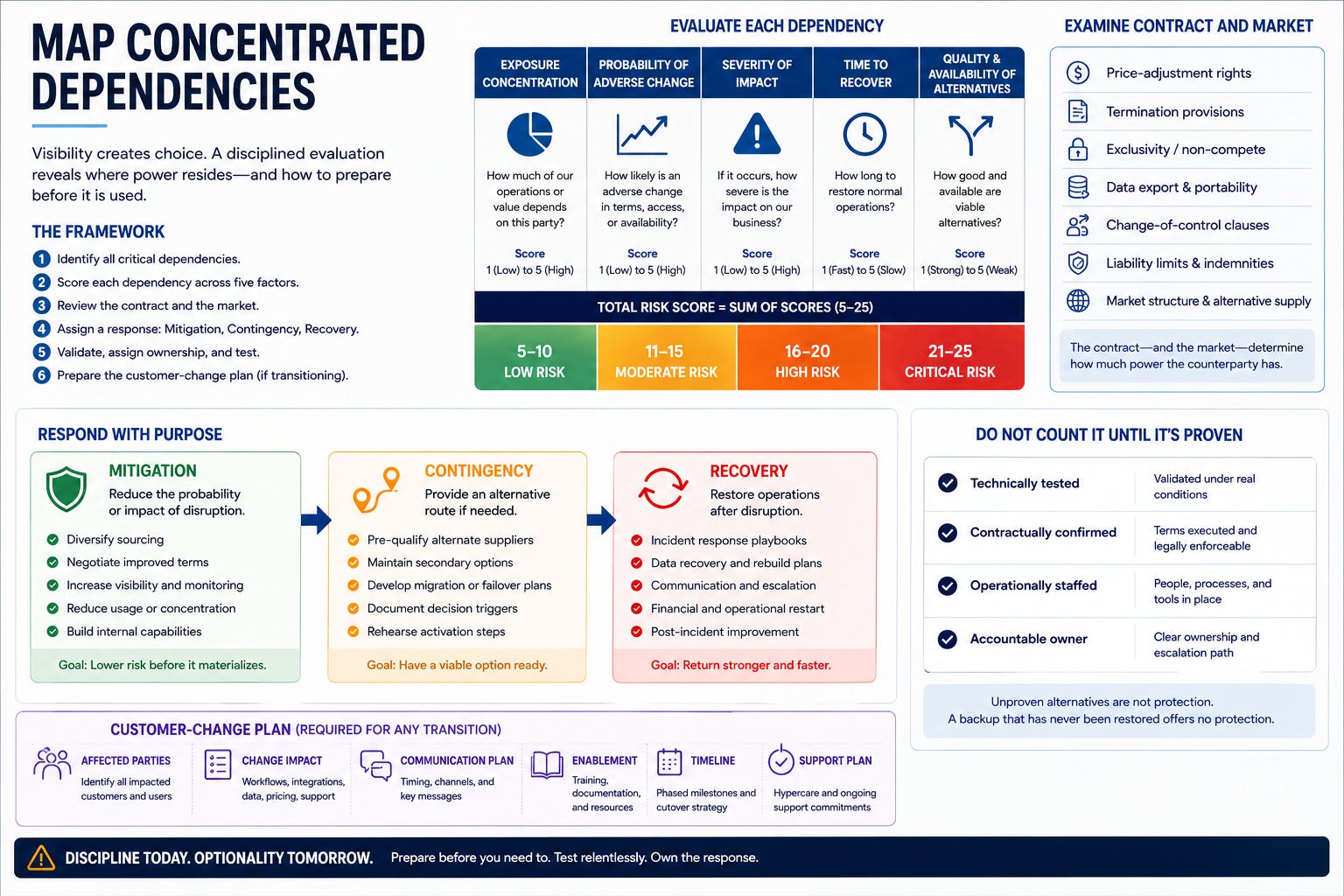
Evaluate each dependency by:
Exposure concentration
Probability of adverse change
Severity of impact
Time to recover
Quality and availability of alternatives
Examine the contract as well as the market. Price-adjustment rights, termination provisions, exclusivity, data export, change-of-control clauses, and liability limits may determine how much power a counterparty actually possesses.
Separate the response into three categories:
Mitigation: reduces the probability or impact of disruption.
Contingency: provides an alternative route.
Recovery: restores operations after disruption.
Do not count an alternative as protection until it has been technically tested, contractually confirmed, operationally staffed, and assigned to an accountable owner.
A backup that has never been restored offers no protection. Neither is an unqualified secondary supplier, nor is an untested migration plan, nor is a financing alternative that has gone undiscussed.
Any transition that alters customer workflows, integrations, data access, pricing, or support also requires a customer-change plan before execution begins.
4. Shorten the learning loop
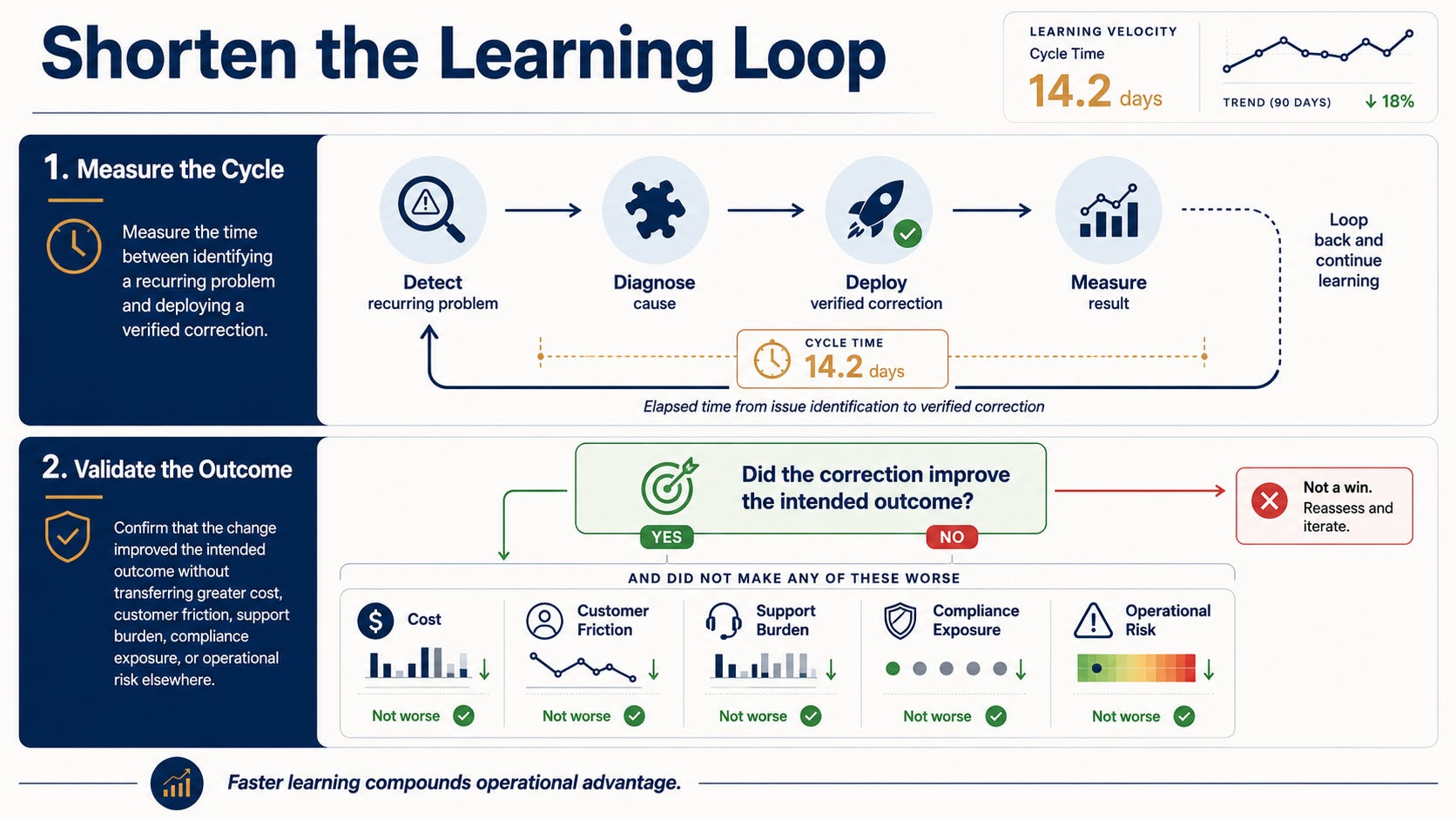
Measure the time between identifying a recurring problem and deploying a verified correction.
Confirm that the change improved the intended outcome without transferring greater cost, customer friction, support burden, compliance exposure, or operational risk elsewhere.
5. Align the economic model
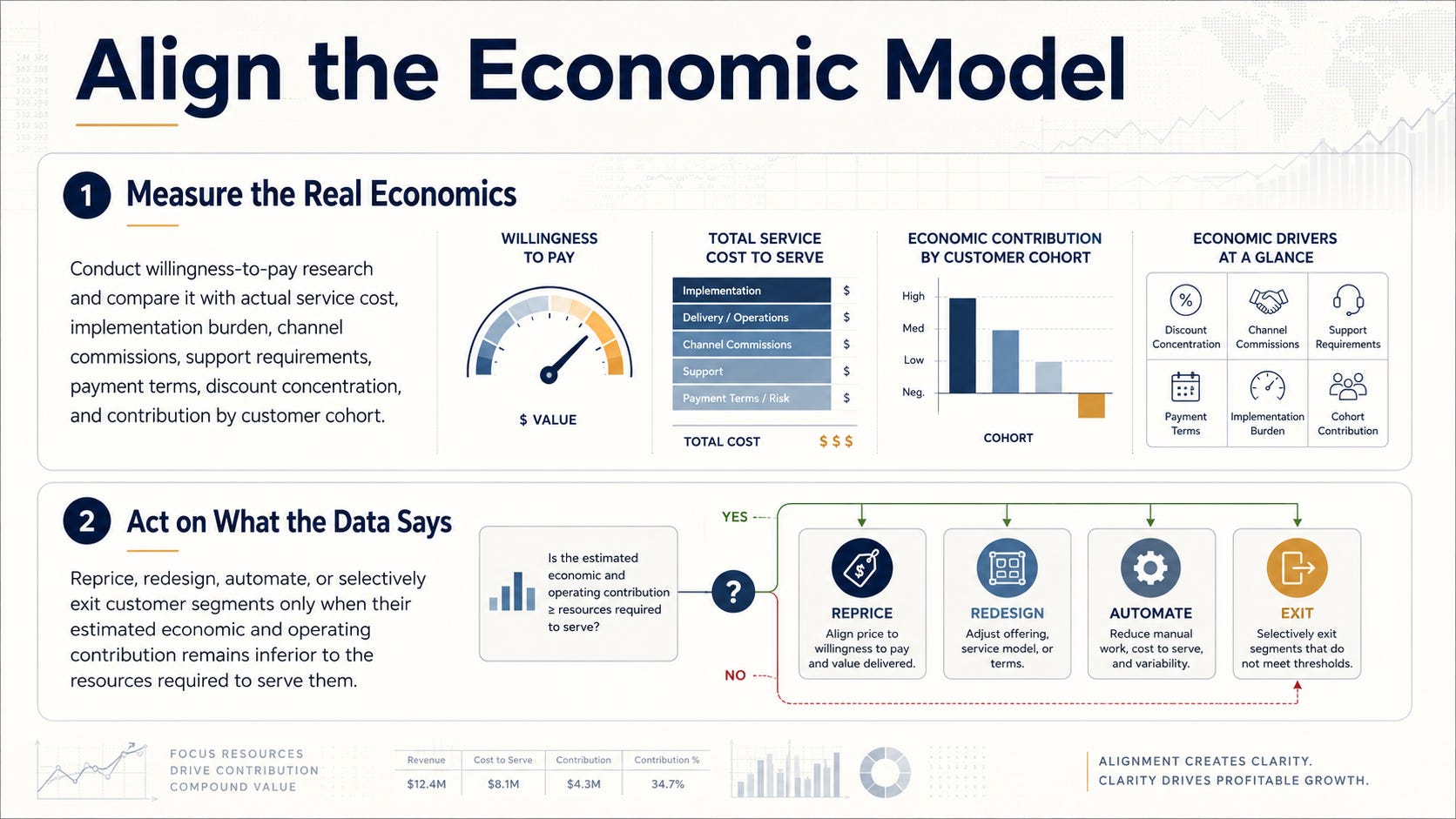
Conduct willingness-to-pay research and compare it with actual service cost, implementation burden, channel commissions, support requirements, payment terms, discount concentration, and contribution by customer cohort.
Reprice, redesign, automate, or selectively exit customer segments only when their estimated economic and operating contribution remains inferior to the resources required to serve them.
6. Institutionalize the advantage
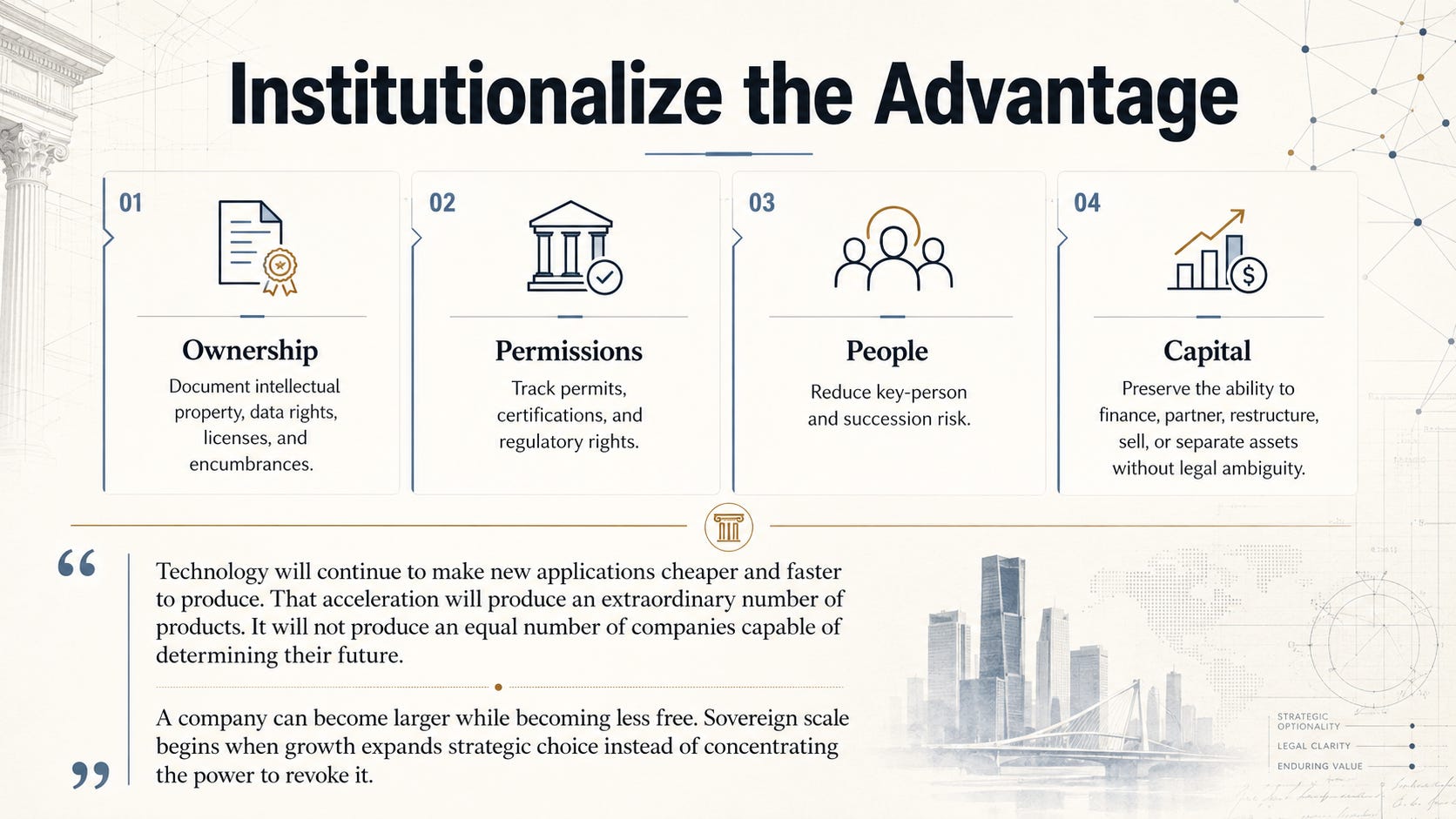
Ownership: Document intellectual property, data rights, licenses, and encumbrances.
Permissions: Track permits, certifications, and regulatory rights.
People: Reduce key-person and succession risk.
Capital: Preserve the ability to finance, partner, restructure, sell, or separate assets without legal ambiguity.
Technology will continue to make new applications cheaper and faster to produce. That acceleration will produce an extraordinary number of products. It will not produce an equal number of companies capable of determining their future.
A company can become larger while becoming less free. Sovereign scale begins when growth expands strategic choice instead of concentrating the power to revoke it.
Ken, I couldn’t agree more.
Three decades of building and launching products has taught me one thing. Products can be copied. Features can be copied. Even pricing can be copied.
What can’t be copied is the years spent understanding the customer, the countless failures that taught you what actually matters, and the position you’ve earned by solving real problems consistently.
It’s one of the reasons Infortum isn’t just a smart card or another fintech app. The card is only the visible piece. The position is built around helping people save money, send money, spend smarter, and giving them ownership of their own data. That’s a much harder thing to replicate than a feature list.
The companies that last don’t win because they built something first. They win because they built something people trust.
Excellent read, Ken.