

The Recovery Economy
Why the Next Decade Will Be Won by the Fastest Learners

As the half-life of competitive advantage collapses, adaptation is replacing scale as the defining capability of successful organizations.
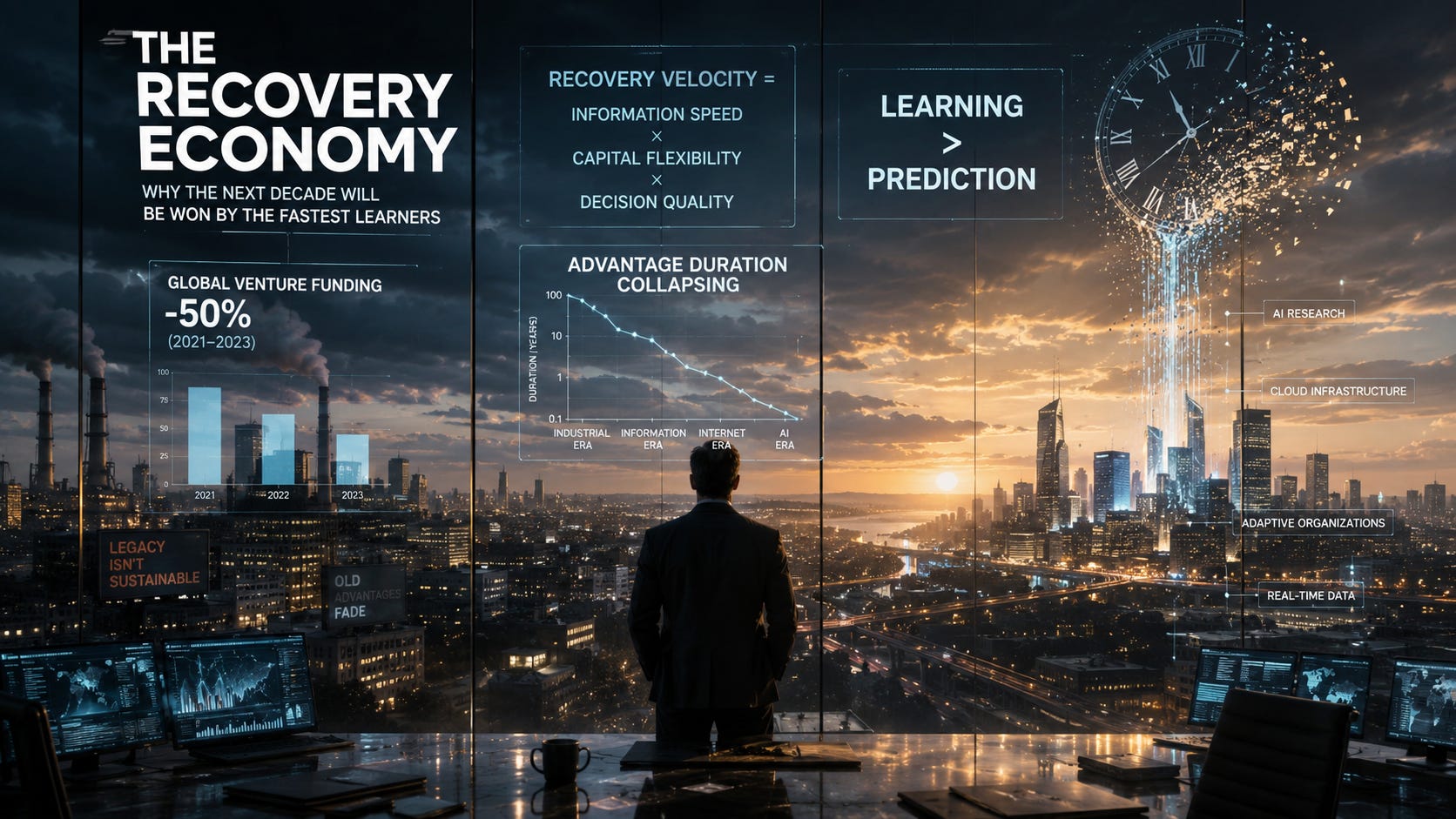
Why This Matters Now - For most of the last fifteen years, companies could afford to be wrong. Capital was cheap, investors rewarded growth over discipline, and profound operational mistakes could easily be covered with another funding round.
That world no longer exists. Today, runway is no longer just a financial metric: it is the exact amount of time an organization has to learn. Cash buys time; learning determines what you do with it. In an era defined by permanent volatility, the central economic question of the next decade is no longer “Who can scale fastest?” It is “Who can recover fastest?”
The Subsidized Margin for Error
During the height of the cheap-money era, scaling an enterprise looked remarkably uniform. Access to abundant, low-cost capital created a corporate culture that actively subsidized inefficiency. Founders were consistently told to capture market share at all costs, operating under the assumption that sustainable unit economics could be engineered later.
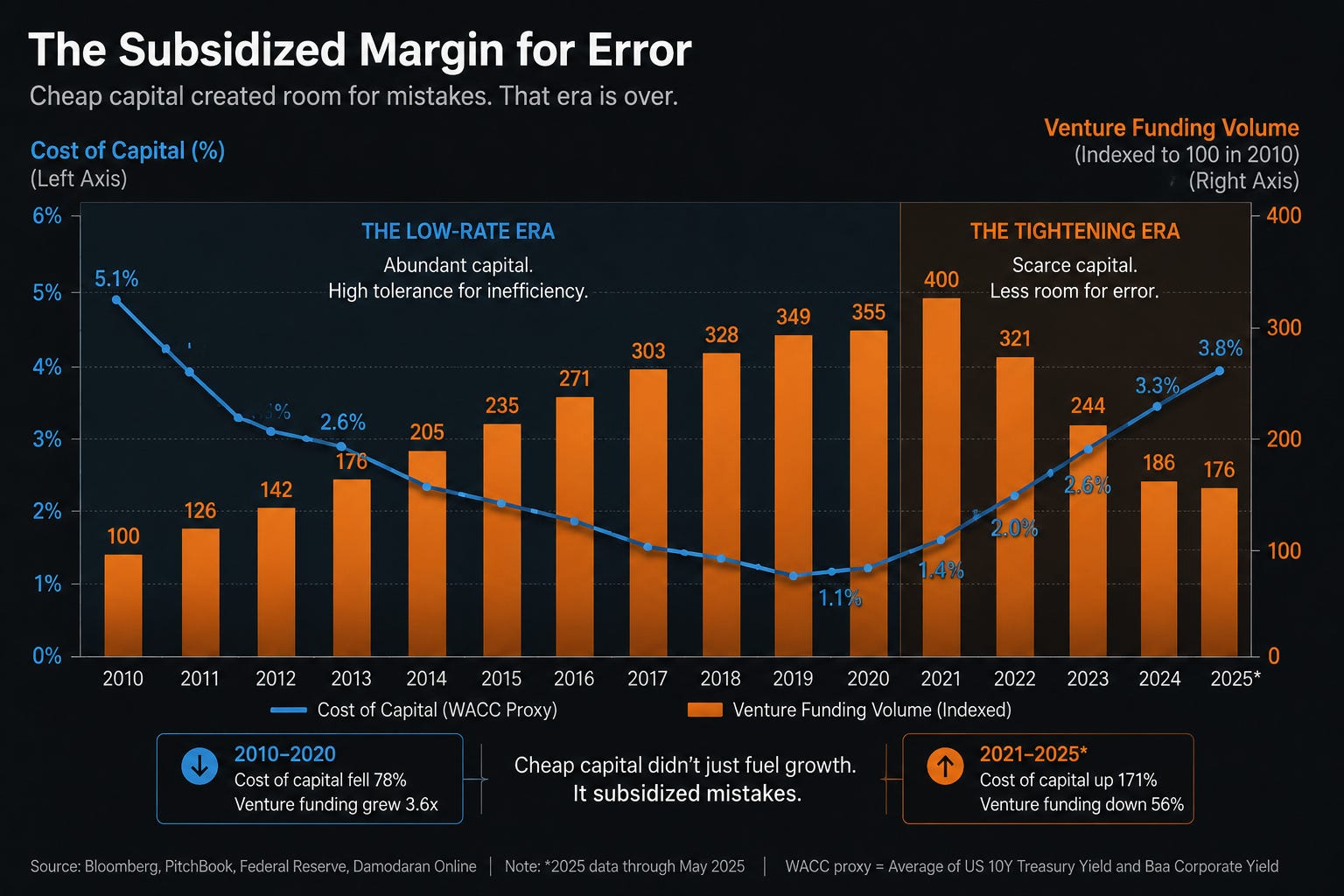
In that environment, major strategic blunders were treated as minor inconveniences. If a product launch failed, a marketing campaign flopped, or an entire geographic expansion stalled, the corporate balance sheet rarely suffered long-term damage. A fresh injection of venture capital or a low-interest credit line would inevitably arrive to absorb the impact. Panic wastes time, but abundant capital allowed founders to hide that panic behind a spreadsheet.
This abundance of capital distorted the true meaning of corporate resilience. True resilience was frequently confused with stubbornness: the financial capacity to keep funding a broken business model long after the market had rejected it. Companies romanticized the idea of “staying the course,” misinterpreting investor-backed survival as genuine product-market fit.
Scale was widely viewed as the ultimate corporate shield. The prevailing belief was that if an organization grew large enough, it would achieve a level of market safety that was impervious to localized failures. This mental model created massive, rigid corporate structures designed to defend existing territory rather than adapt to new information.
The Death of Strategic Certainty
For over a century, traditional business planning rested on a foundational assumption: that markets, regulations, and consumer behaviors would remain stable long enough to execute a multi-year strategy. Organizations spent months crafting immaculate five-year forecasts, treating them as immutable blueprints for capital deployment.
Today, that assumption has entirely collapsed. We have entered an era where prediction is no longer a viable competitive strategy. The corporate environment has entered a state of permanent instability driven by a compounding convergence of forces: accelerated artificial intelligence implementation, fragmented global supply chains, regulatory shifts, and compressed product lifecycles. Markets do not wait for alignment meetings.
The single biggest reason why start-ups succeed | Bill Gross
In this landscape, certainty has become an expensive luxury. When the baseline parameters of an industry can shift overnight, a rigid adherence to a long-term forecast is no longer disciplined: it is dangerous. The average company still behaves as if information is scarce and capital is abundant. They protect old data and burn through cash trying to force their original assumptions to be right.
The reality is the exact opposite. Information is abundant; capital is scarce. Most corporate management systems have simply not caught up to this inversion.
Markets rarely kill companies with surprises. They usually kill companies with truths those companies refuse to accept. The primary corporate villain is no longer an aggressive competitor or a lack of market demand. The true villain is internal inertia: the committees, approvals, reporting layers, and decision paralysis that delay organizational reaction speed. Bureaucracy wastes far more than capital. Most companies do not die because markets move too quickly; they die because decisions move too slowly.
The Half-Life of Advantage
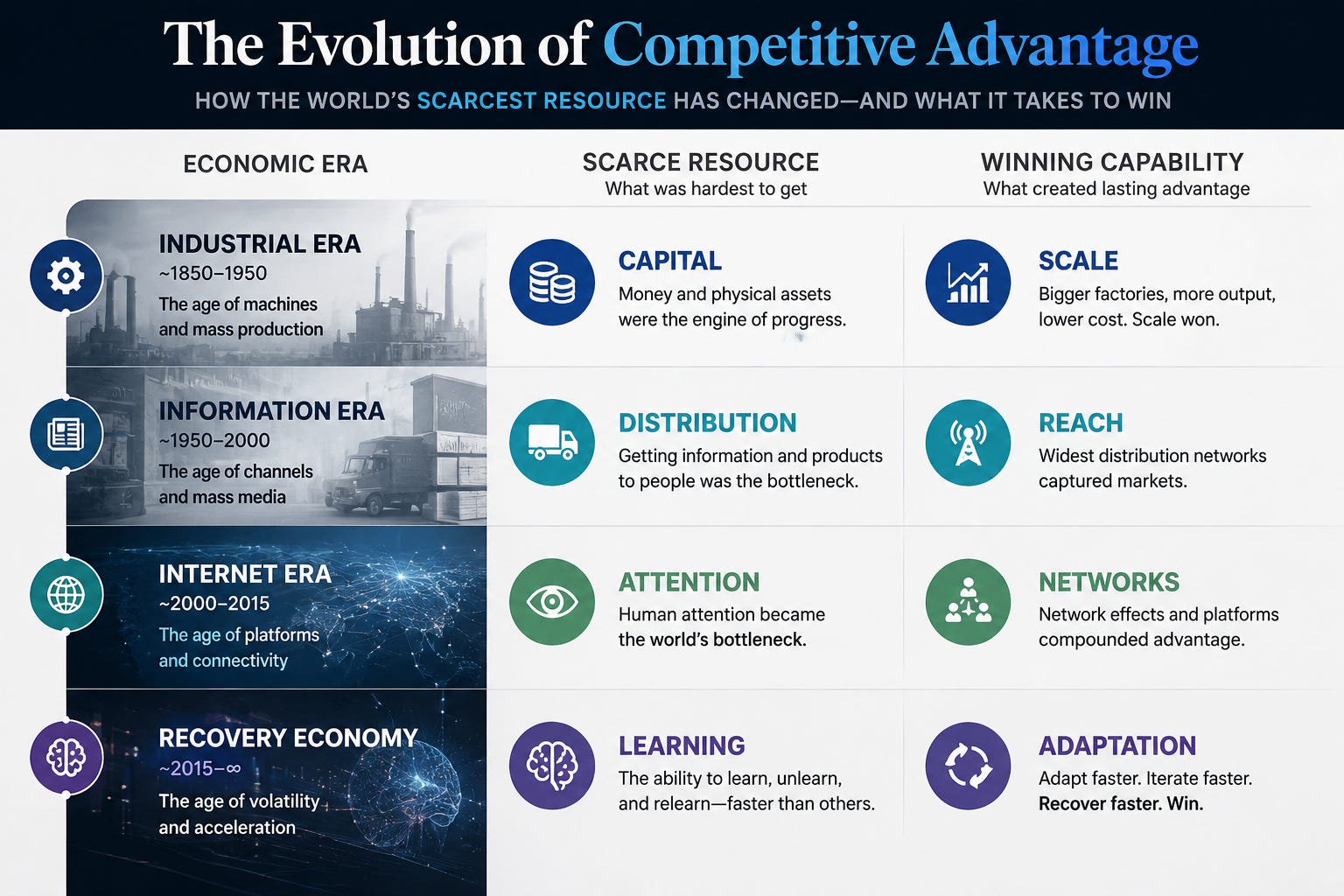
To understand why traditional scale no longer guarantees safety, we must evaluate a fundamental shift in how enterprise value is generated and sustained. To map this transition, we look at the historical progression of competitive advantage:
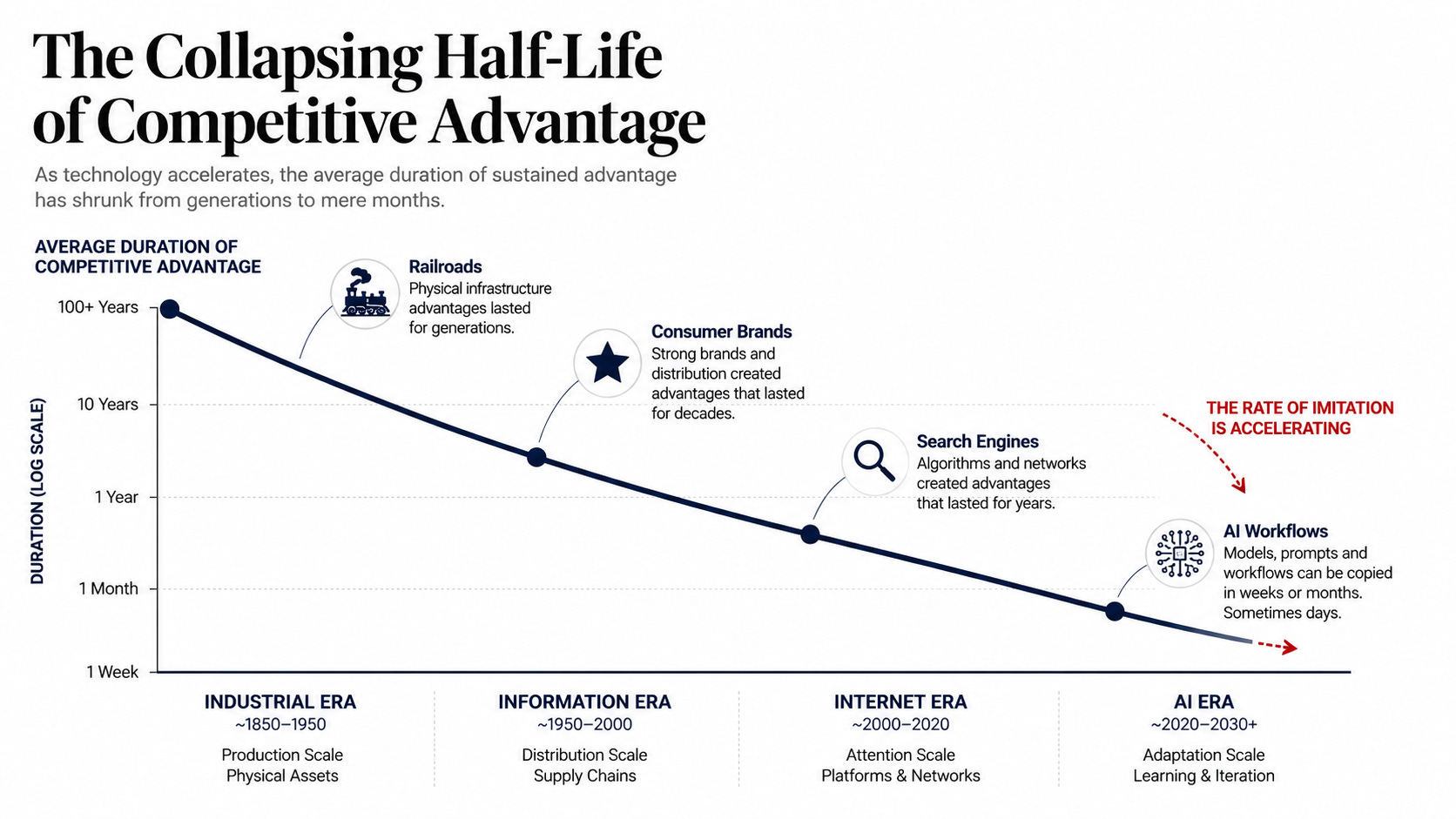
The Industrial Era: Advantage was driven by Production (Physical scale and heavy infrastructure).
The Information Era: Advantage was driven by Distribution (Logistics and supply networks).
The Internet Era: Advantage was driven by Attention (Network effects and platform dominance).
The AI Era: Advantage is driven by Adaptation (Recovery velocity and iteration speed).
The defining characteristic of this progression is that the half-life of a business advantage is collapsing. Historically, the economic value of an advantage could be understood through a simple system:
Advantage Value=Advantage Strength×Advantage Duration
Most companies obsess over strength, focusing entirely on how dominant an idea is today. Few obsess over duration. Yet duration is collapsing across every sector.
A century ago, physical assets like railroads, oil fields, and massive manufacturing plants created structural advantages that could last generations. Later, consumer brands, global distribution networks, and retail footprints yielded advantages that lasted decades. In the internet era, proprietary software, search algorithms, and social networks created edges that lasted years.
Today, in the AI era, software prompts, specific product features, and workflow innovations can be copied in weeks, if not days. In some AI-enabled categories, an advantage can now shrink from years to months, or even weeks. Artificial intelligence accelerates this trend because it compresses the time between innovation and imitation. Capabilities that once required years of engineering effort can now be replicated, modified, and distributed at unprecedented speed. As imitation becomes cheaper, adaptation becomes more valuable.

The challenge is not that advantages disappear. Advantages have always disappeared. The challenge is that they disappear faster than the management systems designed to protect them. Many organizations are optimized to defend an advantage after its economic value has already begun to decay.
When the lifespan of any competitive edge shrinks toward zero, attempting to optimize a static advantage becomes a losing proposition. When advantages expire faster, recovery velocity becomes more valuable than static optimization. In a world of accelerating change, adaptability compounds while certainty depreciates. The future belongs to companies that are wrong more often, provided they possess the structural agility to correct their course faster than anyone else.
The Recovery Economy and the Velocity Equation
The evidence increasingly suggests we are entering what might be called The Recovery Economy. In this new paradigm, the central economic question is no longer “Who can scale fastest?” It is “Who can recover fastest?” True economic dominance belongs to the organizations that can absorb an unexpected shock, extract the underlying data, and instantly reallocate their resources.
This shift favors startups as much as incumbents. Recovery velocity allows small organizations to weaponize speed against scale, completely bypassing the bureaucratic hurdles that paralyze massive competitors. Every business eventually becomes a recovery business. Industries as different as cloud computing, semiconductors, consumer software, and biotechnology also show the same pattern.
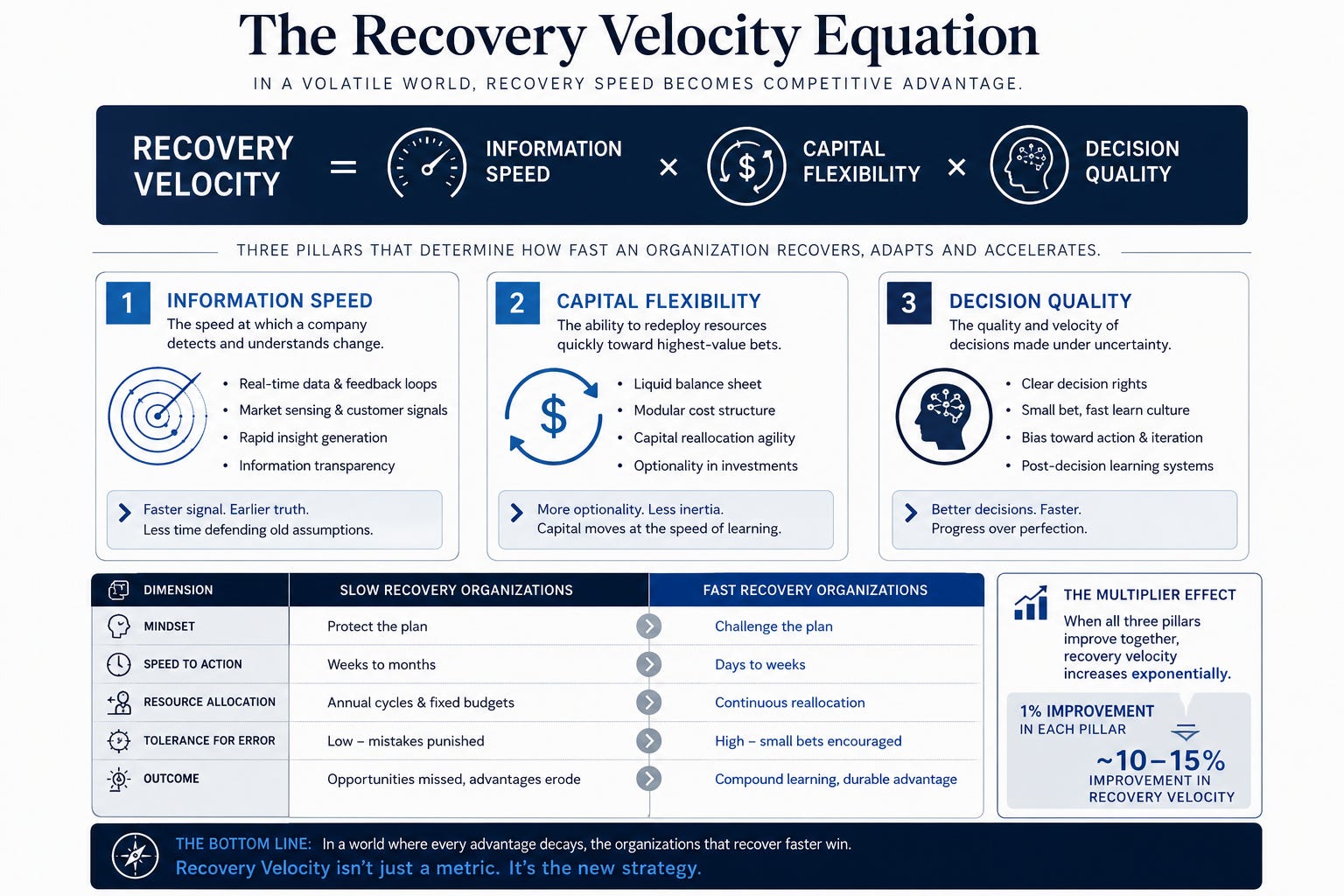
To operate successfully in this landscape, leaders must transition from vague notions of corporate flexibility to a precise operational framework:
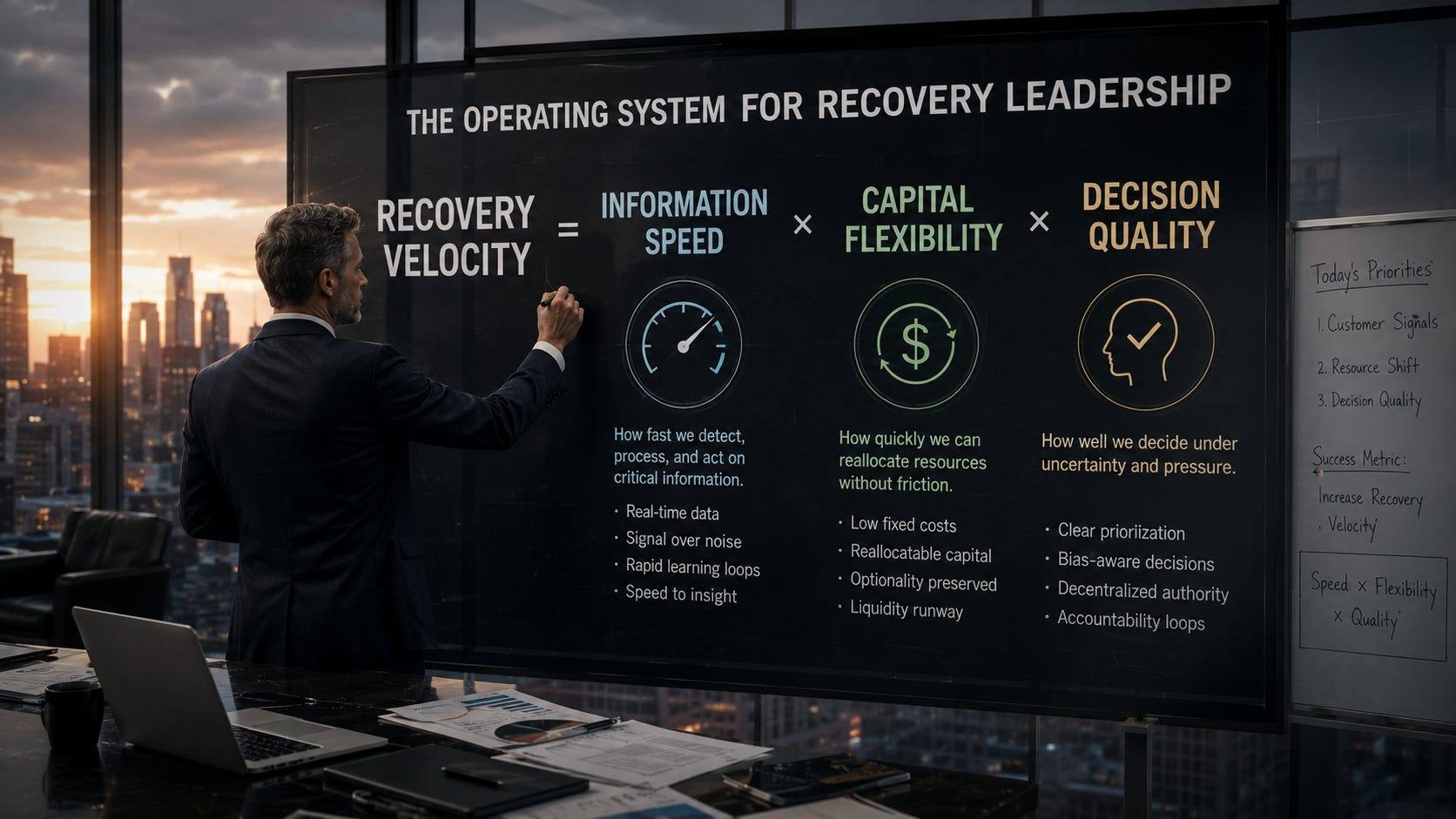
Recovery Velocity=Information Speed×Capital Flexibility×Decision Quality
This equation demonstrates that recovery speed is a structural capability. If an organization processes market information instantly but possesses rigid capital commitments, its recovery velocity is zero. Conversely, if it has abundant cash but cannot process information without a six-month committee review, it faces swift irrelevance.
How to Create Change | Simon Sinek
The Four Stages of Recovery
To systematically optimize this velocity, an enterprise must move through The Four Stages of Recovery:
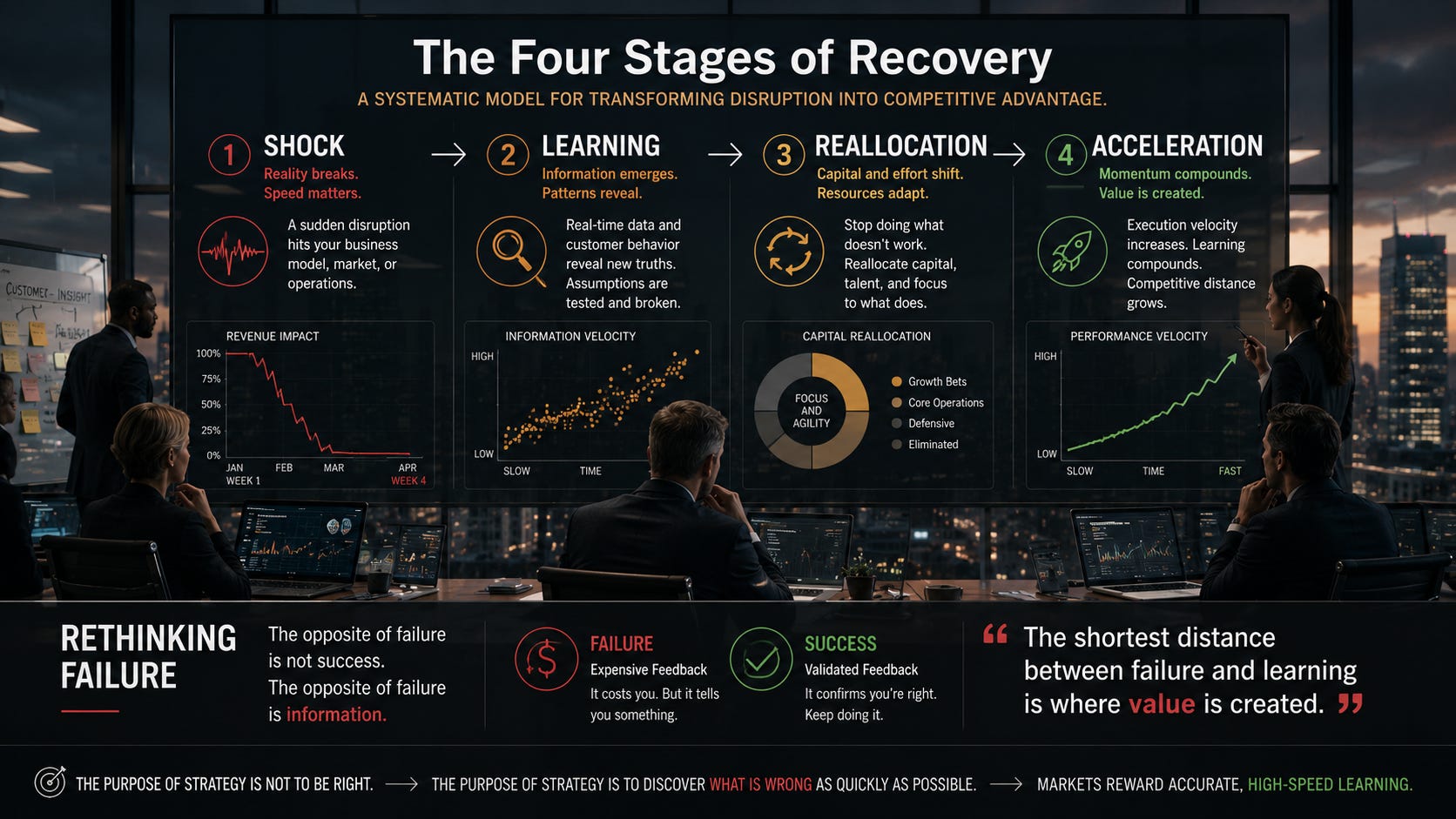
Shock⟶Learning⟶Reallocation⟶Acceleration
This model requires a complete reassessment of failure itself. The opposite of failure is not success. The opposite of failure is information. Failure is expensive feedback; success is validated feedback. Success is simply what happens when enough useful information accumulates and is instantly converted into execution. The shortest distance between failure and learning is where value is created.
The purpose of strategy is not to be right. The purpose of strategy is to discover what is wrong as quickly as possible. Markets do not reward institutional certainty; they reward accurate, high-speed learning.
The Airbnb Test
The human cost of an adaptive failure is brutal. Somewhere in March 2020, thousands of Airbnb hosts opened their dashboards and watched reservations disappear in real time. For many, years of predictable income vanished in a matter of days.
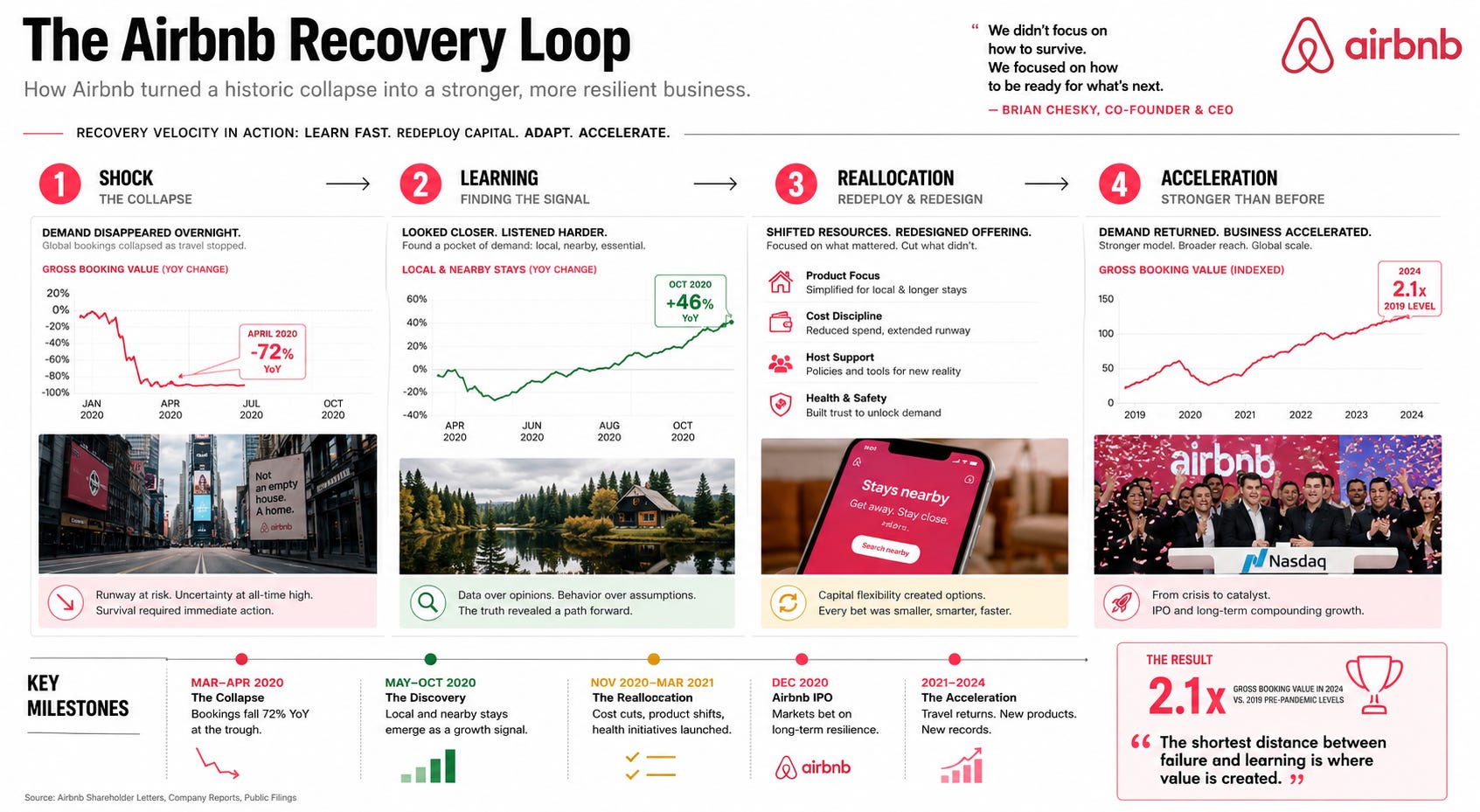
According to internal reports and shareholder letters, Airbnb’s gross bookings plummeted by 72% in April 2020 as worldwide borders closed. Valuation models evaporated, and the founders were forced to halt their highly anticipated IPO plans.
For a traditional, scale-dependent hospitality organization, a shock of this magnitude would be fatal. But Airbnb’s response provides a definitive proof point for the mechanics of high-velocity recovery under extreme constraint, mapping directly across the four stages:
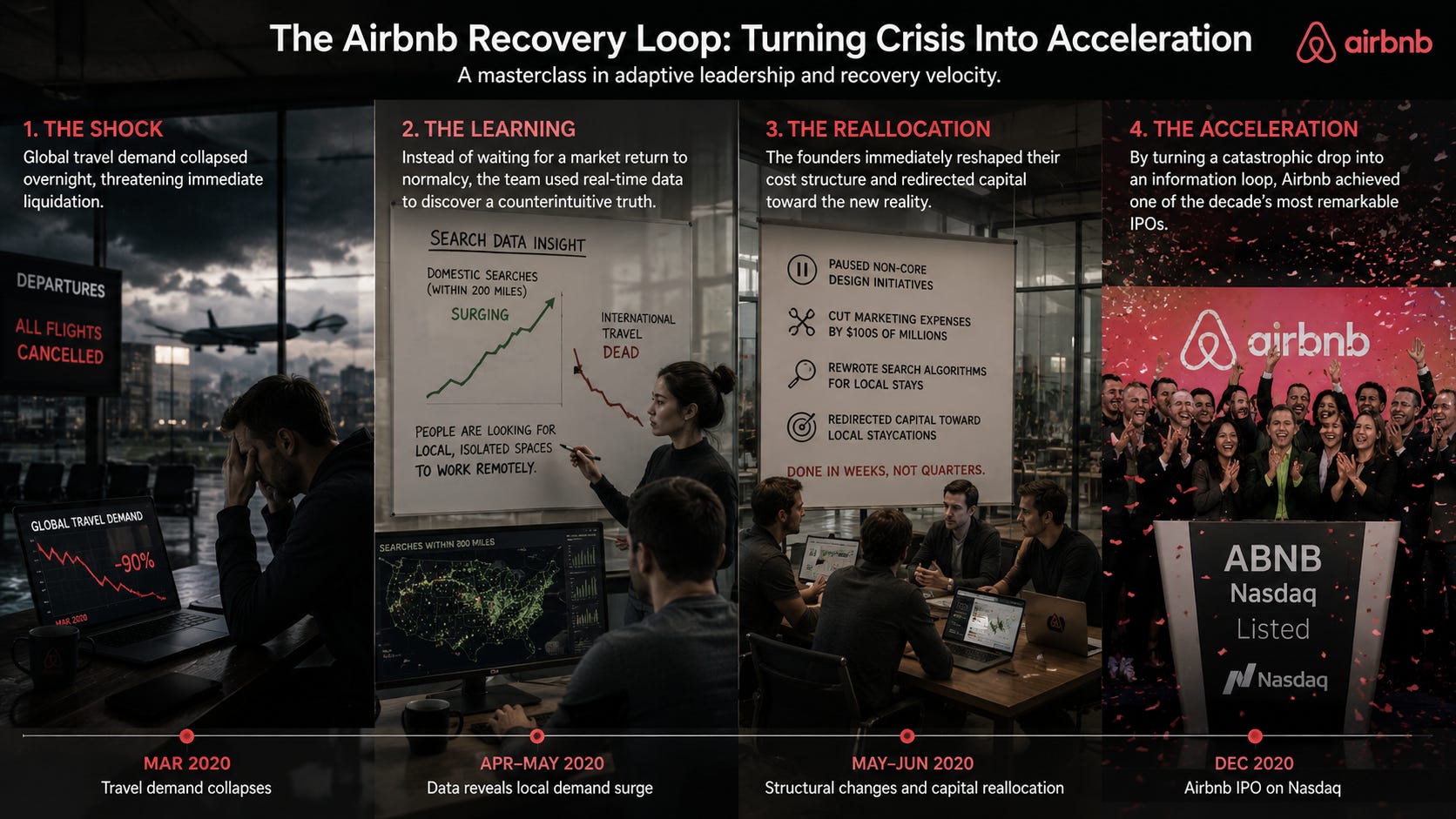
The Shock: Global travel demand collapsed overnight, threatening immediate liquidation.
The Learning: Instead of waiting for a market return to normalcy, the leadership team compressed their data processing cycles. Real-time search data revealed a counterintuitive customer trend: while international travel was dead, domestic searches for homes within a 200-mile driving radius of major cities were surging. People were desperately seeking local, isolated spaces to work remotely.
The Reallocation: The founders made their cost structure immediately flexible. They paused non-core design initiatives, cut marketing expenses by hundreds of millions of dollars, and completely rewrote their search algorithms to prioritize local staycations. They redirected their remaining capital toward this new reality within weeks.
The Acceleration: By treating the catastrophic revenue drop as an information loop, the founders proved that their ultimate asset was not their scale, but their adaptive capacity. By the end of 2020, Airbnb successfully executed one of the most remarkable IPOs of that decade.
Structural Friction and the Failures of Inertia
Every business analysis suffers from survivorship bias. We study the legendary turnarounds because they survived, creating a false impression that any business can be rescued if the founder is simply stubborn enough. We remember the successful adaptations while forgetting the hundreds of structural pivots that resulted in total liquidation.
Why Great Businesses Fail
The hardest part of adaptation is knowing what not to change. Great operators preserve the exact components of a business that create value while aggressively discarding everything else. When an organization fails to move through the stages of recovery, it faces systemic irrelevance.
Consider the trajectory of Kodak. The tragedy is that Kodak correctly identified the future and its engineers invented the core digital camera technology decades before it became a consumer standard. Its failure was organizational, not technological; it simply could not leave the past. Kodak failed because its leadership could not move past its high-margin film business model. They spent years attempting to protect a legacy infrastructure, treating digital experimentation as a minor side project rather than a fundamental pivot.
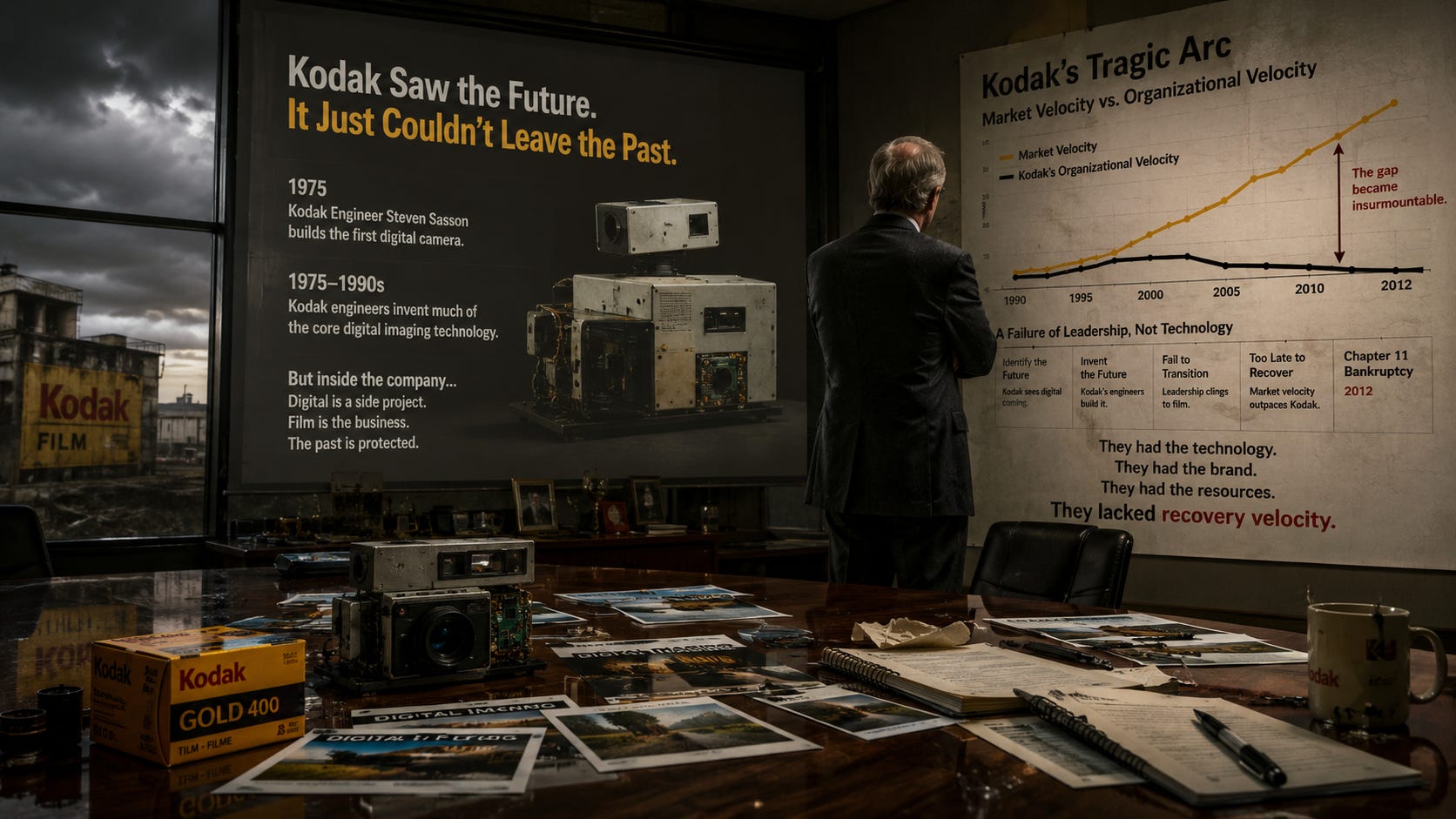
By the time Kodak attempted to reallocate capital toward digital imaging, the market velocity had outpaced its capacity to recover, resulting in a historic Chapter 11 bankruptcy filing that left the company radically diminished. Companies like Kodak, Nokia, and Blockbuster did not lack resources, scale, or brand equity. They lacked recovery velocity. They could not convert new information into new behavior quickly enough to match the environment.
Most failed recoveries are not caused by analytical failures. They are caused by fear and ego. Fear delays decisions, protects legacy operations, and convinces leaders to defend yesterday’s assumptions.
From an investor perspective, this structural flexibility is the ultimate metric of long-term value. High-performing founders often have shorter error-correction cycles than those with the best forecasts. When institutional allocators describe a founder as coachable, they are measuring adaptation speed. They are assessing how quickly a leadership team can absorb a corrective data point from the market, strip away emotional attachment to a failed thesis, and realign their resources.
The Learning Machine
This shift fundamentally redefines the purpose of modern enterprise. The factory was the defining institution of the Industrial Era, optimized for transforming raw materials into physical products at scale. The learning machine may become the defining institution of the AI Era. Modern companies no longer exist merely to produce goods and services; they exist to transform uncertainty into decisions. The faster they perform that conversion, the more valuable they become.
Every market cycle eventually punishes yesterday’s strengths. The corporate structures built for scale and territory defense are structurally mismatched with an environment characterized by permanent volatility. To survive, organizations must transition through the structural hierarchies of economic history:
The companies of the next decade will win because they are Recovery Companies. The future belongs to organizations that can change their minds faster than their competitors.
For more than a century, businesses have built themselves around prediction. Forecast demand. Forecast inventory. Forecast markets. Forecast growth. The assumption was simple: if you could predict the future accurately enough, you could control it. The modern economy is exposing the limits of that belief. The future is arriving too quickly. Technology changes faster, regulation changes faster, consumer behavior changes faster, and competitive advantages disappear faster.
In such an environment, prediction becomes less valuable. Recovery becomes more valuable. For most of modern business history, success belonged to those who could predict the future most accurately. The emerging economy rewards something different. The winners will not be the organizations that avoid mistakes but those that convert mistakes into learning faster than everyone else.
In a world where every advantage decays, recovery is the only advantage that compounds. Every business eventually becomes a recovery business.
Bonus Field Guide: The Monday Morning Agenda
To transition your leadership team from an infrastructure-heavy mindset to a high-velocity recovery model, substitute your standard status updates with these five diagnostic questions first thing Monday morning:
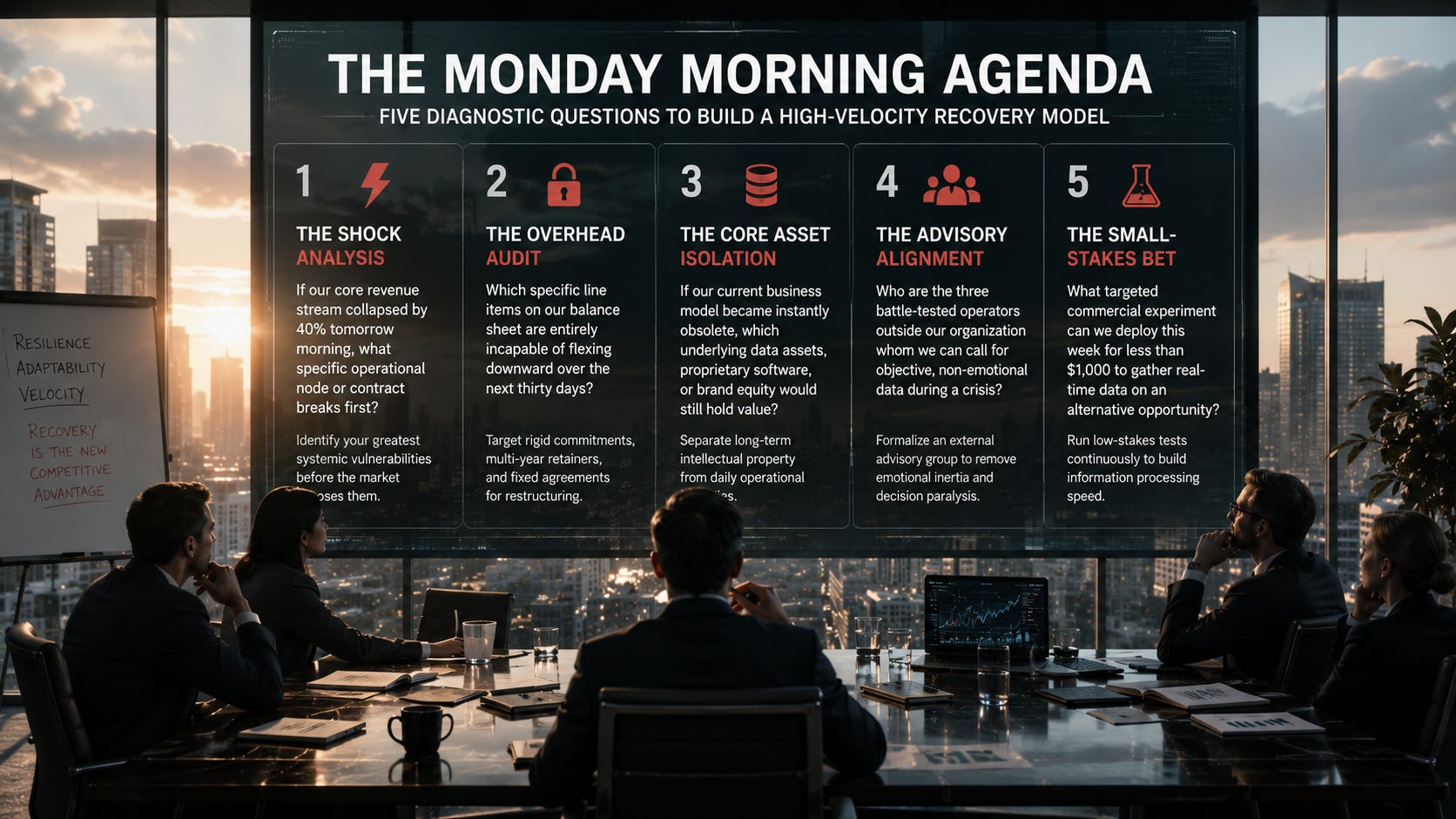
1. The Shock Analysis
If our core revenue stream collapsed by 40% tomorrow morning, what specific operational node or contract breaks first? Force the immediate identification of your greatest systemic vulnerabilities before the market exposes them for you.
2. The Overhead Audit
Which specific line items on our balance sheet are entirely incapable of flexing downward over the next thirty days? Pinpoint rigid real estate commitments, multi-year vendor retainers, and fixed agreements that must be targeted for performance-linked restructuring.
3. The Core Asset Isolation
If our current business model became instantly obsolete, which underlying data assets, proprietary software, or brand equity would still hold clear value? Create a strict boundary between your long-term intellectual property and your daily operational liabilities.
4. The Advisory Alignment
Who are the three battle-tested operators outside our organization whom we can call to receive objective, non-emotional data during a market crisis? Formalize an external advisory group to completely eliminate emotional inertia and decision paralysis from your strategy loop.
5. The Small-Stakes Bet
What targeted commercial experiment can our team deploy this week for less than $1,000 to gather real-time data on an alternative market opportunity? Initiate a continuous loop of low-stakes trialing to systematically build your organization’s information processing speed.