

The Silicon Valley Playbook
How AI Economics Are Decoupling Headcount from Scale

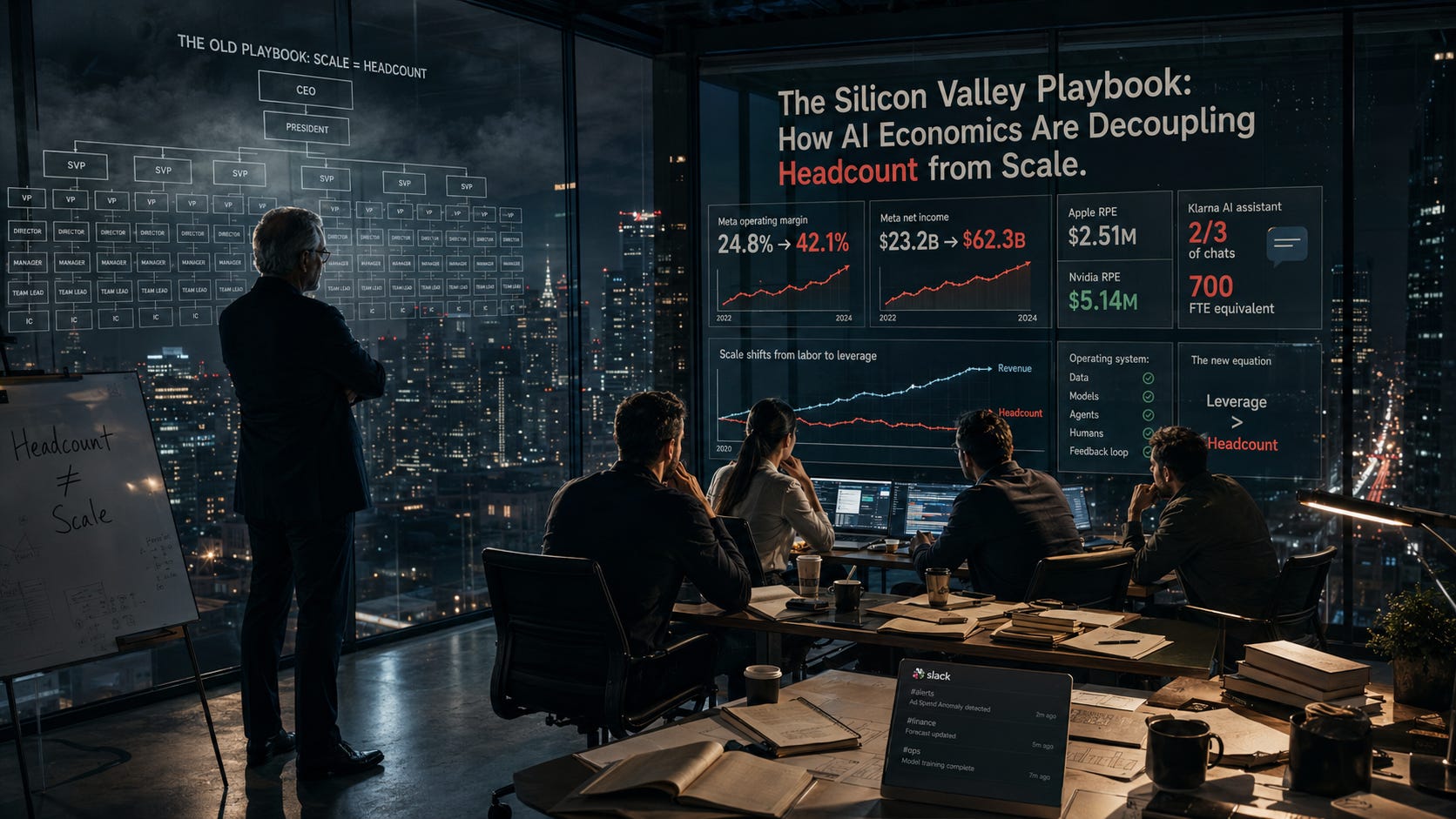
Why This Matters Now - For more than a century, business scale followed a simple rule: bigger usually won. More people meant more output. More layers meant more control. More capital meant more reach. That rule is beginning to fail.
The defining resource of the industrial age was labor. The defining resource of the AI age is leverage.
In late 2022, Meta Platforms Inc. initiated an operational shift that subverted this established corporate theory. When Meta announced tens of thousands of layoffs, many observers assumed the company was retreating. The opposite happened. Revenue recovered, operating margins expanded, and profits surged. According to Meta’s audited filings with the U.S. Securities and Exchange Commission, the company’s operating margin expanded from a cyclical low of 24.8% at the close of 2022 to 42.1% by the end of fiscal year 2024. Net income climbed from $23.2 billion to over $62.3 billion in the same period.
Meta’s turnaround was not caused by layoffs alone. It was heavily accelerated by a macro ad-market rebound and superior algorithmic ad-targeting tools. But the uncomfortable lesson was clear: corporate mass and output were no longer moving in lockstep. In Meta’s case, at least, bloat appeared to be restricting rather than supporting growth.
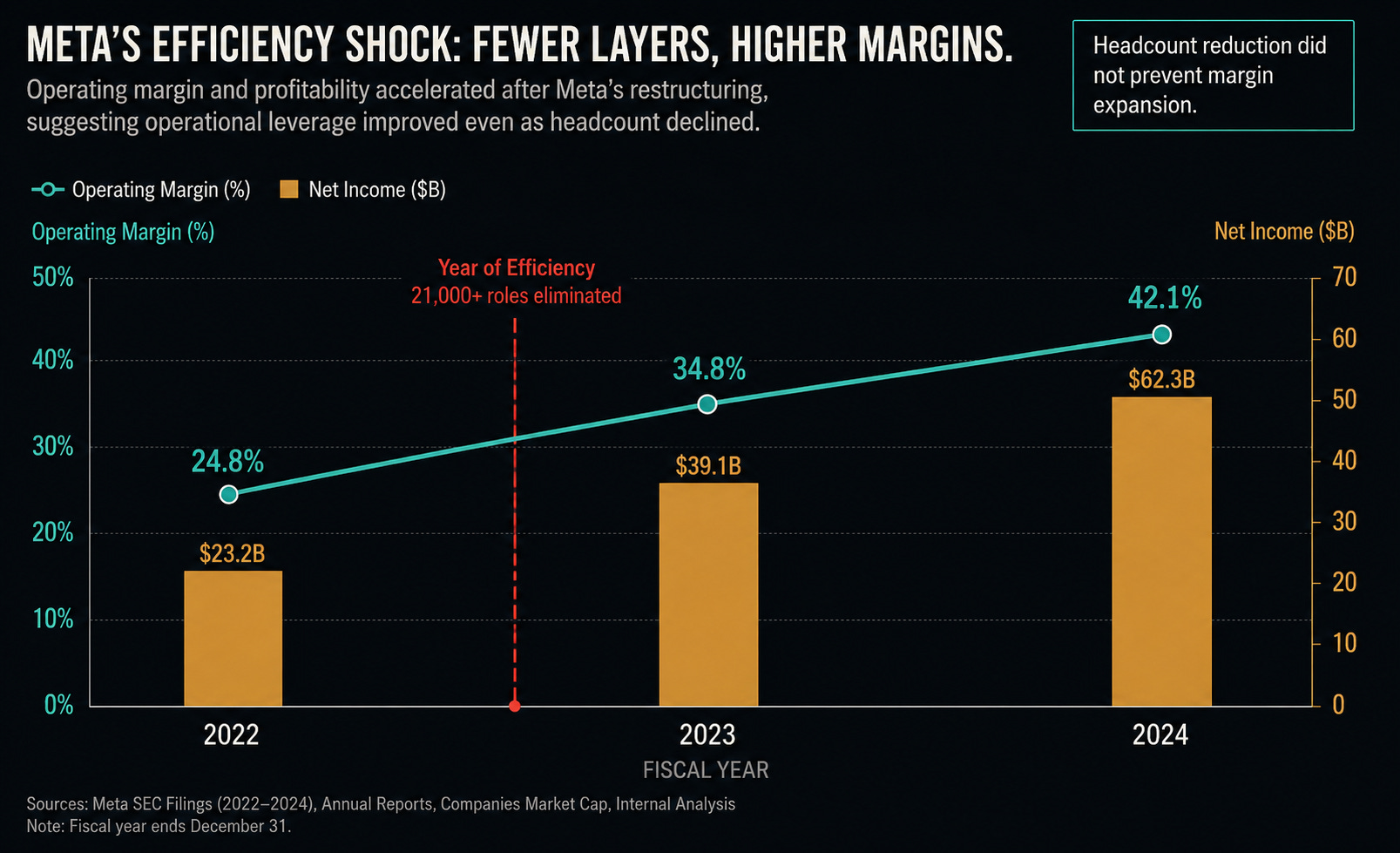
This shift is not a temporary reaction to a cyclical contraction in growth equity markets. A structural uncoupling is underway, reshaping the historical link between organizational scale and human mass. A company’s impact is no longer tied as tightly to the number of people on its payroll. The modern company is increasingly transforming from a labor engine into a coordination engine. In the machine intelligence era, scale is no longer measured in employees; it is measured in orchestration.
HBO’s Silicon Valley now reads less like satire than a warning. The fictional Pied Piper team’s slide from garage focus into corporate bloat mirrors a mistake real founders keep making: they confuse organizational size with organizational strength.
The question confronting the modern builder is no longer “How large can I grow my team?” but “How much leverage can I engineer per desk?”
The Macroeconomics of the Scale Inversion
The corporate restructuring observed at Meta represents a wider recalibration of the global technology and services sectors. Data compiled by Layoffs.fyi shows that the global tech industry shed more than 500,000 jobs between 2022 and 2024, followed by a renewed surge of over 180,000 documented cuts by mid-2026 as companies redirected spending toward efficiency, automation, and AI infrastructure.
Simultaneously, the venture capital ecosystem has undergone a qualitative transformation. CB Insights funding reports indicate that while aggregate global venture funding compressed by over 50% from its 2021 speculative peak, seed and Series A financing rounds for AI-native companies that maintained disciplined, targeted team structures remained resilient. Investors are no longer underwriting raw headcount expansion. They are hunting for capital efficiency.
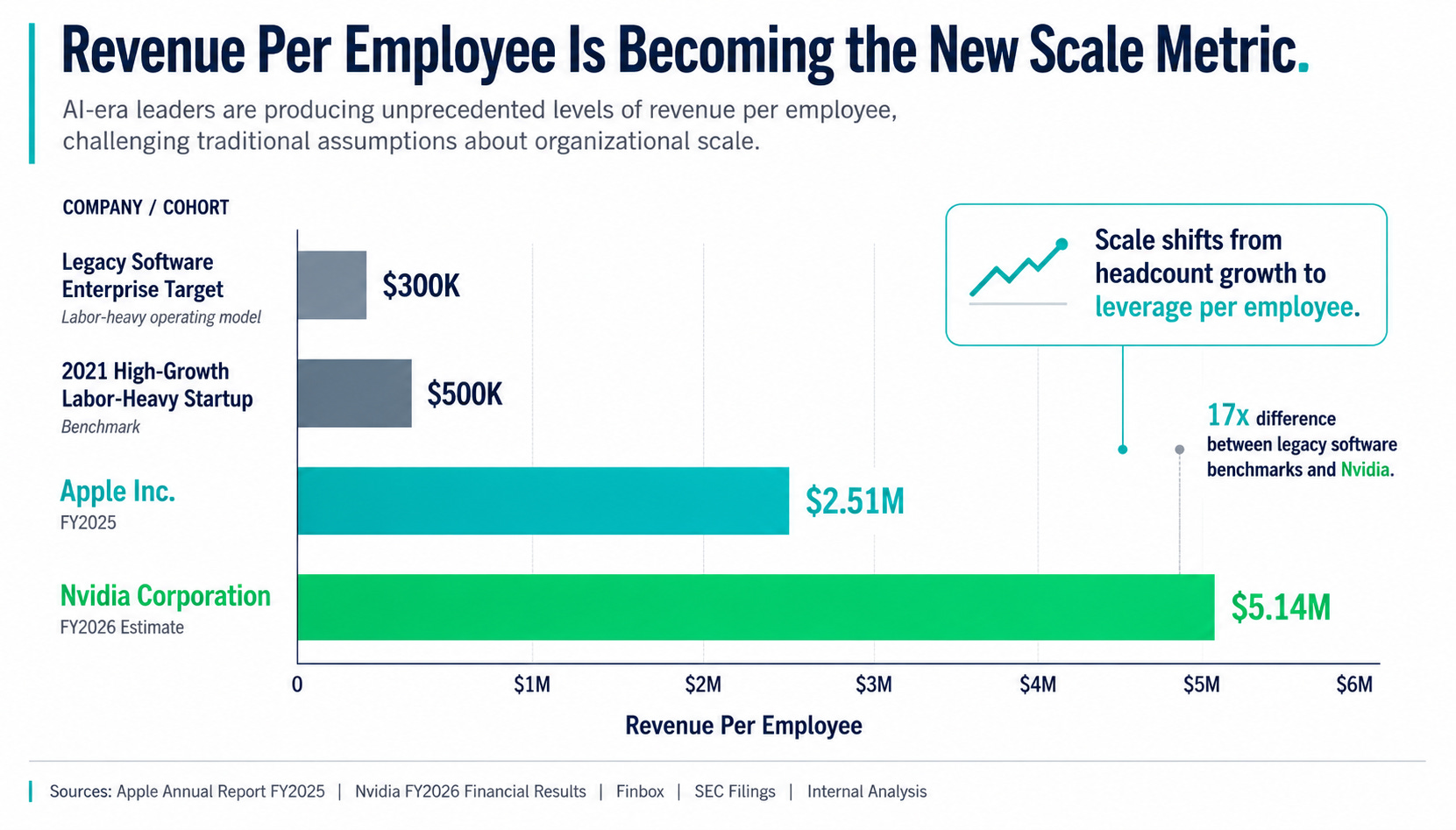
The ultimate metric of this new era is Revenue Per Employee. Today’s category leaders are resetting these economic baselines, achieving numbers that would have been difficult to sustain in a purely labor-driven model.
According to public financial data, Apple Inc.’s revenue per employee reached approximately $2.51 million in fiscal year 2025. Nvidia Corporation, by keeping its internal staff comparatively flat while dominating global computing demand, saw its fiscal year 2026 revenue per employee soar to an estimated $5.14 million based on record full-year revenues of $215.9 billion. When an organization can generate millions in revenue per employee, its cash flow dynamics change. Capital reserves are no longer consumed by internal alignment overhead and payroll drag. Growth becomes more self-sustaining, less dilutive, and more defensible.
Jensen Huang: NVIDIA - The $4 Trillion Company & the AI Revolution
The New Corporate Moat
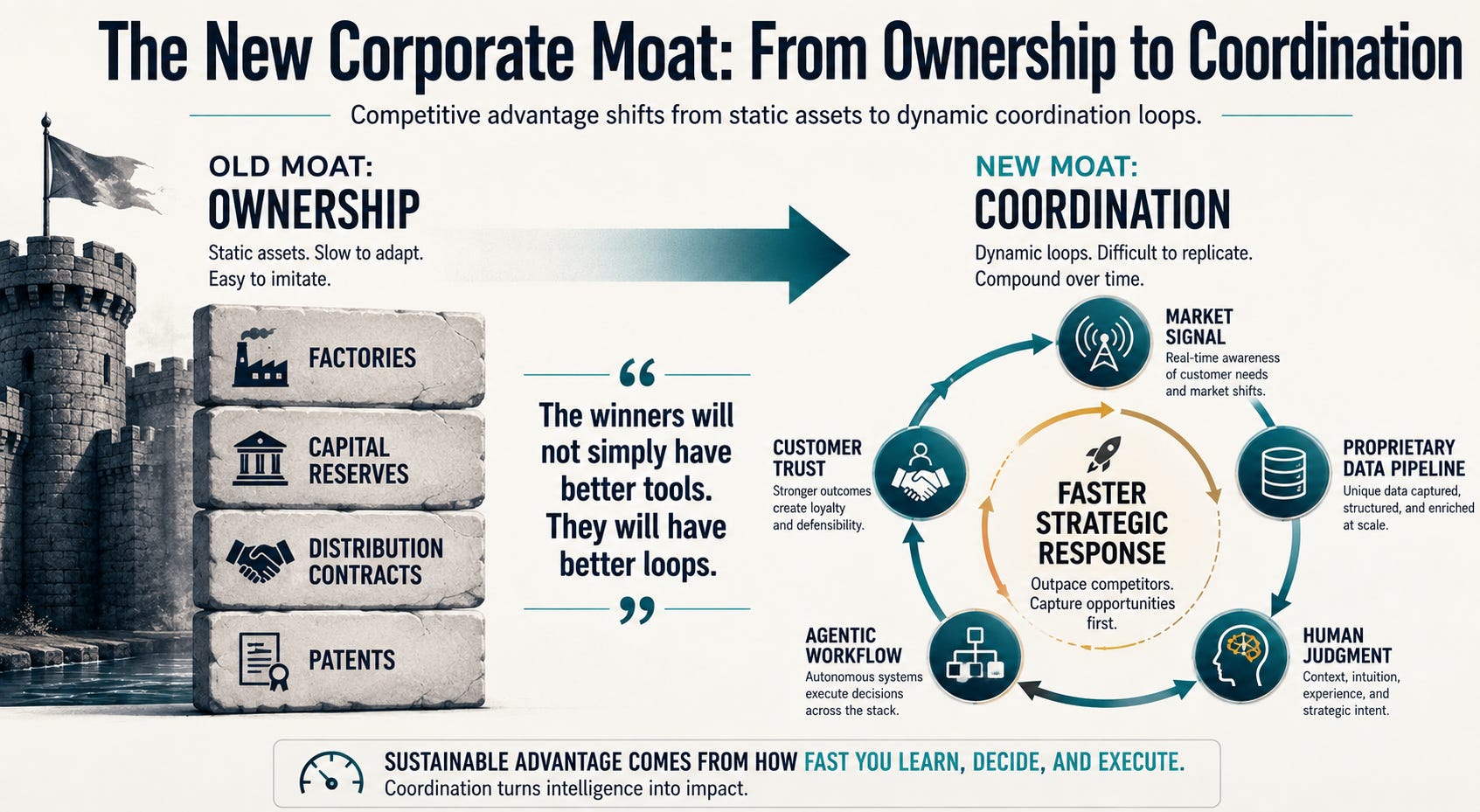
Every company will eventually have access to the same baseline algorithmic models. Optimization itself will become a commoditized utility. When raw intelligence becomes cheap and ubiquitous, the nature of competitive advantage shifts from ownership to coordination velocity.
The old moat was ownership. The new moat is coordination.
The winners will not simply have better tools. They will have better loops. The modern corporate defense system is built on how effectively an organization can integrate intelligent systems, human talent, proprietary data pipelines, operational incentives, and customer trust into a single, friction-free loop. It is not about owning the underlying AI models. It is about building a specialized organizational architecture that can ingest a market signal, execute a complex strategic response, and self-correct faster than an incumbent can schedule an internal alignment meeting.
In this new paradigm, proprietary data pipelines provide the raw material, human judgment sets the strategic intent, and orchestrated agentic workflows execute the tasks. The enterprise that builds the tightest coordination loop creates a widening speed and execution gap for its competitors.
The Management Crisis
The flattening of the corporate pyramid introduces a profound structural crisis: if machine intelligence handles increasing amounts of day-to-day coordination, what happens to middle management?
Historically, middle managers functioned as the human routing infrastructure of the firm. They sat between strategic leadership and front-line execution, translating high-level executive targets into daily operational tasks, monitoring employee performance, gathering manual status updates, and compiling reports.
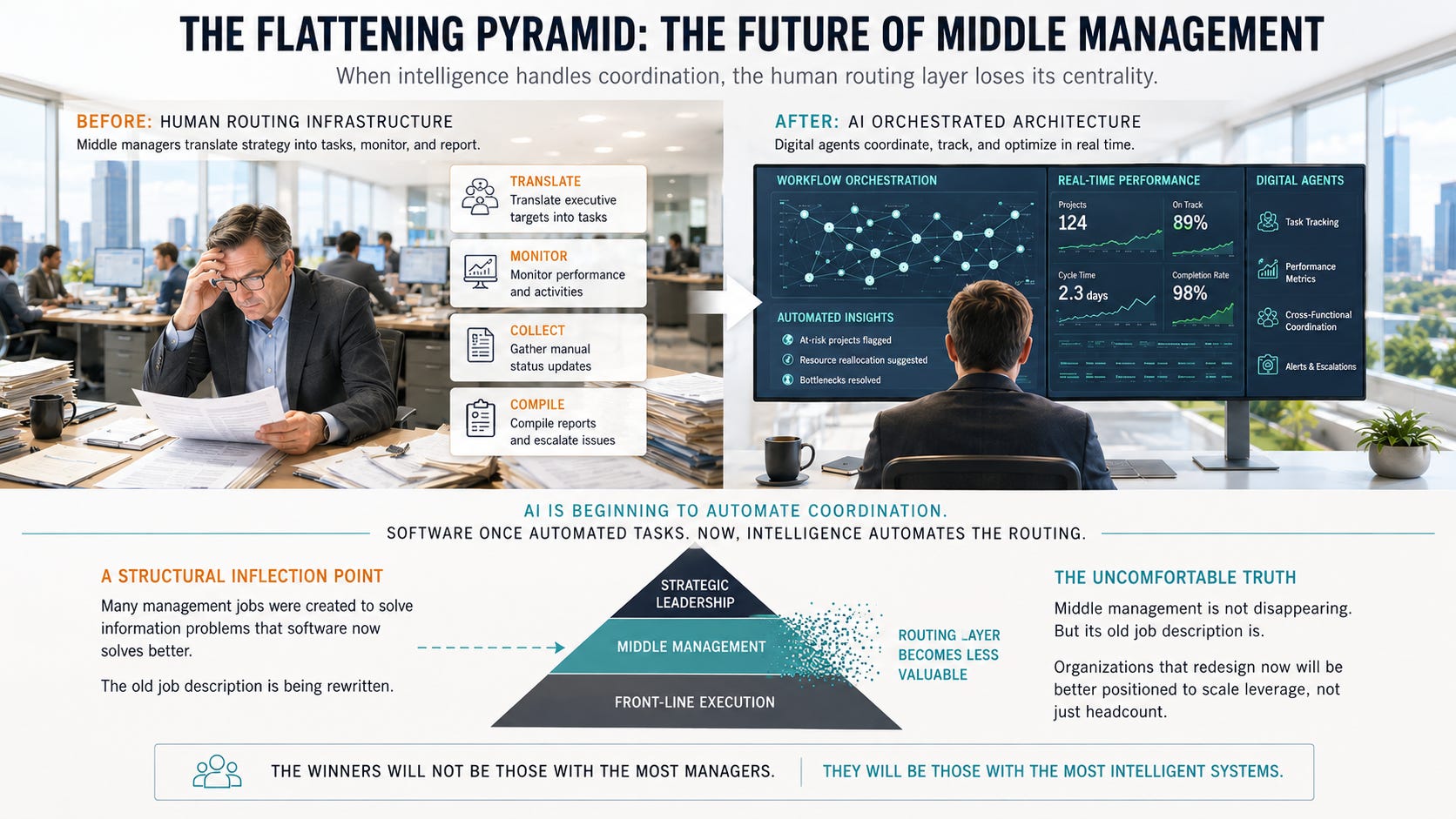
When an organization implements orchestrated architectures, that routing layer becomes significantly less valuable. Software once automated tasks. AI is beginning to automate coordination. Digital agents track tasks in real time, extract performance metrics automatically, and coordinate workflows across departments with far less internal friction.
Middle management is not disappearing. But its old job description is. The uncomfortable implication is that many management jobs were created to solve information problems that software increasingly solves better.
The biggest risk facing many companies is not AI replacing workers. It is competitors replacing management layers.
The organizational chart begins to flatten. At Nvidia, Jensen Huang maintains an unusually broad span of direct reports, often described as roughly 40 to 50. By reducing management filtration, Huang keeps critical strategic data closer to the executive office. This configuration aligns with the idea often described as Founder Mode: strategic leaders staying close to raw information instead of delegating all signal interpretation to layers of hierarchy.
The organizations that adapt will retrain managers into systems designers. The organizations that do not may discover they built entire layers of hierarchy around problems that no longer exist. High-leverage founders realize that extensive management tiers create an internal telephone game where strategic intent is diluted. The manager of tomorrow is not merely a supervisor of people. They are an architect of systems.
Shopify CEO on How AI is a Scapegoat for Mass Layoffs & Trump Derangement Syndrome in Canada
The Four Industrial Chapters
The historical relationship between tools and human labor has moved through four distinct, evolutionary iterations.
The First Revolution: Steam amplified human muscle.
The Second Revolution: Electricity and assembly lines amplified physical production.
The Third Revolution: Computers and cloud software amplified information, compressing manual processes into spreadsheet calculations.
The Fourth Revolution: Machine intelligence amplifies decision-making. Technology is transforming from a tool used by a worker into an autonomous architecture capable of executing multi-step cognitive processes.
Every major technological revolution follows the same pattern. First, it makes existing work faster. Then it changes who performs the work. Eventually, it changes how organizations themselves are structured.
The future belongs to companies that scale intelligence faster than they scale payroll.
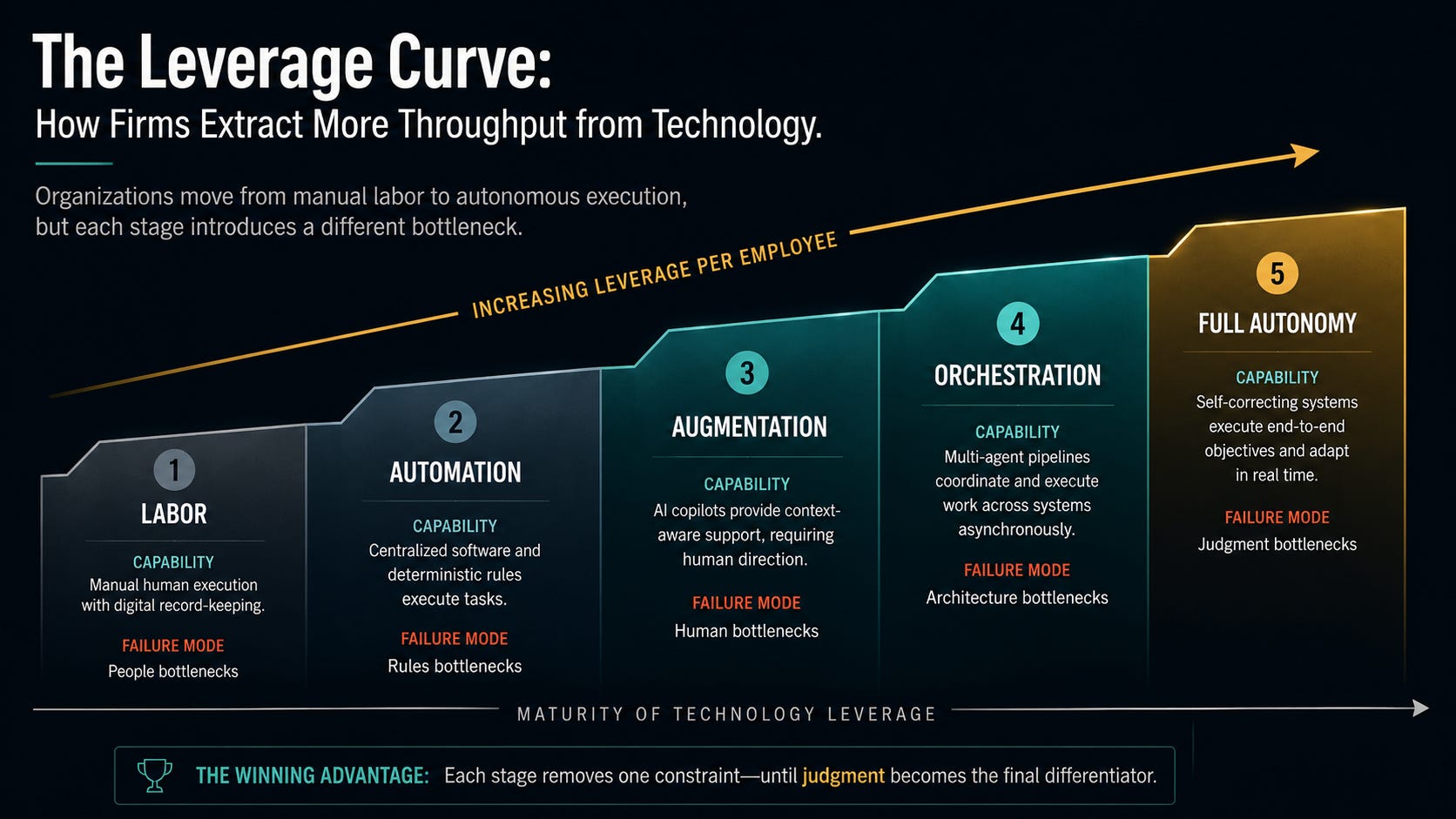
To capitalize on this macro shift, an organization must map its operations against The Leverage Curve, the systemic progression of how an enterprise extracts economic throughput from technology.
Labor: Manual human execution where software acts purely as a static digital ledger. Failure Mode: People bottlenecks.
Automation: Centralized cloud software and deterministic API logic. Failure Mode: Rules bottlenecks.
Augmentation: Context-aware copilots requiring continuous prompting. Failure Mode: Human bottlenecks.
Orchestration: Multi-agent pipelines where digital agents hand off work across platforms asynchronously. Failure Mode: Architecture bottlenecks.
Full Autonomy: Self-correcting execution engines that dynamically adjust internal parameters. Failure Mode: Judgment bottlenecks.
Deep Leverage Beyond Silicon Valley
The principles of leverage density are rapidly rewriting the competitive dynamics of traditional, mid-market service industries.
Look at Klarna, the global financial services firm. By transitioning its front-line operations to an orchestrated, multi-agent AI infrastructure, Klarna condensed its support cycles. According to official performance evaluations published by Klarna, an integrated AI assistant completed two-thirds of customer service chats within its initial month of live operation, executing work equivalent to 700 full-time human agents while shortening resolution times from eleven minutes to under two minutes and anchoring a projected $40 million annual profit improvement. Klarna’s experience may not transfer cleanly to every industry, but it shows how quickly AI can alter the economics of customer-facing operations.
Klarna CEO Sebastian Siemiatkowski on Getting AI to Do the Work of 700 Customer Service Reps
The same transformation is occurring across traditional mid-market spaces. In corporate environments like commercial insurance brokerages or corporate accounting firms, growth was historically tied directly to payroll expansion to handle manual processing, data extraction, and document cross-referencing.
By implementing an orchestrated multi-agent stack, an independent enterprise changes its operating economics. When complex compliance filings arrive, specialized digital agents automatically extract core metrics and query historical databases. A targeted core team of just three professionals can review the machine-generated outputs, applying human judgment and relationship management to execute workloads that used to require an operations staff of thirty.
The same shift is taking place in retail ecosystems via platform providers like Shopify Inc., which designed its architecture to abstract complex transactional processing, distribution coordination, and logistics management away from independent enterprise teams.
The Incumbent’s Trap: Why Large Companies Move Slowly
If capital efficiency and autonomous systems are so powerful, why haven’t the legacy Fortune 500 completely dominated this shift? After all, they possess entrenched customer relationships, massive distribution networks, regulatory expertise, capital access, and deep procurement partnerships that small startups completely lack.
The answer lies in The Incumbent’s Trap. The true competitive advantage is no longer institutional weight itself. The advantage is whether that size produces strategic leverage or crippling bureaucracy. Large companies view problems through a legacy lens: they treat headcount as a protective moat and budget allocation as political power. When a new market opportunity appears, a legacy enterprise rarely builds an autonomous workflow. Instead, it forms a steering committee and schedules a series of alignment syncs.
This happens because legacy complexity compounds faster than headcount. Every year an enterprise operates, it adds more overlapping software systems, more internal policies, more compliance reporting requirements, and more mandatory approvals.
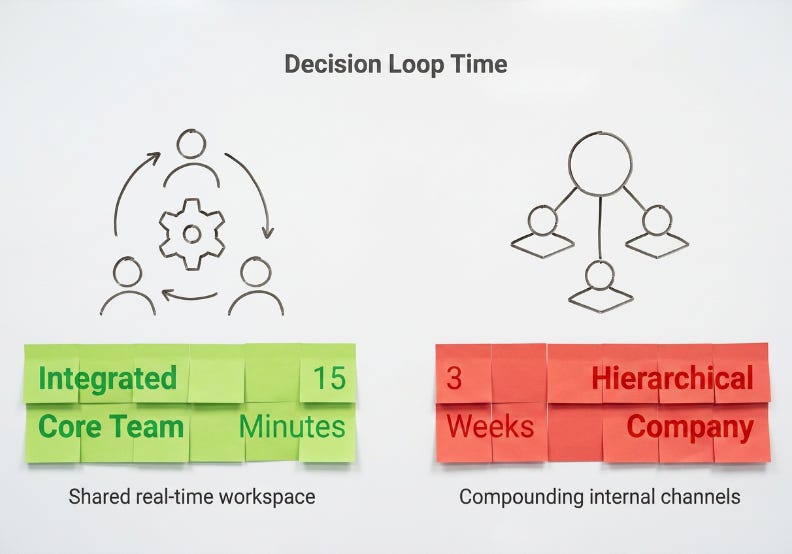
This structural drag creates a severe speed deficit. While the incumbent is waiting for a third-round budget approval, a hyper-lean team utilizing an orchestrated infrastructure has already run thousands of programmatic variations, closed a direct digital integration with a key customer, and captured the market’s initial demand signal.
The Human Layer and the Collapse of Routine Work
As organizational scale decouples from headcount, a common misconception emerges that the ultimate objective is the complete elimination of human capital. This is a fundamental misreading of the economic shift. The goal is the eradication of low-leverage administrative labor.
The people who benefited most from the last generation of software were often those who learned how to manage and route information. The people who benefit most from the next generation may be those who learn how to exercise judgment.
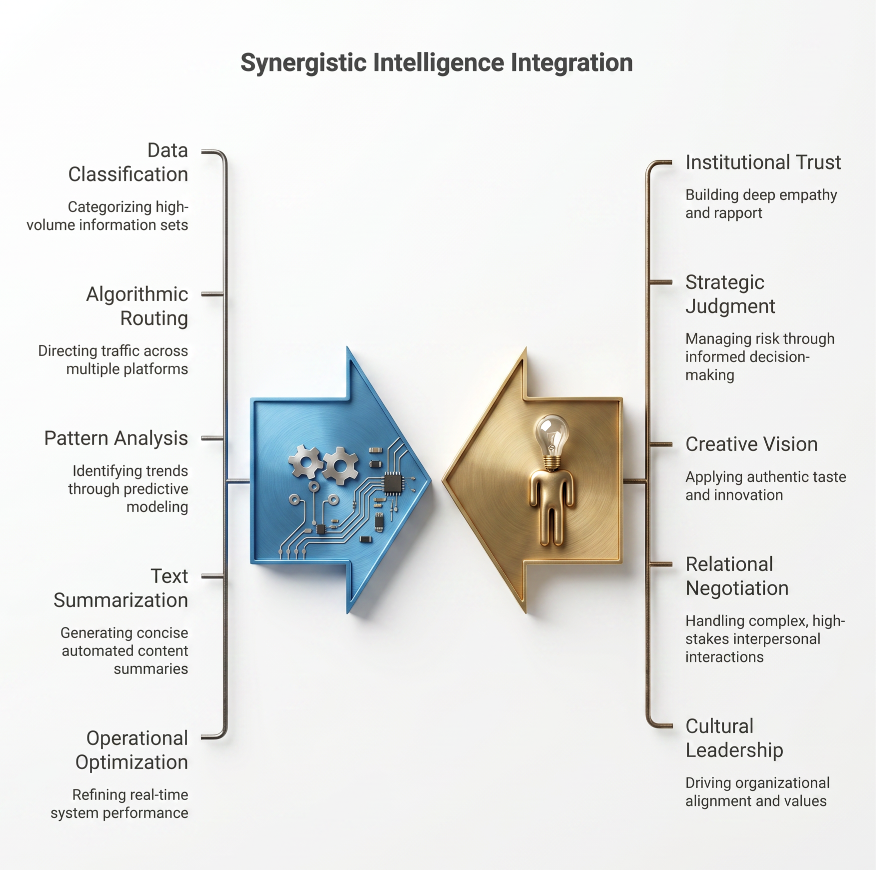
The human layer represents the irreplaceable core of the enterprise. AI architectures excel at processing high-volume, structured tasks at dramatically lower marginal cost, but they are also fundamentally vulnerable to technical risks. Autonomous systems can hallucinate, misroute critical decisions, automate flawed baseline assumptions, and scale algorithmic mistakes exponentially faster than a human workforce.
This persistent systemic risk reinforces why human judgment remains essential. In the AI era, the bottleneck is no longer labor. It is judgment. In markets where AI makes execution cheaper, trust becomes more expensive. The ultimate differentiation for an enterprise will depend on human taste, creative vision, and high-stakes relational negotiation.
The Counterintuitive Danger: Indiscriminate Leanness
Many founders will analyze this structural shift and arrive at a dangerous conclusion: “I must freeze all hiring and run my company with a minimum possible headcount at all costs.” This is a profound operational mistake. The objective of modern enterprise construction is not minimum headcount. The objective is maximum leverage.
Some business models inherently require human scale to secure market share, manage complex physical supply chains, or deliver high-touch enterprise customer experiences. If a founder refuses to hire an essential team member simply to preserve a vanity metric of being a “lean startup,” they are intentionally starving their company of execution capacity.
The goal is intentional scale, not indiscriminate leanness. You should hire aggressively when a role provides clear, non-linear leverage to the entire system, such as an elite software architect who builds automated infrastructure or a top-tier sales leader who opens major distribution channels. Conversely, you must refuse to hire when the headcount request is simply a temporary patch for a broken, poorly designed internal process.
The Danger of the Human Bridge
The single most common mistake made by modern entrepreneurs is using human labor as a temporary bridge for a broken system. When an operational workflow fails, a customer service ticket slips through the cracks, or a data transfer errors out, the instinct of the undisciplined founder is to hire an operations manager to manually oversee the gap.
This is a strategic error. The moment you introduce a human bridge into a workflow, you stop building a scalable software system and start building an administrative layer.
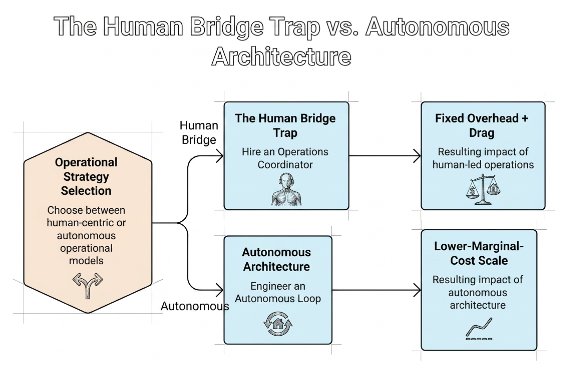
Human bridges introduce variance, communication overhead, and fixed financial drag. More importantly, they remove the forcing function that requires you to engineer a permanent, software-driven fix. Organizations that automate bad processes simply create bad outcomes faster.
The disciplined operator treats every operational failure as a system bug and resolves it through architecture, not labor. If a data transfer fails, you do not hire a data coordinator. You rewrite the API payload logic or deploy an autonomous agent to handle the structural exception. This commitment to systemic solutions keeps the core organization small, nimble, and intensely profitable.
The Operator’s Leverage Audit
Eliminate: Ruthlessly delete any workflow step or status meeting that does not directly contribute to client onboarding, product fulfillment, or pipeline conversion.
Automate: Transition manual operations directly into multi-agent loops, ensuring exceptions are handled via algorithmic logic rather than relying on a human data bridge.
Measure: Anchor executive evaluation dashboards to Revenue Per Employee and Free Cash Flow Per Employee rather than counting total full-time headcount.
The Future of the Firm
Every generation assumes its organizational structures are permanent. They rarely are. Factories replaced workshops. Corporations replaced merchant networks. The institutions that dominate the next century may look as strange to us as the modern corporation would have looked to a trader in 1750.
As intelligence becomes scalable, the old rationale for building labor-heavy organizations becomes harder to defend. When multi-agent systems can execute complex, cross-functional business objectives instantly at dramatically lower marginal cost, the historical necessity for organizational mass weakens.
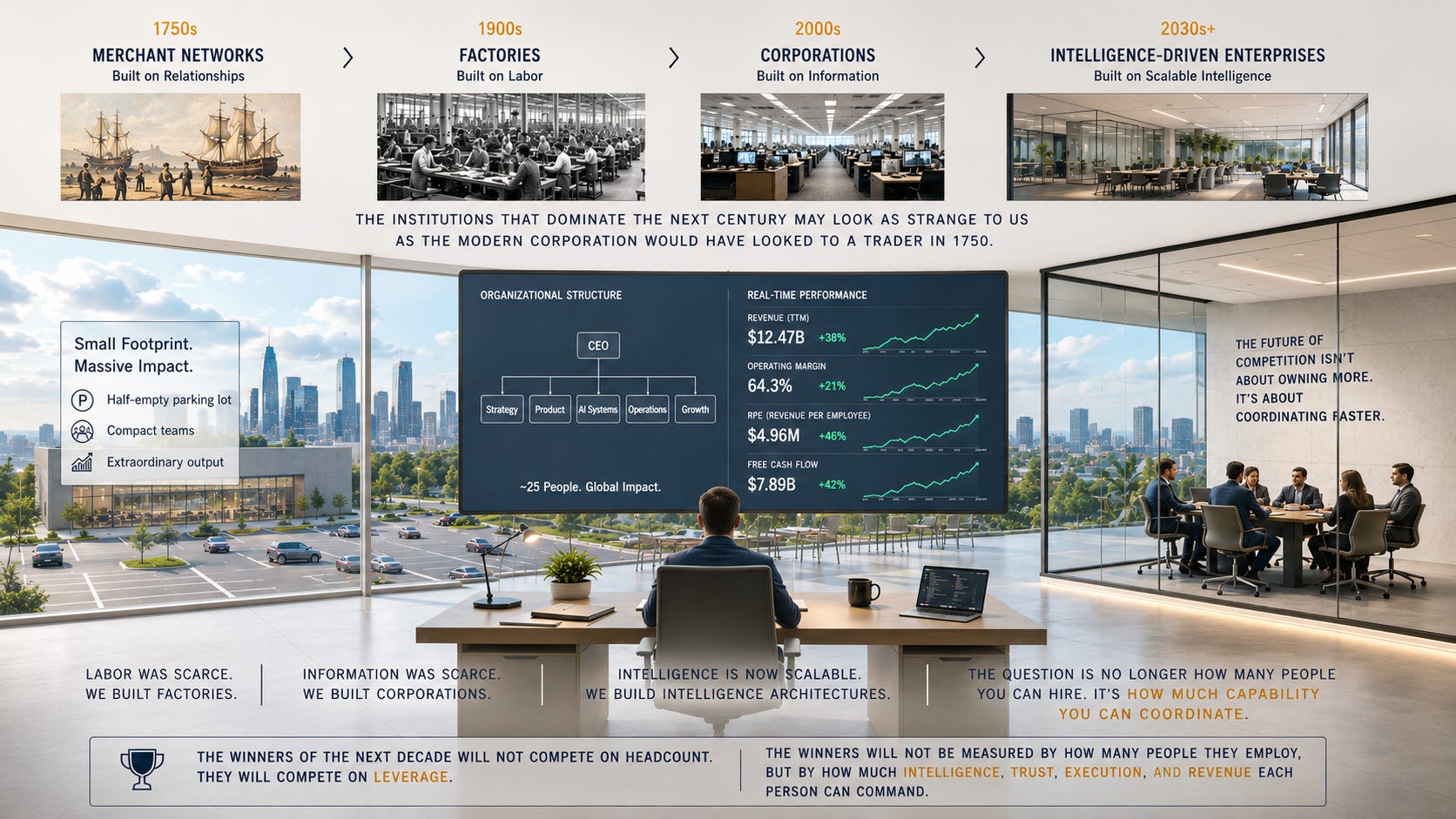
Imagine walking through the headquarters of a dominant enterprise a decade from now. The commercial office footprint will be remarkably small. The parking lot will be half empty. The corporate organizational chart will fit onto a single screen, largely stripped of multi-layered managerial tiers.
Yet the economic output and financial footprint of the organization will be larger than at any point in its history. This transformation will occur not because the firm found a mechanism to make people work harder, but because it designed an architecture that allowed machine intelligence to scale.
The future of competition may depend less on who owns the most resources and more on who can coordinate them fastest.
Every era builds institutions around its scarcest resource.
The factory was built around labor.
The corporation was built around information.
The next generation of organizations will be built around scalable intelligence.
The question is no longer how many people a company can hire.
The question is how much capability it can coordinate.
The companies of the next decade will not compete on headcount. They will compete on leverage. The winners will not be measured by how many people they employ but by how much intelligence, trust, execution, and revenue each person can command.