

The Sovereign Operator
Why the Next Great Companies Will Scale Systems Before Headcount

As capital gets selective and AI gets cheaper, the most durable founders will not automate old work. They will redesign the company around better work.
The Sovereign Operator treats the company less like a headcount pyramid and more like an operating system.
For years, startup success had a uniform: a bigger team, a bigger office, a bigger funding round, and a burn rate everyone pretended was strategy.
Growth was often measured in employee count as much as revenue. A larger organization signaled momentum. Payroll became a proxy for progress.
Many companies did not scale.
They inflated.
That logic made sense in a world where capital was abundant and borrowing costs were near zero. Investors rewarded growth above almost everything else. Survival was subsidized, and efficiency was treated as a problem for later.
That environment no longer exists
.
We are witnessing a structural shift deeper than a routine market correction. For the first time in modern business history, the minimum viable size of a serious company is shrinking. An enterprise can now become dramatically more capable without becoming dramatically larger.
AI is not primarily changing software.
It is changing the economics of organizational design.
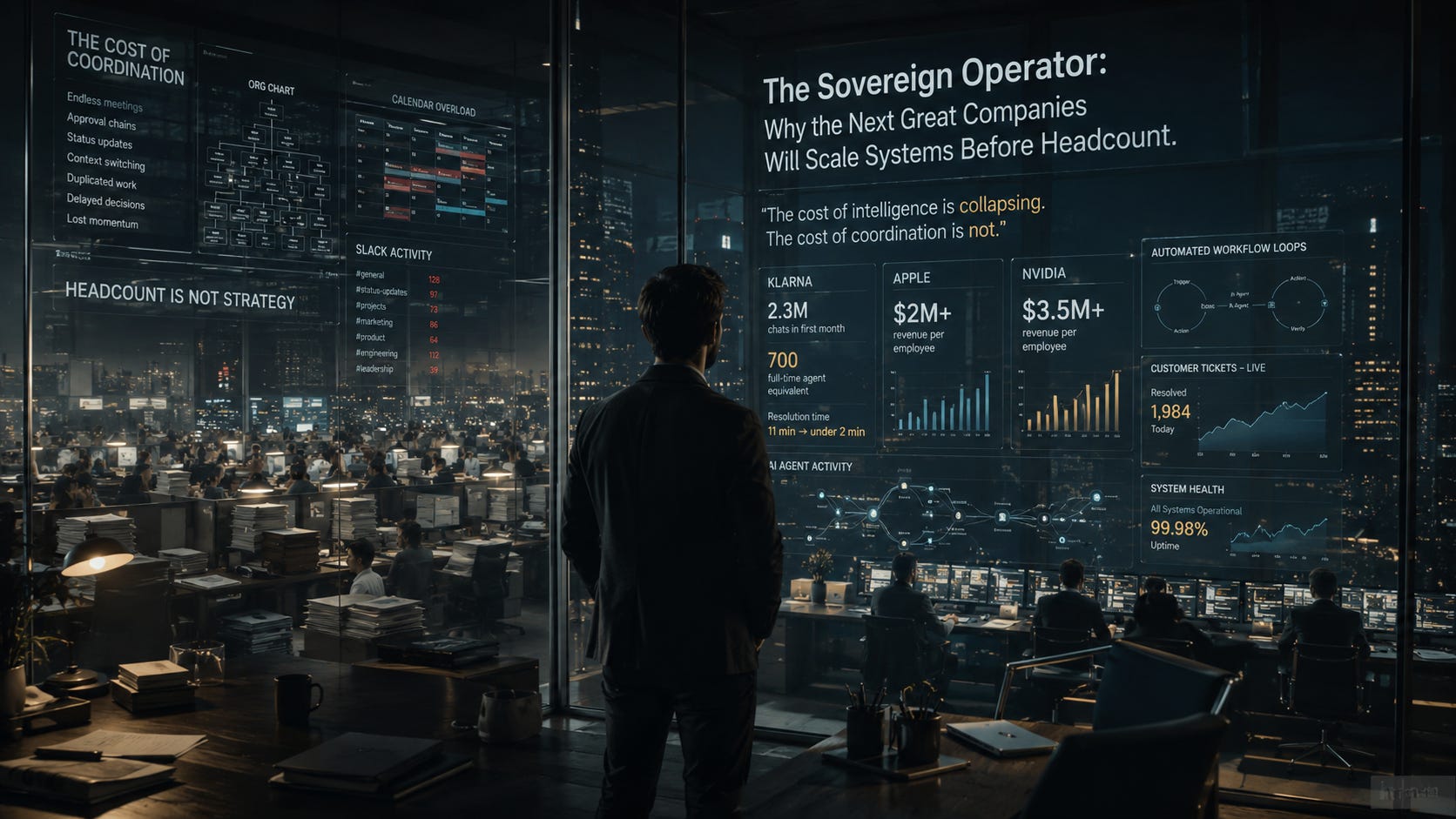
The cost of intelligence is collapsing.
The cost of coordination is not.
Better software may not be the most important consequence. It may be that entire layers of organizational infrastructure stop making economic sense. The modern corporation was built around the assumption that coordination required people. As that assumption weakens, so does the logic behind many structures companies inherited from the twentieth century.
For most of modern corporate history, coordination was the hidden cost of growth. Every new customer required more employees. Every new employee required more managers. Every new manager required more reporting, planning, and oversight. Companies accepted this tradeoff because there was no real alternative.
For the first time, there may be one.
The Three Eras of Scale
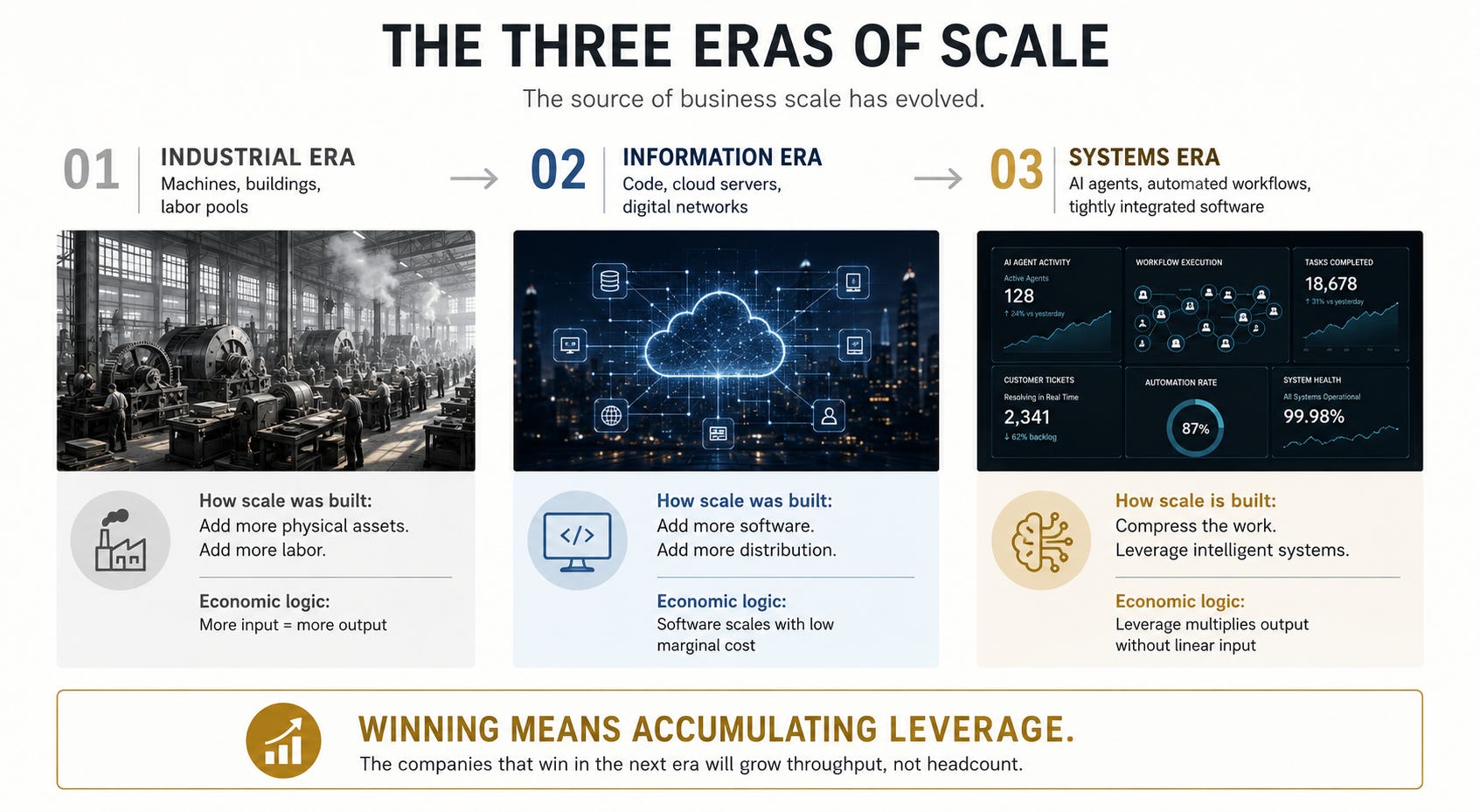
The industrial company scaled through machines, buildings, and labor pools. Winning meant accumulating infrastructure.
The software company scaled through code, cloud servers, and digital networks. Winning meant accumulating software.
The systems company scales differently. It compresses the work itself, expanding through AI agents, automated workflows, and tightly integrated software. Winning means accumulating leverage.
Just as electrification allowed factories to abandon centralized steam engines and redesign the factory floor around decentralized machinery, AI allows modern operators to abandon centralized human chains and redesign the organization around entirely different assumptions about work.
Yet many organizations still look like modern technology companies from the outside while resembling nineteenth-century factories inside, only now connected by Slack channels.
Founders often mistake organizational weight for organizational strength. I have watched founders mistake a crowded calendar for momentum and a growing payroll for proof that the company was working. More than once, I have watched a founder celebrate a hiring milestone, only to discover six months later that the company had become harder to run, not easier.
The result is a company that looks muscular but moves like it is carrying a backpack full of bricks.
The New Way To Build A Startup
Growth Has a Coordination Tax
Most founders assume adding people increases capacity.
Occasionally it does.
What it always increases is coordination drag.
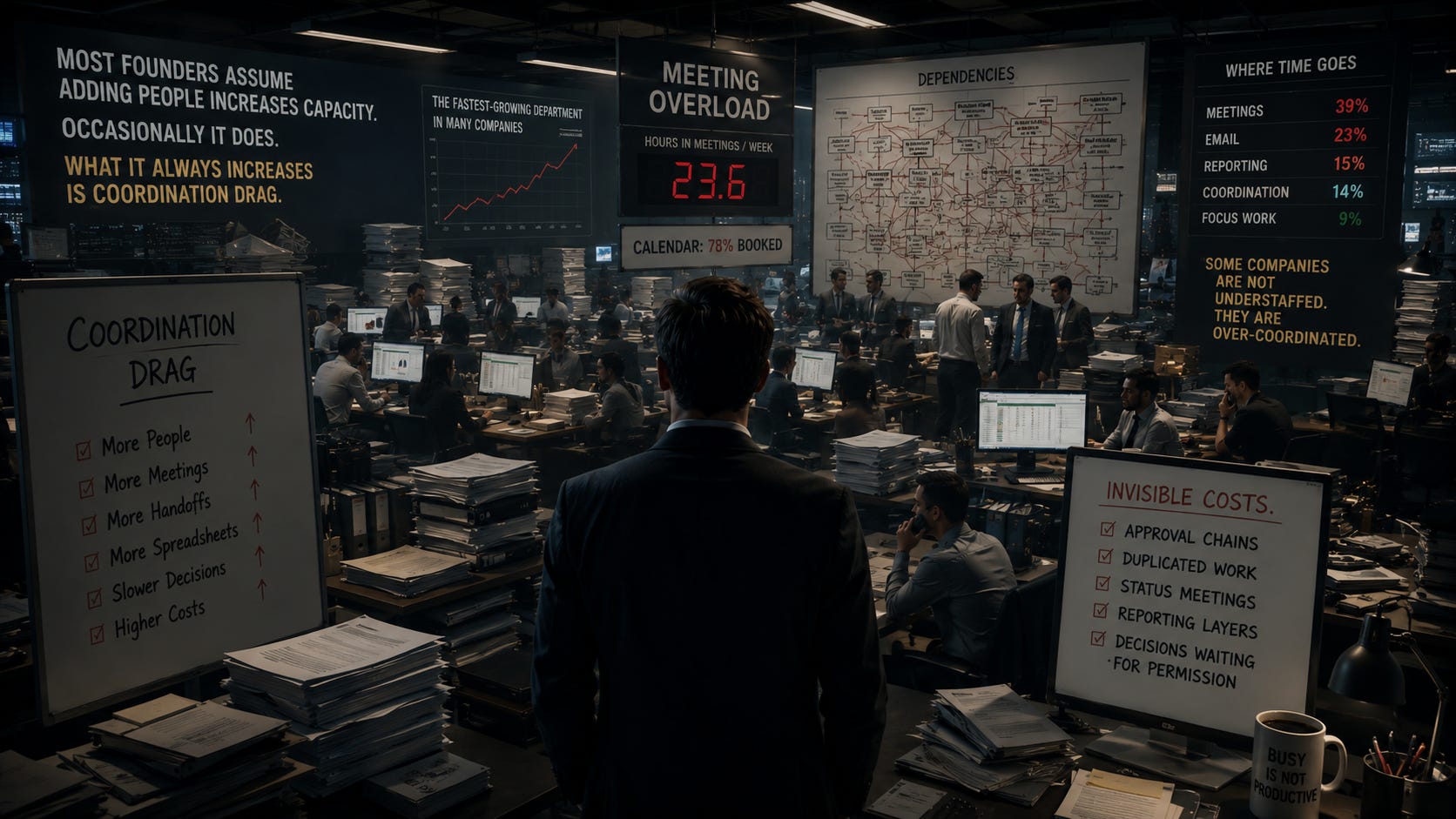
The true villain in modern execution is not bureaucracy or a lack of talent. The true villain is coordination drag. Every new hire brings intelligence, but also calendars, dependencies, handoffs, status meetings, and spreadsheets that did not exist yesterday.
The fastest-growing department in many companies is the one created to manage the complexity of the departments added before it.
Coordination drag rarely appears on financial statements. It hides in approval chains, duplicated work, status meetings, reporting layers, and decisions waiting for permission. It is one of the largest invisible costs inside modern organizations.
Some companies are not understaffed.
They are over-coordinated.
This structural friction is an old trap. Fred Brooks famously noted in The Mythical Man-Month that adding human power to a delayed software project can make it later. Brooks was writing about software development, but the underlying lesson extends to the entire corporate operating system. At a certain point, teams spend more time managing complexity than shipping products.
None of this means headcount is a problem. Great companies still need exceptional people. Some work should never be automated. Some customers still need human judgment, trust, and care.
The point is not to remove people from the company.
It is to stop using people as insulation around broken systems.
Most hiring problems are design problems in disguise.
That is why this transition feels uncomfortable. For decades, managers were taught to equate control with visibility. More people meant more oversight. More departments meant more specialization. More layers suggested maturity.
The new model challenges those instincts. It asks leaders to trust systems where they once trusted hierarchy.
Again and again, the companies that become easier to run are not the ones that add the most tools. They are the ones that finally decide what work should stop existing.
Scale Is Size. Throughput Is Power.
Many businesses still confuse activity with productivity.
Scale is how large the company becomes.
Throughput is how much value flows through the company.
The goal of a Sovereign Operator is not to build a tiny company. The goal is to build a company whose complexity grows more slowly than its revenue.
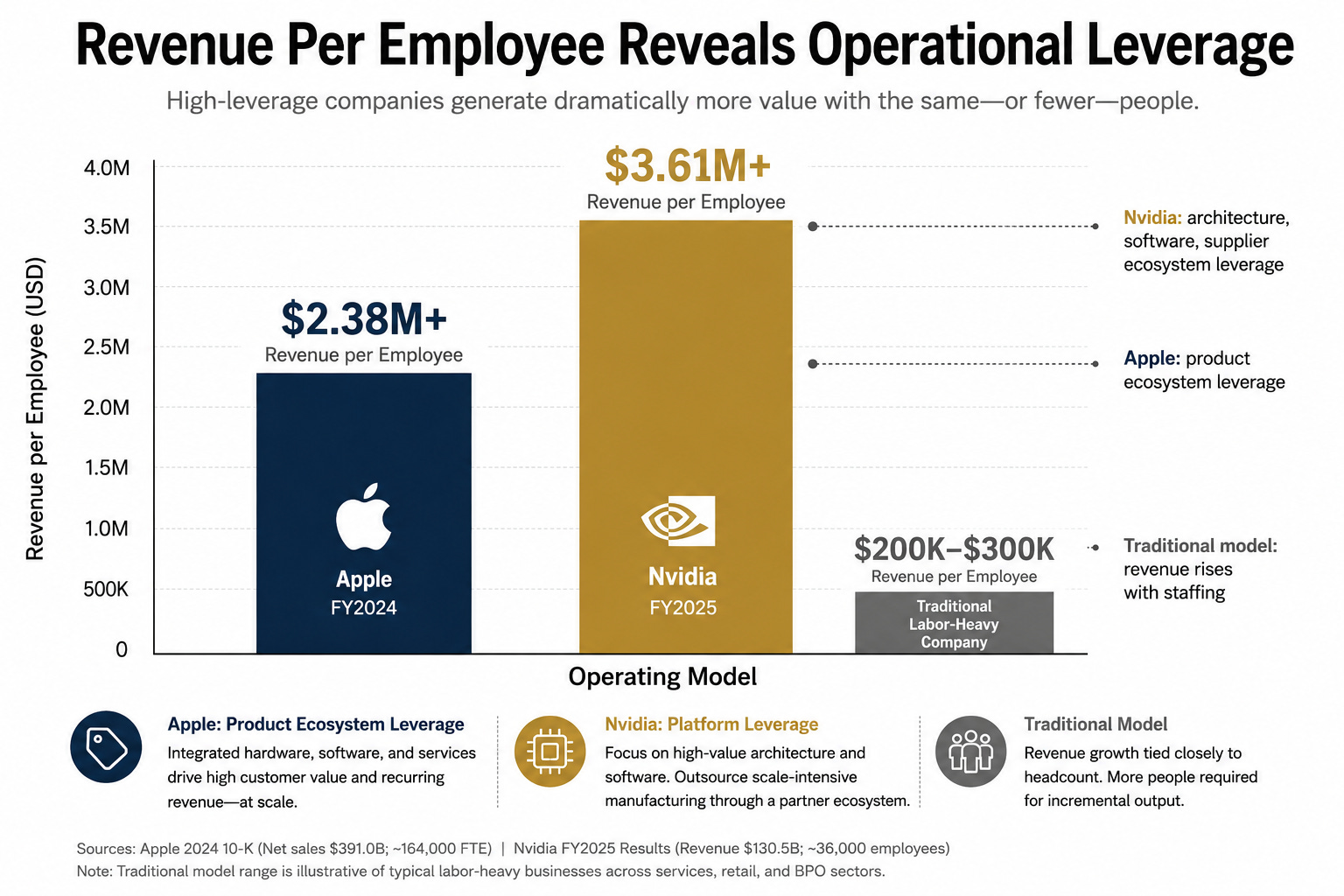
Apple offers a useful benchmark. In fiscal 2024, Apple reported about $391 billion in net sales and roughly 164,000 full-time equivalent employees. That works out to well over $2 million in revenue per employee, a reminder that the best companies are designed so each employee sits inside a system of enormous leverage.
True scale is measured by the leverage of the system, not the mass of the payroll.
Two case studies show what this scenario looks like under pressure.
The Klarna Realignment
Klarna faced the decision many companies are quietly facing right now: hire more people to absorb complexity or redesign the system creating it.
Leadership chose the second path. Klarna reduced hiring and redesigned parts of its customer support and marketing operations around AI-enabled systems. Instead of continuing to scale human support linearly, it deployed a generative assistant built with OpenAI.
In its first month of global deployment, Klarna said the assistant handled 2.3 million customer chats, work equivalent to 700 full-time agents. The company said average resolution time fell from eleven minutes to under two minutes, while customer satisfaction remained on par with human agents.
Those numbers made headlines, but the more important lesson is not that every company can replace support teams with AI.
Klarna is not a universal template.
It is a signal.
The lesson is that workflows should be redesigned before headcount becomes the default answer.
Klarna CEO Sebastian Siemiatkowski on Getting AI to Do the Work of 700 Customer Service Reps
The Nvidia Leverage Model
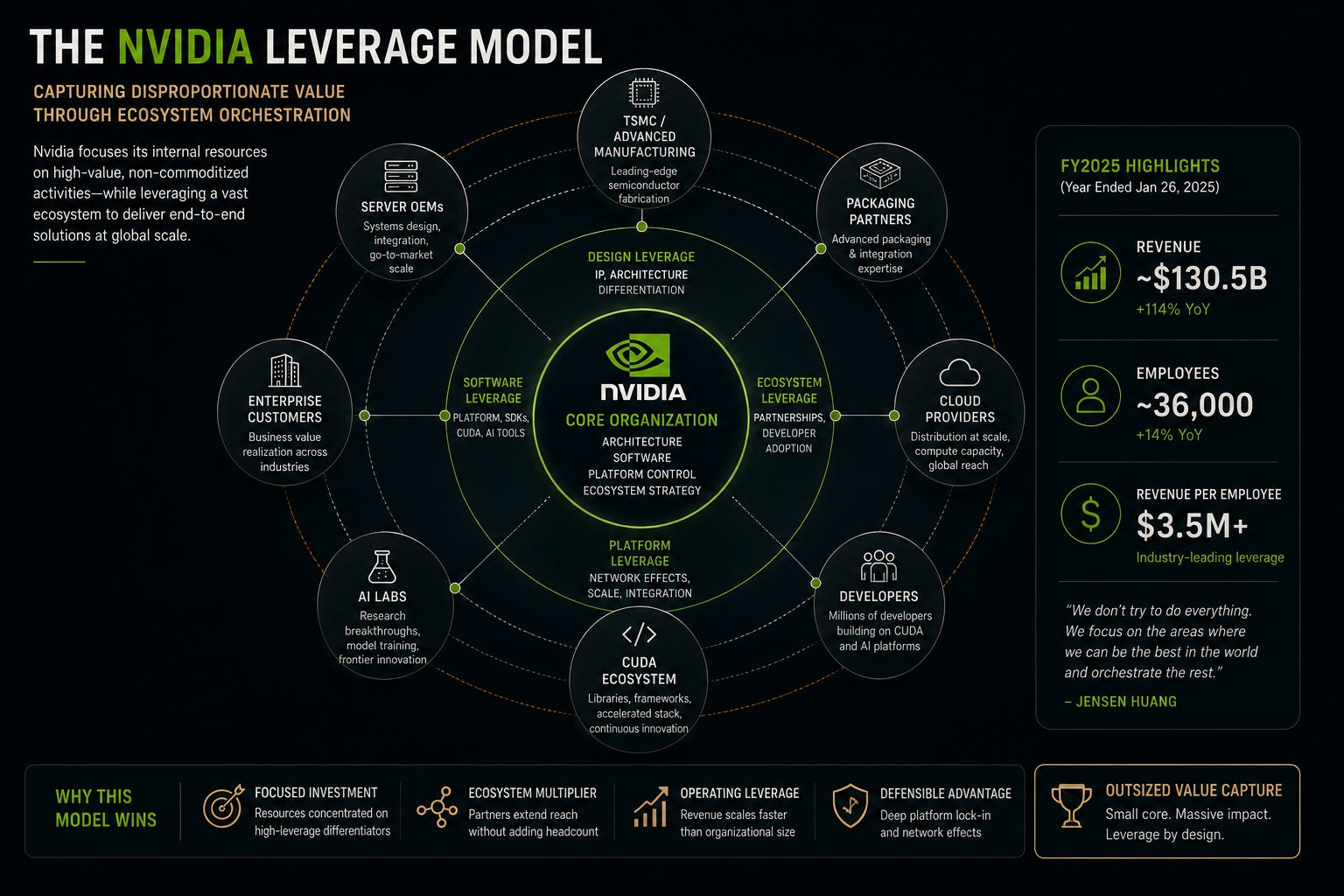
Klarna shows a legacy company compressing parts of its operating infrastructure. Nvidia demonstrates a distinct form of systems-era leverage.
As demand for accelerated computing exploded, Nvidia maintained an unusually lean internal footprint relative to the scale of its economic impact. Its fiscal 2025 filings show roughly $130.5 billion in revenue and about 36,000 employees, which puts revenue per employee above $3.5 million.
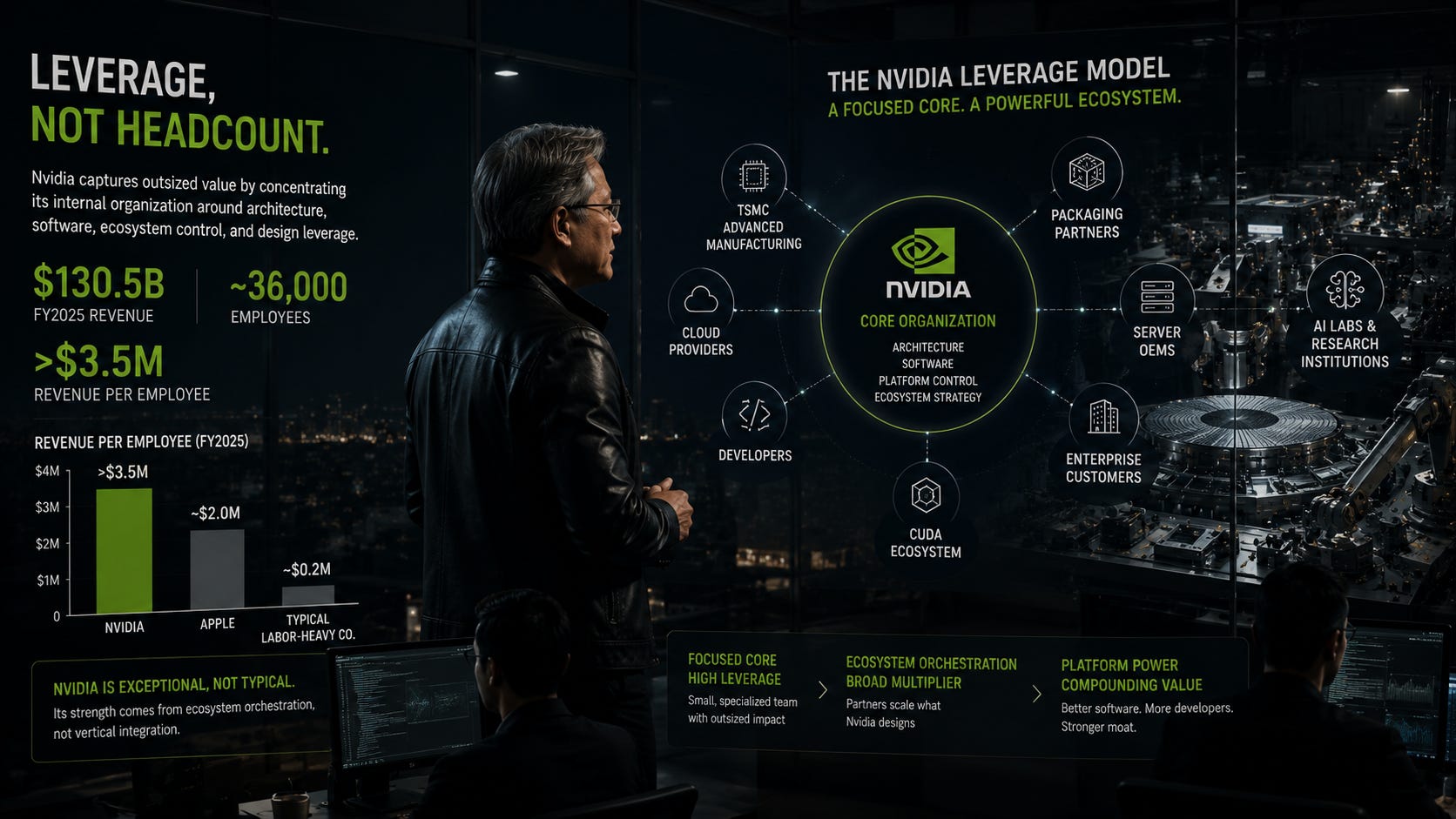
Nvidia is exceptional, not typical. The value of the example lies precisely in its extremity.
Nvidia is not labor-light in the absolute sense. Its leverage depends on a vast external manufacturing and supplier ecosystem. That is the key point. Jensen Huang did not build Nvidia by owning every part of the value chain. He built it by deciding which parts mattered most.
The company captures outsized value by concentrating its internal organization around architecture, software, ecosystem control, and design leverage.
Nvidia does not prove that every company can stay small.
It indicates that a focused group of core operators can anchor a major platform shift when the system around them is designed for leverage.
AI is not reducing the value of talent.
It is increasing the penalty for organizational friction.
The Most Expensive Hire Is the One You Did Not Need
Many companies do not have a productivity problem. They have an irrelevance problem.
A company can become operationally elegant and still economically irrelevant. Fewer wasted hours will not save a company selling an undifferentiated product.
Operational efficiency lowers costs.
Positioning creates demand.
One keeps you alive. The other makes you matter.
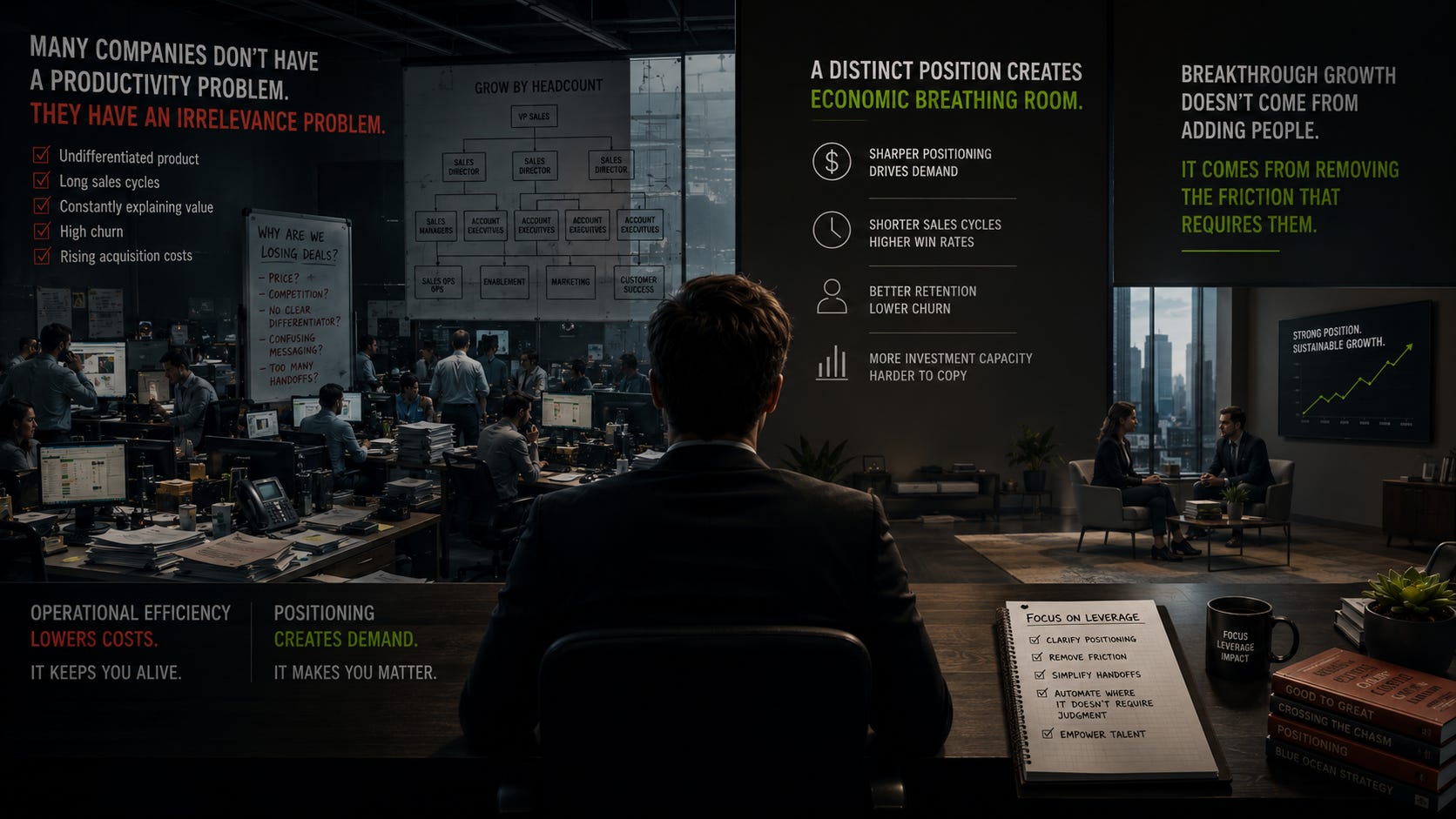
A company with weak positioning needs more salespeople, more account managers, and more customer success representatives to explain its value. A company with sharp positioning arrives with a partial sale. When customers understand why a company matters, sales cycles shorten, retention improves, and marketing becomes more effective.
A distinct position creates economic breathing room, which funds the investments that make the product harder to copy. That breathing room funds the investments that make the product harder to copy.
After decades of interviewing thousands of founders, executives, and innovators, one pattern appears again and again. Breakthrough growth rarely begins when leaders hire more people to build a larger empire. It begins when they finally remove the friction that required those people in the first place.
I have rarely met a founder who regretted removing unnecessary work. I have met many who regretted building an organization around it.
When you hire to fix a broken handoff, you institutionalize the inefficiency.
Headcount becomes a substitute for design.
The Sovereign Operator Test
Before capital or talent is added to solve an operational bottleneck, the Sovereign Operator asks four questions.
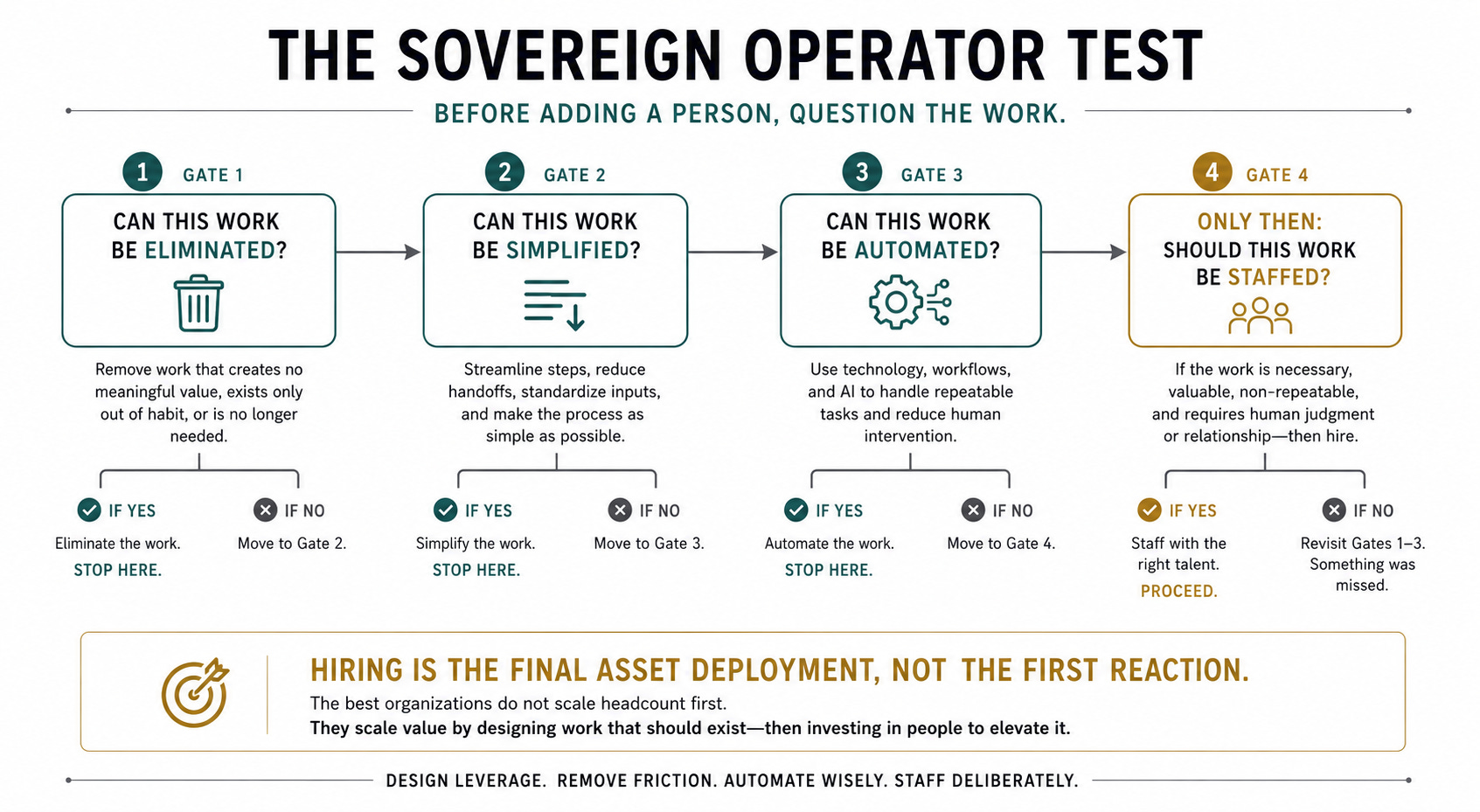
Can this work be eliminated?
Remove reports nobody reads, approvals nobody truly needs, and meetings whose original purpose disappeared years ago. The fastest process is the one that no longer exists.
Can this work be simplified?
Standardize what remains so every employee is not performing it differently. Clean inputs create predictable outputs.
Can this work be automated?
Introduce technology only when a process is repeatable. Automation should multiply judgment and strategy, not patch broken handoffs.
Should this work be staffed?
If the workflow has been stripped of waste, simplified, and automated at its repetitive failure points, only then should exceptional talent be hired to operate and scale the system.
Hiring is the final asset deployment, not the initial reaction.
Vertical AI Agents Could Be 10X Bigger Than SaaS | Y Combinator
When Capital Stops Forgiving Waste
Once capital stops forgiving waste, operating design becomes strategy.
For years, abundant funding allowed founders to compensate for weak economics. That option has become less reliable. PitchBook and NVCA’s Venture Monitor reports have described a tougher fundraising environment since the 2021 peak, with investors placing greater emphasis on burn discipline, profitability paths, and efficient growth.
Investors still reward ambition.
What they increasingly question is waste.
Headcount is not strategy.
Two companies can both report $50 million in annual revenue. One needs constant funding, constant approvals, and endless internal alignment to keep the machine running. The other has room to maneuver because the machine is lighter, cleaner, and easier to adapt.
The difference is not ambition.
The difference is operating design.
Building a Sovereign Organization
The future belongs neither to the biggest companies nor the smallest.
It belongs to the most adaptable.
The test for a modern leader is simple: before approving the next hire, ask whether the role exists because demand is rising or because the system is broken.
Start with five questions:
What work exists only because no one has challenged it?
Which meetings are compensating for unclear systems?
Which hires are covering up broken workflows?
Where are your best people doing low-value coordination?
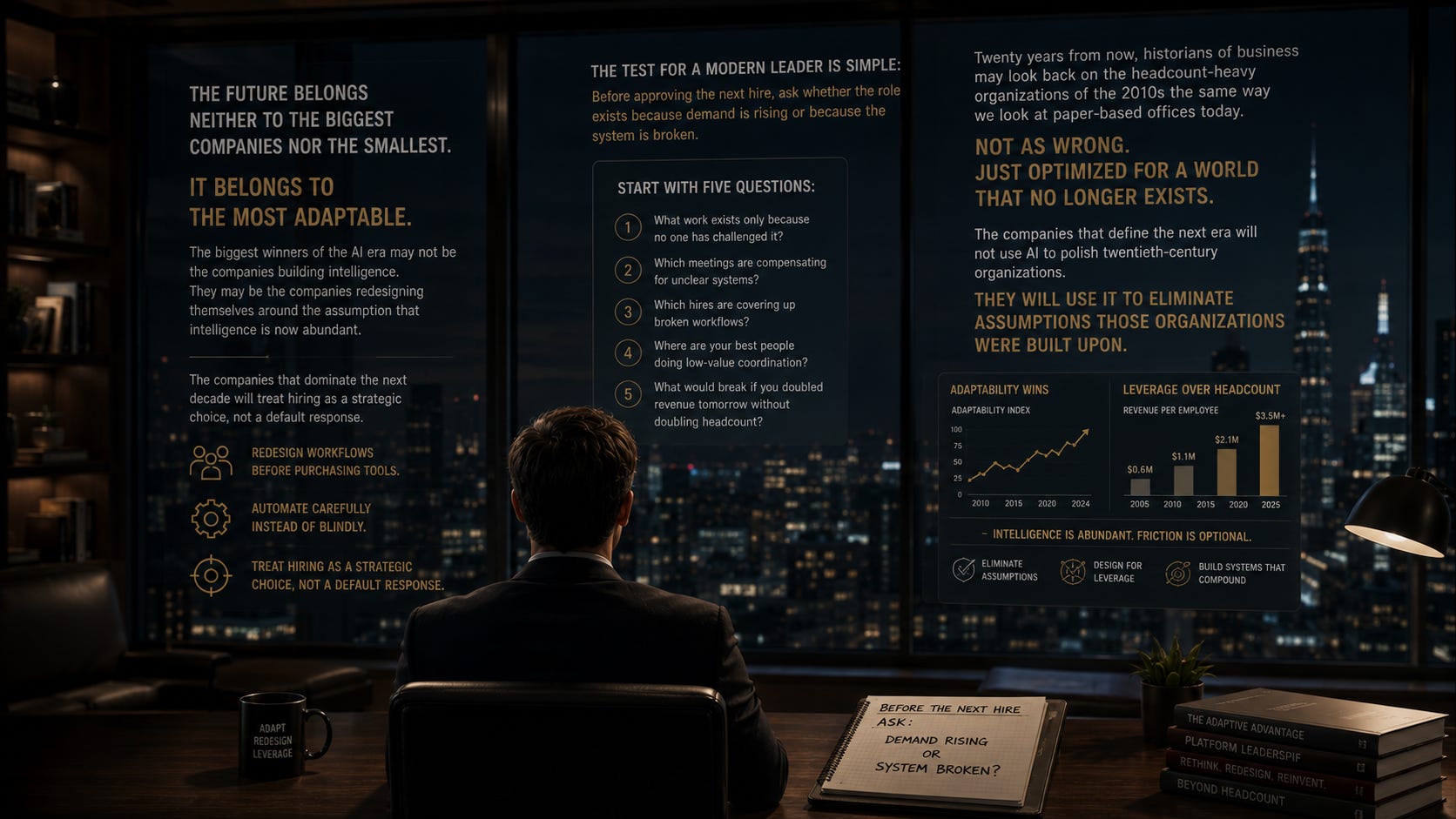
What would break if you doubled revenue tomorrow without doubling headcount?
The biggest winners of the AI era may not be the companies building intelligence. They may be the companies redesigning themselves around the assumption that intelligence is now abundant.
The companies that dominate the next decade will treat hiring as a strategic choice, not a default response. They will redesign workflows before purchasing tools. They will automate carefully instead of blindly.
Twenty years from now, historians of business may look back on the headcount-heavy organizations of the 2010s the same way we look at paper-based offices today.
Not as wrong.
Just optimized for a world that no longer exists.
The companies that define the next era will not use AI to polish twentieth-century organizations.
They will use it to eliminate assumptions those organizations were built upon.