

The Strategic Edge
Institutionalizing Informational Asymmetry

In 2006, Jensen Huang made a decision that nearly killed Nvidia’s hardware business: he decoupled the company’s software from its chips. By pouring billions into CUDA (Compute Unified Device Architecture) while the rest of the market still viewed GPUs as gaming peripherals, Huang was placing a high-conviction bet on a future that did not yet exist. He was not building a component. He was engineering the monopoly, not on chips, but on the language required to use them.
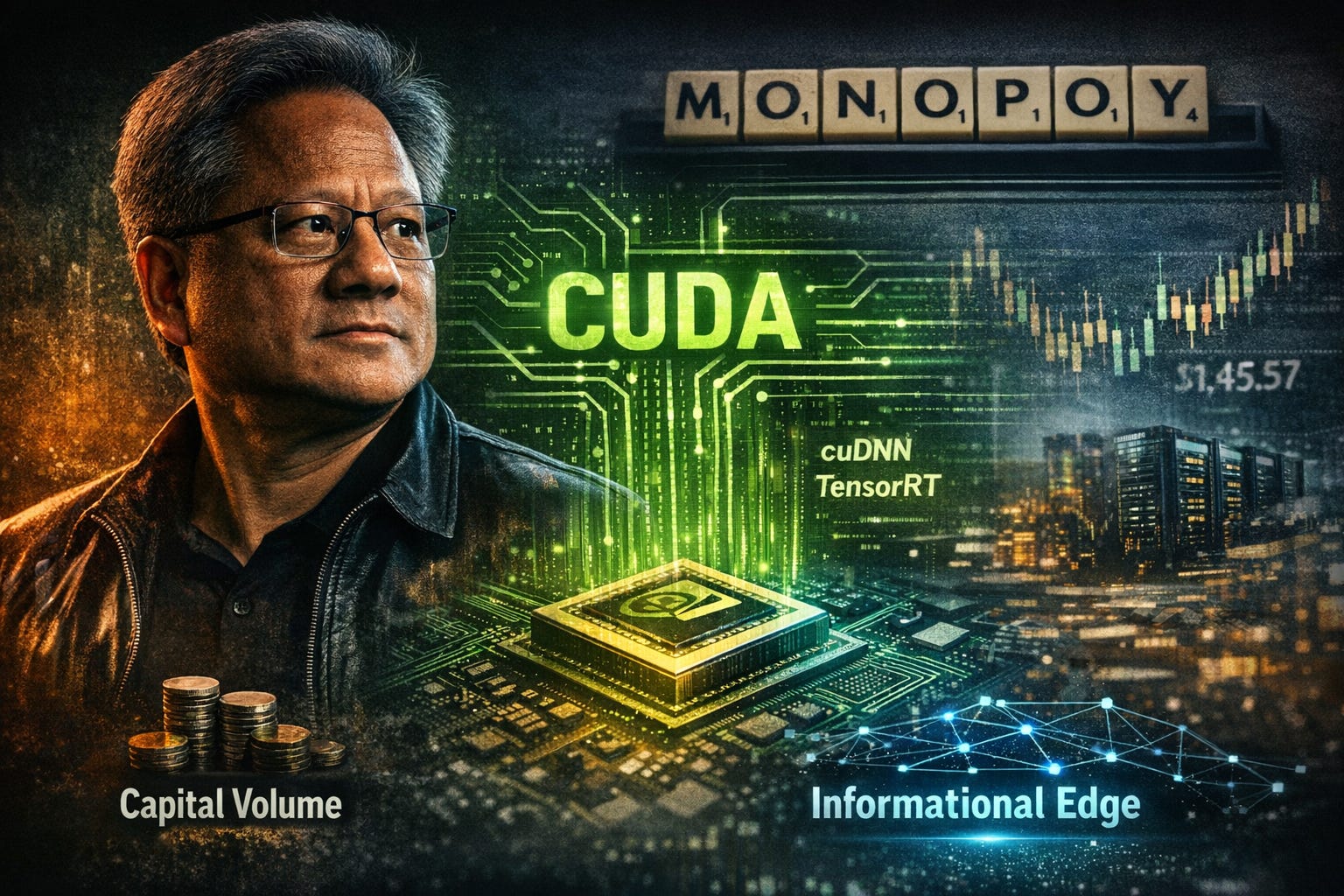
That single move defines the “Axelrod” doctrine at the heart of this piece: success in modern markets is no longer tethered to capital volume. It is tethered to the quality of your informational edge.
The CUDA Moat: Nvidia’s Structural Pre-emption
Bobby Axelrod’s dominance in Billions is predicated on one thing: possessing actionable intelligence before it becomes a market consensus. Nvidia’s trajectory is the industrial-scale application of that same principle.
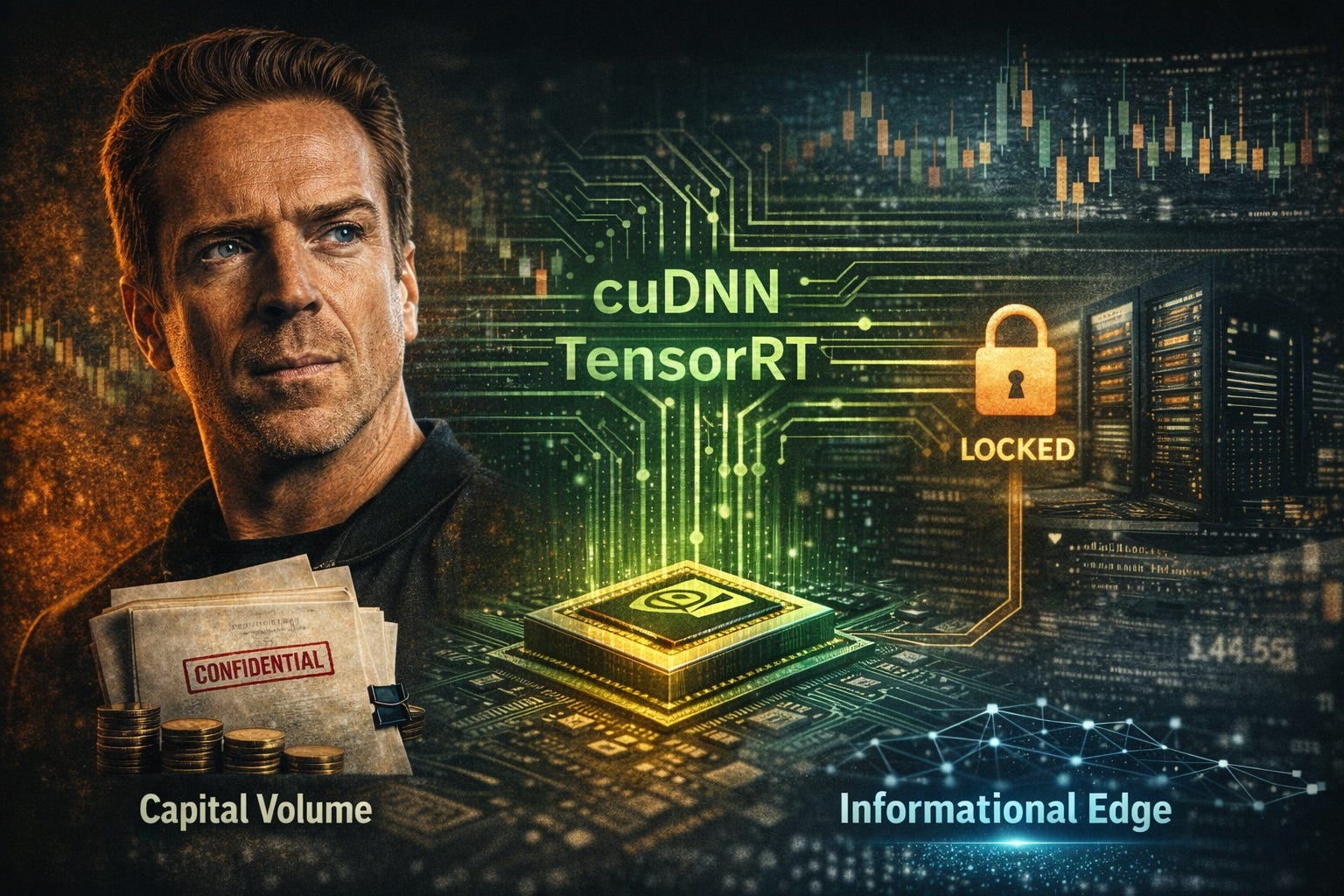
The strategy was never about building faster silicon. It was about what you might call High-Friction Vertical Integration. By providing the proprietary software libraries (cuDNN, TensorRT) that the global AI research community required, Nvidia ensured that abandoning their hardware would mean rewriting a decade of institutional codebase. That is not a competitive advantage. That is a structural lock.
The Software Moat: A defensive barrier built by integrating a product so deeply into a customer’s workflow that the cost of switching exceeds the cost of staying.
As of early 2026, Nvidia holds more than 80% of the data center GPU market. The lesson is not subtle: do not sell a tool. Build the ecosystem that makes the tool indispensable. When your product becomes the infrastructure, you stop competing on price. You compete on existence.
The Data Flywheel: Tesla’s Algorithmic Monopoly
In Billions, Axelrod leverages unconventional data streams to front-run market shifts. Tesla has institutionalized that logic at a planetary scale. While legacy automakers try to close the EV gap through traditional manufacturing, Tesla’s primary advantage is not its factories. It is its cumulative real-world dataset, which surpassed 9 billion miles of Full Self-Driving data in late 2025.
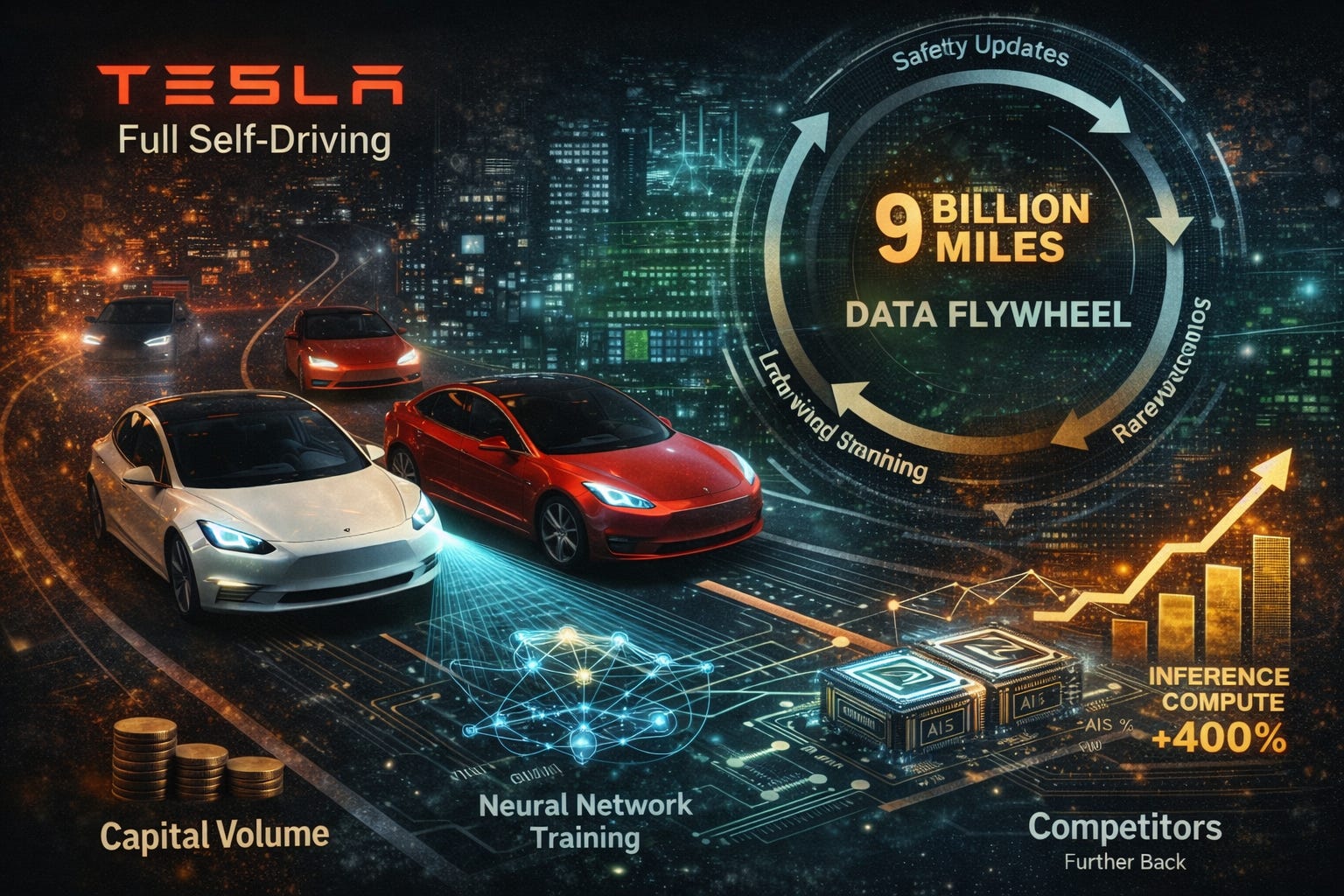
The mechanism is a recursive loop. Every rare driving scenario encountered by a Tesla on the road feeds back into its neural network training. Improved training pushes better software updates to the fleet. Better software puts more capable sensors on more roads. The loop accelerates itself. According to Tesla’s 2025 strategy updates, the company’s inference compute capacity is on track to grow by 400% by 2027 as it shifts toward purpose-built AI5 and AI6 chips. That is not incremental progress. That is a compounding advantage that gets harder to close with every passing quarter.
The competitors are not behind. They are behind and falling further back. The data flywheel does not just create a lead. It widens it automatically.
The Sunk Cost Razor: Blakely’s Hedging vs. Beyond Meat’s Drift
A defining trait of the Axelrod persona is something most executives claim to have but very few actually practice: the total absence of emotional attachment to a losing position.
The Sunk Cost Razor: A decision-making filter that mandates the immediate liquidation of any project the moment its core thesis is proven false.
Sara Blakely understood this instinctively. In the early days of Spanx, she practiced what amounted to “micro-hedging.” She spent two years researching patents and cold-calling hosiery mills in North Carolina while keeping her day job selling fax machines. She did not “burn the boats.” She secured a purchase order from Neiman Marcus before she scaled a single unit of manufacturing. She had a guaranteed exit for her inventory before she had inventory. She did not gamble on a dream. She engineered a certainty.

Beyond Meat sits on the other side of that equation. The broader plant-based protein market is projected to reach $162 billion by 2030, but that number did not save the company. Its valuation cratered in 2024 and 2025 because it could not solve the taste-price parity problem as consumer curiosity cooled. A disciplined operator would have cut the position the moment the mass-adoption thesis stopped holding. Instead, the company stayed locked in a high-overhead manufacturing model designed for a demand curve that no longer existed. The product was not the problem. The refusal to let go of a failing thesis was the problem.
The Trust Battery: Institutionalizing Speed
Axelrod relies on Wendy Rhoades to recalibrate his psychological blind spots. It is the most underrated dynamic in the show and the most transferable one. In the real world, the shift it represents is the move from “CEO as Hero” to “CEO as Orchestrator.”
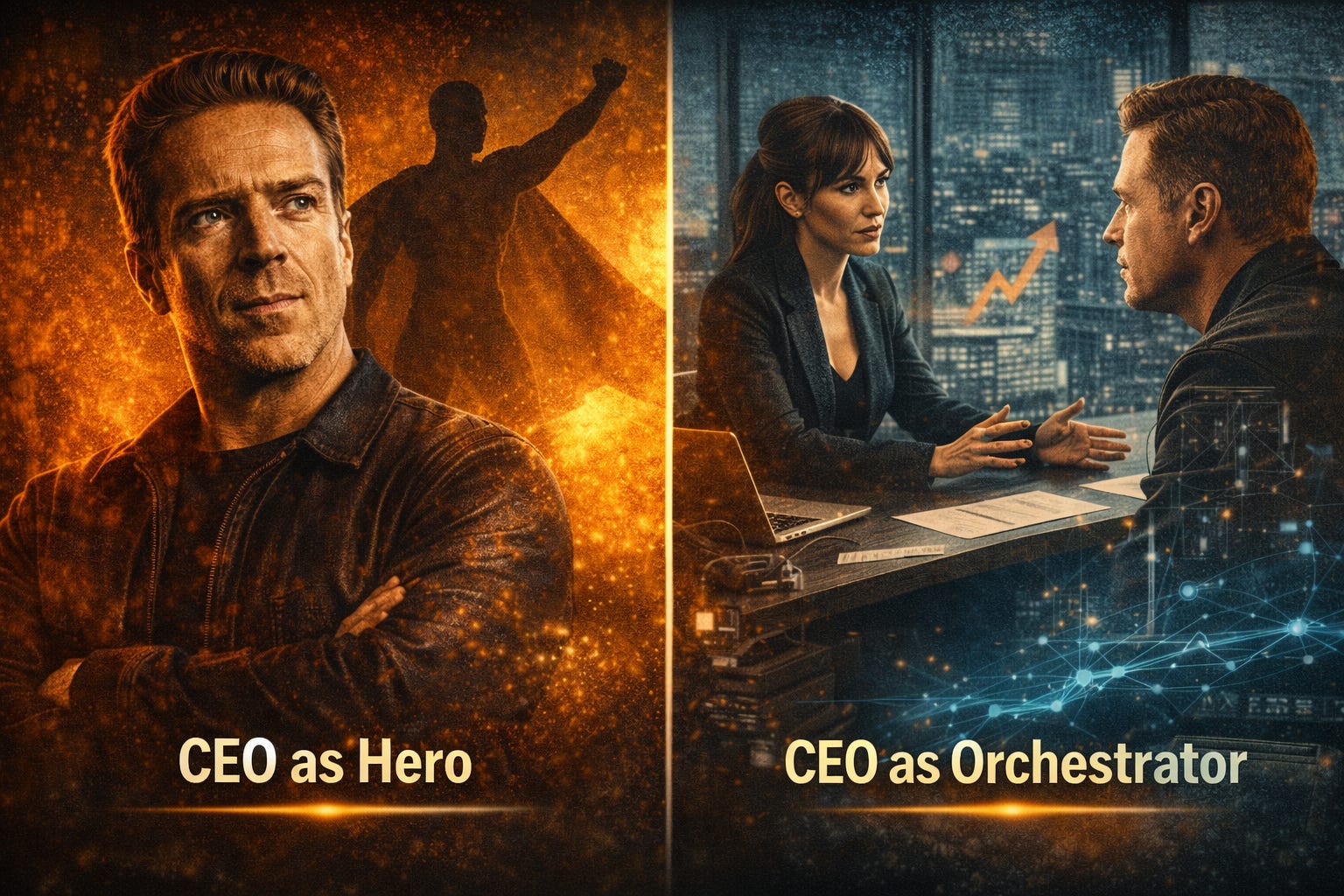
Tobi Lütke at Shopify built an internal framework around this idea. He calls it “The Trust Battery.”
The Trust Battery: A shared metric of relational equity where every interaction either charges or discharges the ability of a team to execute without friction.
The framework is simple, but its implications run deep. When the battery is low, ego-friction increases. Decisions slow down. Communication becomes indirect and defensive. People start covering themselves instead of solving problems. When the battery is fully charged, a team operates at a speed that larger, better-funded competitors simply cannot match.
In Axelrod’s world, speed kills the competition. In Lütke’s, trust is the conductor that makes that speed possible.
The Breakthrough Roadmap: Four Steps to Analytical Dominance
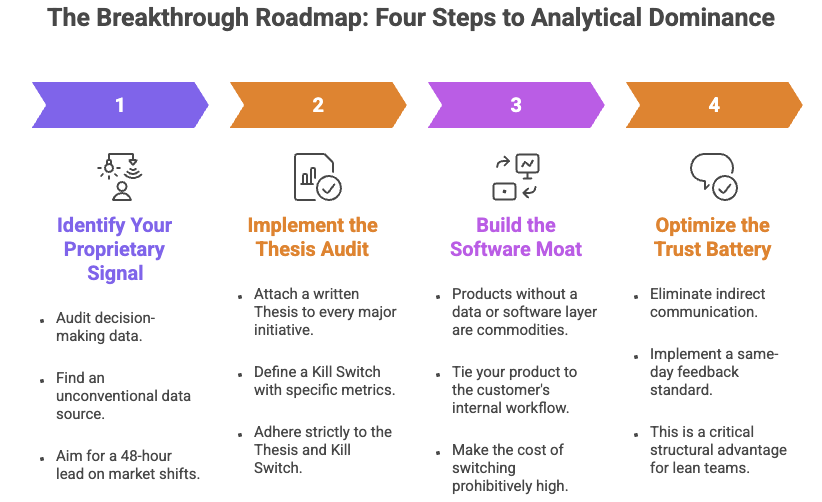
1. Identify Your Proprietary Signal
Audit your decision-making data. If you rely on the same industry reports and market feeds as your top three competitors, you have no edge. Your job is to identify one unconventional data source, whether that is a proprietary customer churn API, a deep-channel supply chain tracker, or a bespoke sentiment analysis tool, that gives you a 48-hour lead on market shifts. If everyone can see it, it is not a signal. It is noise.
2. Implement the Thesis Audit
Every major initiative in your portfolio should have two documents attached to it: a written Thesis and a Kill Switch. The Thesis states the specific market conditions under which the project makes sense. The Kill Switch defines the metrics that would require you to walk away. If customer acquisition cost exceeds a defined threshold for more than two consecutive quarters, the project is terminated. No discussion. No emotional appeals. The thesis either holds or it does not.
3. Build the Software Moat
If you sell a physical product without a data or software layer wrapped around it, you are a commodity. To achieve the kind of margins that give you room to maneuver, your product must be tied to the customer’s internal workflow, not just their inventory shelf. Like Nvidia’s CUDA, the goal is to make the cost of switching so high that the customer stops evaluating alternatives. You are not selling a product at that point. You are selling an operating system.
4. Optimize the Trust Battery
Kill indirect communication. Implement a standard where feedback on deals, projects, and performance is delivered within the same business day. Not weekly. Not at the next quarterly review. The same day. The compression of the feedback loop is not a “nice to have.” For a lean team competing against better-capitalized incumbents, it is the single greatest structural advantage available.
The Decisive Advantage
The Axelrod methodology is not about winning through sheer force. It is about the cold, calculated removal of uncertainty. Moving from participating in the market to defining its terms requires front-running industrial shifts like Huang, institutionalizing data flywheels like Musk, and managing downside risk with the discipline shown by Blakely.
The edge is never found in the headlines. It is built in the infrastructure.
Ask yourself: if you were forced to liquidate every project in your portfolio that did not have a 10x informational edge by tomorrow morning, what would be left?
Further Viewing
The following talks informed several of the case studies in this piece.
Elon Musk on vertical integration and data-driven manufacturing at Giga Texas