

The Vandelay Protocol
The Architecture of the Miscast C-Suite

Most companies are not underperforming. They are miscast.
Underperformance is a visible problem. It shows up in the numbers, the missed targets, and the heavy silence that follows the phrase, “Let’s revisit guidance.” Miscasting is harder to see. It hides behind polished résumés, expensive titles, and leadership pages full of people who look like they belong on a panel called The Future of Strategic Transformation.
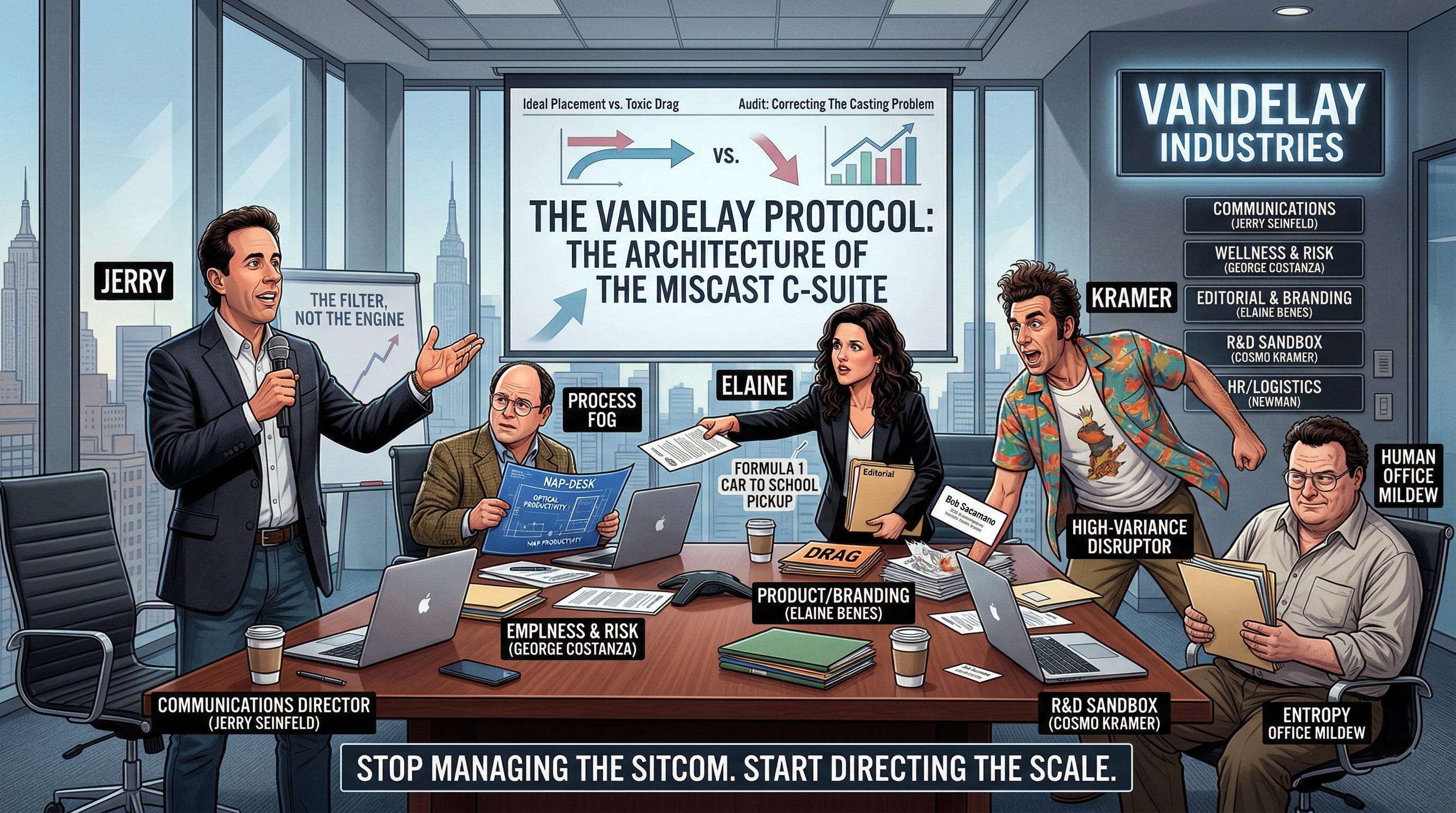
On paper, everything appears intact. In reality, the company is one minor inconvenience away from becoming a live-action episode of Seinfeld.
Businesses rarely suffocate from a lack of talent. They suffocate from the weight of misapplied talent. The wrong person in the wrong seat doesn’t just underperform. They bend the tempo of the entire company around their distortion. They change what gets rewarded. They change how decisions get made. They change what “normal” feels like.
The result is Import-Export Theater: a beautifully presented front for organizational confusion.
Where Talent Breaks
The biggest lie in corporate life is that capability automatically produces performance. It doesn’t. Capability only matters in the right context. In the wrong one, it just creates friction.
Under pressure, people do not become “balanced” versions of themselves. They become more intense about themselves. The wrong seat does not neutralize personality; it weaponizes it. Here is your executive team, reinterpreted through the only management framework honest enough to tell the truth.
🎙️ Jerry: The Perfectionist Critic
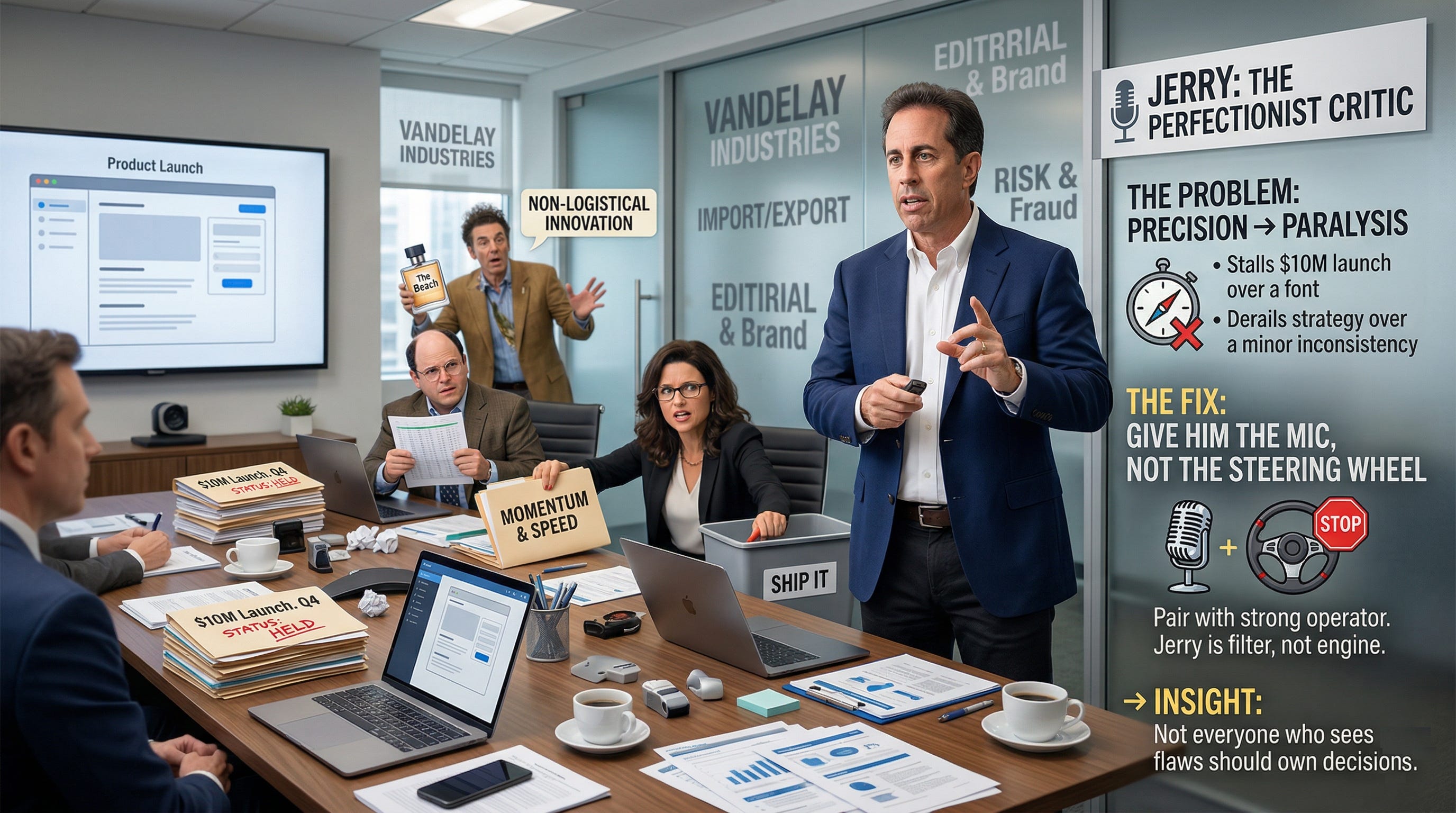
The Profile: High standards, sharp taste, allergic to sloppiness. Jerry notices the 1% that is off—the button color that is “trying too hard” or the headline that feels “slightly too eager.”
The Trap: Putting him in charge of Execution. Jerry will stall a $10M launch over a font choice. He won’t call it a delay; he’ll call it “preserving brand equity.” Meanwhile, the market has moved on.
The Pivot: Brand, Messaging, or QA. Jerry should be the filter, not the engine. He should refine the work once momentum exists, not hold momentum hostage until the work feels “pure.”
The Lesson: Not everyone who sees the flaw should control the clock.
📋 George: The Friction-Generator
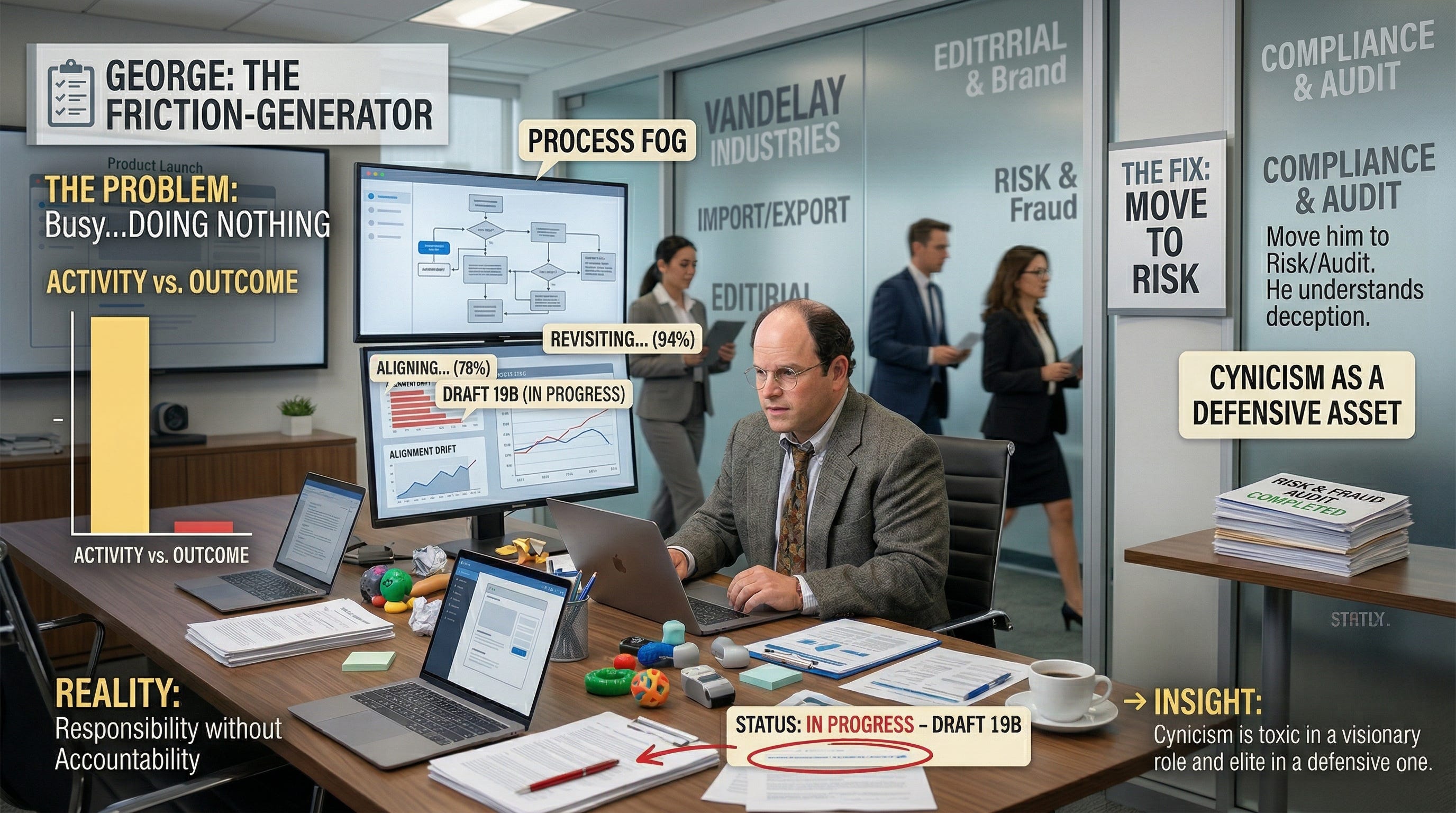
The Profile: Socially alert, master of Optical Productivity—the appearance of motion without the inconvenience of progress. George knows how to look burdened while producing zero ROI.
The Trap: Putting him in charge of Culture or Strategy. George turns departments into theater companies. Everyone is “aligning” and “revisiting,” but nobody is finishing. George builds Process Fog.
The Pivot: Compliance, Audit, or Risk. George knows every trick because he’s considered using them. His paranoia is a world-class asset when the job shifts from “inspiring people” to “detecting distortions.”
The Lesson: Cynicism is toxic in a visionary role and elite in a defensive one.
🚀 Kramer: The High-Variance Disruptor
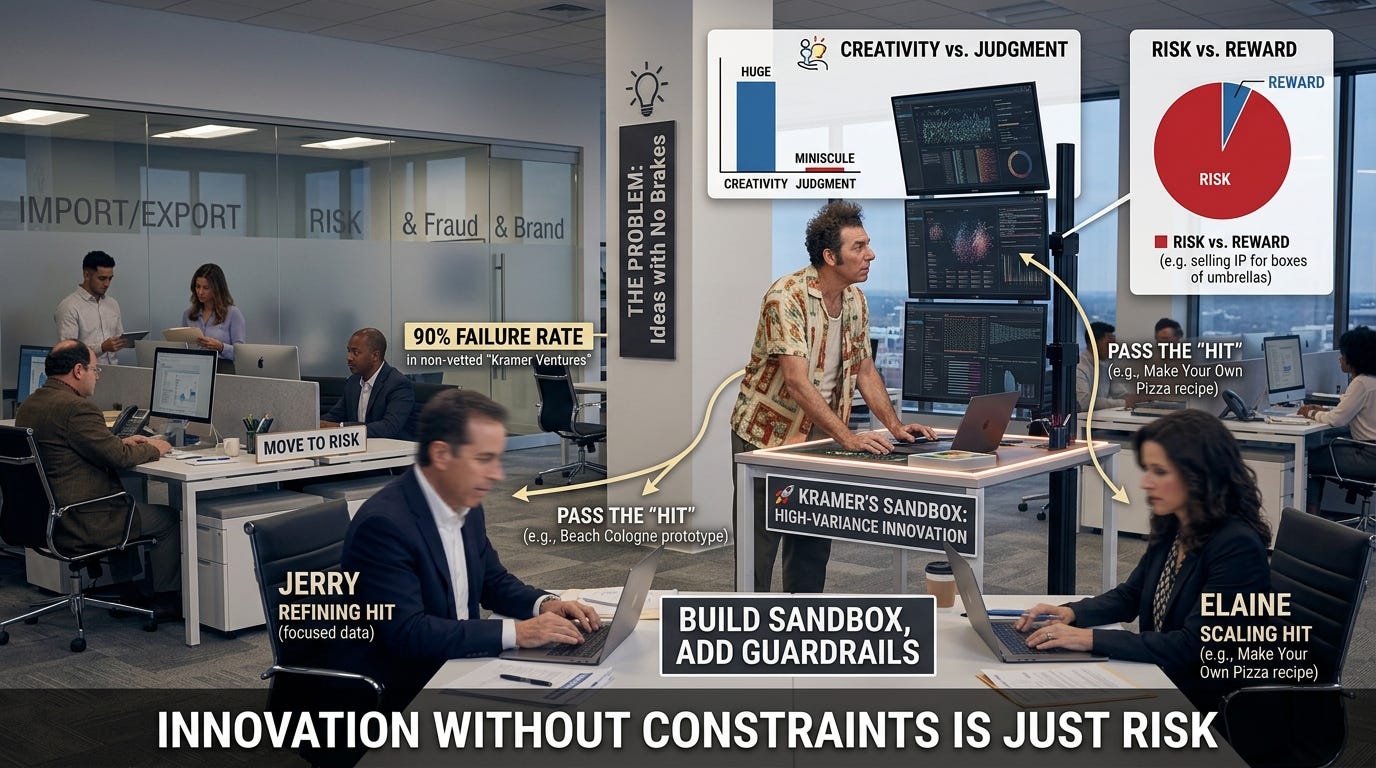
The Profile: Creative, fearless, erratic. Kramer is the “Hear me out...” guy who either delivers a breakthrough or a legal nightmare.
The Trap: Giving him Operational Autonomy. Kramer is exhilarating for invention but catastrophic for consistency. By Thursday, he’ll have changed the pricing model and made a verbal agreement with a “Bob Sacamano” that violates your TOS.
The Pivot: The Sandbox. Finite budget. Narrow brief. Let him throw lightning at problems that benefit from it, then pass the “hit” to a Jerry to refine and an Elaine to scale.
The Lesson: Innovation needs freedom; Operations need protection.
✍️ Elaine: The Radioactive High-Performer
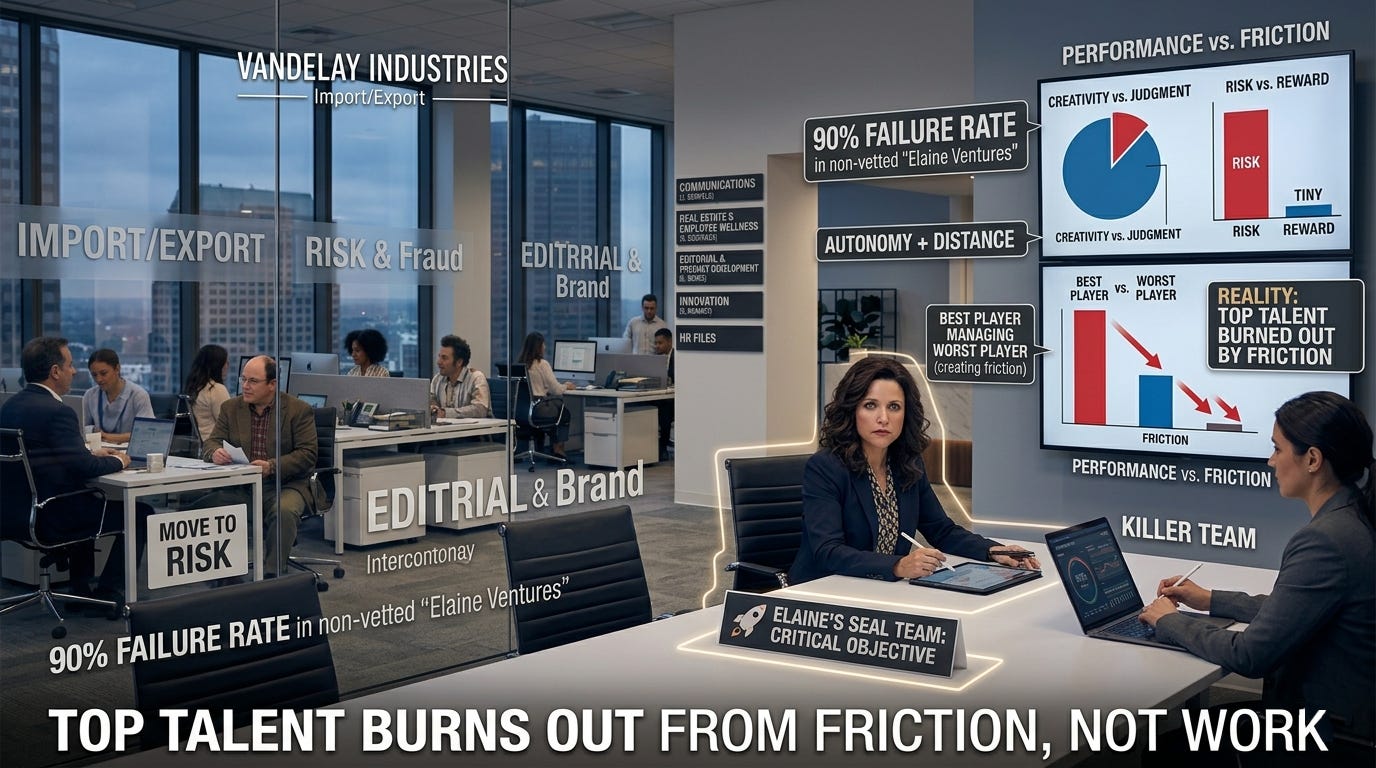
The Profile: Fast, decisive, and competent enough to become everyone else’s solution. She is the informal operating system of the company.
The Trap: Making her Manage the “Drag.” Burying her in weak performers and broken processes. Eventually, Elaine becomes radioactive. Her patience evaporates. Leadership calls her “intense,” but the reality is you’ve assigned a Formula 1 car to school pickup.
The Pivot: Radical Decoupling. Remove her from the management sludge. Give her a hand-picked team of high-impact operators and a massive, singular objective.
The Lesson: Your best people should not spend their prime compensating for your weakest organizational design choices.
📬 Newman: The Ambient Saboteur
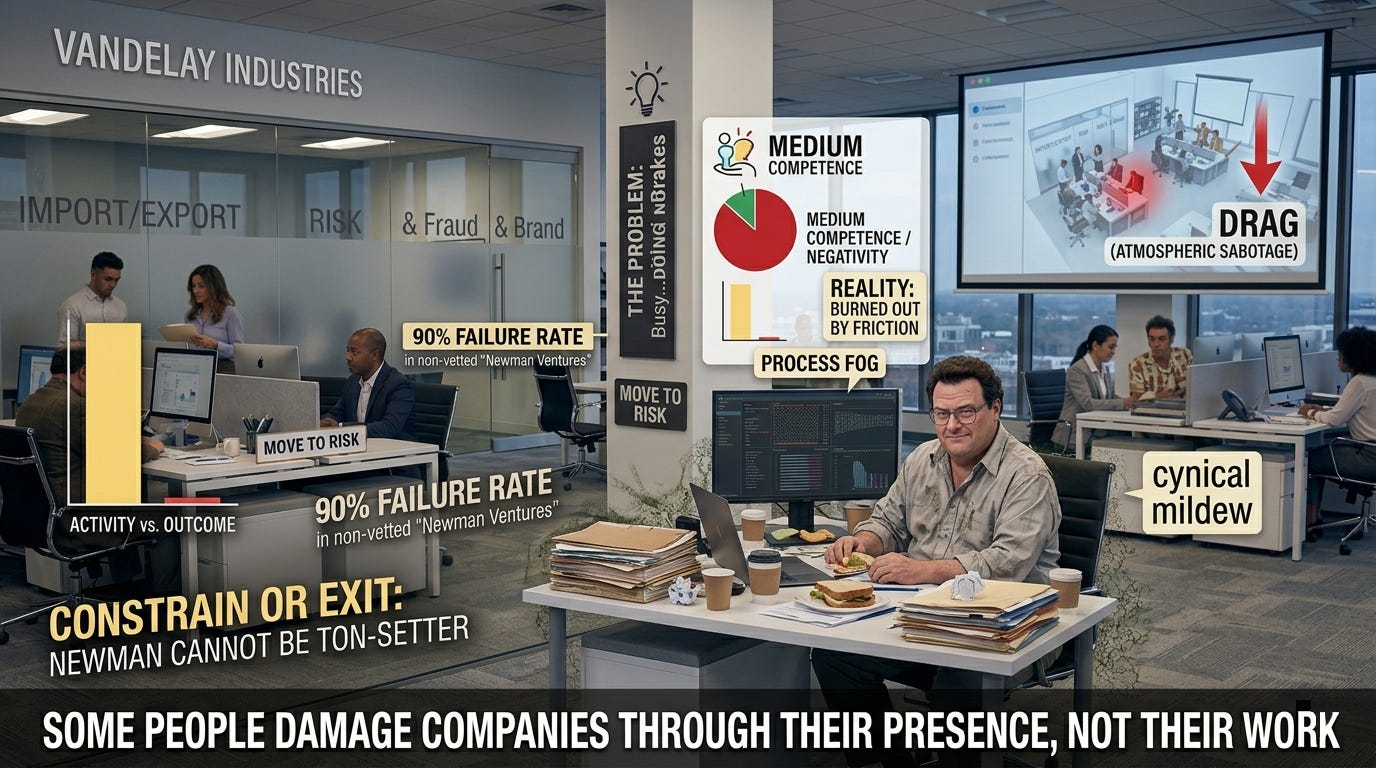
The Profile: Medium competence, high negativity, master of low-grade decay.
The Trap: Letting him linger in the heart of the team. Newman doesn’t destroy a company through a spectacular failure; he corrodes it through proximity. He is the human equivalent of office mildew—spreading the kind of cynicism that makes every strong operator a little more guarded and a little less brave.
The Pivot: Tight constraints or a clean exit. Newman cannot be allowed to become an unofficial information broker. He is not a “bad culture fit”—he is an entropy merchant.
The Lesson: Some people damage companies through their presence, not their work.
How Smart Founders Build Heavy Companies
Founders fall in love with raw talent and assume infinite range. They see intelligence and assume flexibility. They see charisma and assume leadership. They see one reliable adult in the room and assume that person can absorb infinite amounts of nonsense without consequence.
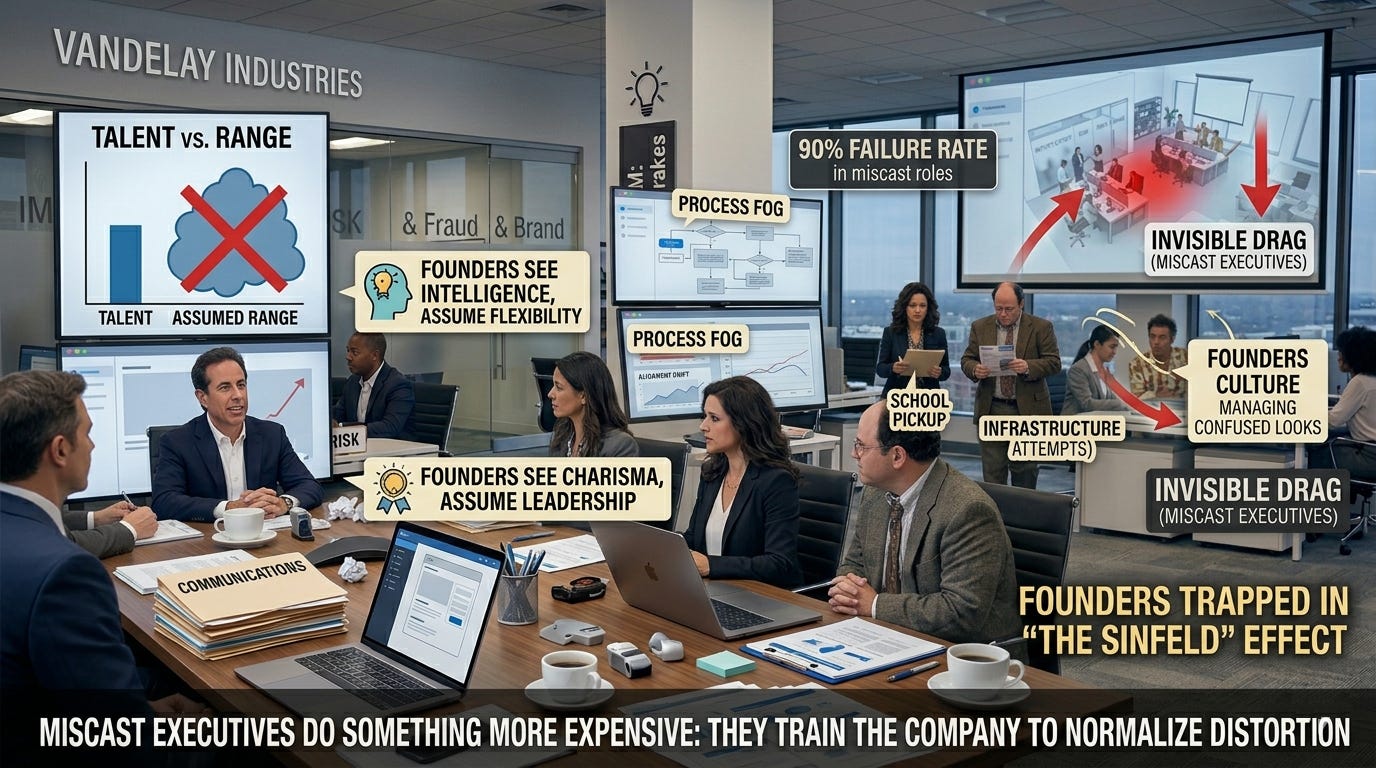
This is how smart companies become heavy. You put the eloquent person in charge of execution. You let the visionary improvise around systems. You overburden the one adult in the room because they can “handle it.” You tolerate the low-grade saboteur because they aren’t quite bad enough to force the issue.
Then one day you wake up inside an org chart that feels less like a business and more like a dinner table argument at Monk’s Café. No one is technically failing, but nothing cleanly works.
Weak talent creates visible problems; miscast talent creates invisible ones. A mediocre employee misses targets. A miscast executive does something more expensive: they train the company to normalize distortion.
Stop Coaching the Wrong Problem
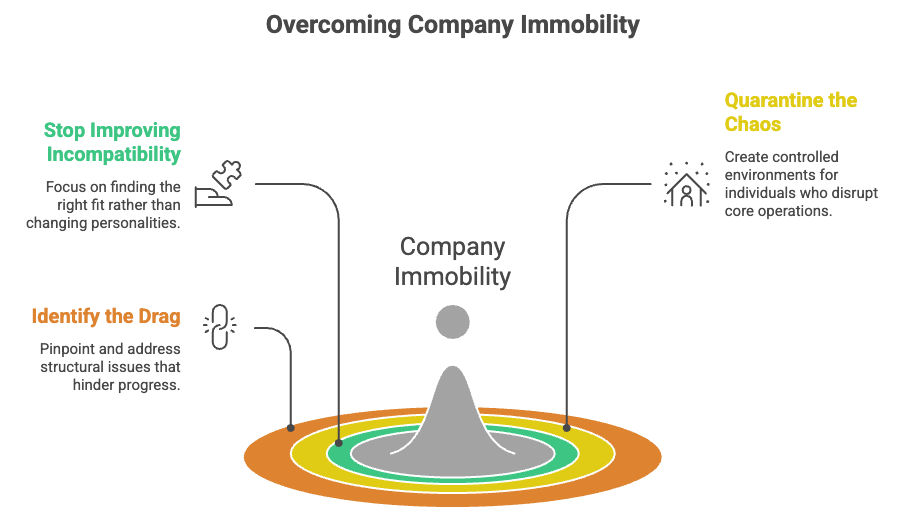
If your company feels talented but strangely immobile, do not start with a new dashboard or a “listening session.” You cannot manage your way out of a structural error. Instead, apply the Opposite Rule: if every instinct you have to “fix” a department has failed, the opposite—recasting the seat instead of coaching around it—is usually the faster path forward.
First, Stop Improving Incompatibility. If a department is stalling under a perfectionist, do not ask how to make that person marginally faster. You are fighting their nature. Ask whether a perfectionist should be leading that function at all. Finding the right fit is faster than changing a personality.
Second, Quarantine the Chaos. Not everyone belongs near the core machine. Some people need leverage without management responsibility. If your Kramer has wandered into the infrastructure with root access and charisma, your problem isn’t his attitude—it’s your access control. Build a sandbox where he can throw sparks without burning down the server room.
Finally, Identify the Drag. Where does momentum come to a halt? Which team turns decisions into discussions? If your Jerry is approving commas on launch day and your Elaine is spending half her week deconflicting nonsense between underperformers, your problem is structural. Your most influential individuals are currently serving as buffers for your least effective design decisions.
Why Casting Beats Coaching
Leadership is not about being the smartest person in the room. It is about being the Director who understands that placing a great actor in the wrong role can lead to a disastrous outcome for the production.
A brilliant actor in the wrong role does not save the production—he ruins the scene. Stop trying to make people “suitable” for the org chart and start redesigning the chart around how people actually behave under pressure.
That is when speed returns. That is when the meetings get shorter, the politics get thinner, and the right people finally stop spending their lives compensating for the wrong ones.
Stop trying to fix the person.
Fix the seat.
Stop managing the sitcom.
Start recasting the company.
As someone who considers himself to be a Seinfeld Historian, I love everything about this. All I can say at this point is, SERENITY NOW!