

Unextractable Growth
The New Playbook for Building Systems That Cannot Be Quietly Hollowed Out

The meeting ends with a round of nods. The founder leaves the room convinced that the strategy is set, the team is aligned, and the path is clear. But forty-eight hours later, the idea resurfaces in a board deck with its edges softened and its ownership blurred. Somewhere in the transit from whiteboard to memo, the original vision has been “refined” by a colleague who wasn’t in the room but has a direct line to the chairman. The value hasn’t disappeared; it has merely been siphoned.

The most dangerous operator in a company rarely looks dangerous at all. They do not slam fists or perform authority for the gallery. They operate through something quieter: the slow leakage of value, context, and credit. This is a piece about the leaders who understand that a company can be gutted without ever appearing to break.
Cheap growth used to hide a lot of internal dysfunction. When capital was abundant and attention was affordable, a business could survive redundant middle layers and vague ownership. Now that attention is expensive and capital is more selective, companies are being judged less by how loudly they promise scale than by how cleanly they execute.
The Physics of Coherence
Building a legacy starts with the engineering of the organization itself. Dr. Lisa Su, CEO of AMD, helped lead one of the sharpest turnarounds in semiconductors by orchestrating a technical pivot that relied on more than just better chips. Her achievement was making the roadmap hard to politicize. In a healthy company, the roadmap does more than set direction: it narrows the room available for politics.
By prioritizing engineering truth over ornamental storytelling, Su ensured that those who meter information to maintain power were rendered obsolete. Research has repeatedly shown that organizations with stronger internal information flow tend to outperform peers, not because transparency is virtuous in the abstract, but because it shortens the distance between a problem and a decision. When every team member has the same data, urgency becomes harder to manipulate.

Watch how Dr. Lisa Su explains the disciplined management style that propelled AMD to challenge global incumbents:
Systems of Record Over Social Weather
In many high-growth environments, “alignment” is treated as a feeling rather than a fact. At KIND, candor functioned less as a virtue than as an operating advantage. The founder, Daniel Lubetzky, understood that without a system of record, a decision is just social weather: subject to change based on who is in the room.
If a decision is not documented in a shared digital workspace immediately after a meeting, it is considered unmade. This creates a trail of accountability that protects the innovator from the “credit drift” often seen in legacy corporate environments. However, transparency can easily become theater. If a culture rewards the appearance of visibility over actual judgment, you haven’t solved the problem; you’ve just given the extractor a brighter stage.
The Case for Tightly Coupled Systems
Tesla is a useful case study in what happens when the distance between design, manufacturing, and customer experience is compressed. Elon Musk’s focus on vertical integration reduces the number of places where misalignment can hide. The advantage is not just manufacturing efficiency. It is that the truth surfaces sooner.
While Tesla’s 2025 revenue showed a slight decline to $94.8 billion, the structural lesson remains valid. Tightly coupled systems expose truth faster. If a production line struggles or margins compress, the problem surfaces in output rather than being redistributed through a chain of vendor excuses and managerial fog. In business, truth is often a more powerful moat than any amount of founder charm.
Watch how Tesla’s mission-driven engineering creates a culture of extreme ownership and rapid innovation:
Scaling Without Ambiguity
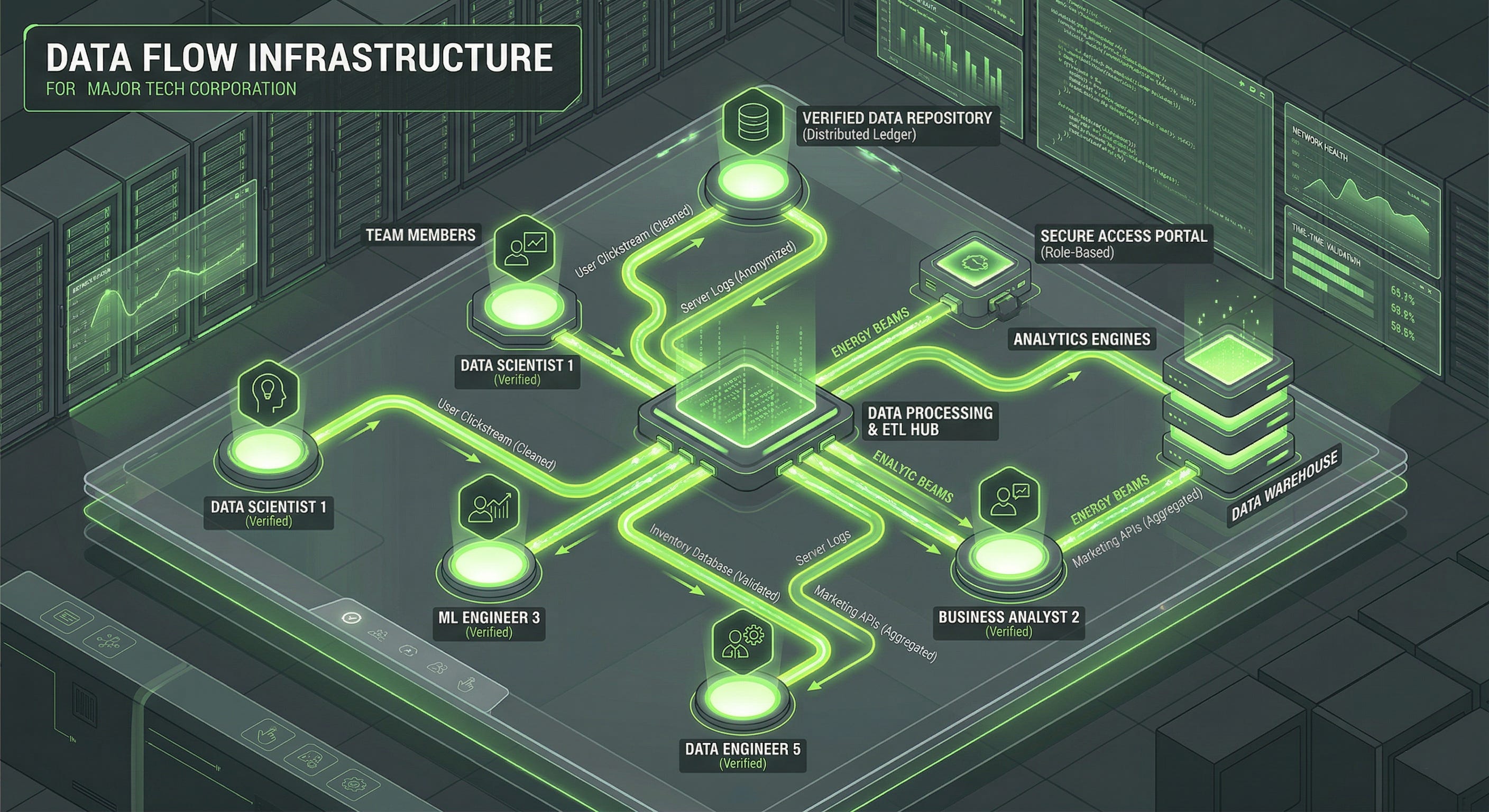
In AI, raw data is abundant. Reliable data is not. The extractor thrives where measurement is fuzzy, because fuzziness makes performance easier to imitate than to prove. They thrive on proxies and vanity metrics.
Scale AI became valuable by working in the uncomfortable layer between model ambition and model reliability. Infrastructure that reduces ambiguity is valuable because ambiguity has become expensive. RSM’s 2025 middle-market survey found that while 91% of respondents reported using generative AI, 41% of those experiencing implementation issues named data quality as a top problem. This is the whole story in miniature: rapid adoption on uneven foundations.
Narrative and Architecture
Some of the most expensive leadership failures are hard to spot on a balance sheet. They exist in the friction between intent and execution. Jane Fraser of Citigroup addressed this by cutting management layers from thirteen down to eight. This reduced the number of places where reality could be softened on its way up the chain.
Fawn Weaver did something different but related: she made narrative ownership part of the asset itself. By securing the story of the brand from the start, she ensured that the brand’s meaning could not be hollowed out by intermediaries. If you do not author your own meaning, someone else will, and they will usually do it in a way that is flatter and more convenient for them.
Watch how Fawn Weaver built a multi-million dollar spirit empire by reclaiming historical narratives and prioritizing legacy:
The First Principles Factor
Complexity is where extraction breeds. In a simple system, underperformance is visible. In a bloated one, it can be disguised as “stakeholder management.” First principles are not about sounding severe; they are about refusing inherited complexity when that complexity no longer earns its keep.
One discovery in a first-principles culture is that many “necessary” processes are really monuments to past insecurities. Asking irritating questions, like what would break if we cut this and who owns this exactly, does more than improve speed. When you understand the fundamental physics of a problem, whether it is energy costs or capital allocation, you cannot be manipulated by someone claiming a task is critical just to serve their own timeline. Simple systems leave fewer places for mediocrity to hide.

Your Breakthrough Roadmap
Legacy is built by designing organizations in which value survives contact with the institution itself.
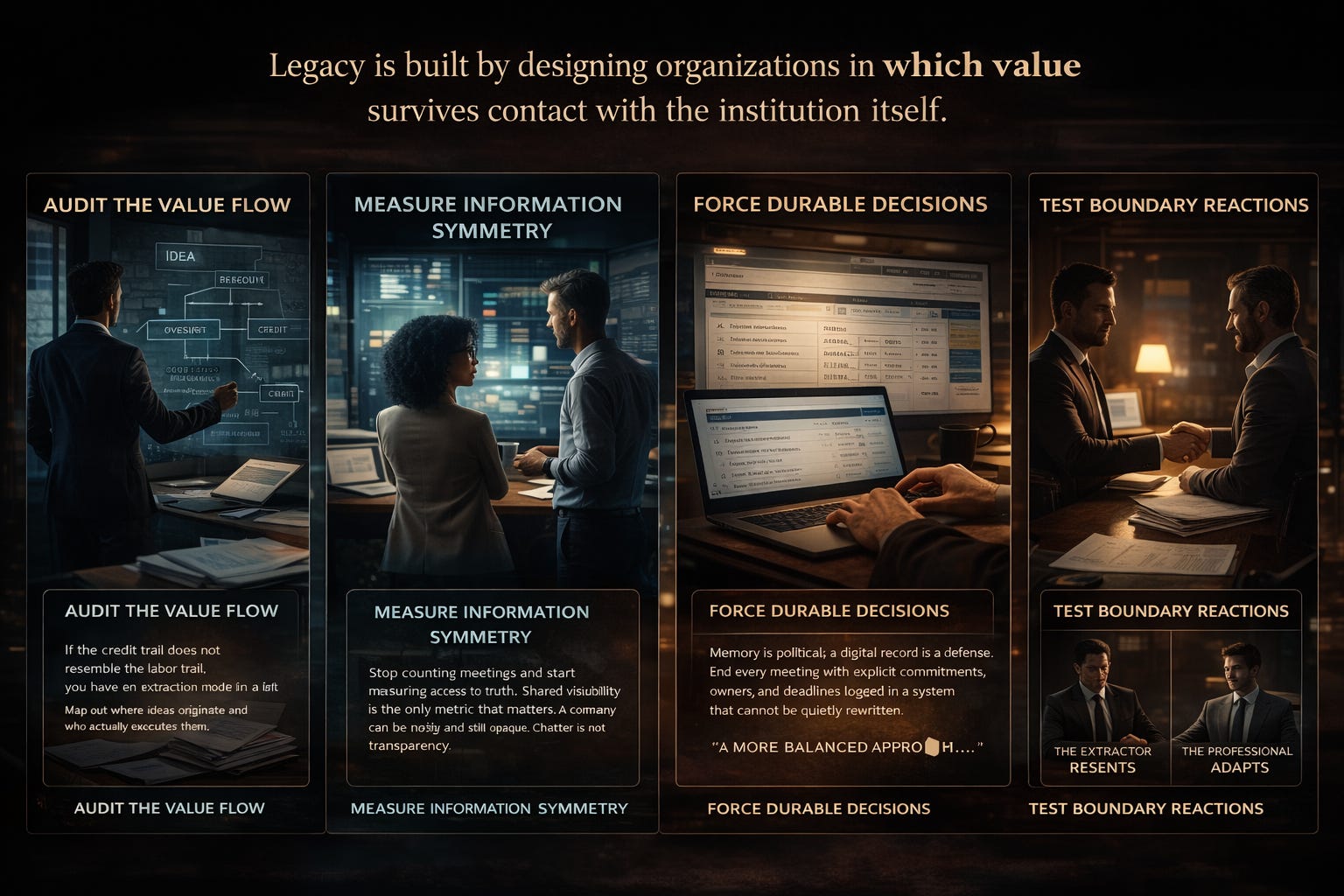
Audit the Value Flow If the credit trail does not resemble the labor trail, you have an extraction model in a nice blazer. Map out where ideas originate and who actually executes them.
Measure Information Symmetry Stop counting meetings and start measuring access to truth. Shared visibility is the only metric that matters. A company can be noisy and still opaque. Chatter is not transparency.
Force Durable Decisions Memory is political; a digital record is a defense. End every meeting with explicit commitments, owners, and deadlines logged in a system that cannot be quietly rewritten.
Test Boundary Reactions Extractors reveal themselves early. Give a partner a clear boundary and observe the reaction. A professional adapts; an extractor resents. Healthy counterparts value clean processes because they protect everyone; extractors dislike them because they narrow the room for revision after the fact.
The challenge of the next decade is not growing at any cost. It is building a company where truth travels quickly, ownership stays attached, and the people producing value are never edited out of the story. If you can do that, you aren’t just scaling. You are building something rarer.
In the end, resilience has less to do with how much capital a company can raise than with how little value it allows to disappear.